
New Zealand’s Darkest, Bloodiest Secret: The Sandfly
Kiwi recommendations for stopping the biting beasts: DEET, geranium leaves, garlic, rancid bacon, Marmite, Vegemite. Does anything really work?
/https://tf-cmsv2-smithsonianmag-media.s3.amazonaws.com/accounts/headshot/Off-Road-alastair-bland-240.jpg)
/https://tf-cmsv2-smithsonianmag-media.s3.amazonaws.com/filer/20120207123104SandflySMALL.jpg)
When Andrew Patterson with Radio Live New Zealand interviewed me several weeks ago about my claims that living and traveling can be expensive in New Zealand, he asked me what Kiwis might do to better promote their nation’s image as a tourist destination for Americans. I said that I thought New Zealand could do no better in promoting itself to America—Americans are already infatuated with New Zealand as an exotic, dazzling and quasi-fantasy land (Lord of the Rings has been a boon to tour operators here who lead walks through the film’s scenery).
But a better answer to Patterson’s question occurred to me only hours later: “Whatever you do, don’t tell any foreigners about the sandflies.”
Oops. Well, this is one well-kept secret that must come out: New Zealand is the generous home to one of the nastiest, most incorrigible, maddeningly annoying bloodsucking insect pests that lives. Called sandflies in common practice and roughly resembling gnats, these vampires of the genus Austrosimulium live throughout the islands. Of roughly a dozen species (exact counts vary), just two bite—the New Zealand blackfly (A. australense) and the West Coast blackfly (A. ungulatum)—and among these it’s only the females. Yet the misery for which these select pests are responsible is tremendous, especially for bewildered tourists who step out of their cars with cameras loaded for shots of Hobbit country but no defense against insects. Locals, mysteriously, seem to have adapted, or have just quit complaining. They even do their best at making light of the grim matter with sandfly sculptures and giant replicas and cafes and menu items named after the tormenters. I, however, have yet to have a good chuckle about sandflies.
Both biting species occur on the South Island, so help me. And though the East Coast does have some sandflies, the worst clouds of them turn vacations into nightmares along the western coastal zones and in the mountains, where rainfall and vegetation prove particularly hospitable to the insects. I have encountered some ghastly swarms near Franz Josef Glacier and near Milford Sound, but the greatest blood loss occurred in the Molesworth farm wilderness and at a national park campground on Lake Rotoiti, where I even risked burning my little house down by cooking dinner locked in my tent.
Just how bad can these bugs really be? Well, I’ll say they outperform even Alaska’s mosquitoes in wickedness. In especially bad circumstances, one may be encased in clouds of sandflies within just seconds of stepping out of a car or coming to a stop on a bicycle. Then they’re upon you, and rather than cleanly inserting a needle and withdrawing just enough blood to keep them sated until the next tourist passes—as the comparatively graceful mosquito will do—sandflies seem to actually munch chunks out of their prey. The bites hurt, and those insects that manage to latch on undetected will swell until translucent with the faint pinkish hue of your own blood. (Squash too many of these and you’ll begin to resemble a late-1980s designer art canvas.) Meanwhile, they release an anticoagulant that keeps the blood coming while causing itching in many victims. Most insect repellent seems to have little effect, and even if you happen to find a remedy that stops them, the pests will still swarm you in vile squadrons, buzzing in your ears, tangling in your hair and generally driving you mad or into a tent. Fishing? Stopping to admire a view? Doing some open-air yoga in the green grass? Forget about it in bad sandfly country.
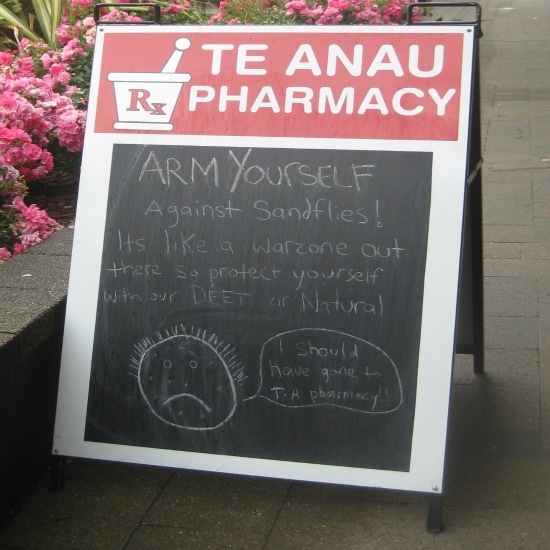
A Te Anau pharmacy advertises relief from sandflies. Photo by Alastair Bland.
Yet I know Kiwi folk who enjoy the great outdoors—who even sit in the grass and read books—and surely there must be ways to stop sandflies. Good to know is that sandflies dislike poor weather, and when it’s raining and blowing may be the best time to stretch out in the grass with that favorite mystery novel or throw a fly in those sweet riffles just upstream from camp. But even when they’re bad, these insects can be managed.
Here are 10 tactics toward winning the battle against sandflies—even if the war is a lost cause.
- Repel Ultra bug spray. It’s 40 percent DEET (diethyl toluamide), one of the nastiest bug poisons on the recreational market. Though it seems to deter the worst of stinging insects, dousing yourself with DEET-rich fluids may come at other health costs.
- A 50-50 blend of baby oil and Dettol eucalyptus-scented disinfectant. This is a recipe we learned of while shopping in a New World supermarket, when a bystander saw us browsing for bug spray and scratching our legs and said, “Sandflies? Here’s what really works.” And it sort of works.
- Geranium leaves. I don’t know what else to tell you except that I suppose you’re supposed to rub yourself with them. Sounds lovely.
- Citronella oil. Rub it on your skin, but don’t hold you breath.
- “’eaps of Marmite!” one Kiwi woman assured me. “You mean you put it on your skin?” I asked. “No! On your toast.”
- “’eaps of Vegemite!” another Kiwi woman told me. “Supposedly it’s the vitamin B that the buggers don’t like.”
- Drinking beer with a splash of kerosene. (This could be poisonous and we don’t recommend this.)
- Eating garlic. Already doing it. No results.
- Rubbing the skin with rancid bacon, as New Zealand’s West Coast gold miners did in the 1860s in their direst hours of torment.
- Blends of olive oil and disinfectants like Jeyes Fluid or Dettol.
A government pamphlet available online reports that no oral medicines have ever proven effective against sandflies, though I’m keen on the beer recipe above. While DEET is widely recognized as a reliable deterrent, the only remedies that work without fail here are to keep moving and, the instant you stop, zip yourself into a tent.
Meanwhile, I’m here for a while—so can anyone offer ideas on what really works against sandflies?
/https://tf-cmsv2-smithsonianmag-media.s3.amazonaws.com/accounts/headshot/Off-Road-alastair-bland-240.jpg)