
Shattered: Christchurch After 10,000 Earthquakes
The abandoned boulevards and blocks of condemned buildings look like a scene from an unhappy future
/https://tf-cmsv2-smithsonianmag-media.s3.amazonaws.com/accounts/headshot/Off-Road-alastair-bland-240.jpg)
/https://tf-cmsv2-smithsonianmag-media.s3.amazonaws.com/filer/20120209023053ChristchurchRubbleSMALL.jpg)
If the ground shakes and no one is there to feel it, did an earthquake really happen? Sure did. Just look at the Quake Map records for Christchurch, much of which feels like an abandoned post-apocalyptic wasteland today. Since September 4, 2010—the day of the big quake at the beginning of the storm—roughly 10,000 earthquakes have rattled the region around this biggest city on New Zealand’s South Island, and thousands of residents have fled.
Some hostels, locally called “backpackers,” have closed, and I passed one that was a sad shadow of happier days, its sign tossed into a rubble heap and its doors and windows locked. So I stayed in a gloomy “holiday park” on Linwood Avenue, where $20 bought me a tent-sized patch of grass among the resident RVs (remind me it’s time to quit traveling if these sorts of places ever become my destination). In the morning I rode through town to have a look at what the earthquakes have done to Christchurch. It was a bumpy ride over miles of split pavement and spilled gravel from construction projects. Crews of workers appeared hard at work, but much of the city is yet to even be demolished. One sector of the city center has been entirely closed. Peering through the chain link fence down the abandoned boulevards and blocks of condemned buildings, onlookers feel they’re looking into a movie set or a scene from an unhappy future in which the world’s cities are only inhabited by ruins, ghosts and silence.
Even in some residential neighborhoods that are partly occupied, things are quiet. Vacant lots strewn with rubble tell of homes split to bits by the most damaging of the quakes—which hit on Feb. 22, 2011—and others are simply vacated, with bricks and shingles piled about the perimeter as these houses, quake by quake, disintegrate. In this small city of 400,000, about 10,000 homes have been condemned or destroyed and it’s expected that up to 10 percent of the population could eventually be scared away by the ongoing shaking, which geologists predict will persist for years.
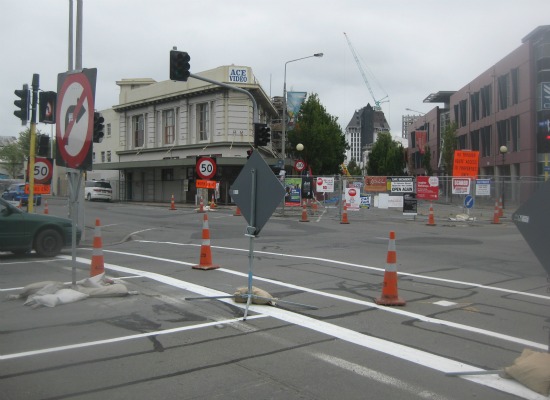
A fence along an intersection marks the perimeter of Christchurch's closed-off city center
I spoke to a pair of local women on the street who said there hadn’t been a quake in some days.
“But that usually seems to mean we’re due for a big cluster of them,” one added with a nervous sigh.
In a bicycle shop, where I stopped for a bottle of lube oil, the owner told me, “Everyone is scared stiff here, but we hear some tourists are actually coming in order to feel an earthquake.”
An elderly lady with her husband lamented New Zealand’s isolation from the global community in such hard times. “Not everyone really seems to even know what’s happened,” she said. “People forget about us since we’re way down here on the bottom of the world.”
But Christchurch’s residents—the majority that hasn’t fled, that is—are hauling themselves forward. The city is currently carrying out a massive reconstruction project. And while structures are knocked down and rebuilt from scratch, the downtown has been resurrected in a hip and artful arrangement of shipping containers, painted and designed and outfitted to house coffee shops, apparel outlets, banks and other essentials of a thriving city center.
I didn’t stick around long, and by noon I was climbing over Dyers Pass Road southward. As surely as the gray gloom of Christchurch’s ruined districts had sagged my spirits, they ascended again as I gained elevation and finally topped out at just over 1,000 feet. From this saddle I took a look at the rolling wild hills of the Banks Peninsula ahead and said a farewell to Christchurch and the Canterbury Plains to the north, and I sailed downhill toward Governor’s Bay. I had decided I would reach Akaroa at the far southeast end of the peninsula that day. Locals warned me that this northern scenic route was a very hilly ride, but I underestimated the challenge. I was counting, for one thing, on grocery stores—but there were none. I was also expecting water sources. Opting not to go knocking on people’s doors, I found no faucets or fountains and so went thirsty for a full 40 miles and six tedious hours.
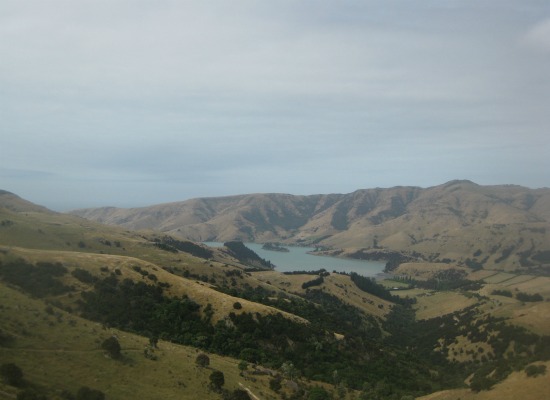
The spacious scenery of the Banks Peninsula is as exhausting as it is beautiful.
After that first climb out of Christchurch, I hit another one of perhaps 2,000 vertical feet between Diamond Harbour and Port Levy. Then the road turned to gravel (a surprise) and went up (a bummer) steeply (a heartbreaker). It was another 1,500-foot ascent, then down again to sea level, where the asphalt resumed. I was running on empty now and had found nothing to eat for hours but one ripe fig dangling over a fence. I had found one drinking fountain—except it was broken, care of the earthquake. I had a bottle of wine, and I was so hungry, dispirited and drained that I considered collapsing in the grass and unscrewing the cap, though that would have gotten me nowhere nearer to a banana heap or a loaf of bread. I knew that the grocery store in Akaroa closed at 8, so I had to hurry—and to my horror a sign directed me onward over an ominously named Summit Road. It was another 1500-foot beast, which I crawled up in pain, with a sticky throat and thick tongue. Over the top, I saw the town of Akaroa ahead on the shore, but it was too soon to cheer; six miles of coastal ups and downs remained.
I reached the town store half dead and just in time to buy a few pieces of fruit, six eggs, carrots and a three-ounce package of walnuts—for $18. Some 4,000 calories in the hole, I refueled before taking the last four miles—which included another 800 feet of climbing. My legs were near the point of quitting—athletes call this condition “bonking”—and I walked the last quarter mile to the gate. Thankfully, the Onuku Farm Hostel, familiar from my first days here in January, had plenty of room for me to camp, and for $12 a night I made myself at home for two days of rest, relaxation and mussel dinners foraged at the seashore.
/https://tf-cmsv2-smithsonianmag-media.s3.amazonaws.com/accounts/headshot/Off-Road-alastair-bland-240.jpg)