
World Wildlife Hunt
It takes $6,000 to shoot a leopard in Botswana. For $1,200, you can shoot a crocodile. Short on cash? There’s always baboons, which go for $200 a pop
/https://tf-cmsv2-smithsonianmag-media.s3.amazonaws.com/accounts/headshot/Off-Road-alastair-bland-240.jpg)
/https://tf-cmsv2-smithsonianmag-media.s3.amazonaws.com/filer/Elephant-Spainsh-King-Juan-Carlos-web.jpg)
The king of Spain visited Botswana recently, and on the famous savanna, teeming with animals familiar from the picture books we read as youths, King Juan Carlos shot and killed an elephant.
When I heard about the king’s outing, I decided to learn a little more about Botswana’s laws governing the protection—or lack thereof—of Africa’s most famous creatures. It turns out that many of them can be lawfully killed for those who buy the privilege. According to the website of Rann Safaris, the hunting outfit that guided King Carlos (who happens to be the honorary president of the Spanish branch of the World Wildlife Fund) it takes $6,000 to shoot a leopard. For $1,200, you can shoot a crocodile. For the pleasure of killing a hyena, you must turn over only $500. For a rhino, sorry, you’ll have to visit South Africa. But if you’re content to shoot an ostrich, stay on in Botswana, where the permits will run you $550. Short on cash? Then there’s always baboons, which go for a paltry $200 a pop. And to shoot the greatest land animal on the planet, the one that lives in matriarchal herds and mourns somberly when a family member dies, the one that’s been targeted by tusk-seeking machine gunners for decades and which you’d think should be a protected species—to shoot an African elephant, you’ll need to pay $19,000. It’s a princely sum, but nothing for a king.
The world is full of opportunities to shoot at its mightiest creatures, whether they’re good to eat or not, and here are just several animals that some of us would love to see and photograph—and that some people just want on the rec room wall.
Sharks. There’s nothing politically correct about shark fin soup, but an annual killing contest goes on in Martha’s Vineyard, where hundreds of sport fishermen gather every July to compete in the Annual Oak Bluffs Monster Shark Tournament. The event’s website states that 98 percent of sharks caught in the derby are released (a change from prior years), but there are prize incentives to bring the largest fish in to the dock, where crowds gather expectantly to see dead and bloody “monsters” hoisted at the weigh station. Last year, the biggest sharks landed and killed included 630-pound and 538-pound thresher sharks, a 495-pound porbeagle and a 278-pound mako. In 2005 a fisherman took a tiger shark weighing 1,191 pounds.
Big cats. The African lion has declined in numbers from possibly 100,000 in the early 1990s to a current population estimated to be as low as 16,000 individuals. Yet hunting of this vulnerable species is legal in parts of Africa. By some reports, in fact, the number of lions killed by licensed trophy hunters each year is on the rise. In California, cougar hunting was banned in 1990—so when a member of the state’s Fish and Game Commission got the urge to kill one this January, he went to Idaho, where hunting the cats is legal. The hunter, Dan Richards, posed gleefully with the cougar in his arms, sparking an explosion of anger among animal rights activists and trophy hunting critics. The controversy centered on the question of whether a man charged with, among other things, protecting cougars in one state should go and hunt them in another. Richards pointed out that he and his friends ate cougar the evening after the hunt—an excuse often voiced by trophy hunters. If you want to put food on the table, shoot a rabbit or a deer—but please, not a top predator.
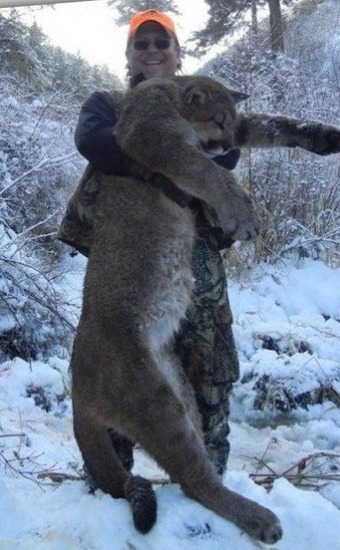
Dan Richards, of the California Fish and Game Commission, went out of state to shoot this Idaho mountain lion.
Bears. They reportedly taste vile if they’ve been feeding on salmon or marine mammals, but that doesn’t stop Alaskan hunters from killing brown bears. In fact, these animals usually aren’t eaten—just skinned and beheaded, as Alaska state law requires. Alaskan black bears, too, are often killed only for wall mounts. The state, to its credit, prohibits one from using the meat of a game animal for purposes other than human consumption, yet exceptions are generously granted to bear hunters, who can at certain times of the year (like during salmon runs) use a black bear’s flesh as pet food, fertilizer or bait. (For wolves and wolverines, the meat does not need to be used at all.) Elsewhere in the world, bear hunters sometimes participate in controversial “canned hunts“—such as the one in 2006 in which King Juan Carlos, our mighty elephant hunter, shot a tame, drunk Russian brown bear named Mitrofan, who was fed honey and vodka prior to being prodded into an open field, where the crowned noble had an easy shot. Even imperiled polar bears are still legally hunted for trophies.
Baboons. I’m almost reluctant to discuss this one, so similar are the animals to us and so grisly the nature of this hunt, but the fact that men and women shoot baboons for kicks needs recognition. Landowners consider baboons pests in some places and welcome trophy hunters, who often use bows to kill the primates. The animals are known to react dramatically when hit, and—much like a human might—a baboon will scream and holler as it tussles with the shaft protruding from its torso. Even hardened hunters reportedly grow queasy at the sight of a skewered baboon panicked with fear. If you have the stomach for it, look through this Google gallery of “baboon hunting” images, showing proud hunters with their trophy kills, or for some less graphic insight into the minds of the people who would kill baboons for the joy of it, read through this baboon hunting discussion. Here is a sample from the conversation: “Seems kinda twisted but given the chance I’d shoot one. Cool trophy.” And: “Good Luck, Hope ya get one. My next time back I’d like to kill one as well.” Someone get me a bucket.
Wolves. While this top predator reproduces relatively rapidly and can be naturally resilient to some level of persecution, sport hunting the gray wolf still stinks. To justify the hunt, wolf hunters describe the animals as having negative effects on deer and elk herds. In the Rocky Mountain states, where wolves were reintroduced in the 1990s, they are already being hunted again. Some wolves are baited into shooting range, others pursued via snowmobile, and in a few places wolves are shot from airplanes—like on the Kenai Peninsula, where a government predator control program is drawing fire from wolf allies. Wolf pelts, not the flesh, are the goal of the game, though cast members of the film The Grey reportedly ate wolf stew in order to prepare for a scene in which the actors, including Liam Neeson, would pretend to dine on wolf meat. Most of the cast vomited during their meal, donated by a local wolf trapper, though Neeson returned for seconds.
More top targets of the trophy hunter’s hit list:
Billfish. Anglers may eat sailfish sashimi or braised marlin, but let’s keep things real: These fish die for their swords.
And crocodiles for their hides.
And walrus for their tusks.
And hippopotamus for … honestly, I really can’t imagine.
This just in: King Juan Carlos has publicly apologized for killing his elephant. “I am very sorry,” he told the press on April 18. “I made a mistake. It won’t happen again.” Sure, now that he’s got his tusks.
/https://tf-cmsv2-smithsonianmag-media.s3.amazonaws.com/accounts/headshot/Off-Road-alastair-bland-240.jpg)