August 1, 2012
Is the Livestock Industry Destroying the Planet?

Seemingly benign bovines and other livestock eat soybeans from the deforested tropics, emit clouds of methane, pollute streams and gobble up 30 percent of the world’s grain production. It makes one wonder whether the world might taste better without them. Photo courtesy of Flickr user orangebrompton.
For the epicurean traveler, discovering new landscapes also means discovering new foods. And no doubt, new tasting experiences are one of the highlights of going places, yet I’m going to suggest something a bit radical, yet simple—that perhaps we all consider abstaining, at least sometimes, from dishes containing either meat or dairy, even while we’re abroad in new lands with exotic cuisines to explore. Don’t panic at the suggestion—just listen: An abundance of science analyzing the impacts on the earth of livestock farming has concluded that humanity’s appetite for meat and dairy products is having serious environmental consequences. Livestock species contribute directly and indirectly to deforestation, water pollution, air pollution, greenhouse gases, global warming, desertification, erosion and human obesity, and virtually anywhere you go in the world, the damage done by ruminants, pigs and poultry, and those who grow feed crops for them, is visible on the land. Dry and scrubby Greece, once a nation of woodlands, has gone to the goats. In Brazil, forests are falling before the advance of soybean fields, cultivated largely as beef fodder. In New Zealand, the banks of wild streams are frequently found trampled and muddied by grazers.
Other ecological problems associated with raising livestock are less obvious to the eye—like loss of biodiversity. On parts of the Great Plains, cows, and the fields of grain they eat, have replaced pronghorn antelope and bison. Livestock ranchers worldwide have participated heavily in the extermination of wild predators. In California, overuse of river water for agricultural use, including a million acres of water-intensive alfalfa (the state’s highest-acreage crop, used for feeding animals), has contributed to the long-term decline of wild salmon runs. Sixty percent of the state’s alfalfa fields lie in the San Joaquin Valley, ground zero in the water wars between farmers and salmon fishermen. And the mighty, man-size totuava, a Mexican fish species that once spawned in huge swarms in the Colorado River delta, has just about vanished partly because the Colorado barely reaches the Sea of Cortez anymore (remember in Into the Wild when vagabond Chris McCandless was unable to find the sea as he paddled a canoe downstream through the Colorado River delta?). Much of the Colorado’s flow is diverted to the Imperial Valley, a regional king of alfalfa hay production. Most California-grown alfalfa is fed to dairy cows—meaning, sadly, that the production of milk and of California’s acclaimed cheeses may be as problematic as raising meat.
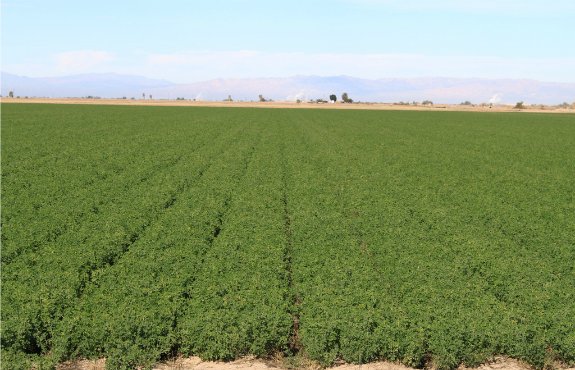
This field of alfalfa in California’s Imperial Valley is irrigated with water from the Colorado River, which scarcely reaches the sea today. Of about 20 million acres of alfalfa in America, about one million grow in California. Virtually all this grass—plus millions more acres of corn and oats—is fed to livestock. Is it a waste of resources? Photo courtesy of Aquafornia.
The global scope of the livestock issue is huge. A 212-page online report published by the United Nations Food and Agriculture Organization says 26 percent of the earth’s terrestrial surface is used for livestock grazing. One-third of the planet’s arable land is occupied by livestock feed crop cultivation. Seventy percent of Brazil’s deforested land is used as pasture, with feed crop cultivation occupying much of the remainder. And in Botswana, the livestock industry consumes 23 percent of all water used. Globally, 18 percent of greenhouse gas emissions can be attributed to the livestock industry—more than is produced by transportation-related sources. And in the United States, livestock production is responsible for 55 percent of erosion, 37 percent of all applied pesticides and 50 percent of antibiotics consumed, while the animals themselves directly consume 95 percent of our oat production and 80 percent of our corn, according to the Sierra Club.
The United Nations report warns that “(l)ivestock’s contribution to environmental problems is on a massive scale” and that the matter “needs to be addressed with urgency,” and a report from the Worldwatch Institute says that “…the human appetite for animal flesh is a driving force behind virtually every major category of environmental damage now threatening the human future…”
So, what can do we do? Easy: Opt out of the livestock industry. Far from depriving themselves of the greatest foods, vegetarians and vegans often discover that some of the very best edible things, prepared dishes and entire national cuisines are based on plants. And for the omnivores out there, the good news is that shifting toward a more sustainable diet is easy: It simply means the minor adjustment of tipping one’s existing diet to one side; that is, omnivores already enjoy fruits, grains and vegetables—so why not just enjoy them more frequently? (I’ve been leaning in this direction increasingly for a decade, and the only non-plant foods I still firmly cling to are certain types of wild seafood.) Even in meat-centric cultures like Portugal, France, Turkey, Argentina and New Zealand, veggies do grow, and fruits do dangle from the branches. Yes, meat is everywhere. Just ignore it. In spite of warnings from meat-eating friends that “you just can’t make it in (INSERT YOUR COUNTRY HERE) if you don’t eat meat,” the truth is that vegetarians can live well almost everywhere. No culture is void of farmers’ markets or fruit-and-veggie shops, and increasingly, restaurant staffs in many places far afield recognize and respect the word “vegetarian.” And whereas the meat-eating traveler might never look further than the meat kebabs and bland grilled chicken of fast-food street vendors for his or her sustenance, vegetarians, by virtue of requiring plant-derived calories, may be required to look a little further and enter the vast bazaars where local farmers gather with their heaps of vegetables and fruits and nuts and baked goods. Many of us could spend hours on such dazzling epicurean forays. (Try browsing through a meat locker or slaughterhouse without losing your appetite, or your breakfast.)
Still skeptical? Well, the problem is, the math just doesn’t add up. We can’t eat meat at the rate we do in a sustainable world. Listen: This source claims that to feed just one omnivorous human requires more than three acres of land while all it takes to produce food for a vegan is one-sixth of an acre. And with more than seven billion people sharing the earth’s 7.68 billion acres of arable land, that would be an even split of about an acre apiece—plenty of space for growing all the food we need and enjoying what’s left for camping, backpacking, kayaking and wildlife watching—except that habitual meat-eating omnivores are using three times their own share of space, requiring that precious wild lands be used for raising animals.
Next time, we’ll have a look at the global menu of vegetarian options, as well as meet a few famous vegetarians.
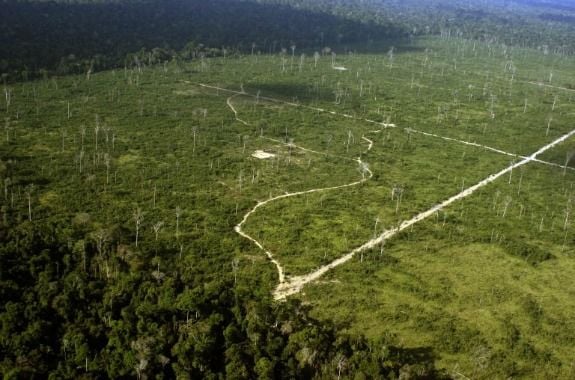
Going, going…but not yet gone: The Amazon rainforest, one of the most beautiful and important ecosystems on the planet, is being sacrificed for the cattle industry. The developed world’s appetite for beef is driving the destruction, with cleared lands often used to grow livestock feed crops for export. Photo courtesy of Flickr user leoffreitas.
Sign up for our free email newsletter and receive the best stories from Smithsonian.com each week.
19 Comments »
RSS feed for comments on this post. TrackBack URI


If I might make a modest proposal, “cultured meat,” or meat grown “in vitro:” beef, sheep, tuna and other animal muscle cells grown in laboratories, using the well-established tissue cultivation method of immersing a few cells in a nutrient-dense glop, and then leaving them alone to divide and increase might prove to be a possible solution.
Cultured meat could feed billions cheaply. It could be grown in any shape, and even texturized to improve palatability: Sheets of meat cells could be stretched mechanically, imitating how an animal uses its muscles. It would be a vastly superior source of protein in terms of health (fat content) and quality.
Here are some positives:
• No environmental impact to our lands and seas
• No inhumane treatment or slaughter of animals
• No antibiotics or hormones
• No transport issues
I must emphasize this is not cloning of whole animals. There would be no real ethical or spiritual issues involved.
Cultured meat tissue has long been considered as a viable option by futurists. The future is now!
Richard, interesting idea, although personally I think that sounds disgusting. I think the point of the article is that we don’t need meat. The earth produces huge quantities of plant life that we don’t full advantage of. Typically, these end-all solutions like bio-diesel or soy beans don’t end up being all they’re cracked up to be, and I’m guessing there would be some sort of side effects from growing massive amounts of cultured meat. You do sound more educated on the topic though.
Actually, cultured meat will still consume resources. It will be grown in climate controlled buildings controlled by computers. That’s energy intensive. Secondly, the muscle tissue, still needs to be fed. Definitely sugar, which is still a huge corn crop. Plus all the other minerals and nutrients, which will be made industrially like most other vitamin supplements. Antibiotics and hormones still may be used to speed growth. And these exceedingly “sterile” environments will still require vats of chlorine bleech and associated cleaners to maintain sterility. Bateria love to grow everywhere. And what about the waste processing? The “meat” still has to “eliminate” the used fuel.
richard spinner – stop thinking star trek and buy soy meat substitutes already in your grocey from the following brands: morningstarfarms.com // daiyafoods.com// sodeliciousdairyfree.com //silksoymilk.com//
Yuck – cultured meat – sounds too much like soylent green for my taste….
So anyways, far from being a vegetarian, I think it would behoove us to take a good close look at what’s happening with our water that’s being used for irrigation – especially for irrigation of feed-crops.
I did some calculations and found that in CA, AZ and NV we may be growing up to 3 Million acres of a crop nobody has ever heard of: Sudangrass. It is a cattle feed that gets shipped mostly to Japan on empty car carriers for their return trip. What irks me most about this crop is that while TX ranchers who are in a drought have to reduce their herds (and raise our prices for domestic beef and dairy), Japanese ranchers can continue to raise their high priced Kobe beef, on feed grown with OUR water – water that we don’t have enough of in the first place.
At the same time, big AG in CA is lobbying heavily for yet more water-diversions and giant infrastructure projects to grow yet more export crops we don’t get any benefits from.
And also at the same time, our rivers and estuaries are dying of thirst along with our beautiful salmon that are also a great food-source.
Big AG creates havoc in our local natural ecosystems without providing benefit to our people. Sudangrass is a prime example of that. But there are plenty of non-feed crops grown strictly for export that are not far behind on the evil-scale.
To Andrew and JJ. I was trying to present an option. It is not a perfect solution but livestock, whether raised industrially or free ranged is no longer a viable option. I have worked in an environmental testing laboratory and am well aware of waste disposal issues. These are minimal in comparison to the impact of an industrial farm. As far as ethics go, no animals are killed. As far as quality goes, it will be superior to any meats currently available. Enormous amounts of the resources used can be directly or indirectly recyled. Solar power could take care of temperature control. Maintaining sterility is critical but not a difficult task. Nutrients are not a big issue but the need for a carbohydrate source will have an environmental impact.
As unappealing as eating cultured muscle tissue might seem, the product theoretically should be excellent. This article concerned the potential threat that raising livestock presents to our planet. The threat is great. I don’t have all the answers. Who does? You both brought up very valid points but please look into tissue cloning before completely dismissing this idea.
After surviving the cold war without going “toe to toe with the Rooskies” it looks like our own appetites will do us in. It wasn’t a problem when there were only a few of us: now it’s too late. We are so hooked on eating meat(especially cows)we are not even willing to give this alarming article serious consideration. Humanity was given one little test: live on Earth and prosper, but don’t destroy your environment: we flunked.
Human beings are the most violent living beings on the face of the earth. They will do any thing to satisfy their desire for pleasures. This is the reason for the outrageous damage being caused to the environment. It is very simple to grow fruits and vegetables, very simple to cook them indpendently or mix them with other vegetable products such as rice, wheat, oats, etc. and make hundreds of varieties of tasty meals without hurting animals and minimizing resources needed to grow food and saving environment at the same time. It is a question of human attitude basically and once people are prepared to change their attitude and wake up to stop the destruction of environment, we can all contribute to save the earth and live as healthier human beings by not not loading ourselves with meat dishes. The article presents a lot of possibilities for a healthy life without damaging the earth. People need to educate themselves.
So where do we buy this artificial meat? How much does it cost? How does it taste?
And while we are at it, why not clone some desirable plant products? Would any durian lover mind if it came In a big yellow blob, without being enclosed in a huge spiky hand grenade?
Technology complicates problems. Less technology creates simple solutions. Permaculture grows food forests in the desert. http://www.permaculture.org.au/
Meat is not the problem, the managers of the farms are the problem. Joel Salatin is raising beef commercially in a way that heals the earth for many years and many many others are following his path. CAFOs and out dated farming methods are the problem, not the cows.
Krishna,
all in all I think that vegetarianism only postpones the inevitable. Yes, with today’s population, as Alastair points out, we can feed lots of more people if we all turned vegan. Of course this theory also is probably based on industrial farming techniques using tons of fertilizer, pesticides, herbicides, etc… in order to keep the yield per acre at a peak – and as such is equally as destructive to our environment as eating cows. Now if you look 50-100 years into the vegan future, we may yet run out of farmland eventually as our population grows. What then?
Kildare – it’s great that Joel Salatin grows high end beef, pork, and chicken on his utopian farm, but if all farmer’s operated this way, there wouldn’t be enough meat to support our ravenous appetites. Our excessive demand for meat requires factory farming to produce it on a massive scale. If we all cut back significantly, then all chickens, pigs, and cows could be raised in fewer numbers, and by more sustainable methods such as those employed by Joel Salatin.
New thinking: grass-grazing livestock and herding animals can actually be one of the major solutions to climate change. You heard that right. It’s all about the animal’s dung and the bacteria that keeps the moisture in the soil. It is our farming practices that is killing the soil and sending emissions into the atmosphere. But that’s industrialization. With this knowledge we could keep farm animals in community settings or on the regular housing block (think goats, chickens) and start practices that actually mimic Nature not oppose it:
http://tedxtalks.ted.com/video/TEDxSomerville-Seth-Itzkan-Reve
Hasn’t there always been a large number of herds of animals roaming the grasslands without them being used as livestock? I agree with the fact that there has been a lot of deforestation, green house gases, etc. but obesity? ehh.. people have their own choice, they can choose to eat healthy or not if they so please. Everyone should know the consequences because it’s always imbedded in our brains. But that’s going into another topic. The fact of the matter is that anything that is lustful, which it be a sports car, a wool coat, or a 16 oz. ribeye, will ultimately do some damage to the Earth.
I agree with DW. Grasslands covered with prarie grass were tore up for wheat production during WWI and instead of replanting to grassland after the war the land was abanded and allowed to blow. This was a manmade tragedy and could have been avoided by using lands as pastures and grazing lands for cattle and sheep instead of cultivation. In case of drouth, the topsoil is protected from erosion by the prarie grass. Horses Cattle and Sheep can survive off this in the summer and be given Hay during the Winter and drouth periods. This is environmentally sound and should be integrated in a modern agriculture.
Thanks for the reply, Mark. My immediate reaction to this idea is to suggest that we probably wouldn’t have to have torn that piece of prairie up to raise wheat if so much other land wasn’t already being committed to livestock. I don’t doubt or deny that cultivation of plants comes at the cost of wild habitat, but I firmly maintain that we would need to maintain and cultivate less crops altogether if we reduced the scope of animal husbandry and meat farming.
I support in-vitro meat – because while humans DO NOT NEED ANIMAL PRODUCTS to survive, my pets, do!!
I know that some folks have their dogs and cats on veggie diets, but I tried and mine just won’t eat it.