
Volcanoes: The Top Hotspots of the World
Volcanic landscapes draw countless tourists to rumbling mountains, rivers of lava and boiling geysers. Here are a few of the hottest destinations
/https://tf-cmsv2-smithsonianmag-media.s3.amazonaws.com/accounts/headshot/Off-Road-alastair-bland-240.jpg)
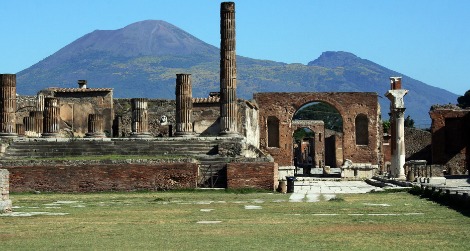
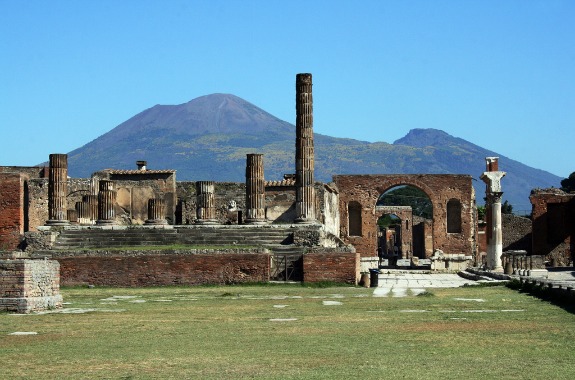
In Pompeii, classic Roman ruins stand before Mount Vesuvius, which erupted in the year A.D. 79 and obliterated the human population of the city. Photo courtesy of Flickr user photographerglen.
The seemingly slow-motion ash plume of a distant and erupting volcano; the petrified rivers of lava on the slopes of a mountain; the stories of towns caught by surprise by descending volcanic avalanches: Such are the elements of vulcanism that amaze and terrify us—though not necessarily enough to keep people at bay, and volcanic landscapes, both dormant and active, draw countless tourists to rumbling mountains, rivers of lava and boiling geysers every year. Following are several of the most inspiring volcanic destinations.
Pompeii. Porous rocks, cinder cones, geysers and lava beds may be fascinating for anyone with a geological conscience, but not much volcanic scenery can quite compare with the Roman ruins of Pompeii, in southern Italy, where archaeologists have uncovered human terror frozen in stone. Body casts have been made of partially preserved figures lying curled in fetal position, seated with arms shielding their heads and in other desperate poses. One family of four was even discovered hiding under a staircase, where they succumbed to the fatal blast of heat that engulfed the city on August 24, in A.D. 79. In all, an estimated 16,000 people died that day. Along with human remains, the ruins of Pompeii include artifacts of the era—like various household items and petrified loaves of bread. And looming over it all is the culprit, Mount Vesuvius. Or, not looming exactly—because Vesuvius is only a shade over 4,000 feet tall (various sources give their own exact figures). Yet the little mountain is considered a real hazard and is among Europe’s handful of active volcanoes. It erupted most recently in 1944. The mountain, along with its relatives Campi Flegrei, Vulcano, Stromboli and the often-rumbling Mount Etna of Sicily, marks the interface between the African and Eurasian tectonic plates, where the former dives under the latter, melts in the heat of the earth’s interior and sends plumes of magma upward to create cone-shaped volcanoes. Hikers can ascend Vesuvius without a great deal of effort. The trail skirts the rim of the crater, where rising steam reminds us—and certainly residents of nearby Naples–that Vesuvius hasn’t yet had its last words.
Krakatoa. On August 26, 1883, the entire 2,667-foot-tall Indonesian island of Krakatoa vaporized in one of the most powerful volcanic explosions in history. More than 36,000 people died in the blast and from the resulting 130-foot tsunami, which swamped the Southeast Asian coastline. The explosion was heard 4,500 miles across the Indian Ocean in Sri Lanka and veiled the earth in an airborne ash layer that lowered global temperatures and affected weather patterns for years. Quite literally, Krakatoa’s was an eruption that rocked the world. For decades, the mountain was gone. Then, in 1927, the sea above Krakatoa’s craggy stump began to boil—and in years following a new mountain emerged. Today, Anak Krakatoa—the “child of Krakatoa”—stands more than 1,300 feet high and is growing an average of 16 feet per year. It’s a little mountain still, but plainly one of the most dramatic. At times, cloud systems above the peak glow with the colors of fire—though scientists are dubious whether the new volcano has the potential to explode with anything like the power of its predecessor. The mountain is an object of great intrigue, and tourists who visit the island may even hike to the summit.
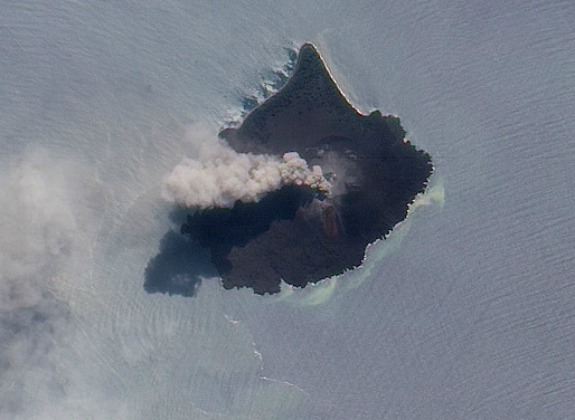
A volcanic island that vanished in a powerful eruption in 1883, Krakatoa has been reborn. Though lava flows readily from the mountain—now just over 1,300 feet tall—tourists eagerly scurry up its slopes. Photo courtesy of Flickr user NASA Goddard Photo and Video.
Mount Lassen Volcanic National Park. The southernmost peak of the Cascades, Mount Lassen in Northern California rises dramatically from an otherwise nondescript landscape of farm country and rolling hills. Cone-shaped like its volcanic cousins to the north—including Mount Shasta, Mount Hood, Mount Rainier and Mount St. Helens (which exploded in 1980, killing 57 people)—Lassen last blew its lid in a series of eruptions between 1914 and 1917. This activity left its northeast side a ruin of volcanic rubble and desolation. Travelers through the mountain, which is bisected by a highway that cuts up and over and right past the summit, will see steaming pools high on the mountain, as well as a devastated area. Lower on the slopes is a craggy landscape of black volcanic rock and hardened lava flows that appear like a turbulent, frozen river. Hikers can walk 700 feet up to the nearby peak the Cinder Cone (that’s the 360-year-old volcano’s name), atop which is an ominous-looking crater. Wish to climb Lassen itself? The summit stands 10,463 feet above sea level, about 5,500 feet above the hill country at its base and 2,000 feet above the trailhead, where hikers park their cars to make the four-hour round-trip trek.
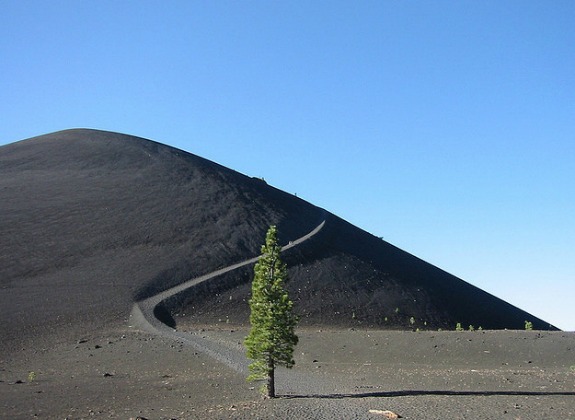
A lone conifer stands beside the trail to the top of Cinder Cone in Lassen Volcanic National Park. Photo courtesy of Flickr user vtsr.
Mauna Loa. Sometimes regarded as the biggest mountain on the planet (and the tenth-largest in the solar system) when measured from its base at the seafloor, Mauna Loa rises more than 31,000 feet and measures 19,000 cubic miles in volume. (The neighboring Mauna Kea is slightly higher and part of the same massif, but Mauna Loa is generally regarded as the central peak of the Big Island.) While Everest climbers may smirk at the suggestion that a gentle shield volcano in the tropics is anything but a molehill, Mauna Loa ranks as one of the earth’s most active and exciting volcanoes. Mauna Loa has erupted 33 times since 1843 and has long been an attraction for locals and tourists seeking photo-friendly volcano-viewing opportunities. Its eruptions have been relatively benign events—though in 1935, the U.S. Air Force was called upon to drop bombs in the path of a lava flow headed for Hilo to try to divert it. The city wound up untouched, and no people have been killed by Mauna Loa’s historical volcanic activity. The most recent eruption was in 1984—a three-week-long outburst that had the Big Island on high alert, threatened to destroy a prison and provided lava lovers with the photo ops of a lifetime.
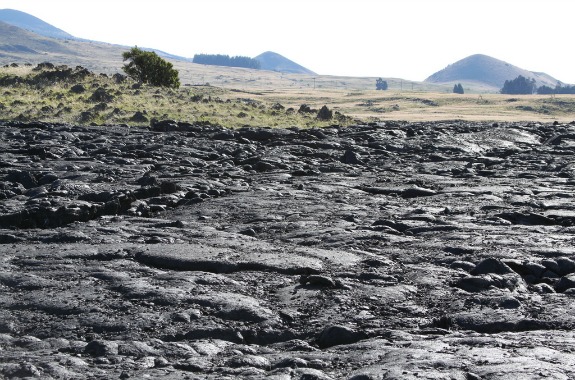
Vast fields of hardened lava remain on the broad slopes of Mauna Loa, on the Big Island of Hawaii, where numerous eruptions have occurred in the past century. Photo courtesy of Flickr user roy.luck.
Yellowstone National Park. The North America Plate is slowly sliding across the surface of the earth—and lying beneath this moving slab of crust is a volcanic hotspot, a vent fuming with heat. This process has left a linear series of scars on the land, including the nearby Snake River Plain. Today, the place we call Yellowstone National Park sits on top of the gurgling hotspot, and as a result the park features hot springs, geysers and rock formations in addition to its fantastic assembly of bison, elk and other megafauna. In fact, wildlife may attract the majority of Yellowstone’s visitors, who have good chances of seeing grizzly bears and wolves from the highway, yet the sheer thrills of vulcanism are a sure draw. At the Old Faithful geyser, which erupts reliably every one to two hours, crowds gather in timely waves to witness the show as water spews 100 feet and more into the air. And sapphire pools of clear, scalding water bring tourists to the rail along paths that wind through a number of dramatic hydrothermal sites. But the gentle volcanic activity of Yellowstone is a bit misleading—for this region is just one of the earth’s supervolcanoes. The Yellowstone supervolcano has erupted three times, scientists believe. The first event was the biggest—a blast about 2.1 million years ago that released 25,000 times the energy of the famed Mount St. Helens eruptions–itself 400 times more powerful than the Hiroshima atomic bomb. The two subsequent eruptions of the Yellowstone supervolcano occurred about 800,000 years apart—and by this pattern geologists speculate that we’re due for another. Such a huge eruption in Yellowstone today would kill an estimated 87,000 people. So enjoy the placid activity of Old Faithful—and cross your fingers.
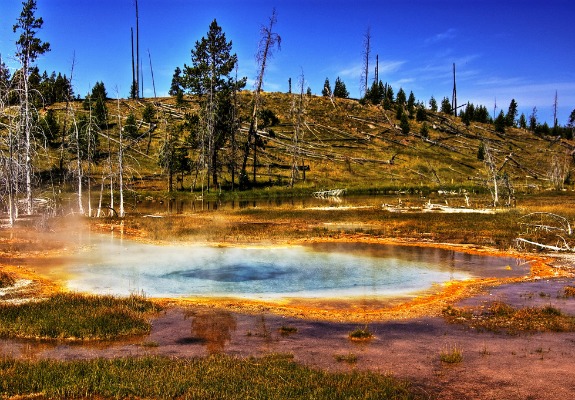
Brilliant autumn colors and quietly steaming thermal pools belie the potentially devastating power in the ground under Yellowstone, which geologists classify as a supervolcano. Photo courtesy of Flickr user Wolfgang Staudt.
We’ve named a handful of volcanic sightseeing spots. What others are worth a journey?
/https://tf-cmsv2-smithsonianmag-media.s3.amazonaws.com/accounts/headshot/Off-Road-alastair-bland-240.jpg)