December 27, 2012
Do We Really Need to Take Vacations to Space?

Is our world really not enough? Simple pleasures like swimming in the Adriatic Sea or hiking in the hills of Greece (in the upper right of the photo) will require staying on Earth. Photo courtesy of Flickr user NASA’s Marshall Space Flight Center.
As we approach 2013, the possibility of entering a sealed aircraft, buckling up and exiting the atmosphere in the name of leisure is no longer science fiction. Rather, space tourism is so close to reality that talks of orbital hotels and space property rights are underway, a space runway has been built, a touristic spacecraft from Virgin Galactic is ready, and hundreds of wealthy travelers have prepaid for their seats at $200,000 a head. While the starting price of a space ticket is for now only an option for the extremely rich, analysts say that streamlining of costs and energy outputs, and bringing large numbers of tourists into orbit at once, will eventually make orbital holidays relatively affordable and, possibly, an option for the masses.
In many ways, space travel closely resembles prior phases of human exploration. Five centuries ago, government-funded vessels from Spain traveled across the Atlantic to the New World. Later, common citizens began to make the same trip, and the trans-Atlantic voyage would become a rather routine errand, for better or for worse. Powerful new nations were consequently born. In 1803, Lewis and Clark, working for the U.S. government, embarked on a scientific and cultural exploration of western North America. Their effort opened the West to millions of settlers—for better or for worse. Now, government space exploration has been a reality for more than 50 years—and it may be inevitable that the general public will follow. Proponents of space travel believe that bringing masses of paying passengers into space—and carrying them in reusable launch vehicles—will make space travel cheap enough to become a feasible everyday activity. This will facilitate research endeavors, and space explorers will likely make great discoveries as they move outward into this next, if not final, frontier. Space travel advocates believe that valuable resources—especially minerals, like gold and platinum, and solar power—could be accessed through missions into the wider reaches of our solar system. Further into an imagined future is the prospect of establishing permanent colonies for human habitation far away from Earth.
But as the industry gears up to go, critics are asking why we must tap into other worlds’ resource banks, why we must endanger the lives of astronauts, and why we should spend money on science-fiction-like undertakings while poverty, pollution, inequality, starvation and extinctions are rampant on Earth. A major concern addresses the pollutants that a space tourism industry could introduce to the Earth’s already strained atmosphere. In October 2010, Scientific American‘s John Matson wrote an article titled “What will space tourism mean for climate change?” He wrote that a mature space tourism industry, consisting of 1,000 flights per year, would spew about 600 metric tons of soot into the atmosphere each year—in addition to greenhouse gases produced during takeoff. Over a period of decades, this soot, seemingly negligible on an annual basis, would produce “a persistent and asymmetric cloud over the Northern Hemisphere that could impact atmospheric circulation and regional temperatures far more than the greenhouse gases released into the stratosphere by those same flights.”
Proponents of space travel are ready with their defense. In a 2009 report produced by Space Future, a company committed to “opening space to the public,” there are virtually no reasons for concern about realizing space travel. The authors, Patrick Collins (owner of Space Future) and Adriano Autino (founder of another space travel promoter Space Renaissance International), acknowledged that space tourism would incur small environmental costs to our planet mainly in its beginning stages. As efficiency increased, however, space travel would begin acting almost as a panacea for all of our planet’s ills. They write that in light of current and increasingly frequent “resource wars” between nations, “…opening access to the unlimited resources of near-Earth space could clearly facilitate world peace and security.” They also believe that space travel will generate valuable educational, cultural and emotional benefits.
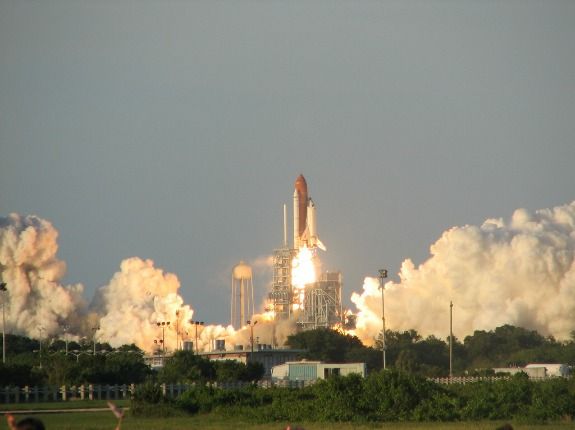
Space travel has been associated with substantial air pollution. While the space tourism industry is gearing up for horizontal takeoff methods, unlike the vertical space shuttle takeoffs (shown above), the particulates that tourist space aircraft introduce to the atmosphere are expected to be considerable in a future of frequent space tourism. Photo courtesy of Flickr user oneaustin.
Space Renaissance International has published a “manifesto” outlining the arguments for why we should travel beyond the gravity and atmosphere of Earth. The document begins, “If we, the seven billion people that make up 21st century humanity, want our civilisation to keep growing and improving, we must…”
But why must our species continue to advance? Do we really want to keep growing? I believe that the physical limitations and boundaries of our planet, if not insurmountable by our technology, might be worth respecting. I also believe we should employ our brilliance as a species in figuring out how to live sustainably on this planet, and I would argue that it’s not our business to plunder the natural resources of any other worlds unless we can at least learn to manage and preserve our own—a challenge at which we are failing. But Space Future, Space Renaissance International and other advocates of space tourism believe that we should now be tapping the energy and mineral resources of space precisely because we have failed to properly use and preserve our own. Deep space exploration may be inevitable, as it seems that the human will to conquer or discover eventually overpowers all obstacles and mysteries.
As long as the choice is mine, I’ll remain on Earth. But market research surveys have indicated that many people in certain countries—especially, it seems, Japan—would enjoy a vacation spent in space. Would you?
If you’re bent on going, reserve your spot. Just be sure you’ve got a window seat—and that it isn’t over the wing.
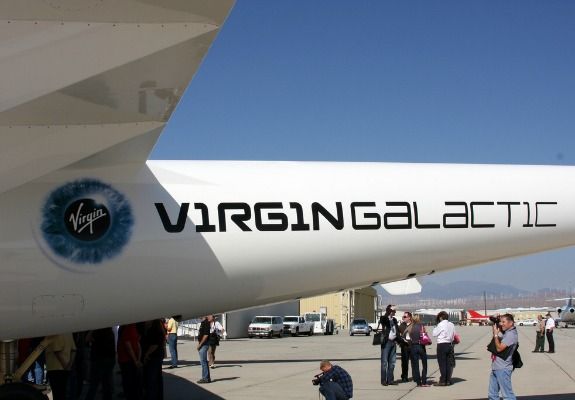
This aircraft, on Virgin Galactic’s New Mexico runway, is likely to be the first to take paying tourists into outer space. Photo courtesy of Flickr user sygyzy.
Sign up for our free email newsletter and receive the best stories from Smithsonian.com each week.
32 Comments »
RSS feed for comments on this post. TrackBack URI


No offence, but you have got to be kidding me! “Why must we continue to advance? “?! What kind of vision is that?? Humanity chained to this rock until the sun blows up or we all die from overpopulation? And how could one not be in awe of the view of earth or the moon from a space capsule? Have fun being stuck on this rock , I’m off first chance I get .
I’d like to read just one article that doesn’t have the obligatory global warming scare.
You know why so many people are cynical about the global warming scare campaign? Because we’ve heard it all before, and somehow survived.
The Population Bomb predicted to cause world wide mass starvation and collapse of cililization before the 21st century.
The New Ice Age predicted in 1974 that never happened.
Killer Bees predicted to cause environmental havoc in the U.S.
We will run out of oil by the year 2000.
AIDS predicted to cause more deaths than the 13th century Black Plague that killed 1/3 of Europe’s population alone.
Y2K predicted to cause a massive break down of our technical infrastructure.
But this time the sky really is going to fall. Sure it will.
But why must our species continue to advance?
Because species that fail to advance fail to survive. Witness the dinosaurs.
LM, there is little doubt among most credible scientists that global warming ALREADY IS happening. This is no longer a matter of speculating about the future, and it’s unreasonable to compare climate change discussions to that short-lived, media-hyped scare over Africanized killer bees.
Tony K, thanks for the thoughts, but Earth is much more than just a “rock.” As far as we yet know, there is not another planet like ours, anywhere. The Earth is an amazing package of resources and life. Not to appreciate what we have will only spur the destruction of the planet.
Alastair, when scientists can accurately predict weather 3 weeks from now I’ll be more inclined to believe they can predict weather 100 years from now. Another pseudo-crisis hyped by the media, opportunistic scientists, lefty politicians and others looking to push a political agenda or simply cash in. As one of these pols said, “Never let a crisis go to waste”. The more hype, the better: more funding for climate researchers looking to make a name, more eyeballs and ad revenue for the media, another opportunity for pols looking to expand their power, which is all they care about. Most scientists agree…big surprise; the ones who don’t support the dogma are ignored and marginalized by the AGW industry. The whole thing reeks of opportunism, hucksterism and self-serving hype. We’ll all survive, believe me.
Do Americans really “need” to take a vacation in Washington, DC?
Do we “need” to visit the Smithsonian?
No, we do these things because we want to — and we are better for it.
The freedom to travel has always been one of our most American rights. We don’t need to demonstrate a “need” for it to some government official, or a writer for Smithsonian. It’s sufficient that we want to travel and can afford to buy a ticket.
Exploration — travel for purposes of learning and discovery — is important. It’s part of what made us the nation we are today. It’s amazing that Smithsonian employees don’t understand that.
If the Smithsonian objects to Americans “plundering” the resources of other worlds, perhaps it should return the Moon rocks (“plunder”) that draw so many visitors who spend money (“squander resources”) in the Smithsonian’s restaurants and gift shops.
John, weather and climate are very different things.
Edward, I don’t understand how you drew the conclusion that I don’t appreciate the significance of travel and exploration. Early in this article I pointed straight at Lewis and Clark, whose journey helped open the continent to millions of settlers (an influx of people that, remember, did not benefit all cultures). What I am asking, though, is simply if there should be limits on where we go.
“What I am asking, though, is simply if there should be limits on where we go.”
That’s easy to answer: No. Humanity has long been defined by the desire to venture beyond the next hill (for whatever reason). To give that up and turn inward would mean losing a fundamental aspect of humanity.
You also seem concerned about the effects that space tourism might have, as illustrated by the “for better or worse” examples of Lewis & Clark and Columbus. Remember that there are no other cultures than what we take with us into space.
And as for the planet? The start of the environmental movement has its roots in the picture of earth from Apollo 8. And that was just a picture. What do you think would happen if thousands (or millions) of people got to see that view for themselves? Perhaps you should google “the overview effect”.
“What I am asking, though, is simply if there should be limits on where we go.”
Not only no, but hell no. In a free country, people are able to go where they choose — not where you think they ought to go.
Nor should travel be a luxury reserved for those with government sponsors, like Lewis and Clark.
And the area you want to declare off limits happens to be >99.9999% of the universe.
A point overlooked by Mr. Bland in his criticism of space tourism is that there is ongoing debate regarding just how significant of an effect the emissions from suborbital vehicles would be on levels of carbon in the stratosphere. When the GRL paper was published in 2010, industry took issue with a number of assumptions in the authors’ model, including the amount of propellant used per flight, the amount of soot such propellants generate, latitude-based sensitivities (the model assumed all launches took place from a single spaceport, or at least spaceports at the same latitude), and other factors. Even the authors of the GRL paper agree that this requires additional study, including measurements of carbon emissions by modern rocket motors and refined models of its effect on the atmosphere.
I’m not sure what it is about humans, but there is something that drives us to explore. What made the Indonesians that found Madagascar and Easter Island get in boats and paddle into the blue horizon? Whatever it was we still have it. It’s just now our boats are made out of Titanium and powered by rockets, instead made out of bamboo and powered by wind. When it comes time to get on that metal boat, sign me up!
This is an example of a “1st world problem”. Americans live in a very small and very unique bubble of exclusivity that they have to consider things as luxurious as “space tourism”. Most of the world lives in hunger and fear. That is the human condition. Americans have locked the human condition outside of their borders for too long. It’s time we joined the rest of the human race.
Why should Americans think we are so exclusive that we can seperate ourselves from daily fear from corrupt authorities with guns taking our groceries from us? Why should Americans think we are entitled to healthy water tested by independent entities that would dare to speak ill of the municipal water supply?
Instead of having foolish thoughts about luxury space tourism, we need to join the rest of the world in worrying about whether our families will survive tomorrow.
Jeff, thanks for pointing out some of the holes in the Ross 2010 GRL paper. What Jeff Greason and I caught after a few days of contemplating the article, looking at the details, and corresponding with the authors, was that they forgot (gee, whoops) to include *any* black carbon in their atmospheric model at the start, ignoring the roughly 30 nanograms/m3 that reaches all the way up to 20 km. (These numbers are from memory, the exact values are on the server at work, and I’m on vacation.) So OF COURSE their model predicted significant changes to the the modeled system when they added their wildly inflated black carbon emissions. When we asked Ross et al to clarify, they stopped talking to us.
As for limiting where anyone should go be *allowed* to go, Mr Bland, you’ll need to create a police state first. And you can try to do that over my dead body.
Oh look, a liberal arts major belittling the hard work of Engineers and Technicians that make the soft smug world of his possible. No thanks liberal arts major, I prefer to look up to the real pioneers of this society like Elon Musk and Branson.
If an extraterrestrial had followed the history of our globe, over 400,000 millenia, he/she would conclude that Earth was dying. During the last two millenia the color and texture of the surface has changed, and now the atmosphere is breaking out as if infected with the plague. Do we really want to infect the rest of our galaxy with this disease?
Hey Smithsonian,
I’ve heard this sort of drivel before but not from the Smithsonian. The Air & Space museum, for example, stands as a tribute to humans reaching beyond their limits and plunging into the unknown. It is foolish to think of space tourism as mere frivolity. Today’s commercial space pioneers will pave the road to inexpensive space travel. Within the next century humans will settle on other worlds. The US can either lead or settle for the second rate and make up excuses not to go.
Humanity is headed for the stars. People like this author can stay here and rot in their politically-correct self-righteousness.
“But why must our species continue to advance? Do we really want to keep growing? I believe that the physical limitations and boundaries of our planet, if not insurmountable by our technology, might be worth respecting.”
The question is wrong. It should rather be asked: “why Mr X must continue to advance” ar “Does Mr Y really want to keep growing (his money, experience, etc.”? Than the answear would be claerer also for the author: because he/she wants to use his money, time and talent in a specified way. Questioning his/her freedom to do so seems to be a bit egoistic IMO.
Most of human “poverty, pollution, inequality, starvation” etc. is caused by immature/corrupt governing and/or social systems outside of the industrialized world. I lived in exactly such a system im my childhood. No, thank You, I want no retreating to a system where I am told how much food I am allowed to buy.
“Mother Earth” would indeed appreciate if we start to exploit some off-world resources.
“Do we really want to infect the rest of our galaxy with this disease?”
I don’t view myself as disease. You are free to view yourself the way you want to.
Your problem consists maily in lack of knowledge or ideas of where the global human demographics is going right now (down), where the technology is going in terms of energy production and storage, what are the common regulatory trends in eg. EU or elsewhere in the industrialized world in terms of recycling etc. Do some research and catch up.
I would love to take a vacation in space. Is anyone exploring ways to make this type of vacation affordable for more people?
Bartosz Malinowski says, “Your problem consists mainly in lack of knowledge or ideas”
Is this not an arrogant view point of someone who considers himself to be part of an exclusive elite that for some reason deserves better than what most of the human race lives on a daily basis? This kind of extremist chauvanistic ideology has caused most of the problems throughout history. People should not annoint themselves as some kind of royalty.
Instead of claiming that others are deficient in their ideas or knowledge it is better to try to understand and accept the ideas and the knowledge of the other.
“As far as we yet know, there is not another planet like ours, anywhere.” and if you have your way we will never know if there is another earth like planet out there.
Amazing how much fear is out there. Careful we might sail of the edge of the world.
Any exodus of Earth is unlikely to be a fair and just process, which is why those privileged enough to leave must not write off Earth as doomed. Billions of humans and other creatures will be left to keep living here–or am I wrong? Will the poor of the Earth who may want to leave this supposedly doomed planet be offered the first seats? Now that would mark human progress!
Again, with respect to the author, I emphatically disagree. I will not lie, I feel very strongly about this subject. It saddens and angers me greatly when I hear people trashing the hard work and sweat of some of the brightest engineers and scientists of the world and calling the efforts of visionaries a “waste of money”. How could one not be moved by the image of the footprint on the moons surface or the idea of people walking the surface of Mars, millions of miles away? A future where we have failed to expand into space is utterly depressing, in part because it would represent our failure to imagine and achieve.
I also resent the often invoked “but people are starving in Africa ” excuse . Do you realize that when the Wright Brothers took flight the world of 1903 was filled with far more injustice and suffering than today? Even now, many people cannot afford to ride on a plane, yet would one argue that weshould have halted development of flying machines until we “sorted out our problems here on the ground?” If we try to solve all suffering and starvation in the world before attempting space travel, the sun will blow up
first. There will always be problems in the world. We can always do our best to make it better but honestly, how will taking money away from science and technology help exactly? Will cancelling space tourism flights result in boxes of hamburgers landing at the feet of the wretched? Why does space travel have to equate to abandoning earth? Did Europe become abandoned after the colonization of the New World? Quite frankly, I’d be more concerned with the money we spend on nuclear bombs and oil wars.
One final thing regarding the “need” factor: We need the furniture in our homes? Do we need the computers we are writing on the page with? (That would be pure luxury in many parts of the world) Do we need cars any more advanced than a Model T? Do we need to treat ourselves to expensive food and vacations? I staunchly believe in protecting the environment, and I believe in helping those who are disadvantaged, but lookkng at space exploration to pay the bill is barking up the wrong tree. Placing arbitrary restrictions on our technological progress is utterly horrifying.
Tony K,
Thanks for the thoughtful comment. I agree with a lot of what you say, and yes–we already do live in a world of luxuries and a world well advanced from previous times. Why stop advancing now, or ever? Forward movement is the nature of humans.
I’ll be on an airplane myself, soon, which will put me halfway to space–but I always will want to come back to Earth.
It seems we are discussing two forms of space travel here: space tourism and human-relocation. Going on a short little flight into space would be cool, without a doubt, and a photo of earth through the cockpit window would generate countless facebook likes.
However, I would never want to be part of a human experiment in which I and many others are placed on a cold and sterile generation ship and set on a blind course into space in the hopes that our great great great great great great great great great great grandchildren MIGHT set foot on a new and inhabitable planet, at which point they would go to war with and slaughter – if they were to succeed – the natives of that planet. Genocide has always coincided with human expansion across oceans and continents, so why not space?
Space travel for the masses is certainly in our future, and earth’s problems will remain with or without it. However, we can and should make conscious, ethical decisions regarding our other-worldly destinations.
To paraphrase Jeff Goldblum’s Ian Malcolm, just that we can doesn’t necessarily mean that we should.
(Read Tony K’s comment after writing this…well put, sir!)
Did the first humans need to leave Sub-Saharan Africa? They hadn’t solved all their problems, and were making a mess of the area they lived in.
Did the Norse/European explorers need to try and find expanded territory or a trade route to the Indies? They hadn’t solved all their problems, and were making a mess of the area they lived in.
Do we need to take vacations and eventually move into space? We haven’t solved all our problems, and we’re making a mess of the area we live in.
To me, all three are the same question, and while there is debate about the ‘goodness’ of the actions taken, I’m glad the first two choices were made the way they were. Assuming expansion happens, it will be messy, because we’re human, but in general we’ve learned from the past and will do it better than in the past.
I see the left wing cancer has spread to even the heart of the Smithsonian. Are these just your opinions or are they the opinions of the Smithsonian board? I am shocked and appalled that how badly things have changed.
What is the problem with space tourism? – nothing as far as I can see. Or is this just some bash the rich thing.
Advance for better of for worse? Really? Every step forward solves another problem. You’d rather Ferdinand and Isabella hadn’t funded Columbus? Or the US govt hadn’t funded Lewis and Clarke. “No thanks we’re quite happy living here on the east coast we’re not interested what is over the horizon to the east.”
We will always want to see over the next horizon it is who we are.
Why must our species advance?
You state that there is still poverty, pollution, inequality here on Earth and you are right, there is. But it is decreasing. Why? One word, knowledge. All are dropping at an exponential rate due to exponential increase in information technologies and their related fields.
Should our advances be asymmetrical? And who gets to deicide?
Go and visit the National Air and Space Museum (you know, part of the Smithsonian) and see the small children eyes open wide with wonder looking up at Apollo 11 and Spaceship One. Amongst them will be a few who are inspired, the next generation’s Goddard, von Braun or Rutan.
If it is now Smithsonian’s doctrine to no longer inspire our youth with aerospace engineering then it might be a good idea to close the National Air and Space Museum first – for good.
The Chinese don’t care what you think or do and so they will go anyway.
If you want your country to be side-lined like mine then this sort of thinking is the way forward. Fortunately you are in the minority.
Being British I have come to accept this sort of anti-patriotic, leftist-liberal claptrap from European institutions safe in the knowledge that the US is still a forward thinking country. Was I wrong?
I admit that I didn’t read most of the replies, so I’m sorry if I’m repeating or walking on…
I’m also sorry that there are so many malcontents. Why does this human condition persist? It leads to all kinds of pain and suffering. We’ve reached the point where we…most of us can be happy all our lives by drug induced euphoria. We can sit in our homes blissfully, with minimum effect on the environment, not littering the beautiful barren worlds of the heavens with our presence and pass into extinction at the whim of Gaia, as it should be. This social system could be sustained, not by forcing it on everyone, but by maximum transfer of productivity through taxation of those who refuse to participate. Why explore, travail, challenge, etc. when true happiness lies a dose away.
Seriously:
How do we get institutions of advancement staffed by people who seem to have trouble differentiating open minded questioning of the way things are done from politically correct dogmatism such as that in this article.
Come on people…
Mr. Bland: I can understand that, and I do agree that there is much we have to appreciate on this planet. I am particularly fascinated by life in the ocean. Looking back, I apologize for striking a rather hostile tone, I appreciate that your post has made me think!