Blogs

  • News
  • |
  • Art
  • |
  • History
  • |
  • Food and Travel
  • |
  • Science
Food & Think

A heaping helping of food news, science and culture

Off the Road

The travel adventures of a nomad on the cheap


February 7, 2013

Bike, Bark, Bite, Blood: The Perils of Cycling in Rabies Country

The intent stare of an unknown dog strikes dread in the experienced cycle tourist. Most healthy-looking animals, no matter how mean, probably do not have rabies, but if bitten one must receive treatment. Photo courtesy of Flickr user theunquietlibrarian.

I left my baggage at a hostel in central Cuenca and rode east, on a small quiet highway that climbed into the beautiful green hills and would eventually lead over a small mountain range and straight down into the Amazon rainforest. My goal for the day was to go as far as the pass and look down toward the world’s greatest river basin, or the fog blanket upon it–but I didn’t get that far. About 10 miles out of town, in the quiet farm country, as I passed a small home on the left side of the road, a pair of dogs came charging from the front yard. This was nothing new; many dogs are pests and nuisances to cyclists here. But when one dog didn’t stop at the usual four-to-five-foot buffer distance and, instead, came right in and sank its teeth into my ankle, I yelled out and stepped off my bike, astonished I’d actually been bitten–the second dog bite of my life. The dog let go and scurried down the road while a woman came rushing from the home, yelling at the thing–her family’s best friend, I’m sure.

“Control your dog!” I snapped at her, rolling up to the dirt bank leading from the road to into their yard and staring at the woman as fiercely as I could. I pulled down my sock to have a look at my heel. “There’s blood! Does your dog have a rabies vaccination?”

The woman said yes.

“Do you have papers or documentation?” I asked.
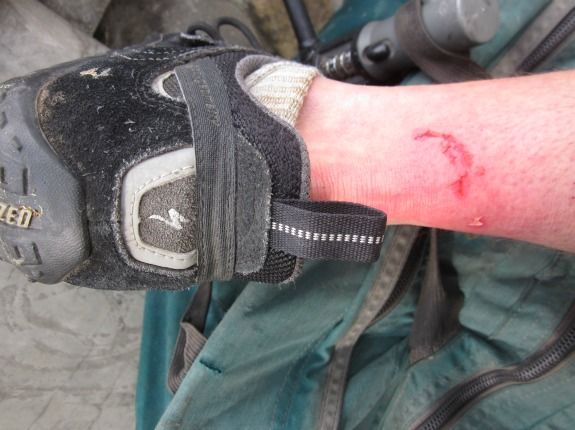
Little bite, big problem: This wound was delivered by a dog just 30 minutes before the photo was taken. The slight presence of blood meant the author would need to go through a week-long rabies vaccination process. Photo by Alastair Bland.

She said yes. I asked if I could see the papers. She said they were lost. Her teenage girls had begun to laugh and giggle at me, and the grandmother who had come out of the house also wore the shadow of a smirk on her face. Nobody apologized or asked if I needed help.

I requested alcohol to clean my wound, which was oozing blood, and after the two women haggled nervously for a minute, I lost my patience and rolled back the way I had come. I needed to get medical attention. One hundred yards down the road, the same dog–a brown-and-white mongrel with pointed ears and wicked eyes–came at me again. I picked up a hunk of cement and threw, just missing the animal as it fled into the brush. The family sullenly watched the entire exchange. I rolled on.

The presence of dogs in Ecuador, as in all developing nations, baffles me. They’re often no better than rats, far less useful than goats and meaner by miles than pigs–yet the people feed them and maintain the dogs’ health just enough to keep them alive. They sport bleeding bald spots and rib cages like washboards, and about 50 percent cannot resist the urge to chase people on bicycles. Most dogs here don’t seem to be strays. That is, they usually appear to belong to a particular household–but why? Do people love these dogs? Name them Max? I doubt it.

As an experienced cycle tourist, I have a mixed relationship with dogs. I have loved several like siblings, and it tickles me every time I see a well-groomed, friendly dog on a leash here–but that gang of mongrels loitering by the roadside 200 yards ahead strikes dread and loathing in me. I often scheme how I might exact the most satisfying revenge on the dogs that harry me down the road through almost every village, snarling ferociously as though I had done something to outrage them. Carrying rocks in a front basket seems an easy precautionary tactic–though I don’t currently have a basket. Firing a three-pronged pole spear loaded with a rubber hand loop at one end would be extremely satisfying. The other day, in the outskirts of Quito, one of the usual “ribcage mutts,” as I call them, charged me and gave me hell for crawling past on a steep grade. It then fled toward a doorway as I launched an orange at its rear end. The owner, who probably hadn’t ever bathed his dog or picked up its poop in a used newspaper bag, poked his head out the upstairs window and yelled at me that I had antagonized the dog by not walking my bike. The exchange made me wonder if, perhaps, some people here do love their dogs even though they neglect them three-fourths of the way to death.
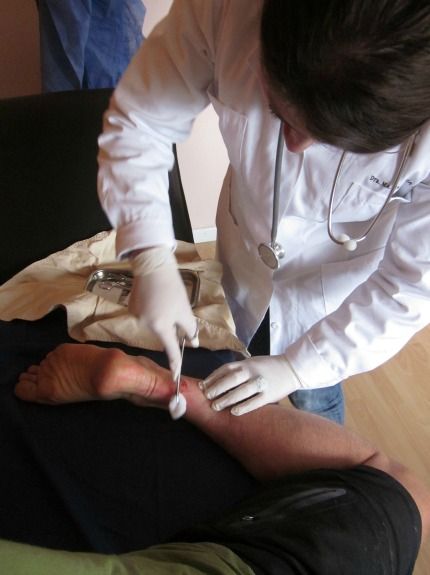
A nurse at the Turi village medical clinic cleans the wound–the first line of defense against rabies. Photo by Alastair Bland.

In the village of Turi, overlooking beautiful Cuenca below, I stopped at a small store and bought a vial of antiseptic for 50 cents and gave my leg a rough cleaning outside. I joined two local boys outside the school, each on their laptops using the free wi-fi, and went online to read what I could about rabies. I had a happy hour beer appointment with another traveler at 6 p.m. in Cuenca and I didn’t want to visit the hospital unless entirely necessary. Before I even connected, a car pulled up in the square and out stepped three beautiful nurses. I put away my laptop and rolled over. “Hello. I was just bitten by a dog,” I said, showing them the wound. “I cleaned it with disinfectant, but can you help? Do you think there is risk of rabies?”

“Yes,” one said. “You need attention.” The women invited me to follow them to the town’s health clinic, where they weighed me, took my blood pressure, measured my height and asked for my name, age, passport number and civil state, taking notes on a clipboard the whole time. Finally, they cleaned the bleeding wound and wrote me an order form for rabies vaccination at Cuenca’s main medical center.

“Is there any cost?” I asked as they began to gesture their farewells. “Nothing,” one said to me, shrugging. ‘We are a public hospital.”

In Cuenca, I found the main hospital closed, for it was after 4 p.m. I spent the late evening researching the perils of rabies and found myself terrified after a few minutes of reading off my laptop. Rabies is extremely deadly. If a person exhibits the first sign of the disease–tingling or burning around the wound–they are usually already goners on an unstoppable downward spiral toward a painful death. At this point, treatment is only given to ease the suffering. Only a handful of people have ever experienced rabies symptoms and still overcome the disease. Usually, to save a bite victim’s life, the vaccine must be delivered prior to the development of the virus in the spinal column and brain. The more I read, the more afraid for my life I became–and angry at the family that never even said they were sorry for their dog’s actions. I noted from several online sources that many authorities will prioritize the testing for rabies of a dog that has bitten someone. This examination is not a forgiving one and may require dissecting the dog’s brain–which got me thinking about my revenge.
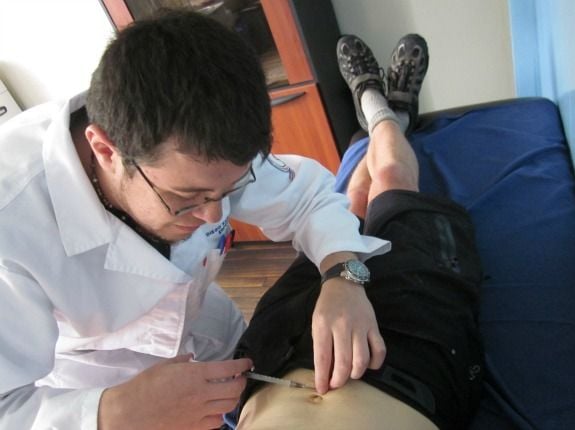
The author receives the first abdominal anti-rabies injection in a series of seven. The process must be commenced anew if just one day in the series is missed–meaning rabies treatments really mess up vacation plans. Photo by Alastair Bland.

“Would you like me to show you where this dog lives?” I hopefully asked the doctor the next morning at Medical Center Number 3, on Calle 12 de Abril. “It’s no trouble. I would be happy to take you there.”

“No,” he said confidently, then ordered me on my back on a cot.

An assistant asked me to pull up my shirt and explained that this would be the first of seven injections into my abdomen, one a day for a week–which spoiled my plans to camp for two or three nights in the lake-studded wilderness of Cajas National Park, 20 miles west and a vertical mile above.

“We close at 4 each day,” the assistant said. “Make sure you’re here. If you miss a day we must begin the whole series again.”

They tossed the needle in the trash and said, “Hasta mañana.”

Rabies treatments are not conducive to the spontaneous travel lifestyles. In my case, I was required to remain in and around Cuenca for six days. I only dared leave town on a bus–and I checked ahead to be sure that Loja, my next destination and 130 miles south, had a vaccination center so I could complete the series. I am now immune to rabies for the next two years, which gives me a powerful sense of indestructibility. Still, I’m thinking about that wicker handlebar basket full of rocks.
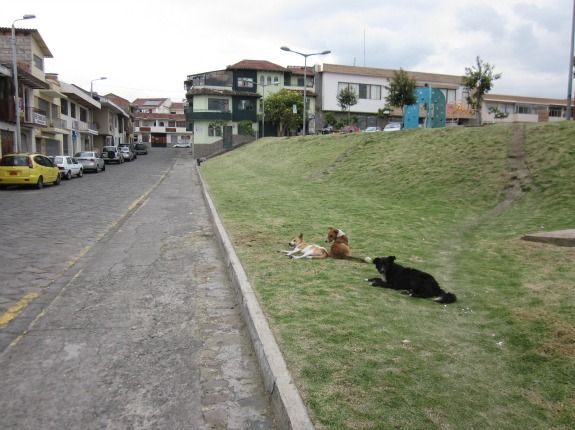
Street dogs in Ecuador often lounge uncomfortably close to the roadside, stirring up loathing and dread in the bare-ankled cyclist who comes their way. Photo by Alastair Bland.

Rabies: What to Know, What to Do

According to the U.S. National Library of Medicine, rabies is carried by mammals and may be passed to a human by a bite or even just a slab of the tongue, as the virus occurs in an infected animal’s saliva. Aside from dogs, other common carriers of rabies include cats, bats, foxes, raccoons and skunks. Anyone who comes into contact with a wild or unknown mammal should be considered at risk of rabies and receive treatment immediately. Symptoms appear following the incubation period, which may take just 10 days or as long as several years. There is no cure once symptoms appear. These may include fever, numbness, tingling and hyperactivity. Death usually occurs within seven days of the onset of symptoms.

Rabies kills more than 55,000 people per year, mostly in Asia and Africa. Travelers to at-risk areas–rabies occurs in most countries–should consider getting immunized before going.

Warning Bats–one of the most common carriers–can deliver a bite without the victim even realizing it. Take no chances. Get vaccinated if you suspect you’ve had contact with an infected animal.

Drinking Alcohol During Rabies Vaccinations As the doctor injected my second dose of Fuenzalida-Palacio vaccine last Friday he said, “No beer, whiskey, nothing.” Oops. “I had a little wine last night,” I said. He shrugged and said, “No big deal.”

Well, what is the deal? I wanted to know because Cuenca has its own brewpub with two imperial stouts on tap, and this was also Super Bowl time in a town swarming with gringo football fans. In other words, I planned on having a few drinks that weekend. According to The Travel Doctor, only two vaccines–that for Japanese encephalitis and the oral vaccine for cholera–come with restrictions on alcohol consumption. Numerous other websites and forums address the same question that I had–can one drink alcohol during post-exposure rabies treatment? Though some travelers have been advised by hospital staff not to exercise, drink alcohol, tea or coffee, or have sex for four months following the first anti-rabies shot, this seems to be entirely unfounded advice.

Thanks a lot, dog: A slight nip and a slow trickle of blood means receiving an inch of wicked needle in the stomach every day for a week. Photo by Alastair Bland.


***

Sign up for our free email newsletter and receive the best stories from Smithsonian.com each week.

15 Comments »

  1. Philip Schienbein says:

    I must say I’m really enjoying these missives from Mr. Bland.

  2. George says:

    Well, first consider taking the necessary shots before travelling and then blame the dogs or whatever can bite you.

  3. Pete D says:

    This is Pete, we met at MyBike in Quito.

    How are things down in Cuenca? I think it’s a cool city, more livable than Quito.

    Just read your story about the dog bite, sorry to hear about it. I got a small bite about 3 months ago in my Quito neighborhood. Kinda weird because I wasn’t directly in the dog’s house or property. Then 2 weeks ago riding with a friend in a place he rides often we got charged by 4 dogs (which is normal) but one bit and ripped my sock. It was like he was playing with me since I felt his teeth on my skin but he didn’t bite. I never got shots for the first bite so hopefully I won’t die down the road. I didn’t know that the virus can incubate for 10 years. I think that dogs know I’m scared and that’s why I got bit and my friend didn’t.

    Yes, dogs are definitely out of control here. Kinda sad and a pain for people walking, especially when walking thru areas on the outskirts of town or in villages. My girlfriend said that a health authority visits every year to vaccinate dogs on mass which helps keeps rabies cases low.

    I carry pepper spray which is sold at a sporting-goods store called “Cotopaxi”. It doesn’t really help when you get charged but I like to have it in case I get “roadblocked” by some scary looking dogs. Never happened yet. The funny thing is all the big rottweilers and German shepherds never bark at me. I did see a cyclist’s version of the pepper spray at a different sporting-goods store in Quito. It had a velcro case that attaches to the top tube for quick drawing. I think I’m going to get one of those. It cost $20 for the case and small can of pepper spray. I have only ever sprayed one dog. When I pull the spray out the dogs stand back. They know it’s something bad.

    I also like having this crash kit in my back pocket when riding. It’s super-light and I have used it once.

    http://www.pricepoint.com/detail/12024-400_BRACP2-2-Accessories-650-Adventure-Essentials/Brave-Soldier-Crash-Paks-First-Aid-Kit-offer.htm?utm_source=SLI&utm_medium=datafeed&utm_campaign=FTP&zmam=3075515&zmas=1&zmac=43&zmap=12024

    Good luck and happy riding on the rest of your trip!

    Pete Dills
    (Seattle)

  4. Tori Jacobs says:

    So sorry to hear about your bite! Very interesting story came out of it though…

  5. H.J. Ruess says:

    My whole life of petting every dog I see, I only have been bitten once. It was a Chihuahua in a car, and I stuck my nose in through the window – and got bitten. I never got the rabies shots. I thought that a dog with rabies would be foaming at the mouth, like in To Kill a Mockingbird.
    May the road rise to meet you, and the dogs turn tail and run.

  6. bish.s says:

    So sorry to read about your misadventure with the dogs in Ecuador but… (sorry, your expectations made me laugh a little) “picking up the poop, giving baths” to their dogs? What were you expecting? This is a 3rd world developing – and in many parts underdeveloped – country. People there do not know that they need to pick up after their dogs! I know some people in USA that do not like to do that. These are poor people that adopt their dogs as just another part of their extended family and let them eat and do whatever they like. An immunization program is the prudent way to go while travelling through countries like Ecuador. I hope you have been immunized against yellow fever and tuberculosis, especially as you plan to go to the Amazon forest area… have you?

    • Alastair Bland says:

      Thanks for checking. Yes–I have been immunized against yellow fever and TB. But I did not receive rabies shots before coming here. I simply didn’t expect that Ecuador’s dogs would be any nastier than the street dogs of any other nation, and they aren’t. I have cycled through many countries. Even in relatively well-to-do places dogs can be horrid. Portugal’s dogs were some of the most aggressive and foul I’ve encountered, and I’ve had close encounters several times in California. But never have I been badly bitten through hundreds of unpleasant interactions with dogs, and, like many, if not most, travelers, I did not see the need to get rabies shots before coming here. In fact, it’s just as easy to get treated after a bite.

      And I didn’t really expect that people in Ecuador would be walking around with plastic bags tied to their dogs’ leashes, nor do I particularly care that they don’t. I was simply illustrating one of many differences between dog ownership culture in developed nations and those less developed.

  7. Alex says:

    Rather than get the series of vaccine shots that forced you to stay put for a week perhaps you could have obtained permission from the owners to take the dog to a vet (where they can observe the dog for 10 days for signs of rabies) or even more confirmatory, biopsy the dog after death if owners can be persuaded. Of course this would have been easy as you said those 3rd world people don’t “love” their dogs and probably would have readily given or sold their dog to you for biopsying.

    I find your ignorance and arrogance offensive especially for a person who has traveled. Developed world dogs might be more pampered but I am not so sure if they are more happy (especially since dogs in developed worlds are confined and neutered). Who are you to decide.

    Hoping you let go of your arrogance and understand other cultures from within rather than with your condescending attitude of other people and their culture. You might even grasp that there are distinct advantages to their methods within their environment. It seems travels have been lost on you except for perhaps boasting to your family and friends of the places you have visited.

    Anyways, enjoy your travels and may you stay clear of harm.

    • Alastair Bland says:

      Thanks for the comment. I didn’t decide anything. It’s just my sensible guess that dogs that are often emaciated, diseased or squashed by vehicles are neglected, and I assume that neglected dogs are unloved dogs. Consider the dog that bit me. It ran across both lanes of traffic to reach me, and its owners (whole family was present) did not object until well after it bit me, when I made a fuss. If my dog, whom I love very much, ran into a highway, I would panic whether she bit a person or not.

      And are you suggesting that neutering dogs is an inhumane practice? I don’t see advantages, for people or dogs, to letting the animals overpopulate and run free since it means a great deal of them will be homeless and/or get hit and killed by cars.

  8. Alex says:

    Yes, you are absolutely correct. If I were a dog, I would prefer to have my testicles removed and be confined inside an apartment/house most of the day and come out only at night with a leash on. This is the natural state of a dog/animal after all. Don’t confuse an adapting solution to the ideal state and think it superior.

    Your reply exemplifies what I was alluding to earlier. Some are hopeless I suppose. Anyways, be safe in your journey.

  9. Carol Eckman says:

    Alex, maybe you don’t know about street dogs in Chile and Argentina, but I have seen them with my own eyes. In Santiago they run in packs and people have been bitten. If this were a contest about dog knowledge of Latin America, I think you would lose. Spaying and neutering are being put forward by the citizens as way to humanely deal with animal abandonment and over-population. If you want to experience the natural state of a dog there are many packs to examine.
    Alastair has not been arrogant, but you are being ignorant.

  10. Andrew says:

    Alex, having been to South America, I can attest to everything the author says. The dogs there are overpopulated, often starving and diseased, and sometimes aggressive. These dogs are not loved, and there is nothing charming or quaint about it, no matter how cultural it may be. It’s sad to see animals treated with such neglect.

    Furthermore, if a dog charged and bit me – in Ecuador or the U.S. – and the owners treated me with apathy and their children laughed at me, I, too, would be angry and would have no objection to the dog being put down.

    Would you consider the parents of a child wandering through the streets and causing trouble to be good and loving parents? Then what about the owners of neglected, hungry, and aggressive dogs?

  11. Claudia says:

    These animals are not PETS. And you have been told wrong…their idea of animal control, and justly right, is to drop them with a bullet. 50+ years ago, a village would pay and or feed one person to kill (beat, bag, burn) and rid their town of these mangy, rabid PESTS. You have failed to do your homework and for some reason choose to inappropriately lash out and make excuses. If you want to watch the Superbowl and hang out with like-minded Americans, so be it. But you might want to befriend a local or two and ask a few questions before you get yourself into some real trouble. I am with Alex on this, but I will be a little more frank about it.

  12. Bill says:

    Consider visiting this CDC rabies webpage to learn more about what is now the standard post-exposure medical management: http://www.cdc.gov/rabies/medical_care/index.html

    I’ve very limited knowledge of rabies. Nonetheless, I strongly endorse the pre-exposure vaccinations. Further you might wish to verify being immune for the two years post-treatment.

    Bill
    retired CDC employee

    • Alastair Bland says:

      Thanks for your words, Bill. I was advised by several doctors that 7 shots, one per day for a week, is sufficient. Later I heard that an 8th shot 10 days after the 7th followed by a 9th and 10th in successive months are also recommended. I have not pursued this line of defense as I have heard it is not essential. Moreover, it seems highly doubtful that the dog had rabies. As I wrote, it was a family dog, present with two children before biting me. I am going to consult with a doctor within a week about the situation. If you know more, please share. To your health!

RSS feed for comments on this post. TrackBack URI

Leave a comment

Comments are moderated, and will not appear until Smithsonian.com has approved them. Smithsonian reserves the right not to post any comments that are unlawful, threatening, offensive, defamatory, invasive of a person's privacy, inappropriate, confidential or proprietary, political messages, product endorsements, or other content that might otherwise violate any laws or policies.

Spam protection by WP Captcha-Free

Advertisement


Follow Us

Travel with Smithsonian


Advertisement