Blogs

  • News
  • |
  • Art
  • |
  • History
  • |
  • Food and Travel
  • |
  • Science
SmartNews

Keeping You Current

Around the Mall

Scenes and sightings from Smithsonian museums and beyond


August 21, 2009

10 Things You Didn’t Know About Asian Elephants

Ambika celebrates her 60th birthday at the Celebrate Asian Elephants event last year.

Ambika, the National Zoo's oldest Asian Elephant, celebrates her 60th birthday at the Celebrate Asian Elephants event last year. Photo credit: Jessie Cohen, National Zoo.

Tomorrow, the National Zoo and the embassies of Sri Lanka, Thailand and India will celebrate Asian elephants. Only 35,000 to 50,000 Asian elephants survive in the world, and of those, 15,000 are in human care. The National Zoo has three: Kandula, Shanthi and Ambika, who at 61 is the third oldest Asian elephant in North America.

The celebration will include elephant baths, training sessions, Sri Lankan dancers and information about the diet and history of Asian elephants. Maybe you have assumed that all elephants are basically the same, but Asian elephants are actually more closely related to mammoths than their modern-day African counterparts. Here are ten other things you probably didn’t know about Asian elephants:

1. Even though they have five toes on both their front and back feet, Asian elephants usually only have four toenails on their back feet.

2. Asian elephants have one “finger” (really, a small protrusion) at the upper tip of their trunk with a pad on the opposite side. They pick up items similar to the way a person does when wearing mittens. Shanthi’s finger is exceptionally long, and she uses it to check locks and open food containers.

3. As they age, Asian elephants lose some of the pigment in their skin, which causes them to look pink in some areas, most often on their trunk. If you look at Ambika’s trunk and ears, you can see where her skin has turned pink.

4. Peanut-loving elephants are a myth. Elephants, Asian or otherwise, don’t eat peanuts in the wild, nor are peanuts a typical diet for captive elephants. In fact, most elephants don’t even appear to like them very much.

5. The height of an Asian or African elephant at the shoulder is roughly equivalent to the circumference of their front foot multiplied by two.

6. An Asian elephant’s trunk can hold about 2.5 gallons of water at a time. But it’s really a nose; they don’t drink from it. Elephants draw water up into their trunk and then blow it out into their mouths.

7. Asian elephants are one of only nine species that can recognize themselves in a mirror. Others include bottlenose dolphins, magpies, gorillas, chimpanzees and, of course, humans, but not until they’re a few months old.

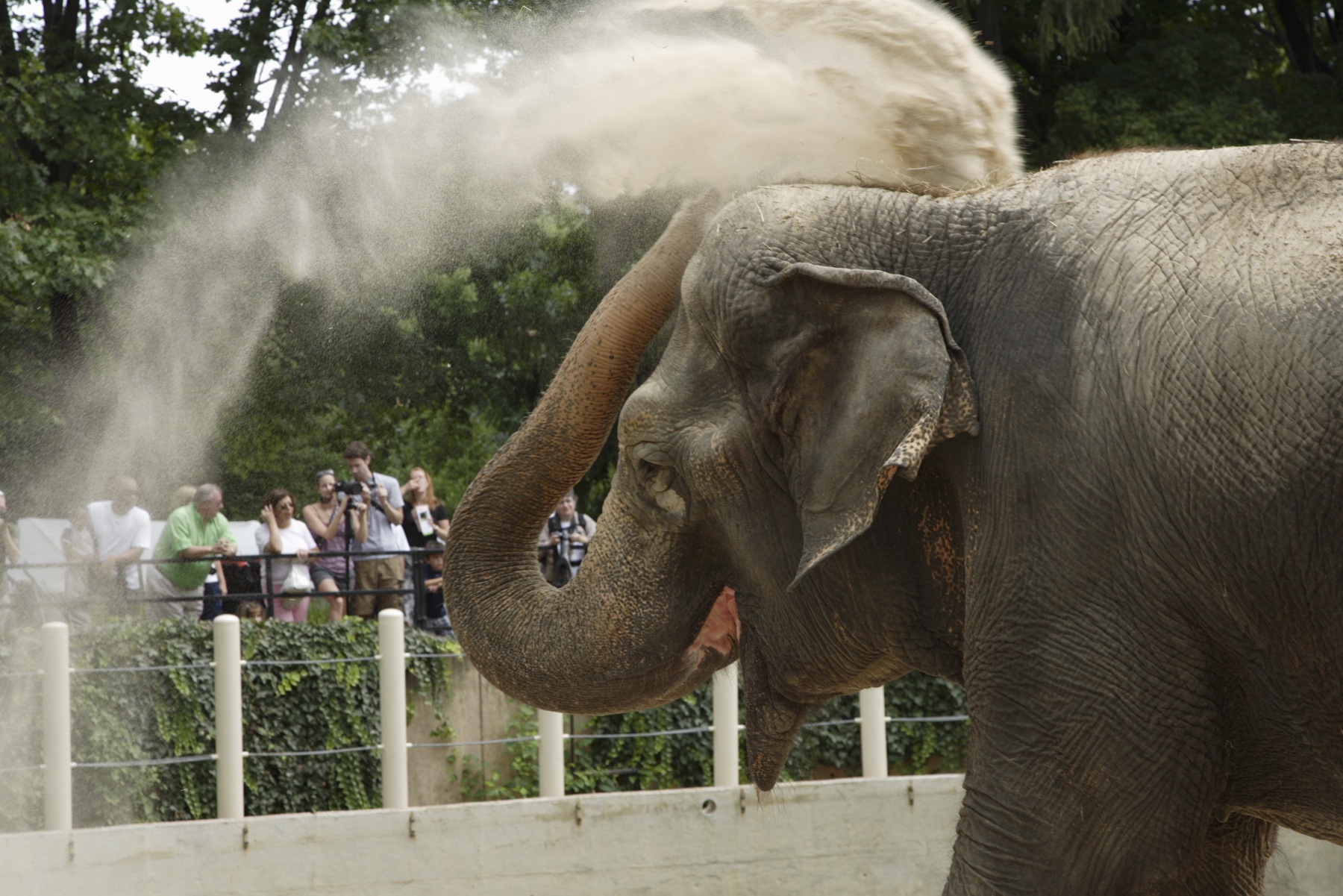
Ambika, the National Zoo's oldest Asian Elephant, demonstrates her dirt-throwing skills. Here, she covers her head and back with dirt to protect herself from the sun. Jessie Cohen, National Zoo

Ambika demonstrates her notorious dirt-throwing skills. Here, she covers her head and back in dirt to protect herself from the sun. Jesse Cohen, National Zoo.

8. Ambika loves to throw dirt. She can cover every inch of her body in mud on a rainy day and dip one shoulder down to dump sand all over the keeper standing next to her.

9. Shanthi was rescued from a well in Sri Lanka when she was a couple of months old and was bottle fed for most of her first year. In 1976, the children of Sri Lanka gave one-year-old Shanthi to the children of the United States as a bicentennial gift.

10. Kandula, who was born in 2001, was only the second Asian elephant to be produced by artificial insemination, a technique that was developed by National Zoo scientists and their German collaborators.

Now that you know some more about Asian Elephants, show it off at the National Zoo’s Celebrate Asian Elephants day, tomorrow from 10 a.m. to 4 p.m.


***

Sign up for our free email newsletter and receive the best stories from Smithsonian.com each week.

4 Comments »

  1. Debbie says:

    Kandula was the 5th Asian elephant born as a result of artificial insemination.

    Ambika is tied with 3 other Asian elephants at 61 years old currently living in North America.

    The artificial insemination process was developed by the German scientists.

  2. Debbie says:

    One study of 3 captive elephants believes that one elephant recognized itself in a mirror and therefore all elephants everywhere have that ability.

  3. Thootdon says:

    Elephant’s ability is not simply recognizing itself in a mirror but extending to its apptitude in painting. They can”be taught to draw and paint flowers (colorful ones at that) and their products could be seen as more beautiful and life-like than the work of some junior-high students.

    http://www.youtube.com/watch?v=He7Ge7Sogrk

    A BBC News article described an exhibition of such paintings at an Edinburgh gallery in 1996:
    Pictures which were painted by elephants have gone on display at an Edinburgh gallery.
    Art graduate
    Victoria Khunapramot, 26, has brought the paintings from Thailand to the Dundas Gallery on Dundas Street.
    They include “self-portraits” by Paya, who is said to be the only elephant to have mastered his own likeness.

    Paya is one of six elephants whose keepers have taught them how to hold a paintbrush in their trunks. They drop the brush when they want a new colour.

    Mrs Khunapramot, from Newington, said: “Many people cannot believe that an elephant is capable of producing any kind of artwork, never mind a self-portrait.

    “But they are very intelligent animals and create the entire paintings with great gusto and concentration within just five or 10 minutes — the only thing they cannot do on their own is pick up a paintbrush, so it gets handed to them.

    “They are trained by artists who fine-tune their skills, and they paint in front of an audience in their conservation village, leaving no one in any doubt that they are authentic elephant creations.”

    Mrs Khunapramot, who set up the Thai Fine Art company after studying the history of art in St Andrews and business management at Edinburgh’s Napier University, said it took about a month to train the animals to paint.
    The web site of the Asian Elephant Art and Conservation Project explains the background behind elephants’ being taught to paint, with the resulting artworks being sold and the monies so raised being used to fund elephant conservation projects. The site includes a video gallery that features several clips of pachyderm artists in action similar to the one linked above, as well as galleries displaying the individual elephants’ works. (Based on the similarity of drawings, we’d guess that the elephant shown in the example video is Hong, an eight-year-old female living at the Maetaman Elephant Camp in Thailand.)

  4. bily bobie says:

    verfy kool i love how they have small ears

RSS feed for comments on this post. TrackBack URI

Leave a comment

Comments are moderated, and will not appear until Smithsonian.com has approved them. Smithsonian reserves the right not to post any comments that are unlawful, threatening, offensive, defamatory, invasive of a person's privacy, inappropriate, confidential or proprietary, political messages, product endorsements, or other content that might otherwise violate any laws or policies.

Spam protection by WP Captcha-Free

Advertisement


Follow Us

Travel with Smithsonian


Advertisement