
A 3-D Printer Goes to Work for the Smithsonian
A new technology can create replicas of pretty much anything, quickly and with great detail
/https://tf-cmsv2-smithsonianmag-media.s3.amazonaws.com/accounts/headshot/joseph-stromberg-240.jpg)
/https://tf-cmsv2-smithsonianmag-media.s3.amazonaws.com/filer/201111010420043D-printer-small.jpg)
In Suitland, Maryland, at the Office of Exhibitions Central (OEC)—a hulking warehouse where the guts of the Smithsonian Institution’s exhibitions are made—the staff have enjoyed playing with a new toy. It is the 3-D printer, and it can make pretty much anything.
“Well, not anything,” model maker Carolyn Thome hastens to add as she shows me the machine. “This is what’s called the build chamber, so that’s the size limit. It’s 15 inches by 10 inches, and it goes 8 inches down.” Any object that can’t fit into the chamber has to be made in several pieces and put together. She shows me a replica of a human arm bone and says, “this was too big for the printer, so we had to cut it, and I don’t like way it turned out. We’ll have to run that again.”
Since it arrived in 2009, the 3-D printer has changed the way the OEC builds exhibitions. Give it a set of 3-D data of any shape, and it will churn out an object that matches it exactly.
To create an object, technicians first upload a digital 3-D data set, obtained either from a CT scan or by combining information from dozens of photographs. The 3-D printer takes this information and builds a replica in much the same way a typical 2-D ink jet printer puts ink down on a page.
“It divides the 3-D object into layers,” Thome says. “So it puts down a .0004-inch thick layer of powder, and wherever there is data in that layer, it will put a drop of binder to create it. It builds it and builds it, and the bed underneath moves down .0004 inches each time.”
“In the end, you’re left with a solid object and a bunch of powder around it. You brush off the powder, and there’s your item.”
Because the bound powder is not always as durable as might be required in an exhibition, the OEC team adds a strengthening epoxy resin after the object emerges from the printer. Although the machine still has some bugs—it will occasionally jam halfway through a job, creating an incongruous sight such as an ancient mummy’s skull, sliced digitally in half—it has opened up countless new possibilities in creating exhibition materials.
“Before we got the printer, we could make molds of skulls, but you run the risk of damaging the skulls,” Thome says. “And with traditional methods, you can’t scale things up and down at all. With this, you just hit a button.”
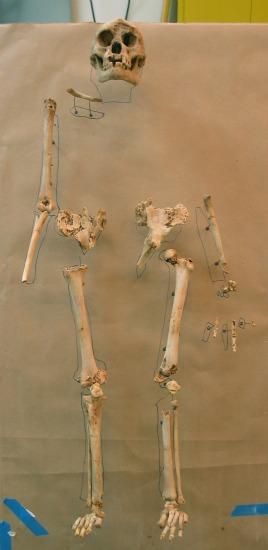
Over the past two years, the OEC has used the printer on a wide variety of projects across the Institution. Thome shows me a replica of a partial early hominid skeleton that was made for the Natural History Museum, as well as a box full of human bone replicas created for a researcher. “With all of these, there was some sort of disease or something,” she says. “This one has a pin or a bolt through it.” For the ongoing “Written in Bone” exhibition at the same museum, a historical brick included in a display was returned to the donor at the donor’s request, so the printer was used to create an exact replica.
“For our next project, we scanned a statue of Thomas Jefferson at Monticello, and then we’re going to have that 3-D printed, full size,” says Thome. The Jefferson statue will be sent to an upcoming exhibition at the African American History and Culture gallery at the American History Museum. For large projects such as the Jefferson statue, the printer is able to create exact replicas in far less time than manual methods.
The OEC team also takes time to have some fun with the printer. In 2007, when they worked to refurbish Uncle Beazley—a 27-foot-long fiberglass triceratops model that had stood on the National Mall since the 1970s—they took a set of photos of it. Thome hands me a palm-sized Uncle Beazley that the printer churned out recently from the photographic data. “Now, we’re able to print Uncle Beazley at any scale,” she says.
A fairly recent innovation, 3-D printing technology is still evolving rapidly, and Thome looks forward to even more advanced models in the future. “This is a rapidly prototyping machine, there are new ones coming out all the time” she says. “But even this one, it can print things that actually work. It’s just pretty cool.”
/https://tf-cmsv2-smithsonianmag-media.s3.amazonaws.com/accounts/headshot/joseph-stromberg-240.jpg)