
Sinfully Delicious Apples That You Should Never Try to Eat
Inspired by the work of Cornell scientists, Los Angeles-based Jessica Rath creates sculptures and photographs of the autumn fruit
/https://tf-cmsv2-smithsonianmag-media.s3.amazonaws.com/accounts/headshot/megan.png)
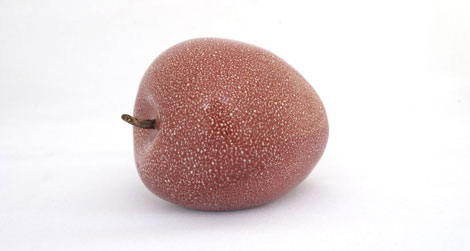
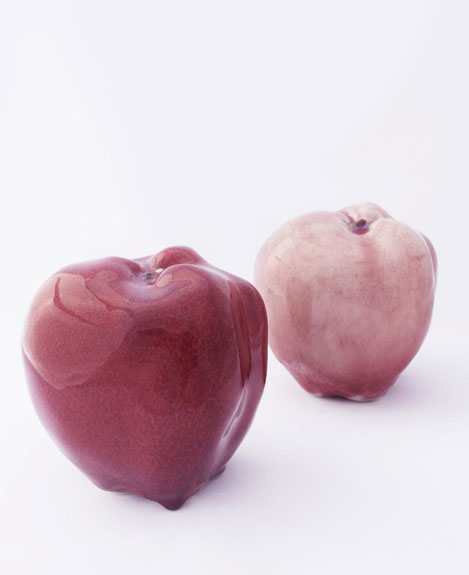
Deacon Jones, by Jessica Rath.
Last weekend, I went apple picking. It’s one of my favorite fall traditions, and I have been going every year since I can remember. When I was a kid, my mother made a trip to the apple orchard a magical thing. She taught me how to gently twist an apple, so that it would pop off the branch without others plunking to the ground. She would point out the sun-kissed fruits at the tippy top of the trees while I climbed to get them.
We’d leave the orchard with a bag of salty cheese curds, half-eaten caramel apples and pounds and pounds of beautiful apples in sacks slung over our shoulders. Then, the baking would begin.
As I marveled at the way she could peel an apple in one long, curly strand, my mom imparted her wisdom. “The Northern Spy is a pie apple,” she’d say. “For applesauce, Cortlands. And Galas, Paula Reds and Honey Crisps are just good eating apples.”
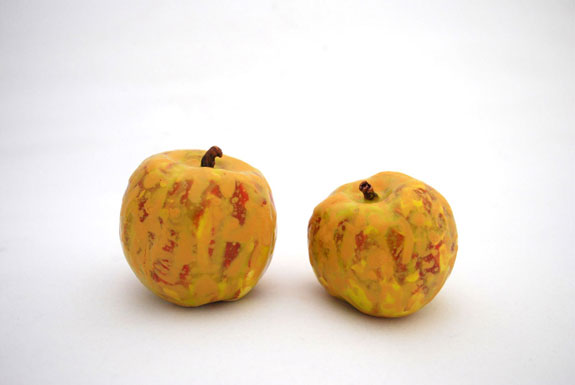
Drap d’ or gueneme, by Jessica Rath.
But for all my picking experience, when it comes down to it, I don’t actually know very much about how these delicious varieties came in to being.
A few years ago, Jessica Rath, an artist based in Los Angeles, had a similar realization. She was reading Michael Pollan’s Botany of Desire and learned about the U.S. Department of Agriculture’s Plant Genetic Resources Unit (PGRU) located on part of Cornell University’s campus in Geneva, New York. Pollan described this facility as a “botanic ark,” since it preserves living trees of some of the rarest and most endangered apple varieties.
You see, if you plant an apple tree from a seed, odds are its apples will be bitter. This is the case even if you pluck a seed from the tastiest apple in the orchard and plant it, because each seed has its own genetic material. To replicate a tree with sweet apples, orchardists, therefore, graft from that tree and produce a field of clones.

Unnamed cluster, by Jessica Rath.
To Rath, this idea that the edible apple is a human creation—a work of art, even—was spellbinding.
“What other than taste was attractive to a man or a woman over the hundred years that he decided to graft that tree?” says Rath. “Was it the blush of a cheek? Its whiteness? Or possibly its muscular size?”
What constituted beauty, she wondered, in the scientist’s eye?
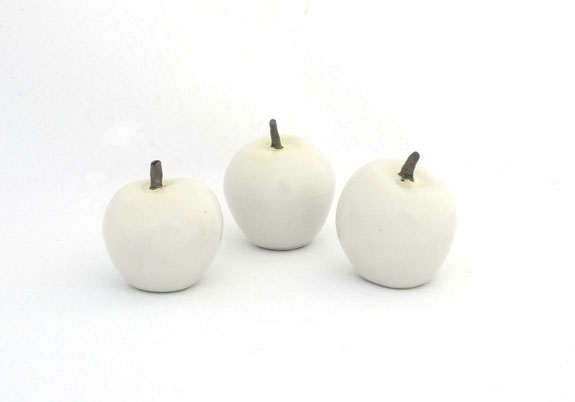
Whiteness, by Jessica Rath.
On September 15, 2009, Rath made her plea on Kickstarter—Take me to the apple breeder…. In two weeks, thanks to generous donors, she had a trip to Geneva funded.
At the PGRU, apple curator Philip Forsline showed Rath around the many varieties he has collected from the far reaches of the world. The artist then met with Cornell scientist Susan Brown, who breeds new-and-improved disease-resistant varieties for mass production at the Agricultural Experiment Station. During her visit, Rath photographed the diversity in the apples she saw. She also took hundreds of apples home to Los Angeles with her. “I bought an extra refrigerator,” she says, “and kept them as cold as I could keep them.”
From the rare varieties she had stowed, Rath then selected nine of “the smallest ones, the largest ones, the ones that were the most muscular and odd” to sculpt. For each type, she combined her favorite characteristics from several individual apples into one sculpted apple. “They are not copies,” she says. But the final products are life-sized.
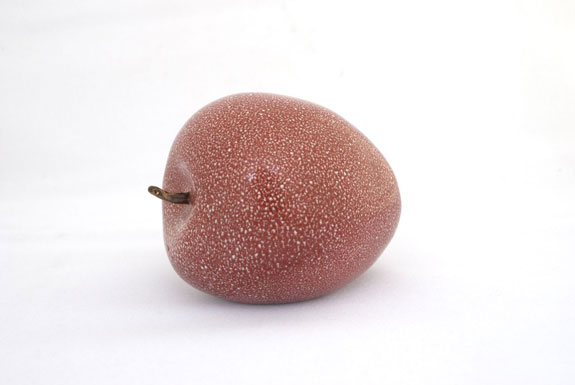
Dulcina, by Jessica Rath.
To create her tempting porcelain apples, Rath began by sculpting the apple out of clay. Then, she created a plaster mold of that sculpture and poured porcelain slip, which is a liquid clay, into that mold. Once the porcelain dried and shrank away from the mold, it was removed. The result is a hollow porcelain replica of the original sculpture.
Rath developed different glazes and glaze combinations to replicate the colors of the real-life apples. “I tried to create blushes and russets and things that would draw a human to them in the first place,” she says. After the porcelain apples were fired in a kiln, they were luminous “like apples can be when you see them on the tree and they are catching light.”
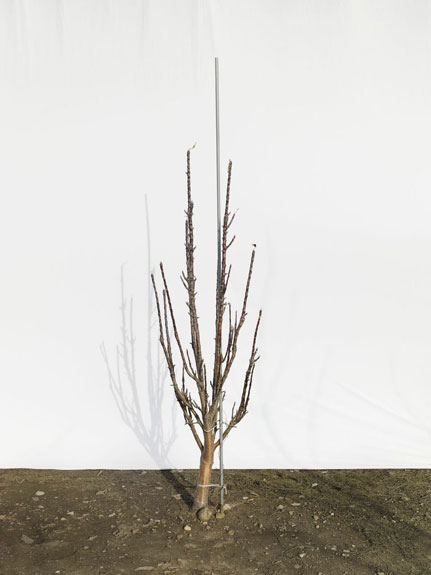
Clone columnar with early pubescence, by Jessica Rath.
In March 2011, Rath returned to Geneva. Funded by a grant from the Center for Cultural Innovation, she photographed some of Susan Brown’s experiments—trees created by cross-pollinating two clones and saplings grown from those trees’ seeds. She staged a 20-by-30-foot white muslin backdrop behind each of the trees, so that she could capture their varying silhouettes. Some are tall and thin, others wide and weeping. “Within one cross, this really vast amount of genetic diversity was being shown,” says Rath.
The Pasadena Museum of California Art will be displaying Rath’s jewel-like apples and her stark photographs of wintry apple trees in “take me to the apple breeder,” a new exhibition opening October 28.
You may never look at an apple the same way again.
/https://tf-cmsv2-smithsonianmag-media.s3.amazonaws.com/accounts/headshot/megan.png)