
Amazing Close-Ups of Seeds
A scientist-artist duo creates stunning images, taken through a scanning electron microscope, of seeds in the Millennium Seed Bank
/https://tf-cmsv2-smithsonianmag-media.s3.amazonaws.com/accounts/headshot/megan.png)
/https://tf-cmsv2-smithsonianmag-media.s3.amazonaws.com/filer/90/dc/90dcd644-2e75-43b9-b31d-f6dbc6412135/delphinium-pergrinum.jpg)
About an hour south of London, in Sussex, scientists at the Royal Botanic Gardens, Kew, are preparing seeds for storage. Researchers at 48 partner institutions in 16 countries collect seeds and send them to Kew, where the specimens are cleaned, dried for about a month and then stored for perpetuity in an underground vault, kept at a chilly -20 degrees Celsius. The Millennium Seed Bank, as it is called, was founded in 2000 as an effort to stock away viable seeds, now, should we need them to restore plant populations in the future. Nearly 100,000, or about one quarter, of the world’s plant species, are currently threatened. “We can’t afford to let these plants, and the potential they hold, die out,” says Kew, on its Web site.
The Millennium Seed Bank is a global seed garden of epic proportions. By 2010, the project had amassed about 10 percent of the world’s 400,000 plant species, and the trajectory is to reach 25 percent by 2020.
Wouldn’t you like to see it? The vault itself, of course, is hidden from the public eye. But, MSB’s seed morphologist Wolfgang Stuppy and visual artist Rob Kesseler have come up with a clever workaround.
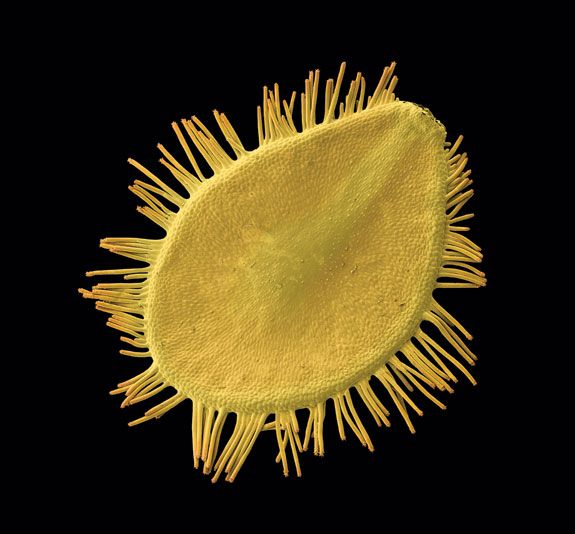
In a new book, Seeds: Time Capsules of Life (Insight Editions), Stuppy tells the story of seeds and seed evolution with the extraordinary visual aid of Kesseler’s gorgeous images of specimens from the collection. To capture their exquisite structures, Kesseler takes seeds just millimeters in size and magnifies them tens and hundreds of times under a scanning electron microscope.
The seeds featured in the book represent the great diversity in the plant kingdom. Over 360 million years, seeds have evolved in both their form and function. Today, seeds range in size from the Seychelles nut, which weighs 44 pounds, to the miniscule seeds of wild orchids, where, in a single gram there can be two million. ”The smaller they are, the more intricate and crazy their surface patterns are,” says Stuppy. Seeds disperse by wind, water or by hitchhiking on animals, and they have the wings or barbs to do so. “We tried to take the most exciting examples that illustrate the way seeds have adapted to do their job,” adds Stuppy.
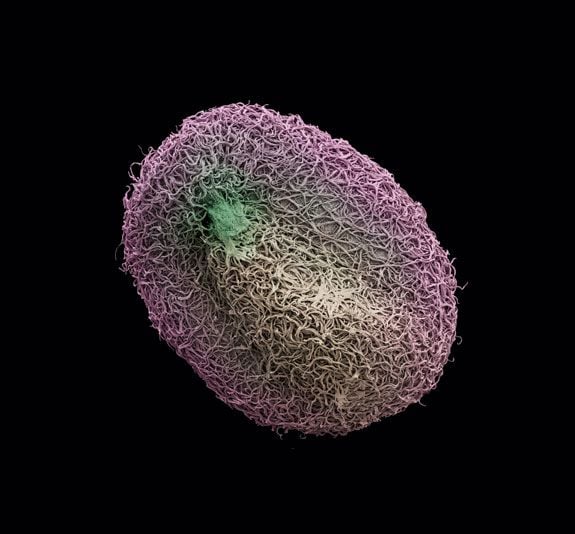
As an artist, Kesseler has always been inspired by the natural world. He started working with microscopic plant material in the early 2000s, when he was a NESTA fellow at Kew. To create his scanning electron micrographs, he places an individual seed on an aluminum stub specimen mount, about the size of a dime. The seed is coated with a microfine layer of gold or platinum and put into a vacuum chamber, where it is bombarded with electron particles. The electron beam measures the seed’s surfaces and translates these measurements into a digital image.
“You can take a seed, measuring a millimeter, and make it look like a Volkswagon Beetle,” says Stuppy. The resulting picture is big, sharp and has a hyper-realistic quality. “You can’t do this with any other method,” he says.
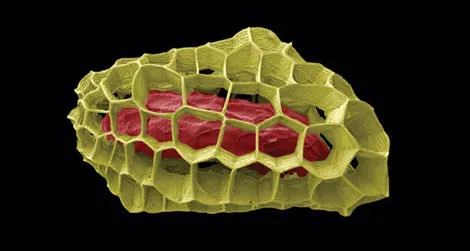
In post-production, Kesseler cleans up the black-and-white images, pixel by pixel, with a graphic tablet and pen. Then, in Photoshop, he adds color. “People often ask, ‘Is that the real color?’” says Kesseler. ” And, I’ll say, ‘Well, no.’ But, I am introducing the color based on looking at the original plant—the flowers, the leaves.” In an image of a sand milkwort, for instance, he colors the main portion of the seed green and the funky tuft of hair at the top pink, to match the color of the flower it actually produces. He tends to highlight different functional characteristics of the seed by color in the process. “Plants use color to attract an audience of insect collaborators. I use it to attract an audience of humans,” says Kesseler.
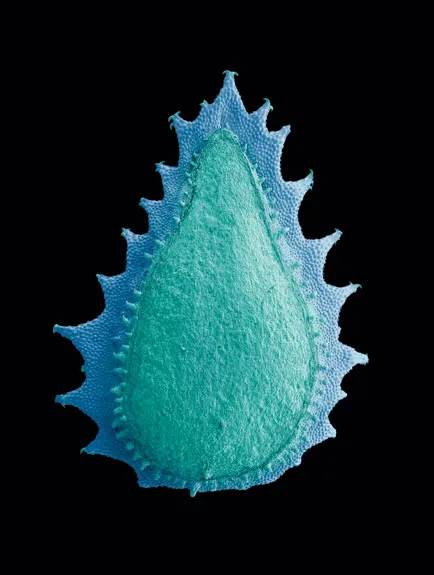
Botanists, who have had scanning electron microscopes at their disposal for decades now, are familiar with the amazing shapes and ornamentations of seeds. But, Stuppy claims that Seeds is the first attempt of its kind to share this microscopic world with a wider public audience.
“The beauty comes first,” says Stuppy. “The fact that it is a seed is secondary.”
Kesseler agrees. “They have a disturbing sense of familiarity,” he says. The seeds are vaguely recognizable as some sort of life form. “But you are not quite sure,” he adds. “You respond to them visually, as an impact, and then you are drawn to ask, what is this?”
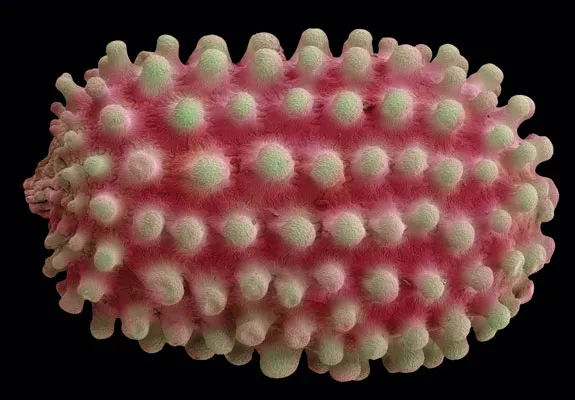
If viewers are curious enough, the hope is that they will read about the plants. Then, once people learn about plant species on a deeper level, perhaps they will come to understand how profoundly important it is to save them. According to Kew, humans are the reason that many of the nearly 100,000 threatened plant species are in danger of extinction.
“If you want to achieve any change in the public, science alone can’t achieve that. You can tell people a lot about climate change; rationally, they can grasp it. But, hardly anyone does anything,” says Stuppy. “Science goes for the head. The real change has to come from the heart. Art goes for the heart.”
/https://tf-cmsv2-smithsonianmag-media.s3.amazonaws.com/accounts/headshot/megan.png)