
Nimbus Clouds: Mysterious, Ephemeral and Now Indoors
Dutch artist Berndnaut Smilde has found a way to create clouds in gallery spaces. In the seconds before they dissipate, he captures beautiful photographs
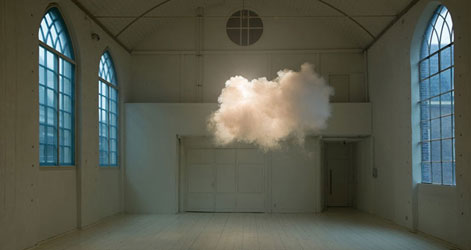
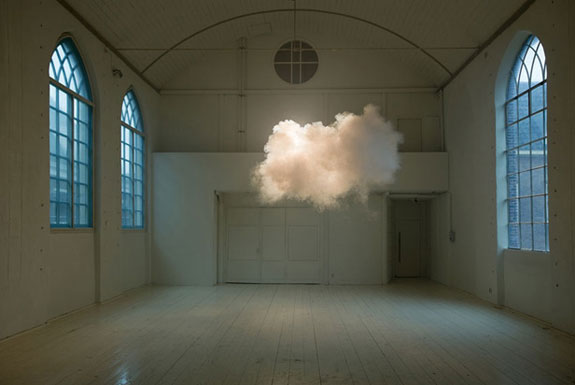
Nimbus II. © Berndnaut Smilde.
While we would all love to control the weather most days, no mere mortal has succeeded in this endeavor. Berndnaut Smilde, however, seems to have the magic touch. Hailing from Groningen, a northern city in the Netherlands (a country well acquainted with clouds and rain), Smilde uses a very precise science to create nimbus clouds indoors; he then photographs the fleeting moment that each cloud is suspended in air.
Nimbus clouds are clouds that produce precipitation, characterized as well for their low altitude and great volume. Smilde certainly manages low altitude; he conjures his faux clouds under a roof, after all. But, fortunately for his venues, no rain falls from the short-lived clouds.
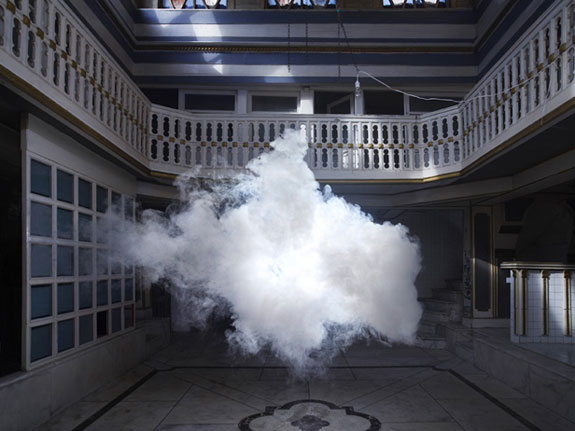
Nimbus Cukurcuma Hamam II. © Berndnaut Smilde.
Smilde’s experiments started in a small exhibition gallery called Probe in the Dutch city of Arnhem in 2010. This year, he graduated to larger spaces, including a 15th-century church and an old castle. While he has no science background, Smilde uses an artist’s fascination to create something entirely new.
“Some things you just want to question for yourself and see if they can be done,” Smilde writes in an email. “I imagined walking in a museum hall with just empty walls. There was nothing to see except for a rain cloud hanging around in the room.”
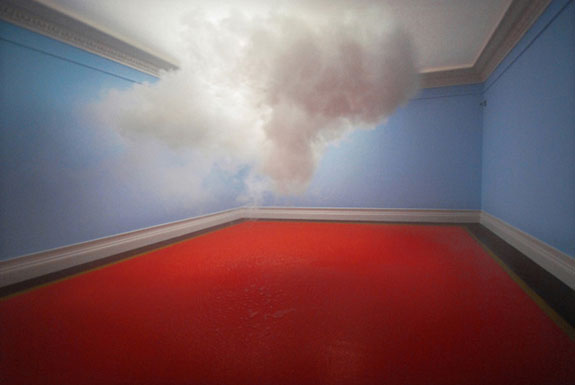
Nimbus. © Berndnaut Smilde.
The artist, who now lives and works in Amsterdam, has always been fascinated by the impressive skies in Old Dutch seascape paintings. “My grandparents had one with really threatening-looking clouds. I remember I was intrigued by the power of it. I couldn’t really grasp what it was, but there was something big, magical and dark about to happen in that painting,” writes Smilde. “I wanted to create the idea of a typical Dutch rain cloud inside a space.”
But conceiving the idea and making it happen are two very different things. Smilde did lots of research on clouds and in doing so stumbled upon a substance called aerogel. Also known as ”frozen smoke,” aerogel is made up of 99.8 percent air, making it the lightest solid material on Earth. Intrigued by its resemblance to clouds, Smilde started experimenting with this smoke. “By trying and testing different methods with temperature controllers and moisture I got the hang of it. It’s not really a high-tech process. I make the clouds using a combination of smoke, moisture and the right backlighting,” says Smilde. “I can adapt and control the setting, but the clouds will be different every time.”

Nimbus Minerva. © Berndnaut Smilde.
Smilde’s indoor clouds are marvelous—so much so that Time magazine declared them one of the best inventions of 2012.
Since his masterpieces only stick around for a few seconds, it is rare to be a witness. Smilde has created clouds for public audiences just three times. The artist admits that while it is nice to recreate it for a group, his main focus is on photographing the cloud. His photographs, not the clouds themselves, are what end up on exhibition. “I like the photograph better, as a document of a cloud that happened on a specific location and is now gone,” he notes.
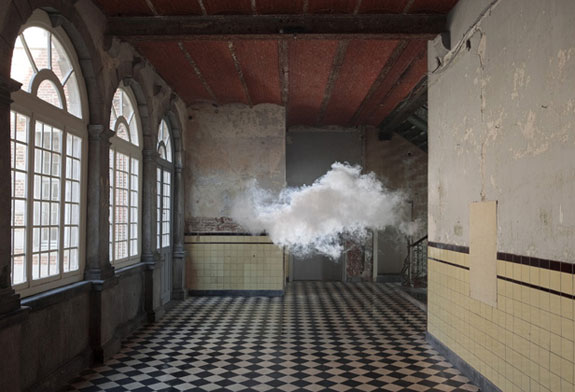
Nimbus D’Aspremont. © Berndnaut Smilde.
As a result, the location of the cloud is an important aspect, as it is the setting for his creation and part of the artwork. In his favorite piece, Nimbus D’Aspremont, the architecture of the D’Aspremont-Lynden Castle in Rekem, Belgium, plays a significant role in the feel of the picture. “The contrast between the original castle and its former use as a military hospital and mental institution is still visible,” he writes. “You could say the spaces function as a plinth for the work.”
Smilde has referred to his indoor clouds as a visualization of bad luck. “The ominous situation is not so much represented by the shape of the cloud, but by placing it out of its natural context,” says the artist. “In this case, it’s the unnatural situation that could be threatening.”
The artist focuses on the ephemerality of his subject. “It’s there for a brief moment and the clouds fall apart,” he says. Since clouds are something that people tend to have strong connections to, there are a lot of preconceived notions and emotions tied to them. For him though, his work presents “a transitory moment of presence in a distinct location.”
Smilde’s work will be included in “The Uncanny,” a month-long show opening January 16 at the Ronchini Gallery in London. His photographs will also be featured in an exhibition at SFAC Gallery in San Francisco, from February 15 through April 27, 2013.