
The Long History of the Espresso Machine
In the 19th century, coffee was big business in Europe. As inventors sought to improve brews and reduce brewing time, the espresso was born
/https://tf-cmsv2-smithsonianmag-media.s3.amazonaws.com/accounts/headshot/Jimmy-Stamp-240.jpg)
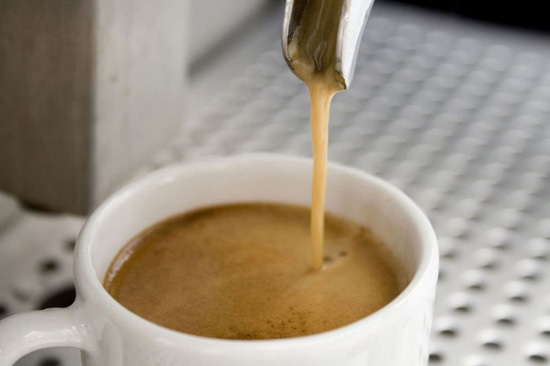
A freshly poured espresso shot (image: wikimedia commons)
Each topic we tackle on Design Decoded is explored through a multi-part series of interlocking posts that will, we hope, offer a new lens for viewing the familiar. This is the second installment in a series about that centuries-old molten brew that can get you out of bed or fuel a revolution. Java, joe, café, drip, mud, idea juice, whatever you call it, coffee by any other name still tastes as bitter. Or does it? In our ongoing effort to unlock the ways design factors into the world around us, Design Decoded is looking into all things coffee. Read Part 1 on reinventing the coffee shop.
For many coffee drinkers, espresso is coffee. It is the purest distillation of the coffee bean, the literal essence of a bean. In another sense, it is also the first instant coffee. Before espresso, it could take up to five minutes –five minutes!– for a cup of coffee to brew. But what exactly is espresso and how did it come to dominate our morning routines? Although many people are familiar with espresso these days thanks to the Starbucksification of the world, there is often still some confusion over what it actually is – largely due to “espresso roasts” available on supermarket shelves everywhere. First, and most importantly, espresso is not a roasting method. It is neither a bean nor a blend. It is a method of preparation. More specifically, it is a preparation method in which highly-pressurized hot water is forced over coffee grounds to produce a very concentrated coffee drink with a deep, robust flavor. While there is no standardized process for pulling a shot of espresso, Italian coffeemaker Illy’s definition of the authentic espresso seems as good a measure as any:
A jet of hot water at 88°-93°
C (190°-200°F) passes under a pressure of nine or more atmospheres through a seven-gram (.25 oz) cake-like layer of ground and tamped coffee. Done right, the result is a concentrate of not more than 30 ml (one oz) of pure sensorial pleasure.
For those of you who, like me, are more than a few years out of science class, nine atmospheres of pressure is the equivalent to nine times the amount of pressure normally exerted by the earth’s atmosphere. As you might be able to tell from the precision of Illy’s description, good espresso is good chemistry. It’s all about precision and consistency and finding the perfect balance between grind, temperature, and pressure. Espresso happens at the molecular level. This is why technology has been such an important part of the historical development of espresso and a key to the ongoing search for the perfect shot. While espresso was never designed per se, the machines –or Macchina– that make our cappuccinos and lattes have a history that stretches back more than a century.
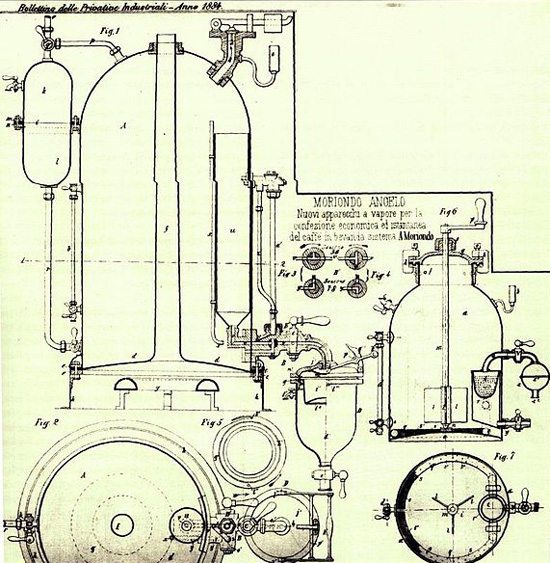
Moriondo’s patent for a steam-powered coffee machine (image: wikimedia commons)
In the 19th century, coffee was a huge business in Europe with cafes flourishing across the continent. But coffee brewing was a slow process and, as is still the case today, customers often had to wait for their brew. Seeing an opportunity, inventors across Europe began to explore ways of using steam machines to reduce brewing time – this was, after all, the age of steam. Though there were surely innumerable patents and prototypes, the invention of the machine and the method that would lead to espresso is usually attributed to Angelo Moriondo of Turin, Italy, who was granted a patent in 1884 for “new steam machinery for the economic and instantaneous confection of coffee beverage.” The machine consisted of a large boiler, heated to 1.5 bars of pressure, that pushed water through a large bed of coffee grounds on demand, with a second boiler producing steam that would flash the bed of coffee and complete the brew. Though Moriondo’s invention was the first coffee machine to use both water and steam, it was purely a bulk brewer created for the Turin General Exposition. Not much more is known about Moriondo, due in large part to what we might think of today as a branding failure. There were never any “Moriondo” machines, there are no verifiable machines still in existence, and there aren’t even photographs of his work. With the exception of his patent, Moriondo has been largely lost to history. The two men who would improve on Morinodo’s design to produce a single serving espresso would not make that same mistake.
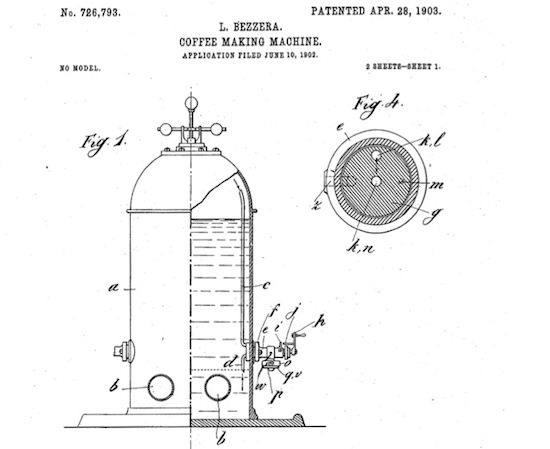
Luigi Bezzera’s patent for a “coffee making machine” (image: Google Patents)
Luigi Bezzerra and Desiderio Pavoni were the Steve Wozniak and Steve Jobs of espresso. Milanese manufacturer and “maker of liquors” Luigi Bezzera had the know-how. He invented single-shot espresso in the early years of the 20th century while looking for a method of quickly brewing coffee directly into the cup. He made several improvements to Moriondo’s machine, introduced the portafilter, multiple brewheads, and many other innovations still associated with espresso machines today. In Bezzera’s original patent, a large boiler with built-in burner chambers filled with water was heated until it pushed water and steam through a tamped puck of ground coffee. The mechanism through which the heated water passed also functioned as heat radiators, lowering the temperature of the water from 250°F in the boiler to the ideal brewing temperature of approximately 195°F (90°C). Et voila, espresso. For the first time, a cup of coffee was brewed to order in a matter of seconds. But Bezzera’s machine was heated over an open flame, which made it difficult to control pressure and temperature, and nearly impossible to to produce a consistent shot. And consistency is key in the world of espresso. Bezzera designed and built a few prototypes of his machine but his beverage remained largely unappreciated because he didn’t have any money to expand his business or any idea how to market the machine. But he knew someone who did. Enter Desiderio Pavoni.
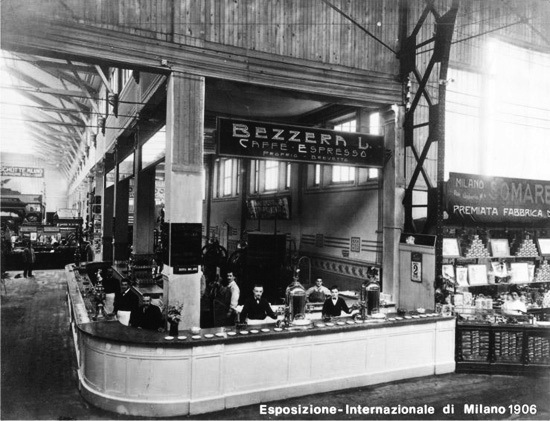
Bezzera’s espresso machine at the 1906 Milan Fair (image: Bezzera)
Pavoni bought Bezerra’s patents in 1903 and improved many aspects of the design. Notably, he invented the first pressure release valve. This meant that hot coffee wouldn’t splash all over the barista from the instant release of pressure, further expediting the brewing process and earning the gratitude of baristas everywhere. Pavoni also created the steam wand to access the built-up steam that collected inside a machine’s boiler. Bezzera and Pavoni worked together to perfect their machine, which Pavoni dubbed the Ideale. At the 1906 Milan Fair, the two men introduced the world to “cafeé espresso“. Bezzera, though he may have even built Pavoni’s first machines, slowly faded from the picture –he may have been bought out– as Pavoni continued to widely market his name brand “espresso” (“made on the spur of the moment”) machines, which were produced commercially in his workshop in Milan. With its numerous innovations, the Ideale marked an important step in the first development of modern espresso. After the Milan Fair, similar espresso machines began to appear throughout Italy, and Bezzera’s early utilitarian machine evolved into the elaborate gilded contraptions that look like a hood ornament for an airship in a Jules Verne novel.
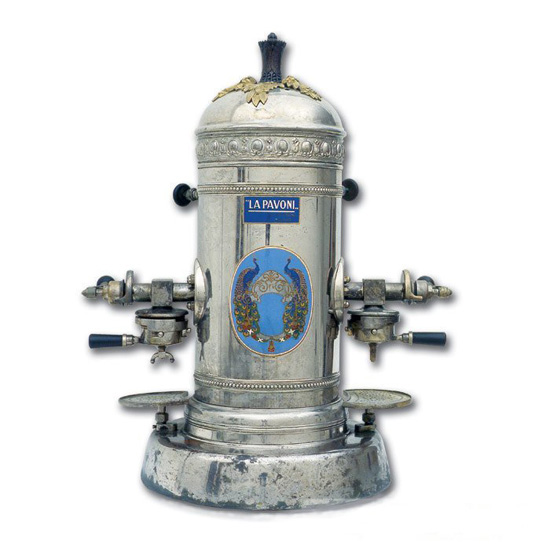
A 1910 Ideale espresso machine
These early machines could produce up to 1,000 cups of coffee per hour, but relied exclusively on steam, which had the unfortunate side effect of imbuing the coffee with a burnt or bitter taste and could only conjure up, at best, two bars of atmospheric pressure – not even enough for the resulting drink to be considered espresso by today’s standard. As electricity replaced gas and Art Deco replaced the chrome-and-brass aesthetic of the early 20th century, the machines became smaller and more efficient, but no coffee innovators managed to create a machine that could brew with more than 1.5-2 bars of pressure without burning the coffee. Pavoni dominated the espresso market for more than a decade. Yet despite the success of his machines, espresso remained a mostly regional delight for denizens of Milan and surrounding areas.
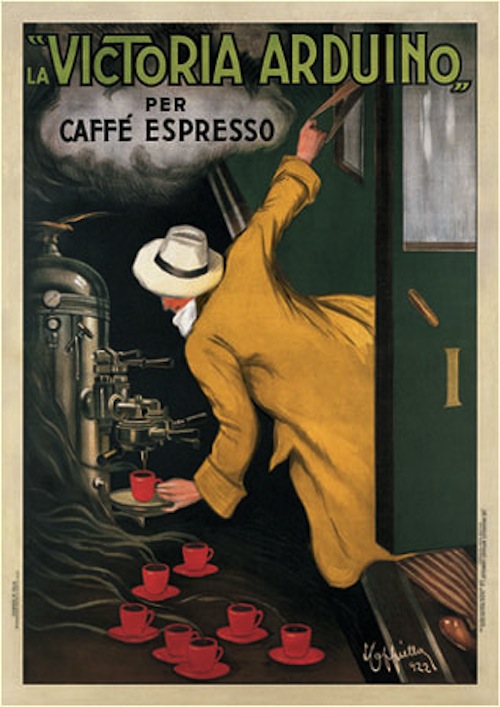
Victoria Arduino Poster (image: Wikimedia commons)
Among Pavoni’s growing competition was Pier Teresio Arduino. Arduino was an inventor determined to find a method of brewing espresso that didn’t depend exclusively on steam. Even though he conceived of incorporating screw pistons and air pumps into the machines, he was never able to effectively implement his ideas. Instead, his main contributions to the history of espresso are of a different nature. Arduino was a businessman and master marketer – more so than even Pavoni. He built a marketing machine around espresso, which included directing graphic designer Leonetto Cappiello to create the famous espresso poster that perfectly captured the nature of espresso and the speed of the modern era. In the 1920s, Arduino had a much larger workshop than Pavoni’s in Milan and, as a result of his production capabilities and marketing savvy, was largely responsible for exporting machines out of Milan and spreading the espresso across the rest of Europe.
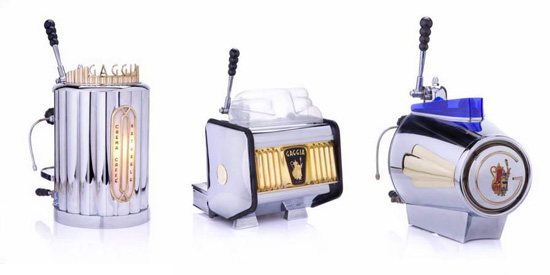
Vintage Gaggia lever machines (image: Espresso Machine Classics)
The man to finally surpass the two-bar brewing barrier was Milanese café owner Achille Gaggia. Gaggia transformed the Jules Verne hood ornament into a chromed-out counter-top spaceship with the invention of the lever-driven machine. In Gaggia’s machine, invented after World War II, steam pressure in the boiler forces the water into a cylinder where it is further pressurized by a spring-piston lever operated by the barista. Not only did this obviate the need for massive boilers, but it also drastically increased the water pressure from 1.5-2 bars to 8-10 bars. The lever machines also standardized the size of the espresso. The cylinder on lever groups could only hold an ounce of water, limiting the volume that could be used to prepare an espresso. With the lever machines also came some some new jargon: baristas operating Gaggia’s spring-loaded levers coined the term “pulling a shot” of espresso. But perhaps most importantly, with the invention of the high-pressure lever machine came the discovery of crema – the foam floating over the coffee liquid that is the defining characteristic of a quality espresso. A historical anecdote claims that early consumers were dubious of this “scum” floating over their coffee until Gaggia began referring to it as “caffe creme“, suggesting that the coffee was of such quality that it produced its own creme. With high pressure and golden crema, Gaggia’s lever machine marks the birth of the contemporary espresso.
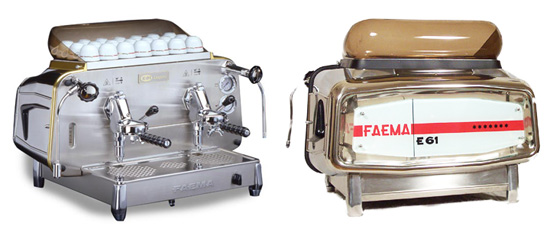
The Faema E61 espresso machine
But that is not then end of the evolution of the Macchina, not by far. The next revolution in espresso machine happend, appropriately in the revolutionary 1960s when Gaggia’s piston machine was surpassed by the Faema E61. Invented by Ernesto Valente in 1961, the E61 introduced many more innovations and espresso firsts. Rather than relying on the manual force of the barista, it used a motorized pump to provides the nine atmospheric bars of pressure needed for brewing espresso. The pump draws tap water directly from a plumbing line, sending it through a spiral copper pipe inside a boiler before being shot through the ground coffee. A heat exchanger keeps the water to an ideal brewing temperature. With its technical innovations, smaller size, versatility and streamlined stainless steel design, the E61 was an immediate success and is rightly included in the pantheon of the most influential coffee machines of history.
There are surely a few other steps along the way, but these developments track the larger commercial history of the espresso. Over more than a century, the espresso machine has been drastically improved, with electrical components, computerized measurements, and portable pneumatics. But as with the finest objects of design, science and technology is not enough. There is an art to the espresso as well. The talent of the barista is as important as the quality of the beans and the efficiency of the machine. Indeed, it is said that a good espresso depends on the four M’s: Macchina, the espresso machine; Macinazione, the proper grinding of a beans –a uniform grind between fine and powdery– which is ideally done moments brewing the drink; Miscela, the coffee blend and the roast, and Mano is the skilled hand of the barista, because even with the finest beans and the most advanced equipment, the shot depends on the touch and style of the barista. When combined properly, these four Ms yield a drink that is at once bold and elegant, with a light, sweet foam crema floating over the coffee. A complex drink with a complex history.
/https://tf-cmsv2-smithsonianmag-media.s3.amazonaws.com/accounts/headshot/Jimmy-Stamp-240.jpg)