Blogs

  • News
  • |
  • Art
  • |
  • History
  • |
  • Food and Travel
  • |
  • Science
Collage of Arts & Sciences

Where the studio meets the research lab

Design Decoded

Sketching the blueprints behind everyday things

threaded

Your go-to fashion blog for all things historical and sartorial

Retina

The Best Visuals from Smithsonian and the Web


August 16, 2012

Aircraft Design Inspired by Nature and Enabled by Tech

A 3D-printed model of Airbus’s future concept plane for 2050 (image: Autodesk Gallery)

As if it weren’t already mind-bending enough to envision yourself hurtling through the skies in a metal canister at 500 miles per hour, now Airbus wants you to imagine your gravity-defying journey in an aircraft with transparent skin. Tapping into some of the most cutting-edge design thinking today, the aviation leader has developed a concept plane that is not intended for flight—at least not in this iteration—but is an innovation tool that “stretches the imagination of engineers, and…highlights some of the challenges and decisions that lie ahead for air travel.”

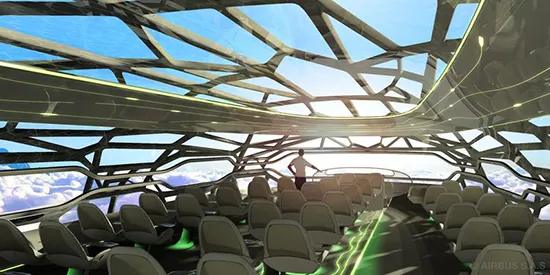
The concept plane, which they hope resembles the real Airbus models of 2050, takes biomimicry as a guiding principle for the design of forms and materials. The most noticeable aspect of this approach is in the fuselage, which, instead of being wrapped in opaque metal, is composed of a web-like network of structural material that looks a bit like a skeleton. In fact, that’s exactly what it should remind you of, because it’s inspired by the bone structure of birds.
(image: Airbus)

In a presentation on the company’s future design plans, chief engineer Charles Champion explained, “Bone is both light and strong because its porous interior carries tension only where necessary, leaving space elsewhere.” The space between the so-called “bionic bones”of the plane become panoramic windows that wrap all the way around. “[Y]ou will be able see the pyramids or the Eiffel Tower through the transparent floor of the aircraft.”
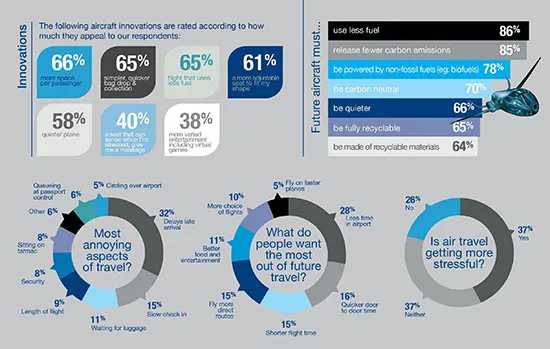
An infographic showing results from Airbus passenger surveys on the future of air travel (image: Airbus)

While the structural design is inspired by creatures that have existed for millennia, many of the materials are produced using technology that as barely been known for a decade. 3D-printing is one of the techniques that may enable Airbus to create the precise, spare forms they require, first drafting them on a computer and then manufacturing them through rapid layering that builds up the design exactly as it’s intended, with no waste. For the cabin’s electrical system, Airbus intends to integrate a brain-like “network of intelligence” into the walls of the plane, which is responsive to interior climate conditions and passenger needs without requiring huge amounts of cable, wire and switches.
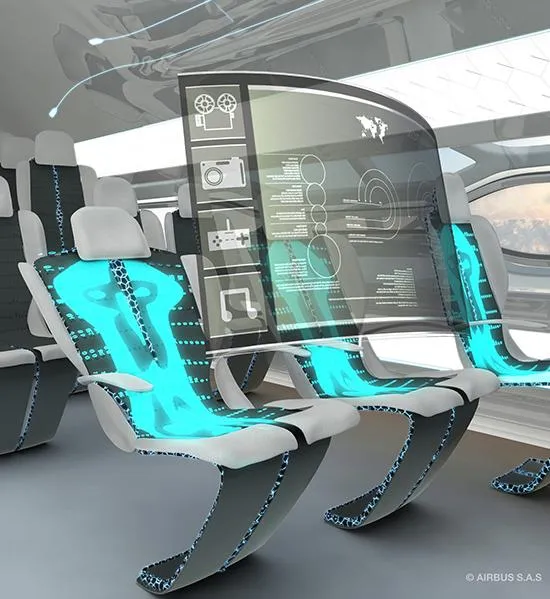
Shape-shifting “smart” seating and holographic entertainment (image: Airbus)

All of these strategies—the lightweight structure, waste-free manufacturing, and wireless electrical systems—can contribute to reductions in emissions and fuel use. The cumulative effect of using fewer resources for each plane could result in a massive overall improvement in aviation’s environmental impact. In that vein, the Airbus concept plane is one of the few instances (at least for now), where the term “organically grown” refers not to food, but to seating. The seats of the plane will potentially be composed of plant-based biomaterials which go a few leaps past memory foam toward smart materials that form to and remember the body’s optimal position.
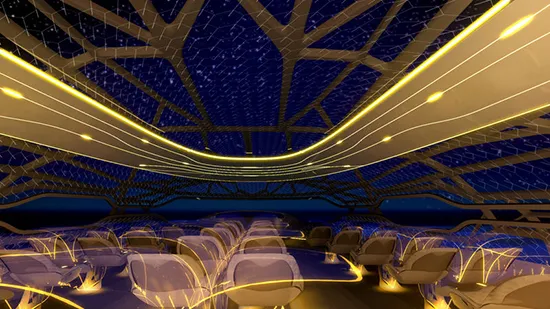
A full night sky view (image: Airbus)

Of course all of the aspects of physical comfort and wellness that currently elude passengers will find their way into this in-flight experience, too, in the form of interactive zones, where travelers can socialize, play games, exercise and enjoy various holistic treatments like massage and aromatherapy. It’s almost enough to make you forget you’re trapped inside a pressurized container six vertical miles above your home planet.


***

Sign up for our free email newsletter and receive the best stories from Smithsonian.com each week.

12 Comments »

  1. Braniff says:

    I have a feeling that some enterprising business people will want to conduct tours of the Alps, the Himalayan mountains, the Antarctic continent or the deserts of the world with these aircraft–if and when they are built. But how about those who suffer from fear of heights?

  2. Birgit Mohney says:

    Very inspiring post that made me look at aviation and air travel in a whole new, and hopeful, way. Next stop Star Treck!

  3. Peter says:

    Why does ‘shorter journey times’ not score on that survey?
    Does nobody care about going faster anymore?? That aircraft looks disctinctly subsonic to me, I’m still pining and hoping for a successor to Concorde!!
    This aircraft looks like something from a fantasy manga cartoon, not the least bit feasible to actually design and build. When did Airbus start hiring Art graduates to design their aircraft concepts instead of engineers?? This shows a complete ignorance of aircraft systems design – how do they plan on air-conditioning that greenhouse??
    What a thoroughly frustrating time it is to be an aerospace engineer!

  4. Jo-Anne Sewlal says:

    Looks great but the transparent floor might not be such a good idea, especially for people scared of heights.

  5. MARIE AFRAZIER says:

    Exceeding even the birds, humans will fly higher than they ever dreamed of. I will experience this in my next life time.
    Marie Frazier

  6. Maura says:

    A transparent floor is not the greatest idea – I like a bird’s eye view but prefer not to be reminded that my feet are high in the sky.

  7. Dave Brough says:

    Interesting that the airliner of the future still has people sharing the space, but more people an in ever bigger aircraft. One of the reasons people love cars over transit is because they don’t have to share. No wonder they call it AirBUS!

  8. Marshall Cypress says:

    awesome… I am sure the tickets to fly on the thing would only be in the tens of thousands.

  9. BoogerFree says:

    Bad idea. It’ll be so bright inside everyone will be required to wear sunglasses. Tint the windows, and then having the roof as see-through will be rendered useless.

  10. Chuck says:

    Really, “wrapped in opaque STEEL”….? Care to edit that?

  11. Randolph Smoot says:

    That’s ALUMINUM, not steel, that plane structures are currently made of. A steel plane would require *enormous* amounts of power to get off the ground.

    Those renderings show a large amount of space for each passenger. I’d expect the reality to be even more crowded than planes currently are.

    At least it doesn’t look like an organic spacecraft from Alien.

  12. Greg W. says:

    I wouldn’t want to be on of the first ones to fly in it, but I would love to take a tour in one some day. The design is very cool but for someone who is afraid of heights, I don’t think I would do well. If it was a quick tour over the Grand Canyon, or something like that, would be when I fly in it.

RSS feed for comments on this post. TrackBack URI

Leave a comment

Comments are moderated, and will not appear until Smithsonian.com has approved them. Smithsonian reserves the right not to post any comments that are unlawful, threatening, offensive, defamatory, invasive of a person's privacy, inappropriate, confidential or proprietary, political messages, product endorsements, or other content that might otherwise violate any laws or policies.

Spam protection by WP Captcha-Free

Advertisement


Follow Us

Travel with Smithsonian


Advertisement