
The LEGO-like Building Blocks of the Olympic Slalom Canoe
How a three-time Olympic competitor designed an innovative new whitewater system using underwater bricks
/https://tf-cmsv2-smithsonianmag-media.s3.amazonaws.com/accounts/headshot/sarah-rich-240.jpg)
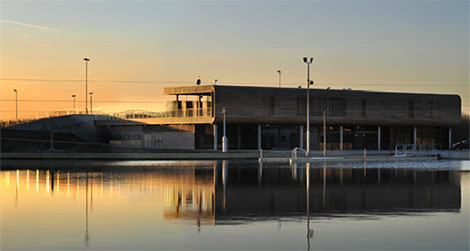
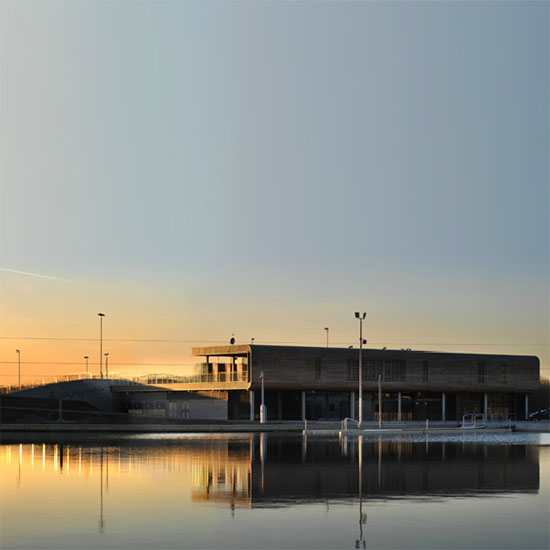
FaulknerBrowns Architects’ design for the Lee Valley White Water Center
When the Olympic Games come to a close in a few days, many of the buildings that were designed and constructed specifically for these two weeks of international mayhem will lose their primary function. But the Lee Valley White Water Centre will not.
The artificial whitewater park, which was designed by UK-based Faulknerbrowns Architects, was conceived from the start with the intention of creating a permanent recreational destination on the northern outskirts of London. The center opened well before the games at the end of 2010, and was the only Olympic venue that was open to the public before the official event. With the games done, the facility becomes a playground for amateur rafters and a training location for elite slalom canoe competitors.
The building itself is elegant—a modern clamshell structure encased in wood, with generous glass facades looking out over the floodplain in which the artificial river is inserted. Perhaps more remarkable than the building itself, though, is the design and engineering of the rapids. Recent innovations from Colorado-based S2O Design allow the whitewater to be fully adjustable in intensity and trajectory, enabling the course to be tuned exactly to ICF regulations, and then dialed back for inexperienced daytrippers.
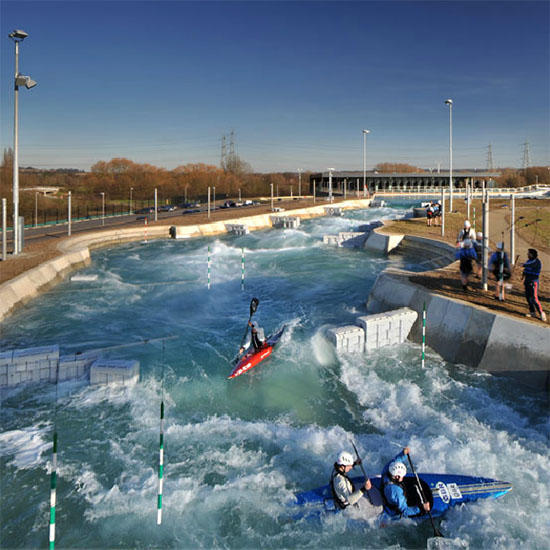
The white water course for the 2012 Olympic slalom canoe event
S2O Design was founded by Scott Shipley, a three-time Olympic competitor in the slalom canoe event, and U.S. national champion in 2010. Shipley is also a mechanical engineer, and each of the members of his design firm are, like him, kayaker-engineers. “We grew up as paddlers, we grew up as racers, we grew up as extreme paddlers, we grew up doing freestyle,” Shipley says of his team, “and I think that’s so crucial to the design of whitewater parks…you’re bringing natural whitewater in some cases back to a community that’s industrialized their river, you’re opening that river back up, you’re recreating a riparian zone, you’re recreating natural whitewater, you’re recreating a river system.”
In the case of London, S20 was tasked with creating rapids in an environment quite different from where you’d naturally find them—a flat piece of land with wide, nearly still expanses of water. At the most basic level, the first thing that’s needed is a powerful pumping mechanism to get massive volumes of groundwater moving quickly through the course infrastructure. But speed isn’t the only requirement. Creating a consistently challenging, but naturally varied course requires shaping the movement of the current. For this, Shipley’s company has designed a product called RapidBlocs.
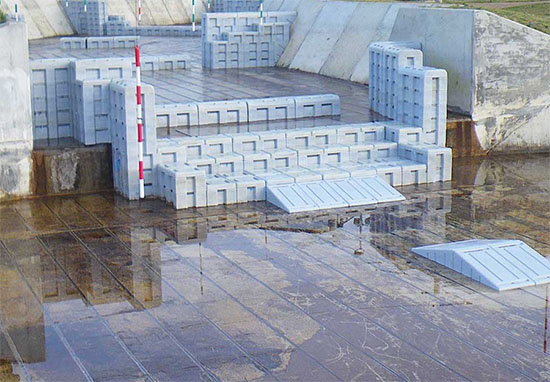
S20 Design’s innovative white water course design system—a series of adjustable modules called RapidBlocs
Since the earliest whitewater slalom competitions in the 1930s, most artificial courses have been constructed primarily of concrete, with static forms inserted to mimic boulders, logs, and other features that ordinarily create rapids. S20′s design turns the static features into adjustable plastic modules—a bit like underwater Legos—which can be positioned with a high degree of precision, and moved at no cost, essentially creating a new stretch of river each time. Because competitive sports evolve over time, RapidBlocs also promise whitewater park managers the ability to remain at the leading edge of course design without having to rebuild or invest huge amounts of money to make updates.
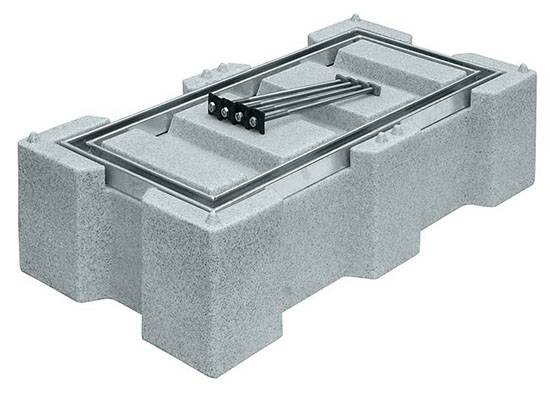
Example of a single RapidBlocs module, designed from HDPE plastic with galvanized bolts
In addition to using this design for racing venues, Shipley hopes individual kayakers will take advantage of the innovation as a way to train towards international competition in their own waters. Because RapidBlocs can be configured in small-scale locations to create short courses, Olympic hopefuls could theoretically install a few blocks wherever they paddle, elevating the complexity and difficulty of their training.
A nice short video of the Lee Valley whitewater course, created by Twelve Productions, can be seen below:
Lee Valley Whitewater Course from Twelve Productions on Vimeo.
/https://tf-cmsv2-smithsonianmag-media.s3.amazonaws.com/accounts/headshot/sarah-rich-240.jpg)