
Designing a 51-State Flag
Even in 1958, the American flag was designed through crowdsourcing amateurs. If Puerto Rico joins the union, who will design the 51-star flag?
/https://tf-cmsv2-smithsonianmag-media.s3.amazonaws.com/accounts/headshot/sarah-rich-240.jpg)
/https://tf-cmsv2-smithsonianmag-media.s3.amazonaws.com/filer/designing-51-state-631x300.jpg)
Back in January, when Newt Gingrich was still a GOP hopeful, he presented the idea of making the moon into the 51st member of the United States. Fast-forward a few months: Gingrich did not win the nomination, the moon remains uncolonized, but the notion of another state was in fact a very real part of the 2012 election. In Puerto Rico, a clear majority of citizens voted for the island’s statehood.
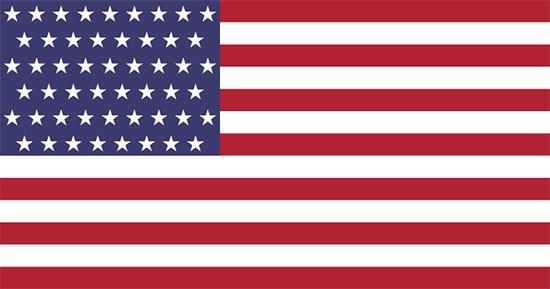
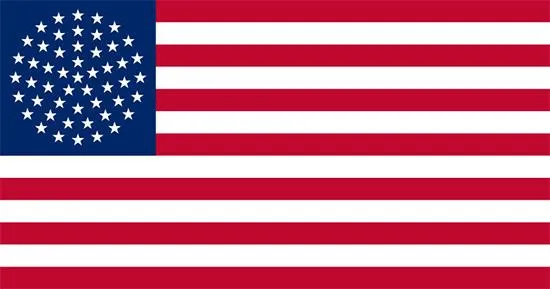
This doesn’t mean that Puerto Rico will be promptly admitted to the union. A number of factors and decisions still stand between the vote and the final outcome. However, it does beg the question: What would a 51-star flag look like? And, for that matter, what was the design process at other moments in history when the US scaled up its territory?
There’s a great five-minute clip on the archives of the wonderful StoryCorps in which the credited designer of the 50-state flag—a man named Bob Heft—describes the circumstances in which his configuration won official status as the US flag. As a high school student in the late 50s, right before Hawaii and Alaska were admitted to the union, Heft had to come up with a special project for his American History class. He decided to cut up an existing 48-star flag and sew it back together to create a 50-star flag (“I had never sewn in my life,” Heft says, “and since making the flag of our country, I’ve never sewn again.”). The stunt earned him a B- from a teacher who believed he didn’t know how many states the country had.
Heft submitted his design to the White House, alongside more than a thousand other ideas for the 50-star flag, and while there were a few others that shared the same concept, Heft’s was credited as being the official one. (His teacher changed his grade to an A.) After his moment of the national stage, Heft spent his life as a teacher and small-town mayor in Michigan, where he died in 2009, allegedly in possession of a copyright for several other flag designs, including a 51-star and 60-star version (presumably that scenario did not include the moon as one of the other nine new states).
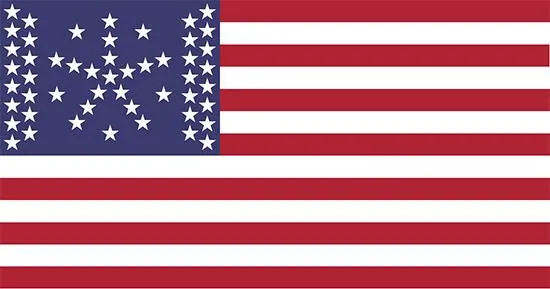
The kind of unsolicited crowdsourcing that occurred in 1958 is of course nothing compared to the number of designs likely to be generated in 2012, with Adobe Creative Suite ready to generate perfectly identical stars in precisely symmetrical formations. Reddit users got started right away after Puerto Rico’s vote, and designs are popping up elsewhere across the Internet. The irregularity of the number makes for some interesting solution, probably the best one being a star-spangled Pac-Man eating star-spangled pac-dots. Of course, doing this legitimately requires some math. Back in 2010 when Puerto Rico was still a few years off from the big decision, Slate did their due diligence and asked a mathematician how 51 stars could best be fit into the allotted real estate. They provide a few formulas to follow, should you decide it’s your turn to be the next American flag designer.
/https://tf-cmsv2-smithsonianmag-media.s3.amazonaws.com/accounts/headshot/sarah-rich-240.jpg)