
The Privacy Wars: Goggles That Block Facial Recognition Technology
For designers, the battle over what it means to be private in a very public world is a new frontier to be conquered
/https://tf-cmsv2-smithsonianmag-media.s3.amazonaws.com/accounts/headshot/Jimmy-Stamp-240.jpg)
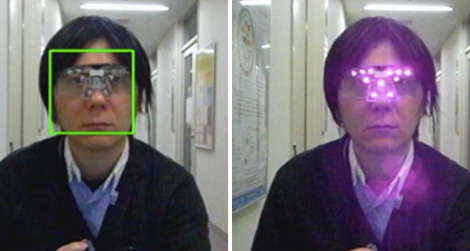
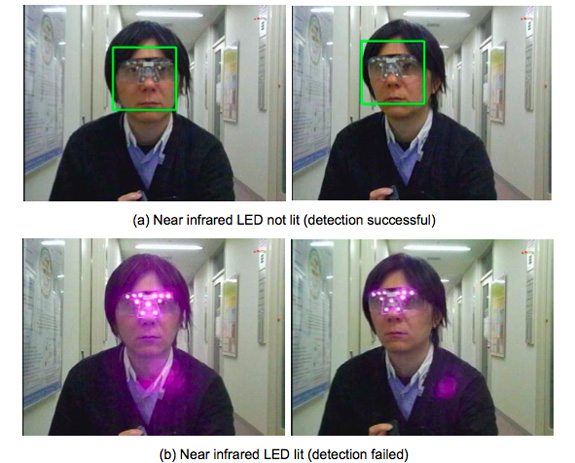
Execution of Facial Detection. Area in Green Frame Indicates Successful Detection (image: NII)
Camouflage Couture is all the rage. As drones, security cameras, social networks, and even our personal computers have become more sophisticated, the use of facial recognition technology is becoming increasingly widespread. For some people, this is a great convenience and for others it’s an invasion of privacy. For designers, it’s a new frontier to be conquered.
Previously, we saw how one designer, Adam Harvey, recently unveiled a line of “anti-drone” clothing for personal counter-surveillance. As a student, Harvey, in collaboration with hair stylists, fashion designers and makeup artists, designed CV Dazzle, an edgy, high-fashion camouflage created to disrupt computer vision algorithms – particularly facial recognition software. However, for those people not interested in glamming up with anti-surveillance makeup, Isao Echizen associate professor at The National Institute of Informatics (NII) in Tokyo, has designed the “privacy visor” to “protect photographed subjects against invasion of privacy caused by unintentional capture in camera images” (pdf). The visor does this by emitting near-infrared lights that confuse facial recognition software with “noise” but won’t adversely affect the wearer’s vision or disguise their face from human perception.
As evidenced by the image above, the design of the visor still needs some work. The prototype looks like a cross between Google’s Project Glass and the ship from the end of Close Encounters of the Third Kind. But this is just a first step toward commercially available counter-surveillance gear. Echizen doesn’t see the system as new tool for criminals to disrupt increasingly sophisticated security technologies, but as a means for individuals to combat the degradation of the boundary between their public and private lives. Semiotician and philosopher Roland Barthes believed that this degradation, which was initiated by the invention of the camera, would result in the creation of a new social value: “the publicity of the private” – that is, the public consumption of private information. This is exactly what the team at NII is trying to combat with the privacy visor. Their report cites experiments about surveillance and personal security conducted at Carnegie Mellon:
“a third of tested subjects who had agreed to being photographed for the experiment their names could be identified by comparison with information of photos, etc. …. there were also cases where the interests of the tested subjects and some social security numbers also were found out.”
Indeed, it’s becoming more difficult to maintain even a modicum of privacy. Of course, sometimes this is attributable to user error or poorly managed online profiles, but even those people who take great care to maintain–or abolish the traces of–their online presence may find themselves victim to the publicity of private information in the form of identity theft or targeted marketing campaigns. But good design (and science!) can help. Right now, however, the best options for those interested in personal counter-surveillance (but don’t want to wear a ski mask) involve either walking around with a spaceship on your face or looking like early 1970s David Bowie. So really it’s a win-win. But who knows what the aesthetic of counter-surveillance will ultimately look like? Perhaps personal counter-surveillance will dictate the next trends, or perhaps it will be completely concealed, integrated into our clothing, our accessories, or even our skin – a part of our every day lives. Camouflaged camouflage.
/https://tf-cmsv2-smithsonianmag-media.s3.amazonaws.com/accounts/headshot/Jimmy-Stamp-240.jpg)