
Victoria’s First Dinosaur Trackway
After moving a few track slabs myself this summer, I can tell you that it’s not easy work!
/https://tf-cmsv2-smithsonianmag-media.s3.amazonaws.com/accounts/headshot/RileyBlack.png)
/https://tf-cmsv2-smithsonianmag-media.s3.amazonaws.com/filer/20110811093008victoria-tracks-screen-grab.jpg)
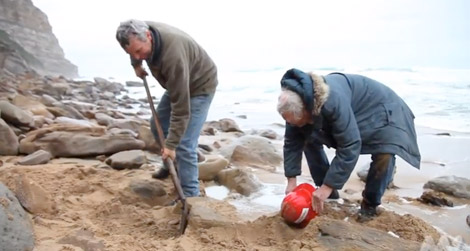 All too often, dinosaur tracks don’t get the respect they deserve. Reconstructed skeletons in museum halls are typically more aesthetically pleasing and visually impressive, and by comparison, tracks sometimes seem rather mundane. Yet dinosaur tracks record prehistoric behavior—the actual steps of living animals—and the fossil traces can form critical parts of our understanding of Mesozoic life in places where dinosaur body fossils are hard to come by. Even in places where bones are common, tracks place particular types of dinosaurs in certain environments, and that’s valuable information for reconstructing prehistoric life. A significant set of tracks from Victoria, Australia has just been described.
The tracks, found at Milanesia Beach, were made by small theropod dinosaurs during a time when Australia was closer to the South Pole, about 105 million years ago. These were footsteps left by polar dinosaurs. In a reversal of what is usually the case, more dinosaur bones have been found in the same fossil layers than tracks, and the discovery of the dinosaur footprints greatly increases the number of trace fossil specimens from the area.
Paleontologist Tom Rich explains how the blocks containing the tracks were removed in the video above. After moving a few track slabs myself this summer, I can tell you that it’s not easy work! And make sure that you check out paleontologist Tony Martin’s blog The Great Cretaceous Walk, too. Tony discovered some of the tracks, and he provides plenty of background on why they’re important.
/https://tf-cmsv2-smithsonianmag-media.s3.amazonaws.com/accounts/headshot/RileyBlack.png)