Blogs

  • News
  • |
  • Art
  • |
  • History
  • |
  • Food and Travel
  • |
  • Science
Dinosaur Tracking

Where paleontology meets pop culture

Hominid Hunting

Meet the members of the tangled human family tree

Innovations

How human ingenuity is changing the way we live

Surprising Science

Ideas, news and discoveries from the world of science


March 28, 2012

Las Vegas’ Truly Terrible Dinosaurs

The head of Tyrannosaurus at the Las Vegas Natural History Museum. Photo by the author.

Las Vegas, Nevada, is not a city I immediately associate with dinosaurs. To judge by the billboards along Interstate 15 approaching town, slot machines, strip clubs and performances by has-been comedians is what the town is all about. But, strange as it may seem, Las Vegas has a natural history museum, and the small building is home to some of the worst dinosaurs I have ever seen.

In execution, the Las Vegas Natural History Museum feels less like a true museum and more like a curiosity cabinet cobbled together out of taxidermy mounts and anthropological items. A lion pouncing on a bucking wildebeest greets patrons along the main corridor, and a glass case shows off a collection of African ceremonial masks without providing any cultural context for the items. Splintering whale bones and life-size shark models decorate the nearby marine life gallery, and despite the fact that Las Vegas has no immediate connection to human origins, a gallery downstairs presents a series of disturbingly inaccurate early human mannequins. “Lucy” certainly deserves better. But I wasn’t there for the trophy room of stuffed mammals or the Egyptian tomb exhibit. I had come for the dinosaurs.
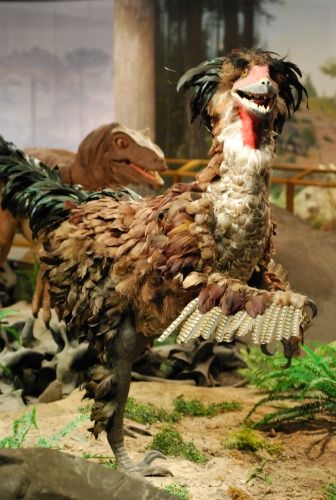
A truly terrible Deinonychus, on display at the Las Vegas Natural History Museum. Photo by the author.

The first thing I saw upon walking into the Engelstad Family Prehistoric Life Gallery was an utterly atrocious Deinonychus. Plastered with feathers, the sickle-clawed predator looked as if it had been tarred and feathered for some Early Cretaceous offense. While I have repeatedly griped that there are too many naked dinosaurs in books, movies and museum displays, this poor creature made me reconsider my insistence on this point. No wonder some people feel that feathered dinosaurs look stupid—when restored without careful reference to living birds, some downy deinonychosaurs really do strain our love for dinosaurs.

A few other creatures, such as our sail-backed cousin Dimetrodon and a model of the extinct whale Zygorhiza, inhabit the hall, but the dinosaurs are given top billing. Almost all are sculptures or animatronics. A brown, dopey-looking Herrerasaurus squats in the corner of one exhibit, sharing little resemblance with the actual predatory dinosaur, and visitors can push a button to make a seafoam green Allosaurus bellow ineffectually. Nearby, a small pack of Troodon pose to chase away a nest-raiding mammal, and while I was disappointed that these dinosaurs were not feathery, a look back at the dreadful Deinonychus made me feel that it may have been best to leave these dinosaurs without plumage. The grand centerpiece is a diorama of that most famous face-off: Triceratops versus Tyrannosaurus. The ornery horned dinosaur constantly jerked and snorted, and the Tyrannosaurus—a recent recipient of some mechanical surgery based on the square cut in its right side—was poised to charge.

I couldn’t figure out what the point of the exhibit was. The displays provided a minimum of educational tidbits, such as the difference between “bird-hipped” and “lizard-hipped” dinosaurs, but I did not see any of the visitors look at the other panels. The monstrous dinosaurs seemed to speak for themselves, at least with the help of pushbutton snarls. Fossils were almost absent from the hall. A few isolated dinosaur track slabs were scattered through the hall, and a small glass case contained a single vertebra from Camarasaurus, but that was nearly all. (There is another display about dinosaur eggs, but that part of the room was so dimly lit that I couldn’t read the explanatory panels or see the eggs.) Another exhibit, about Nevada’s changing landscape, noted that the time of the dinosaurs is poorly known in Nevada, and the prehistoric hall is certainly a testament to that.

There’s more than one way to display dinosaurs. Not every museum has to be Smithsonian’s National Museum of Natural History or the American Museum of Natural History. There are so many stories to tell about dinosaurs lives—how they grew, ate, fought, reproduced and more—that small, regional museums have ample opportunity to show off aspects of dinosaur biology that might get missed in the famous fossil halls of bigger, older institutions. And local museums can play an important role in displaying pieces of local geologic history that may be hidden in collections elsewhere. But the Las Vegas Natural History Museum’s paleontology hall feels more like a tourist trap, populated by low-grade dinosaurs presented without any unifying story or aim. Dinosaurs have much to tell us about evolution, extinction and past worlds, and it is a shame to see them treated as mere monsters made to roar on command.


***

Sign up for our free email newsletter and receive the best stories from Smithsonian.com each week.

11 Comments »

  1. Kevin says:

    Oh god, that Deinonychus looks like an elementary school arts and crafts project that got caught in a few rainstorms.

  2. Andy Farke says:

    An important distinction is that the Las Vegas Natural History Museum is _not_ the same as the Nevada State Museum, Las Vegas, which I understand actually has some very nice, scientifically grounded exhibits. One major difference between the two is that the LVNHM does not have bona fide curators or collections staff as near as I can tell from their website (or apparently even a major collection outside of the exhibits), whereas the NSM does. Judging by the LVNHM annual report, they have big plans that should professionalize things, but that will take time!

  3. BJ Nicholls says:

    Semi non-random Deinonychus tar and feathering. Yet another reason to fear and loathe Las Vegas.

  4. Tim Koenig says:

    Oh come on…cut them a little slack. If you want to see dinosaurs in Las Vegas, think Wayne Newton or contemporaries.

    As for poor Deinonychus, if you spend any time with a flock of chickens, you’ll recognize a really baaad moulting season complicated by a horrible case of feather mites. I’m sorry, but I can’t explain the tail feathers on top of his head.

  5. drtachyon says:

    You’ve never been to the Fernbank Museum in Atlanta. The Walk Through Time in Georgia exhibit is laughable; pot bellied T-rex and all. Surprisingly shoddy considering it opened in the mid-90′s. The rest of the museum and building are rather nice.

  6. Christina says:

    That Deinonychus is certainly starting this gray, rainy day right for me. What with that big smile, it’s totally a dino in drag!

  7. Josh Bonde says:

    A blog like this just goes to show how someone without any sort of background information can pick on a regional institution which has enriched the lives of tens of thousands of children in an urban environment. Mr. Switek takes aim at the Las Vegas Natural History Museum, a target seemingly deserving of such scorn as to ridicule the exhibits and to lament the particulars of the lighting of some displays. Perhaps if Mr. Switek were in the know, he would know that this gem of downtown Las Vegas serves over 50,000 students in the Las Vegas metro area every year, most of which do not pay entrance fee’s as a result of being from “at risk” schools. Perhaps if Mr. Switek had delved deeper he would know that the Las Vegas Natural History Museum is the only purely natural history museum in the state of Nevada and that the museum is run purely off of the generosity of the community, a community hardest hit in the nation by the unfortunate economic circumstances of the times. Indeed there are marine live exhibits, believe it or not but many inner city children (and adults) aren’t afforded the opportunity to travel the country to nit pick museums and thus may be the only opportunity a child has to see a living shark.

    The Las Vegas Natural History Museum does in fact have large plans in store for the future, such as an expansion of collections, displays and such. This museum services nearly 100,000 citizens of the Las Vegas metro area every year and visitorship continues to grow. It is short sighted and small minded to put down an institution which gives so much to its community, a sense of place in the world for some who know nothing more than the asphalt between their home and school. As for the outdated dinosaur animatronics…I have to admit, it was similar displays which my parents took me to at the Lawrence Hall of Science in Berkley, California over 20 years ago which set my path to becoming a paleontologist. Rather than ridiculing a Smithsonian affiliate museum we should be reaching out and lifting these local institutions in every community which have hard working paid and volunteer staff working their butts off for the betterment of our society. Instead of poo pooing an institution for what you perceive as short comings I challenge anyone who bothers to read this reply to go to your local museum (county, natural history, children’s, etc.) and enjoy it.

    For full disclosure I am a recent addition to the Board of Directors of the Las Vegas Natural History Museum, however my above comments are purely my own opinion and not those of the LVNHM. I have worked at and with a number of museums, it is a hard business between finances and the ability to give a quality product; something Mr. Switek clearly does not appreciate. Rather than pointing and laughing at Las Vegas’ truly terrible dinosaurs perhaps we should be shaking our heads disappointingly at Mr. Switek for his hurtful comments toward a truly generous institution.

  8. Jennifer Fox says:

    Hear, hear, Josh!

  9. Mike Huggins says:

    Well, maybe the LVNHM should “man-up” and take criticism constructively, and for what Brian’s criticisms are actually about – technical accuracy, not LVNHM’s “generosity” or “sense of place” or efforts for “at risk students,” all fine goals. I mean, is it a Natural History Museum or is it something else?

  10. Alexa says:

    An open letter to the Smithsonian blogger who trashed our Natural History Museum

    http://www.lasvegasweekly.com/news/2012/apr/04/open-letter-smithsonian-blogger-who-trashed-our-na/

  11. Amy Green says:

    Good evening, Mr. Switek. I first heard about your blog posting entitled “Las Vegas’ Truly Terrible Dinosaurs” in the Las Vegas Weekly. The author here http://www.lasvegasweekly.com/news/2012/apr/04/open-letter-smithsonian-blogger-who-trashed-our-na/ responds to your blog and I would like to briefly do so in kind. I don’t deny that the museum may not be state of the art, or spectacularly impressive. What does offend me is a line like this: “To judge by the billboards along Interstate 15 approaching town, slot machines, strip clubs and performances by has-been comedians is what the town is all about.” That is the Las Vegas marketed toward tourists. I assume that you were here as a tourist and thus got that angle of Vegas. You apparently had little desire to see life here as it is lived everyday – or even to consider who might have been in the museum that day and why. Arguably, there were probably few tourists, as there aren’t any strippers or has-been comedians on exhibit. Whether it is a good decision or not, Las Vegas has built an economy on tourism and that is not the subject of my complaint here.

    I am an educator – I have worked in higher education since 2004 and as such, I have educated hundreds of students from here and from all over the world, some more and some less prepared for college. I have seen them struggle, I have seen them lose jobs, lose homes, and have to move mid-semester because of a foreclosure. These are the people you denigrate when you imply that Vegas is a trashy town. Unfortunately, it isn’t just you – many writers and armchair commentators speak in equally disparaging terms.

    I want you to understand that living, breathing men and women from all walks of life live here, from the successful to the destitute. We have experienced the financial collapse of our whole economy (Las Vegas isn’t the only city down here – Henderson and Boulder City, in close proximity to what you would likely deem “Vegas” suffered as well) and many of us remained here to shore up what was left.

    I hope that you will consider the comments that are posted after your piece – you hurt many hard working men and women with your reckless words and insults.  
    Dr. Amy M. Green
    English Department
    University of Nevada, Las Vegas
    4505 Maryland Parkway, Mailstop 5011
    Las Vegas, Nevada 89154
    greena@unlv.nevada.edu

RSS feed for comments on this post. TrackBack URI

Leave a comment

Comments are moderated, and will not appear until Smithsonian.com has approved them. Smithsonian reserves the right not to post any comments that are unlawful, threatening, offensive, defamatory, invasive of a person's privacy, inappropriate, confidential or proprietary, political messages, product endorsements, or other content that might otherwise violate any laws or policies.

Spam protection by WP Captcha-Free

Advertisement


Follow Us

Travel with Smithsonian


Advertisement