
The Mysterious Martharaptor
Utah paleontologists unveil Martharaptor, an enigmatic Cretaceous dinosaur
/https://tf-cmsv2-smithsonianmag-media.s3.amazonaws.com/accounts/headshot/RileyBlack.png)
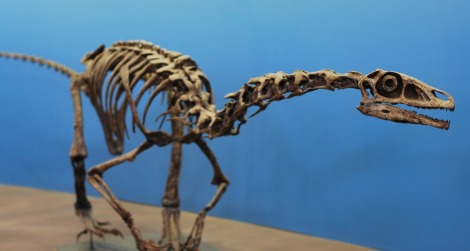
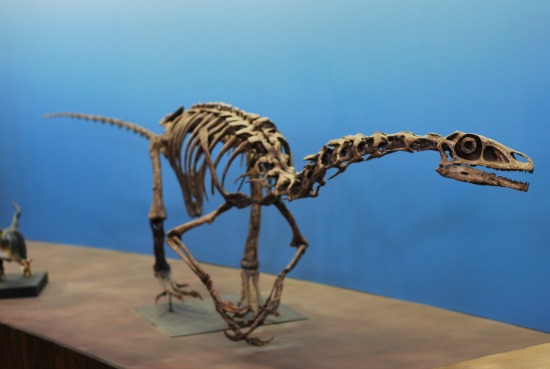
Martharaptor’s affinities are a mystery, but, if the dinosaur was a therizinosauroid, it probably looked like its cousin Falcarius (pictured here at the old Utah Museum of Natural History). Photo by the author.
What is Martharaptor? That’s the question raised by paleontologists Phil Senter of Fayetteville State University, Jim Kirkland and Don DeBlieux of the Utah Geological Survey in their description of the previously-unknown dinosaur, published last week in PLoS One. Too little of the creature was preserved to be sure, but the enigmatic theropod may belong to one of the strangest dinosaur lineages of all time.
Martharaptor greenriverensis is another Utah dinosaur, named after its co-discoverer Martha Hayden–a frequent field volunteer and an assistant to the Utah state paleontologists for over two decades. The theropod’s remains were found in the roughly 121-million-year-old rock of the Cedar Mountain Formation near the town of Green River. Unfortunately, the dinosaur’s body didn’t remain in articulation, but the size and distribution of the bones led Kirkland, DeBlieux and Senter to believe that the Martharaptor bones come from a single animal. The partial skeleton includes parts of the forelimbs and hindlimbs, aspects of the hip, a scapula, several hand claws and other fragments.
Other theropod dinosaurs have been found in the same level of the Cedar Mountain Formation before. Previously, Kirkland and other paleontologists found at other sites a small coelurosaur named Nedcolbertia, an unnamed dromaeosaur and the famous Utahraptor. But Martharaptor isn’t quite like these dinosaurs. While the authors of the new study state that their conclusion is provisional, and awaits discovery of a better specimen, Martharaptor seems to resemble the tubby, fuzzy therizinosauroids. These omnivorous and herbivorous dinosaurs descended from a carnivorous ancestor and stand out in having long necks, large hand claws and a heavier frame than other coelurosaurs. The scapula and claws of Martharaptor, in particular, resemble those of the therizinosauroid Falcarius–a form found lower down in Utah’s Cedar Mountain Formation.
At the moment, we can be sure that Martharaptor belonged to the coelurosaur branch of the theropod family tree. Beyond that, though, the dinosaur’s identity, biology and evolutionary history are intertwined mysteries. Paleontologists have to find a better skeleton, but the discovery of Martharaptor itself testifies to the richness of eastern Utah’s badlands. New dinosaurs are being named from Cedar Mountain Formation quarries every year, and there are a few dinosaurs from the formation’s 30-million-year span that are already awaiting description. We’re only just starting to become acquainted with Utah’s Early Cretaceous dinosaurs.
Reference:
Senter P, Kirkland JI, DeBlieux DD (2012) Martharaptor greenriverensis, a New Theropod Dinosaur from the Lower Cretaceous of Utah. PLoS ONE 7(8): e43911. doi:10.1371/journal.pone.0043911
/https://tf-cmsv2-smithsonianmag-media.s3.amazonaws.com/accounts/headshot/RileyBlack.png)