
The Bat-Winged Dinosaur That Never Was
Just when naturalists began to suspect that birds might be dinosaurs, one researcher put forward a truly strange idea of what early bird ancestors would have looked like
/https://tf-cmsv2-smithsonianmag-media.s3.amazonaws.com/accounts/headshot/RileyBlack.png)
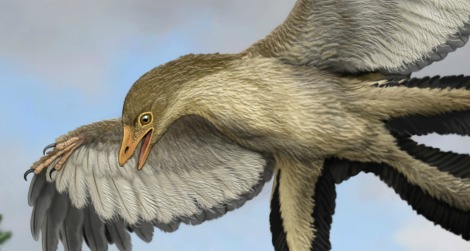
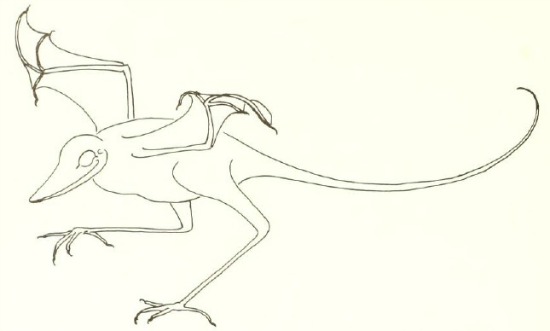
Pennycuick’s hypothetical Archaeopteryx ancestor, with membranes between the fingers and no feathers. From Pennycuick, 1986.
How dinosaurs took to the air is one of the longest-running debates in paleontology. Ever since the first skeleton of Archaeopteryx was discovered in 1861, researchers have wondered what the archaic bird might tell us about how flight evolved and how the feathery creature connected its reptilian ancestors with modern birds. Even now, when we know that birds are a feathered dinosaur lineage, the origins of flight remain a contentious issue constrained by the available fossil evidence and our ability to reconstruct how prehistoric creatures moved.
Before paleontologists confirmed that birds are dinosaurs, though, various researchers came up with speculative schemes to explain how birds originated. Naturalist William Beebe, for one, proposed that bird ancestors started off as parachuting reptiles that benefited from expanded scales (his conception of protofeathers). Other scientists came up with their own ideas, imagining everything from seagoing protobirds to gliding reptiles.
When ornithologist Colin Pennycuick wrote his paper “Mechanical Constraints on the Evolution of Flight” in 1986, however, paleontologists were warming to the idea that Archaeopteryx spanned the evolutionary space between living birds and dinosaurs like Deinonychus. This narrowed down the list of early flight scenarios to hotly debated “ground up” or “trees down” hypotheses for the origin of flight, and raised the possibility that feathers evolved among non-avian dinosaurs first. Within these debates, Pennycuick put forward his own idiosyncratic proposal.
Pennycuick believed that birds took to the air by way of the trees. Bird ancestors progressively shrunk in size over time, he believed, and started gliding before they could actually fly. He couldn’t envision that birds evolved from a running, leaping ancestor, as other researchers suggested. For Pennycuick, flight was a gradual extension of gliding.
But what did the ancestor of Archaeopteryx look like? Pennycuick assumed that feathers and flight were closely tied together–something that is not true at all and had already been pointed out by paleontologist John Ostrom in his work on bird origins. Feathers are important for display and insulation and were only later co-opted for flight. All the same, Pennycuick needed a gliding–but featherless–ancestor for Archaeopteryx to make his idea work. So he conjured something really weird.
Pennycuick was puzzled by the clawed fingers of Archaeopteryx. Why would a bird have differentiated fingers? Rather than look at the fingers as just a holdover from dinosaurian ancestry, Pennycuick assumed that they had some kind of flight function. The fingers of Archaeopteryx, he proposed, “could have supported a small, batlike hand-wing.” Such a structure would have been inherited from the featherless ancestor of Archaeopteryx, he proposed, “constituting the main wing area in the stage before feathers were developed.”
Where the feathers of Archaeopteryx came from, Pennycuick couldn’t say. He mused on the need for feathers in the transition from gliding to flight, but he didn’t offer an explanation for how feathers evolved. He only mentioned that “The development of down feathers as thermal insulation is a separate process that may or may not have preceded the development of flight feathers.”
The fuzzy dinosaur Sinosauropteryx proved Pennycuick wrong a decade later. Paleontologists like Ostrom and artists such as Gregory S. Paul had long suspected that feathers were a widespread trait among bird-like theropod dinosaurs, and a flood of exceptional fossils has shown that feathers and their precursors have a deep, deep history. Dinofuzz, or structurally similar body coverings, might even go back to the root of the Dinosauria. How evolutionary forces molded those adornments, however, and what drove the evolution of flight feathers, remain as aggravatingly contentious as ever.
Reference:
Pennycuick, C. 1986. Mechanical Constraints on the Evolution of Flight. Memoirs of the California Academy of Sciences. 8, 83-98
/https://tf-cmsv2-smithsonianmag-media.s3.amazonaws.com/accounts/headshot/RileyBlack.png)