
Why Did Plant-Munching Theropods Get So Big?
Were these Late Cretaceous dinosaurs just the culmination of an evolutionary trend towards ever-larger body size or was something else at work?
/https://tf-cmsv2-smithsonianmag-media.s3.amazonaws.com/accounts/headshot/RileyBlack.png)
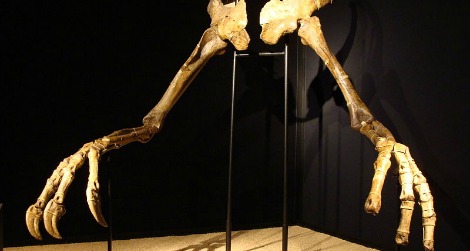

The arms of the huge ornithomimosaur Deinocheirus. How did such herbivorous theropods get to be so big? Photo by Eduard Solà, image from Wikipedia.
When I was first becoming acquainted with dinosaurs in the mid 1980s, “theropod” was synonymous with “carnivorous dinosaur.” Large or small, from Tyrannosaurus to Compsognathus, every theropod I knew of sustained itself on the flesh of other organisms. But it was just about that time that new discoveries and analyses revealed that many theropod dinosaurs were omnivores, or even herbivores. The ostrich-like ornithomimosaurs, beaked oviraptorosaurs and utterly bizarre therizinosaurs, in particular, embodied a switch from an ancestral meat-filled diet to one more reliant of fruit and foliage. Not only that, but these herbivorous theropods grew almost as large as the biggest carnivores–the ornithomimosaur Deinocheirus, the ovriraptorosaur Gigantoraptor and Therizinosaurus were all enormous Cretaceous dinosaurs. But why did these plant-chomping dinosaurs become giants?
In the latest of a spate of papers considering herbivorous theropods, paleontologists Lindsay Zanno and Peter Makovicky paired evolutionary trees with mass estimates derived from femora lengths and a bit of number crunching to see if there was any distinct evolutionary pattern that might explain why Deinocheirus and similar herbivorous theropods grew to such large sizes. Were these Late Cretaceous dinosaurs just the culmination of an evolutionary trend towards ever-larger body size–called Cope’s Rule–or was something else at work?
Zanno and Makovicky didn’t find any sign of directional selection for larger body size. Even though the earliest representatives of the ornithomimosaurs, oviraptorosaurs and therizinosaurs in Asia were much smaller than their Late Cretaceous relatives, the paleontologists point out that this signal has probably been biased by preservation. The 125-million-year-old deposits that contain small members of these groups seem to be skewed towards “mid-sized vertebrates,” the authors point out, and don’t seem to preserve larger dinosaurs that might belong to the same lineages. Indeed, therizinosaurs of about the same age from North America, such as Falcarius, were larger than species in Asia, meaning that herbivorous dinosaurs might have occupied a range of body sizes and evolved larger body sizes at multiple intervals. There was no simple, straight-line trend of bigger and bigger bodies through time.
Nor did a herbivorous lifestyle alone seem to account for gigantism among these dinosaurs. Even though big herbivores gain particular benefits from their size in terms of breaking down tough, low-quality foods more efficiently, Zanno and Makovicky doubt that this relationship drove the evolution of increased body size in the dinosaurs. Instead, they favor “passive processes” that might be tied to ecology and whether these dinosaurs were omnivores more than herbivores. And, as the paleontologists stress, the pattern relies on how complete we think the dinosaur record is. Some ecosystems might be preferentially preserving larger or smaller dinosaurs, which has the potential to skew the big picture. While Zanno and Makovicky ruled out some possibilities, we still don’t really know what accounts for the multiple herbivorous theropod growth spurts.
Post-Script: After four years working with Smithsonian magazine’s wonderful crew, and over 1,000 posts about various aspects of dinosauriana, it’s time for me to move on. I’ll be leaving Dinosaur Tracking next month. Don’t fret, I’ll still be digging into dinosaur science, but I’ll be at a new blog elsewhere on the web (stay tuned for details). I am deeply indebted to my editors Brian Wolly, Sarah Zielinski and, of course, Laura Helmuth (now doing a great job at Slate), as well as the rest of the Smithsonian staff for inviting me to come here and geek out about dinosaurs every day. And many thanks to all of you–the readers and commenters who have helped make this blog a success. You have all made blogging for Dinosaur Tracking an absolute pleasure.
Reference:
Zanno, L., Makovicky, P. 2012. No evidence for directional evolution of body mass in herbivorous theropod dinosaurs. Proceedings of the Royal Society B. 280. doi: 10.1098/rspb.2012.2526
/https://tf-cmsv2-smithsonianmag-media.s3.amazonaws.com/accounts/headshot/RileyBlack.png)