December 21, 2011
Why Did Jewish Communities Take to Chinese Food?
![]()

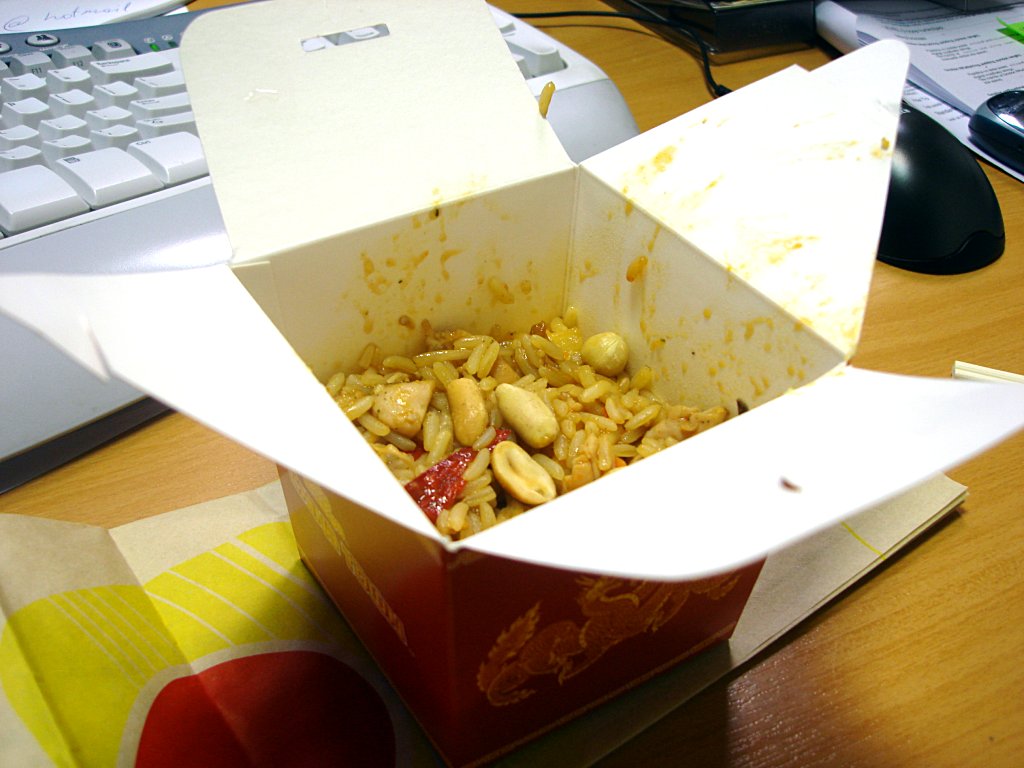
For immigrant Jewish populations, Chinese food offered an exotic spin on familiar foods. Image courtesy of Flickr user dslrninja.
The custom of Jewish families dining out at Chinese restaurants, especially on Christmas Day, has long been a joking matter. “According to the Jewish calendar, the year is 5749,” one quip goes. “According to the Chinese calendar, the year is 4687. That means for 1,062 years, the Jews went without Chinese food.” Even Supreme Court Justice Elena Kagan made light of the tradition during her Senate Judiciary Committee hearings. Granted, Chinese restaurants are typically among the few businesses open on December 25th, but it turns out that there are historical and sociological reasons why these two cultures have paired so well.
In a 1992 study, sociologists Gaye Tuchman and Harry G. Levine focused their attentions on New York City, where there are substantial Jewish and Chinese immigrant populations. No matter how different the cultures may be, they both enjoy similar foods: lots of chicken dishes, tea and slightly overcooked vegetables. For Jewish newcomers, Chinese cooking offered a new twist on familiar tastes. Then there’s the matter of how food is handled, a matter of great importance to observant Jews. Chinese food can be prepared so that it abides by kosher law, and it avoids the taboo mixing of meat and milk, a combination commonly found in other ethnic cuisines. In one of their more tongue-in-cheek arguments, Tuchman and Levine wrote that because forbidden foods like pork and shellfish are chopped and minced beyond recognition in egg rolls and other dishes, less-observant Jews can take an “ignorance is bliss” philosophy and pretend those things aren’t even in the dish.
Chinese restaurants were also safe havens, the sociologists observed. Jews living predominantly Christian parts of the city might have to contend with the longstanding tensions between those groups. Furthermore, an Italian restaurant, which might bear religious imagery ranging from crucifixes to portraits of the Virgin Mary, could make for an uncomfortable dining experience. A Chinese eatery was more likely to have secular decor.
There was also the sense among some Jewish participants in the study that Chinese dining, with exotic interiors and the strange-sounding menu items, was a delightfully non-Jewish experience. Furthermore, like visiting museums and attending the theater, Chinese restaurants were seen as a means of broadening one’s cultural horizons. “I felt about Chinese restaurants the same way I did about the Metropolitan Museum of Art,” one of the study’s unnamed interview subjects remarked. “They were the two most strange and fascinating places my parents took me to, and I loved them both.”
For a fuller explanation on how this dining trend came about, you can read Tuchman and Levine’s study online [PDF]. And if you have memories of a Chinese restaurant experience, share them in the comments section below.
Sign up for our free email newsletter and receive the best stories from Smithsonian.com each week.


This is very interesting. I’ve always wondered why Jews dine on Chinese restaurants during Christmas but I’ve never gave it much thought.
That makes so much sense on the Kosher aspect!! I had my own hypotheses on the Chinese on Christmas thing, but this article covers it all.
I could think of a few other factors which might contribute to that affinity.
1) The typical Chinese restaurant dining style is family-oriented. Sharing a number of dishes among all the diners at a table is standard. When indulging in an unfamiliar cuisine, the ability to share it (without fuss or raised eyebrows) makes it into a more entertaining and bonding experience.
2) All non-Chinese people are foreigners in a Chinese restaurant, and are treated with approximately the same respect as each other. That offers a degree of equality which hasn’t always been available to Jews in this society, and a degree of comfort that comes along with that treatment. Moreover, see (3).
3) Increased familiarity with the cuisine brings increased respect (or at least comfort, knowing they’ll be able to please the customers) from the proprietors, creating a virtuous cycle that keeps happy customers coming back.
So, I think a big part of what makes Jews and Chinese restaurants into a couple is hospitality. As for the “overcooked vegetables,” I would dispute that. The vegetables in Chinese cooking, even Chinese-American style cooking, are steamed or sauteed, not boiled into submission. That Jews like and eat fresh vegetables (however cooked) and aromatic herbs is not in dispute.
My thought was always that Chinese restaurants were simply the only restaurants open on Christmas day.
Yes, all well and good, but do the Chinese eat at Jewish restaurants at Tet?
My wife and I are Baptist and had Chinese for lunch today!
I remember dining with my family — sibs, cousins, parents, aunts, uncles, grandparents — at a Chinese restaurant in Queens NY many years ago. The older-style Chinese menu, with its “one from Column A, two from Column B” choices, provided another opportunity for arguments, which must have been an attraction for my relatives.
I also remember my cousins ordering pistachio ice cream for dessert, not because they liked that flavor, but because the enjoyed hearing the waiter trying to say “pistachio”.
There is another reason. There is almost no milk used in the preparation of most of Chinese cuisine, no matter from what province.
My parents always took my family to Chinese restaurants to celebrate birthdays. It was food my mother never cooked at home and that was more appealing and exotic to her than typical “American” fare.
I think chew (#8) is on to something. I know many Jews who are more comfortable eating shellfish or bacon than mixing dairy and meat.
I think it was the Chinese tea and fortune cookies that were the main attraction.
For additional information on this topic, read this touching, humorous and sometimes sad book:
The Fortune Cookie Chronicles by Jennifer 8 Lee. There is a chapter devoted to Jews and Chinese food but the entire book and the history of Chinese food in America is fascinating.
http://www.fortunecookiechronicles.com/
We never ate at Chinese restaurants on Christmas or other times–they weren’t kosher. But it was a nice day because most of us had the day off and unlike other Jewish holidays we could travel to visit each other. We ate standard Jewish American kosher food.
And now there are kosher Chinese restaurants which I occasionally patronize; actually I prefer Mediterranean food.
And now just about any cuisine has its kosher counterparts–great.
My mom just told me that we went to Chinese Restaurants when it rained- not certain why- but that was the plan-I also remember eating tomato egg drop soup- can’t find it any longer- and for those from LI- August Moon in Mahasset was the place to go in the 60′s & 70′s!
I had an aunt from NY who found herself living in Chicago. Chinese food was her favorite, so for her, it went beyond Christmas Day! I learned to like it for her sake. Now….love it! I heard about the whole deeper connection from my daughter who took a “Food and Rabbinics” class in college. Worth the tuition!
I wonder if this preference for Chinese cuisine has extended to other Asian restaurants and their cuisines.
Because my daughter and her children are Cambodian, and I am Jewish, I find myself eating in a variety of SE Asian restaurants between Olympia and Seattle, WA: Thai, Vietnamese, Cambodian – or a mix of the three.
Many Anglo Jews find the Chinese-American restaurant to be more American than Chinese these days, and have switched to other Asian cuisines – even South Indian (but not Filipino, for some reason): here in Lacey, WA, an Indian and a Filipino restaurant operate side-by-side quite profitably.
Bob Godwin,
Lacey, WA
“A Chinese eatery was more likely to have secular decor.” – not sure if I’d use the term “secular”. Buddhist and Taoist imagery was probably just so exotic that most non-Asians just saw it as more kitschy than as religious.
Most people are over thinking this. The reason that Chinese food on Christmas for Jews became a tradition has everything to do with “blue laws” and very little to do with culture and dietary laws. Folks over 50 can remember a time when on Sundays and major Christian holidays ALL businesses were closed except for delicatessens and Chinese restaurants. On Christmas, the larger society ground to a halt. The kids were off of school and the majority Christian culture was focusing all their attention on hearth and home and church. What to do? The movie theaters were empty but open. So Mom, Dad, and the kids went out to catch a show and pass some time. The only places that were open and serving food were Chinese restaurants. These “unchristmasy” entertainment options were so consistently limited in most large towns and cities prior to 1970 that it became a custom that was anticipated with a bit of pleasure. A time to get together with fellow non-Christians and have a pleasantly ironic “outsiders unholiday”. This article is vastly overthinking this. Did the guy who wrote this article even ask any Jews over 50 about this? I kind of doubt it.
Lisa Shaffmaster hit the nail on the head; she should become a carpenter for her accuracy.
Me? At 72, I believe that qualifies me as being over 50, I lived in Connecticut. It was so blue that it went for the Democrats last year .
The blue laws to which she refers to is potentially the real reasons, but it does not explain states that were sans blue laws.
My brother and I looked forward to Christmas because we knew we could have some of our favorite foods…Chinese. Even today, my taste for Asian cuisine is only increasing with some of the foods that are now coming to the fore. Sushi, and other marvelously tasty foods from the Asian countries delight my taste buds.
Keep in mind that the three major monotheistic religions in the world are Eastern: Judaism, Christianity, and Islam. Israel is in Asia, not Europe.
Methinks that Lisa missed one thing…many Chinese dishes taste like Jewish food. Won Ton soup anyone?
“Yes, all well and good, but do the Chinese eat at Jewish restaurants at Tet?”
Tet is a VIETNAMESE holiday.
Here’s the reason why. Sweet and Sour chicken!
My mother (born 1913)who lived in Chicago with her parents, told me about being sent up an alley to get chop suey. My grandmother, who was an immigrant from Hungary, did not keep a kosher house.
Clearly the eating of Chinese food by Jews has a long and enigmatic history. It would be interesting to focus on when Chinese food became available in Jewish neighborhoods and how that impacted eating habits.
Has anyone seen the GEICO commercial that featured a “scientist” holding a test tube while the voice-over told us that they (GEICO) sent him out to get data on why people were switching to GEICO? Asked to give his results, the “scientist” said “Maybe they just like to save money.”
Maybe Scott Berkowitz and Top Secret have the answer – Jews like Chinese food for the same reason everyone else does – it just tastes good!
In the section of Brooklyn that I grew up in, you knew if you were either in a Jewish neighborhood or Italian neighborhood by the ratio of Chinese restaurants or pizzerias to the surrounding blocks, more Chinese restaurants & take-outs, meant you were in a predominantly Jewish area, more pizzerias, it was Italian. We ordered in Chinese food a lot in those days, so it was always a treat to eat out in one of our favorites, and there were several to choose among. In fact, those restaurants were so good, that Mayor Beame, would come in from Manhattan, to eat at his favorite, Richard Yee’s on Avenue U & skip Chinatown entirely. As a Brooklyn College student with limited funds, my friends & I would walk off campus to the local Chinese restaurant for their lunch menu specials. For just a couple dollars, we could get a full meal, including soup, rice, egg roll & unlimited tea.
I think Jonathan Ames put it best: “I never understood the stereotype about Jews liking Chinese food. I wasn’t aware there was a kind of food we *don’t* like.”
When I read the title of this article, I was sure there would be some mention of the connection with Shanghai as the port of last resort for many Jews fleeing Nazi terror. When noone else would take them in, Shanghai set up a section of town for Jews to reside in, and I supposed that many who were thus spared would have picked up a taste for Chinese food there, prior to immigrating to the West.