August 18, 2011
One Man Against Tyranny
![]()

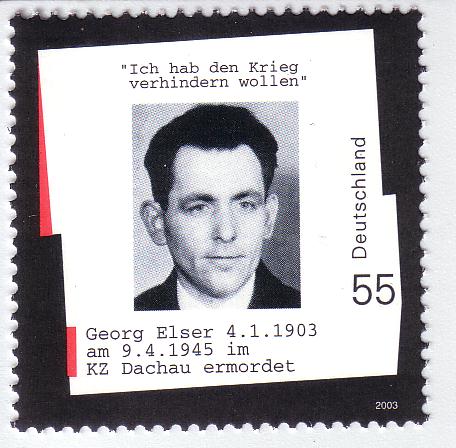
Georg Elser, whose attempt to kill Hitler came within moments of succeeding, commemorated on a stamp. The German phrase means "I wanted to prevent war." Image: Wikicommons
Maria Strobel could not believe it of her Führer. Adolf Hitler and his party—a group of senior Nazis that included Heinrich Himmler, Joseph Goebbels and Reinhard Heydrich—had spent more than an hour in her Munich bierkeller. Hitler had delivered a trademark speech, and, while they listened, Himmler and the others had run up a large beer bill. But the whole group had left in a hurry—leaving the tab unpaid and Strobel untippped.
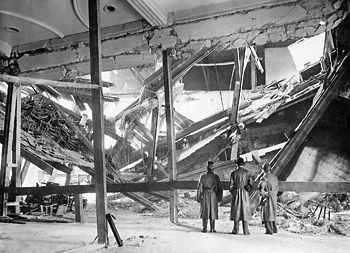
Much annoyed, the Bavarian waitress set about clearing up the mess. She had made only a small dent in the pile of steins when, at 9:20 p.m. precisely, there was a huge explosion only a few feet behind her. A stone pillar disintegrated in the blast, bringing part of the ceiling crashing down in a rain of wood and masonry. The explosion hurled Strobel the length of the hall and out through the bierkeller’s doors. Though stunned, she survived—the person closest to the blast to do so. Eight others were not so fortunate, and a further 63 were so badly injured that they had to be helped out into the open air. As they staggered toward safety, the dais where Hitler had been standing eight minutes earlier lay crushed beneath six feet of heavy timber, bricks and rubble.
Hitler always said he had “the luck of the devil,” and during his years in power he survived more than 40 plots to kill him. The most famous of these culminated in July 1944, when Claus von Stauffenberg managed to place a bomb inside the conference room in Hitler’s East Prussian headquarters, the Wolf’s Lair. On that occasion, a table support absorbed most of the blast and the Führer survived to hobble out, his eardrums shattered and his trousers torn to ribbons.
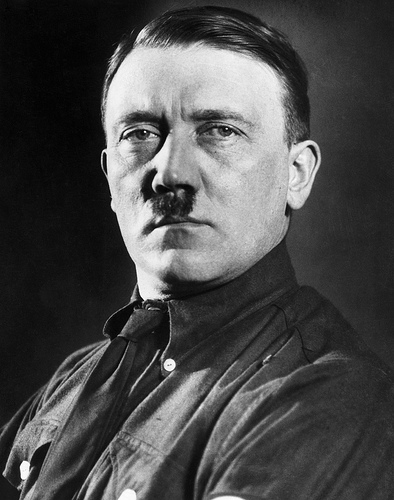
That attempt on Hitler’s life is famous—it was the basis for Valkyrie, the 2008 Tom Cruise film—but it can be argued that it was considerably less astounding, and less courageous, than the bierkeller bombing five years earlier. For one thing, Stauffenberg was well-equipped; he really should have done better with the resources at his disposal. For another, he and his fellow plotters were not convinced anti-Nazis; they may have had an aristocratic disdain for their plebian leader, but their primary reason for wanting Hitler dead was not horror at the barbarism of his regime, but simple conviction that he was leading Germany into the abyss.
The Munich bomb, on the other hand, exploded on November 8, 1939, at the height of the Führer’s popularity and less than three months after the outbreak of World War II—before the final order was given for the invasion of France, and when Russia remained a German ally and the United States remained at peace. Not only that; this bomb was the work of just one man, an unassuming carpenter who was far more principled than Stauffenberg and whose skill, patience and determination make him altogether much more interesting. Yet the Munich incident has been almost forgotten; as late as 1998 there was no memorial, in Germany or anywhere else, to the attempt or to the man who made it.
His name was Georg Elser, and this is his story.
Born in 1903, Elser was just below average height and just above average intelligence. He was not much of a thinker, but clever with his hands: an expert cabinetmaker who never read books, rarely touched newspapers and had little interest in politics. He had voted Communist, and briefly joined the Red Front Fighters’ League—streetfighters who took on their Nazi counterparts, the Brownshirts. But Elser was no Marxist, just a typical member of the German working class in the 1930s. He certainly wasn’t a brawler; for him, the attraction of the Fighters’ League was the chance to play in its brass band. In 1939, the only organization that he belonged to was the Woodworkers’ Union.
Beneath this unremarkable exterior, however, Elser did care—mostly about the way the Nazis and their policies were reducing ordinary Germans’ standard of living. The “economic miracle” that Hitler often boasted of had been achieved at considerable cost. Working hours were long and holidays few. Trade unions and political parties were dissolved or banned; wages were frozen. Meanwhile, members of the Nazi party enjoyed privileges not available to those who refused to join. Elser, who was noted as a perfectionist who took infinite care over his work, found it increasingly hard to make ends meet as real wages declined. Asked later to explain his decision to take on Hitler, he was blunt: “I considered that the situation in Germany could only be changed by the elimination of the current leadership.”
There were only a few signs that Elser might be prepared to take his opposition to Nazi regime beyond the crude jokes and grumbles that his handful of friends indulged in. He refused to listen to the Führer when he came on the radio; he would not give the Nazi salute. When a pro-Hitler parade passed though his home town of Königsbronn, in southwestern Germany, he ostentatiously turned his back on it and started whistling.
Yet Elser never confided to anyone that his views were hardening. He remained almost entirely solitary: unmarried and estranged from his father. And it was typical of the man that when, early in 1938, he finally concluded that something needed to be done about the Führer, he didn’t look for help.
It was then that Elser displayed his hidden qualities. Other anti-Nazis had wavered for years over where, when and how they might get close enough to Hitler to kill him. Elser took a purely practical approach. The Führer was renowned for his security consciousness; he tended to cancel arrangements or change plans abruptly. To have a chance of getting to him, Elser recognized, he needed to know that Hitler would be in a specific place at a particular time. And there was only one annual certainty in the Nazi leader’s program: each November, he traveled to Munich to speak at an elaborate commemoration of the Beer Hall Putsch, the risible 1923 attempted coup that had set his party on the road to power. Surrounded by thousands of Old Fighters—Nazis whose party membership dated to 1922 or earlier—Hitler would swap stories and reminisce before delivering the sort of lengthy speech calculated to rouse his loyalists to a frenzy.
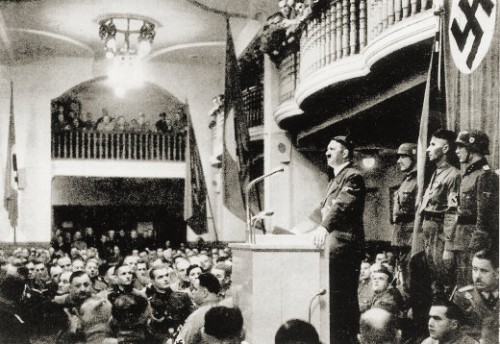
So it was that in November 1938—10 months before the Germans invaded Poland—Elser took a train to Munich and scouted out the Nazis’ celebrations. He visited the beer hall where the putsch had started. Known as the Bürgerbräukeller in 1923 but as the Löwenbräu by 1939, it was a cavernous underground hall, capable of holding more than 3,000 revelers and selected by Hitler as the perfect site for a centerpiece speech. Elser attended the festivities, took note of the cellar’s layout, and was surprised to realize that security was lax. In a typical piece of Nazi fudge, two groups were at loggerheads over which was responsible for the Führer’s safety; Hitler opted for his National Socialist German Workers’ Party over the Munich police, which put Christian Weber in charge of security. But Weber, a fat and corrupt former nightclub bouncer, was not much minded to take the sort of strenuous precautions that might actually have safeguarded his leader. A convinced Nazi, it simply did not occur to him that others might hate Hitler enough to take drastic action of their own.
While Elser was in the bierkeller he noted the stone pillar just behind the speaker’s dais; it supported a substantial balcony along one wall. His rough calculations suggested that a large bomb placed within the pillar would bring down the balcony and bury both the Führer and a number of his chief supporters. The question was how to conceal a device sufficiently powerful to do the job within a piece of solid stonework.
Here again Elser proved to have precisely the qualities needed for the job. Knowing that he had a year to prepare, he went to work methodically, obtaining a low-paying job in an arms factory and taking whatever opportunities presented themselves to smuggle 110 pounds of high explosives out of the plant. A temporary job in a quarry supplied him with dynamite and a quantity of high-capacity detonators. In the evenings, he returned to his apartment and worked on designs for a sophisticated time bomb.
In April 1939, Elser returned to Munich to carry out a detailed reconnaissance. He made sketches of the beer cellar and took more precise measurements. He also visited the Swiss frontier to work out an escape route, finding a stretch of the border that was not patrolled.
That August, as Hitler stoked up tension with Poland and Europe slipped toward war, Elser moved to Munich and began the final preparations for planting his device. The work involved huge risks and revealed an imaginative side to the bomber’s personality that few who knew him realized he possessed. Taking advantage of the Löwenbräu’s lax security, Elser became a regular customer. Each evening he would take his dinner there, order a beer and wait until closing time. Then he would slip upstairs, hide in a storeroom and emerge after 11:30 to get down to the crucial job of hollowing the pillar.
The work was astonishingly painstaking and slow. Working by flashlight, Elser first neatly cut a hole in some wood cladding; this job alone took him three nights. Next he attacked the pillar itself. The noise of a chisel striking stone echoed so loudly through the empty bierkeller that Elser restricted himself to single blows every few minutes, timing the descent of his hammer to coincide with the passing of a streetcar or the automatic flushing of the urinals. Every fleck of stone and piece of dust had to be swept up to leave no evidence of his work; then the panel he had cut out of the wood had to be seamlessly replaced before Elser made his escape through a side exit early the next morning. The carpenter returned to the bierkeller evening after evening, working on his plan for 35 nights in all. On one occasion he was nearly caught; a waiter found him inside the building as the place was opening and ran to tell the manager. Questioned, Elser insisted he was simply an early customer. He ordered a coffee, drank it in the garden and left unmolested.
It was typical of Elser that he labored to produce the most efficient bomb he could. By modifying a clock, he created a timer that would run for up to 144 hours before activating a lever; that would trigger a system of springs and weights that would launch a steel shuttle into a live rifle round embedded in explosive. Next, Elser added a second timer to act as a fail-safe, then enclosed the whole bomb in a beautifully built box designed to fit precisely into the cavity he had excavated. He minimized the risk of discovery by lining the cavity with cork, which muffled the noise from the bomb’s clock, and then placing a sheet of tinplate inside the wood panel to prevent any bierkeller worker putting up decorations from unknowingly driving a nail into his delicate mechanism. When he was finished, he returned to the bierkeller with the box he’d made and discovered that it was fractionally too big. He took it home, planed it down and went back again to make sure it fit.
Elser’s research had revealed that Hitler always began his speech in the Löwenbräu at about 8:30 p.m., spoke for about 90 minutes, then stayed to mingle with the crowd. On that basis, he set his bomb to explode at 9:20 p.m.—midway, he calculated, through Hitler’s customary tirade.
Finally, having planted the bomb three days before Hitler was due, sealed it in and removed the last traces of his work, Elser returned to Munich two nights later— just 24 hours before Hitler was due to speak. Then, at a time when it was entirely reasonable to suppose that even the inefficient Weber might have stepped up his security a little, he broke back into the bierkeller and pressed his ear against the pillar to check that his device was still ticking.
Had Elser paid closer attention to the newspapers, he might have felt that all his work had been wasted—shortly before Hitler was due to deliver his bierkeller speech, he canceled the arrangement, only to reinstate it the day before he was due to travel. But then, had Elser read the newspapers, he would also have realized that, as a concession to Hitler’s urgent need to be in Berlin, his speech had been rescheduled. It would now begin at 8 p.m. and last for little more than an hour.
In the event, Hitler stopped speaking at 9:07 p.m. precisely. He declined the efforts of the Old Fighters to have him stay for the usual drink, and at 9:12 hurried out of the Löwenbräu and back to the Munich railroad station. Eight minutes later—when Elser’s bomb exploded in a blinding flash, right on time—the Führer was boarding his train with all his retinue and most of the bierkeller crowd had left the building. It was not until the Berlin express halted briefly at Nuremburg that an incredulous Hitler learned how close he had come to death.
By 9:20 Elser, too, was far from the Löwenbräu. That morning he had taken a train for Konstanz, close to the Swiss border, and when darkness fell he set out to walk into Switzerland. But if Hitler’s luck held that night, his would-be assassin’s ran out. Elser’s April reconnaissance had taken place in peacetime; now, with Germany at war, the border had been closed. He was arrested by a patrol as he sought a way through wire entanglements. Told to turn out his pockets, he quickly found himself in trouble. Perhaps hoping to persuade the Swiss authorities of his anti-Nazi credentials, he was carrying with him sketches of his bomb design, a fuse, his Communist party membership card, and a picture postcard of the Löwenbräu—an incriminating collection of possessions at the best of times, and worse when, minutes later, an urgent telegram arrived with news from the bierkeller.
Elser was taken back to Munich for interrogation. Hitler himself took a close interest in the bomber, asking to see his file and commenting favorably on his “intelligent eyes, high forehead and determined expression.” But for Hitler, the sophistication of the plot was evidence that the British Secret Service was behind it. “What idiot conducted this investigation?” he demanded when told that Elser claimed to have worked alone.
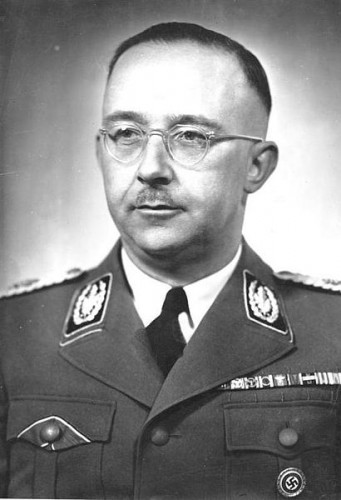
The bomber was subjected to beatings, hypnosis and torture in an attempt to get at Hitler’s truth; he stuck to his story, and even reproduced a version of his bomb to show the Gestapo he had built it. Eventually, the historian Roger Moorhouse relates, Himmler himself arrived in Munich to continue the interrogation:
“With wild curses, [he] drove his boots hard into the body of the handcuffed Elser. He then had him … taken to a lavatory … where he was beaten with a whip or some similar instrument until he howled with pain. He was then brought back at the double to Himmler, who once more kicked and cursed him.”
Through all this, the carpenter stuck to his story, and eventually the Gestapo gave up and packed him off to Sachsenhausen, a concentration camp. Strange to say, Elser was not executed or even badly treated there; although held in solitary confinement, he was allowed a bench and his tools, and kept alive until the last month of the war. It is generally supposed that Hitler wanted him alive to star in a war crimes trial in which he would have implicated the British in the Munich plot.
There are those who say that the Nazis were too efficient to allow a lone bomber to hurt them in this way, and that the whole affair had been stage-managed to provide Hitler with an excuse to clamp down further on the left. Martin Niemöller, a Protestant pastor held at the same camp as Elser, would later testify that he had heard this story on the prisoners’ grapevine; Elser himself is supposed to have confessed to it. But now that we have the transcripts of the interrogation, and better understand the inefficient and chaotic way that Hitler ran the Nazi state, this theory no longer rings true. The Nazis, in wartime, needed no reason or excuse to stamp out resistance. Today, historians accept that the attempt on the Führer’s life was serious, and that Elser acted alone.
There remains the vexing question of how, or whether, Elser’s life should be celebrated. Can an act of terrorism ever be justified, even when its purpose is to kill a murderous dictator? Might the innocent lives the bomber took in the Löwenbräu have been balanced by those that could have been saved had Hitler died before the war was fully underway?
Himmler, for one, had no desire to wait for those questions to be answered. In April 1945, as the Americans, British and Russians closed in, he had Elser taken from his cell and shot. A week later, the death was reported in the German press, blamed on an Allied air raid.
In the frantic last days of the Thousand Year Reich, few would have noticed the announcement. And six years and more than 60 million deaths later, fewer still would have recalled the name of Georg Elser.
Sources
Michael Balfour. Withstanding Hitler in Germany 1933-45. London: Routledge, 1988; Martyn Housden. Resistance and Conformity in the Third Reich. London: Routledge, 1997; Ian Kershaw. Hitler: Nemesis, 1936-1945. London: Penguin, 2000; Roger Moorhouse. Killing Hitler: The Third Reich and the Plots Against the Führer. London: Jonathan Cape, 2006.
Sign up for our free email newsletter and receive the best stories from Smithsonian.com each week.


Fascinating story; thank you for pulling Georg Elser back into the spotlight. I suppose the Nazis must have moved him around after his capture, for the text says he was originally sent to Sachsenhausen but the image of the German stamp indicates he was killed at Dachau. That 2003 stamp also seems a kind of tribute to Elser’s actions, so happily his story still catches some attention in Germany. (Also, one little typo–”serous” when “serious” was intended.) Again thanks for the great article.
Thank you – typo fixed.
Yes, Elser was moved to Dachau – a much more deadly place than Sachsenhausen, which was used mainly to hold political prisoners – early in 1945. More on this here. And the now discredited theory that Elser was a Nazi pawn and/or working with British intelligence is explored in detail here.
Great article! I appreciate that you bring up the dilemma of celebrating the life of someone who was trying to kill Hitler but was also willing to kill many others along with him. It’s worthy of discussion, particularly as I found myself gripped with Elser’s precision and disappointed at his failure…
Those visiting Germany before the end of October may also like to know that a special exhibition commemorating Elser is on at the Sachsenhausen Memorial and Museum, just outside Berlin:
What a focused individual, who would have found himself demonized had the Nazis prevailed, but now exists in a twilight zone reality. It is a shame he did not succeed, the world would be a different place now.
I think it’s hard for many Americans to comprehend these times and what it took for Georg, and other potential assassins, to even take that first step…
It’s hard to imagine being a non-Nazi in Germany of that period, unfortunately not too hard these days.
Great story, but I cannot believe that the writer would question whether an act of terrorism can ever be justified, even when its purpose is to kill a murderous dictator like Hitler. In light of the evil that Hitler already was known for there is every justification. Not to mention that the hall was filled with all of his minions and fellow Nazis. Just as in any conflict, there would be unfortunate and tragic loss of civilians, in this case the servers and waiters. They certainly could not have been asked to leave the room before the blast.
@ Alan
The vast majority would agree with you, I know, but, from a philosophical standpoint at least, the question is valid.
And while it’s true that most of those whom Elser expected to kill would have been Nazis, as things played out, the majority of his victims were actually ordinary employees of the bierkeller. Some may have been supporters of the NSDAP, others perhaps were not; it’s very unlikely any were directly responsible for serious crimes. In that sense the innocent weren’t merely collateral damage. Does that make a difference?
It’s sad lately that Hollywood can’t seem to come up with an original movie idea. Just open up a history book once in a while. it’s all out there. I could see Edward Norton perhaps as the Lead.
Reminds me of the controversy over America’s John Brown. Sure- freeing slaves is a great goal- but he was starting a violent revolution.
[...] MAN WHO almost killed Hitler. “The Munich bomb, on the other hand, exploded on November 8, 1939, at the height of the [...]
Wonderful article.
I do think your definition of terrorism needs some work though. Targeting murderers like Hitler and his confederates in 1939 can hardly be termed terrorism if the word is to retain a useful meaning. Collateral damage is always regrettable but it is not the same thing as targeting the innocent/non-combatants. Call it political violence if you wish, but terrorism? Terrorism is politcal violence that specifically targets the innocent/non combatants or targets nobody specific at all. Targeting a political elite or miltary figures may be assasinations, but they aren’t terrorism.
While I would have liked the outcome had he succeeded, Elser at the time didn’t know just how murderous Hitler would turn out to be. As the article points out, Elser simply wanted Hitler dead because he felt Hitler was leading Germany into an abyss. That doesn’t sound much different than rhetoric we have been hearing about American presidents for the last decade or so, and yet we’d condemn anyone who resorted to attempted assassination of those they disagreed with. So – while in retrospect the outcome – a dead Hitler – would have been (in my opinion) great, Elser’s motives don’t really seem all that different from any other person who seeks to assassinate political leaders with whom they disagree. (And just to be clear – knowing what we know now about Hitler, I’d have done what Elser attempted)
Very interesting, I had never heard of this. Thanks for publishing this.
So why did Elser run, instead of just going back to his daily life and keeping his mouth shut? Was there something about the bomb that pointed back to him? I suppose the bierkeller staff might eventually remember that someone came and had dinner every night, but still (going by the article), it seems his attempt to dash across the border was not as well thought out as the rest of his plan.
“It is a shame he did not succeed, the world would be a different place now.”
Yes and most likely a far worse place. A murdered Hitler would have been a martyred Hitler. The Nazis would have still retained power and WWII would have still proceeded except with a more cautious leadership. While Hitler correctly read the timidity of the Allies at the start of the war and successfully exploited it, those early successes lead to the numerous disastrous decisions he made later in the war that greatly helped the Allies.
A Nazi Germany without Hitler would have been more cautious and started the war later when they were better prepared as most generals called for and were overruled by an impetuous Hitler. Once the war started Europe would have still been overrun and it would have been very, very unlikely that Germany would have turned to Russia before England had been dealt with one way or another. Without a neutralized England at it’s rear the prospect for Russia would have been very, very grim. Even with an active England, the strategy used in Russia would have been much more sane without the constant objective switching Hitler engaged in and the crazy no-retreat orders. The German casualties on the Russian front would still have been horrendous but Russia would have suffered even more that it did in reality and most likely would have been crushed or at the very least greatly diminished in a peace settlement.
So the most likely outcome of a successful assassination attempt at that time would have been a Nazi empire controlling Europe and some if not all of Russia. The death camps would have killed off far more people and the war itself would have killed far more people. All in all killing Hitler at that point in history would have been really, really bad. Now if Hitler had been killed before assuming control of Germany that would have most likely changed things for the better.
Julius:
It is not necessarily true that the outcome would have been better. As in the 1944 attempt, if it had succeeded the world might have had a more competent leader to contend with. It is unlikely Rommel would have been ready to surrender to the Allies, but rather would have prosecuted the war with much greater ability.
Wonderful article; Georg Elser’s willingness to risk all and the enormous lengths to which he went in order to target Hitler deserve to be remembered by history.
Jack, re: “It is not necessarily true that the outcome would have been better.” In my view, whether or not a successful assassination would have had net positive or negative effects turns on who would have taken Hitler’s place in the event of his death. Famous as a micromanager, Hitler meddled constantly in the war effort, down to the level of keeping discretionary control over whether or not reinforcements could be deployed in specific battles (as with German armor at Normandy), and what weapons were produced and how (It was Hitler who decreed that the Me-262 be a bomber, and not an interceptor, to name one example). His interference often worked to the advantage of the Allies. If Hitler had been killed, and replaced by someone equally ineffective, such as Goering, the assassination might have been to the good. However, if someone like Himmler had taken control, things could have gone even worse for Europe’s Jews and occupied Europe. If the OKW had supplied the next leader, aka Rommel or perhaps Von Rundstedt, the war might have ended sooner.
As for whether or not it was permissible to target Hitler, there shold be no question that it was. Do not forget that a precedent had already been set by the successdful SOE assassination of the man many believed would be Hitler’s successor – Reich-Protector Reinhardt Heydrich, aka “The Butcher of Prague.” Lidice was a terrible retribution, but the opportunity had to be taken. Innocent lives may have been taken in an attempt on Hitler’s life, but weighing the costs and benefits is part and parcel of any espionage or military operation. There’s no denying it is an ugly business, but such choices have to be made in war.
Tblakely, re: “So the most likely outcome of a successful assassination attempt at that time would have been a Nazi empire controlling Europe and some if not all of Russia. The death camps would have killed off far more people and the war itself would have killed far more people.” You have no way of knowing this; your post is speculation – as any conjecture of alernate history must be. To take the USSR for example, another Nazi leader might have had the strategic vision not to invade Russia at all. Hitler’s other big blunder was to declare war on the U.S. after Pearl Harbor; had he not done this, the “Pacific First” faction of FDR’s team might have had a bigger voice in our operations. PM Churchill, of course, was working overtime to get the USA into the war as an ally, but there was also considerable sentiment to concentrate on the Pacific and leave Europe to solve its own problems. Hitler also erred in starting the war when he did, in Sept. 1939; previously, German warplanners had set the mid-1940s as their time table to go to war, and their preparations were not yet compete… the army, navy and air force were not yet fully-equipped or modernized. Example: the Germans still relied on millions of horses, since only the top-line units were fully mechanized.
No doubt this is an interesting exercise in “what if” history…
What terrorism?
Georg did not bomb to incite terror in the civilian population. He bombed a specific military target, accepting that there would be collateral damage. Thought of that way, Georg was no more a terrorist than was the 8th Air Force and less of one than the British Bomber Command which aimed at “targets” far less specific than Georg’s.
Tblakely:
It’s never too productive to play the “what if” game with history, but I believe you’re wrong in assuming the world would have been worse off had Elser assassinated Hitler. That’s especially the case had the bomb also taken out the top ranks of the Nazi leadership.
The NDSAP was clearly a one-man show, and it’s hard to believe it would have stayed focused on Hitler’s dreams of death and conquest, particularly if the ambitious Himmler and Goering also had died in Munich. Nobody else in the Party — or all of Germany — had the charisma, daring or standing to pull off what Hitler did.
For all we know, the cooler heads in the Abwehr (no friend to Hitler)would have taken control and quickly moved to strike an armistice with the Western powers. At that point, with all the bloodshed having been confined to Poland, an accord certainly would have been possible.
As for what would have happened next, it’s anyone’s guess, The Reich by then had subsumed Austria and Czechoslovakia, and those gains alone would have satisfied most rational leaders. (Of course, any armistice would have had to address the fate of conquered Poland, but the geopolitical problems posed by that nation’s partitioning between Germany and the Soviet Union are far beyond my ken.)
In any event, it’s hard for me to shed any tears for Russia, without whose complicity the horror of 1939-45 would never have occurred.
This was a great article until the third-to-last paragraph. I was a history major and graduate student. My professors would have marked me down for it had I written it. They would have told me that kind of touchy-feely speculation does not belong in a serious historical paper. (Perhaps it is more justified in a “popular” article. I don’t know. But I would expect better of the Smithsonian.)
And as someone who lost a quarter of his family in the Holocaust, I assure you that there is no “vexing question” when it comes to whether or not Elser’s act was heroic. This was no act of terror. It was an act of humanity writ large.
This remark makes no sense: “The Nazis, in wartime, needed no reason or excuse to stamp out resistance.” In wartime, all countries have more many reasons to stamp out opposition. Some of FDR’s censorship of the press clearly had political motives. Hitler was no exception.
Better to say that, while he was winning the war, Hitler was in a good mood. This dramatically unsuccessful attempt on his life actually benefited him, making him appear invincible. He could afford to be forgiving–or at least forgetful. He was far less forgiving in early 1943 with the students of the White Rose. (Just after the disaster of Stalingrad.) And he was absolutely vile with anyone remotely connected to the July 20, 1944 attempt on his life.
We sometimes forget that, while Hitler was certainly a very evil man, he wasn’t a machine. He remained a human being, with moods that shaped how he responded to events.
–Michael W. Perry, editor of Chesterton on War and Peace: Battling the Ideas and Movements that Led to Nazism and World War II
@Okie
In that case, Hamburg becomes the new Hiroshima. Development of the atomic bomb overshadows everything else.
[...] Smithsonian Magazine has an interesting piece up about Georg Elser, the man who almost single-handed killed Hitler in the early days of World War [...]
Tblakely:
I dunno. It seems to me if Hitler is killed this night? Almost no matter who survives among the leadership, Goering, Goebbels, Himmler etc that the Army leadership, a far more conservative group, becomes far more important in decisionmaking. It seems to me one can make a pretty good case that the top Nazi’s end up battling one another until they are dead or of decreasing influence and the Army prevents or delays the attacks upon France and/or Russia.
It isn’t clear to me that Hitler’s death at this point doesn’t mark the end of German aggression, at least externally. It may well not have stopped much of the Holocaust across Poland however.
All of the speculations made in the comments are plausible, but, looking at the event from a 1939-point of view, a successful killing of Hitler almost certainly would have prevented the existing sitzkrieg from becoming the great cataclysm of world war. None of Hitler’s henchmen had the same charisma or sense of destiny that he did, and none of his generals at that time had any intention of fighting the Soviets while France and Britain were still unconquered; in fact, the generals didn’t even have a plan for defeating France (they actually opposed the von Manstein Ardennes offensive, the one which broke the back of the French), and would likely have been happy with simply retaining what Hitler had taken. Also, with Hitler dead, his henchmen would likely have engaged in a violent struggle for the right to succeed him, which would have hindered the whole Nazi war effort. (For their part, the Western Allies would have been more inclined to offer a compromise peace, and any German leader would have been more inclined to accept it.)
In any event, people have to take actions with the information available to them, and Elser’s information was that Hitler was leading the continent into a great catastrophe. He got that right.
Finally, I disagree that this was an act of terrorism.
Terrorism is usually not a means to an end but the end itself; the intent is to terrify people by some apparently senseless act of murder (usually of victims having no access to any political power) and by doing so hold power over them. Elser’s act was designed to kill the leader of an army of aggression, and the means was well calculated to achieve that goal. Would his act have been any different from Britain’s killing of Heydrich or America’s shootdown of Yamamoto? (In Heydrich’s case, the British-Czech forces knew beforehand that his killing would lead to massive reprisals against civilians, “collateral damage” if you will.)
From what I read of the Wannsee conference its pretty unlikely that the Holocaust would have racked up 6 million without the special leadership of Hitler.
Hell- without the invasion of Russia the Germans wouldn’t have even gotten their hands on most of the European Jews.
This assassination would have been good all around- well except for the Poles and the Czechs- but even they would have fared a whole lot better under Army rule than hard core Nazis.
Elser must have known he would be killing some of Hitler’s supporters – he probably thought it a net gain.
The most scary thing about the comments was the one where it was claimed that Elser was NOT a terrorist.
“Targeting a political elite or miltary figures may be assasinations, but they aren’t terrorism.”
Well, I would respectfully disagree with a single name: Breivik.
I would say what Elser did is terrorism. I would also say it was a justified terrorism. Nothing wrong with terrorising evil…
The world would have been a different place if the United States would not have entered World War 1. If we would have stayed out of that conflict than Germany would have never had the Weimar Republic and Nazism probably would have never happened. A victorious Germany in World War 1 would have been a much better alternative to what happened…
It’s a far stretch of the imagination to put this guy on a stamp for killing 8 of the wrong people, injuring 63 and destroying a bar.
Fascinating article, although I grinned when it was questioned whether this act of “terrorism” was justified. That word, “terrorism” would not have been used to describe what happened had the article been written, I dunno, 11 or more years ago. But alas, even the Smithsonian has to help keep the rabble in line.
With the benefit of hindsight, Elser’s ‘silver bullet’ would have arguably saved 60 million lives. Today, who would quibble with that ‘act of terrorism’? But at the time, in late 1938, the extent of the Nazis’ crimes against humanity was not yet apparent and Hitler still enjoyed credibility with key national leaders such as Chamberlain.
Labels are so important: did the French resistance engage in illegal ‘terrorism’ to eject the Nazis in WWII? And if so, was the justification that their country was in a state of war under the siege of a foreign power, unlike Germany in Elser’s example?
At the time, there was no international criminal court. In another case of ‘what if’, on what basis would such a court have found that Elser committed an act of murder or terrorism – or a heroic deed?