August 12, 2011
The Body on Somerton Beach
![]()

Mortuary photo of the unknown man found dead on Somerton Beach, south of Adelaide, Australia, in December 1948. Sixty-three years later, the man’s identity remains a mystery, and it’s still not clear how – or even if – he was murdered.
Most murders aren’t that difficult to solve. The husband did it. The wife did it. The boyfriend did it, or the ex-boyfriend did. The crimes fit a pattern, the motives are generally clear.
Of course, there are always a handful of cases that don’t fit the template, where the killer is a stranger or the reason for the killing is bizarre. It’s fair to say, however, that nowadays the authorities usually have something to go on. Thanks in part to advances such as DNA technology, the police are seldom baffled anymore.
They certainly were baffled, though, in Adelaide, the capital of South Australia, in December 1948. And the only thing that seems to have changed since then is that a story that began simply—with the discovery of a body on the beach on the first day of that southern summer—has bec0me ever more mysterious. In fact, this case (which remains, theoretically at least, an active investigation) is so opaque that we still do not know the victim’s identity, have no real idea what killed him, and cannot even be certain whether his death was murder or suicide.
What we can say is that the clues in the Somerton Beach mystery (or the enigma of the “Unknown Man,” as it is known Down Under) add up to one of the world’s most perplexing cold cases. It may be the most mysterious of them all.
Let’s start by sketching out the little that is known for certain. At 7 o’clock on the warm evening of Tuesday, November 30, 1948, jeweler John Bain Lyons and his wife went for a stroll on Somerton Beach, a seaside resort a few miles south of Adelaide. As they walked toward Glenelg, they noticed a smartly dressed man lying on the sand, his head propped against a sea wall. He was lolling about 20 yards from them, legs outstretched, feet crossed. As the couple watched, the man extended his right arm upward, then let it fall back to the ground. Lyons thought he might be making a drunken attempt to smoke a cigarette.
Half an hour later, another couple noticed the same man lying in the same position. Looking on him from above, the woman could see that he was immaculately dressed in a suit, with smart new shoes polished to a mirror shine—odd clothing for the beach. He was motionless, his left arm splayed out on the sand. The couple decided that he was simply asleep, his face surrounded by mosquitoes. “He must be dead to the world not to notice them,” the boyfriend joked.
It was not until next morning that it became obvious that the man was not so much dead to the world as actually dead. John Lyons returned from a morning swim to find some people clustered at the seawall where he had seen his “drunk” the previous evening. Walking over, he saw a figure slumped in much the same position, head resting on the seawall, feet crossed. Now, though, the body was cold. There were no marks of any sort of violence. A half-smoked cigarette was lying on the man’s collar, as though it had fallen from his mouth.
The body reached the Royal Adelaide Hospital three hours later. There Dr. John Barkley Bennett put the time of death at no earlier than 2 a.m., noted the likely cause of death as heart failure, and added that he suspected poisoning. The contents of the man’s pockets were spread out on a table: tickets from Adelaide to the beach, a pack of chewing gum, some matches, two combs and a pack of Army Club cigarettes containing seven cigarettes of another, more expensive brand called Kensitas. There was no wallet and no cash, and no ID. None of the man’s clothes bore any name tags—indeed, in all but one case the maker’s label had been carefully snipped away. One trouser pocket had been neatly repaired with an unusual variety of orange thread.
By the time a full autopsy was carried out a day later, the police had already exhausted their best leads as to the dead man’s identity, and the results of the postmortem did little to enlighten them. It revealed that the corpse’s pupils were “smaller” than normal and “unusual,” that a dribble of spittle had run down the side of the man’s mouth as he lay, and that “he was probably unable to swallow it.” His spleen, meanwhile, “was strikingly large and firm, about three times normal size,” and the liver was distended with congested blood.
In the man’s stomach, pathologist John Dwyer found the remains of his last meal—a pasty—and a further quantity of blood. That too suggested poisoning, though there was nothing to show that the poison had been in the food. Now the dead man’s peculiar behavior on the beach—slumping in a suit, raising and dropping his right arm—seemed less like drunkenness than it did a lethal dose of something taking slow effect. But repeated tests on both blood and organs by an expert chemist failed to reveal the faintest trace of a poison. “I was astounded that he found nothing,” Dwyer admitted at the inquest. In fact, no cause of death was found.
The body displayed other peculiarities. The dead man’s calf muscles were high and very well developed; although in his late 40s, he had the legs of an athlete. His toes, meanwhile, were oddly wedge-shaped. One expert who gave evidence at the inquest noted:
I have not seen the tendency of calf muscle so pronounced as in this case…. His feet were rather striking, suggesting—this is my own assumption—that he had been in the habit of wearing high-heeled and pointed shoes.
Perhaps, another expert witness hazarded, the dead man had been a ballet dancer?
All this left the Adelaide coroner, Thomas Cleland, with a real puzzle on his hands. The only practical solution, he was informed by an eminent professor, Sir Cedric Stanton Hicks, was that a very rare poison had been used—one that “decomposed very early after death,” leaving no trace. The only poisons capable of this were so dangerous and deadly that Hicks would not say their names aloud in open court. Instead, he passed Cleland a scrap of paper on which he had written the names of two possible candidates: digitalis and strophanthin. Hicks suspected the latter. Strophanthin is a rare glycoside derived from the seeds of some African plants. Historically, it was used by a little-known Somali tribe to poison arrows.
More baffled than ever now, the police continued their investigation. A full set of fingerprints was taken and circulated throughout Australia—and then throughout the English-speaking world. No one could identify them. People from all over Adelaide were escorted to the mortuary in the hope they could give the corpse a name. Some thought they knew the man from photos published in the newspapers, others were the distraught relatives of missing persons. Not one recognized the body.
By January 11, the South Australia police had investigated and dismissed pretty much every lead they had. The investigation was now widened in an attempt to locate any abandoned personal possessions, perhaps left luggage, that might suggest that the dead man had come from out of state. This meant checking every hotel, dry cleaner, lost property office and railway station for miles around. But it did produce results. On the 12th, detectives sent to the main railway station in Adelaide were shown a brown suitcase that had been deposited in the cloakroom there on November 30.
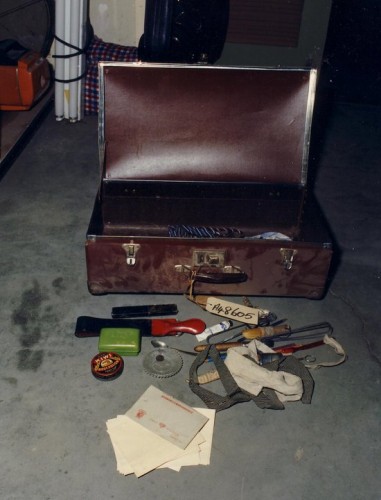
The staff could remember nothing about the owner, and the case’s contents were not much more revealing. The case did contain a reel of orange thread identical to that used to repair the dead man’s trousers, but painstaking care had been applied to remove practically every trace of the owner’s identity. The case bore no stickers or markings, and a label had been torn off from one side. The tags were missing from all but three items of the clothing inside; these bore the name “Kean” or “T. Keane,” but it proved impossible to trace anyone of that name, and the police concluded–an Adelaide newspaper reported–that someone “had purposely left them on, knowing that the dead man’s name was not ‘Kean’ or ‘Keane.’ “
The remainder of the contents were equally inscrutable. There was a stencil kit of the sort “used by the Third Officer on merchant ships responsible for the stenciling of cargo”; a table knife with the haft cut down; and a coat stitched using a feather stitch unknown in Australia. A tailor identified the stitchwork as American in origin, suggesting that the coat, and perhaps its wearer, had traveled during the war years. But searches of shipping and immigration records from across the country again produced no likely leads.
The police had brought in another expert, John Cleland, emeritus professor of pathology at the University of Adelaide, to re-examine the corpse and the dead man’s possessions. In April, four months after the discovery of the body, Cleland’s search produced a final piece of evidence—one that would prove to be the most baffling of all. Cleland discovered a small pocket sewn into the waistband of the dead man’s trousers. Previous examiners had missed it, and several accounts of the case have referred to it as a “secret pocket,” but it seems to have been intended to hold a fob watch. Inside, tightly rolled, was a minute scrap of paper, which, opened up, proved to contain two words, typeset in an elaborate printed script. The phrase read “Tamám Shud.”
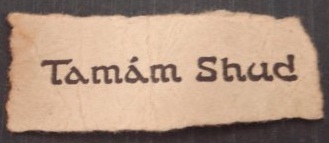
The scrap of paper discovered in a concealed pocket in the dead man’s trousers. ‘Tamám shud’ is a Persian phrase; it means ‘It is ended.’ The words had been torn from a rare New Zealand edition of The Rubaiyat of Omar Khayyam.
Frank Kennedy, the police reporter for the Adelaide Advertiser, recognized the words as Persian, and telephoned the police to suggest they obtain a copy of a book of poetry—the Rubaiyat of Omar Khayyam. This work, written in the twelfth century, had become popular in Australia during the war years in a much-loved translation by Edward FitzGerald. It existed in numerous editions, but the usual intricate police enquiries to libraries, publishers and bookshops failed to find one that matched the fancy type. At least it was possible, however, to say that the words “Tamám shud” (or “Taman shud,” as several newspapers misprinted it—a mistake perpetuated ever since) did come from Khayyam’s romantic reflections on life and mortality. They were, in fact, the last words in most English translations— not surprisingly, because the phrase means “It is ended.”
Taken at face value, this new clue suggested that the death might be a case of suicide; in fact, the South Australia police never did turn their “missing person” enquiries into a full-blown murder investigation. But the discovery took them no closer to identifying the dead man, and in the meantime his body had begun to decompose. Arrangements were made for a burial, but—conscious that they were disposing of one of the few pieces of evidence they had—the police first had the corpse embalmed, and a cast taken of the head and upper torso. After that, the body was buried, sealed under concrete in a plot of dry ground specifically chosen in case it became necessary to exhume it. As late as 1978, flowers would be found at odd intervals on the grave, but no one could ascertain who had left them there, or why.
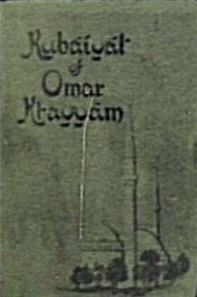
The dead man’s copy of the Rubaiyat, from a contemporary press photo. No other copy of the book matching this one has ever been located.
In July, fully eight months after the investigation had begun, the search for the right Rubaiyat produced results. On the 23rd, a Glenelg man walked into the Detective Office in Adelaide with a copy of the book and a strange story. Early the previous December, just after the discovery of the unknown body, he had gone for a drive with his brother-in-law in a car he kept parked a few hundred yards from Somerton Beach. The brother-in-law had found a copy of the Rubaiyat lying on the floor by the rear seats. Each man had silently assumed it belonged to the other, and the book had sat in the glove compartment ever since. Alerted by a newspaper article about the search, the two men had gone back to take a closer look. They found that part of the final page had been torn out, together with Khayyam’s final words. They went to the police.
Detective Sergeant Lionel Leane took a close look at the book. Almost at once he found a telephone number penciled on the rear cover; using a magnifying glass, he dimly made out the faint impression of some other letters, written in capitals underneath. Here, at last, was a solid clue to go on.
The phone number was unlisted, but it proved to belong to a young nurse who lived near Somerton Beach. Like the two Glenelg men, she has never been publicly identified—the South Australia police of 1949 were disappointingly willing to protect witnesses embarrassed to be linked to the case—and she is now known only by her nickname, Jestyn. Reluctantly, it seemed (perhaps because she was living with the man who would become her husband), the nurse admitted that she had indeed presented a copy of the Rubaiyat to a man she had known during the war. She gave the detectives his name: Alfred Boxall.
At last the police felt confident that they had solved the mystery. Boxall, surely, was the Unknown Man. Within days they traced his home to Maroubra, New South Wales.
The problem was that Boxall turned out to be still alive, and he still had the copy of the Rubaiyat Jestyn had given him. It bore the nurse’s inscription, but was completely intact. The scrap of paper hidden in the dead man’s pocket must have come from somewhere else.
It might have helped if the South Australia police had felt able to question Jestyn closely, but it is clear that they did not. The gentle probing that the nurse received did yield some intriguing bits of information; interviewed again, she recalled that some time the previous year—she could not be certain of the date—she had come home to be told by neighbors than an unknown man had called and asked for her. And, confronted with the cast of the dead man’s face, Jestyn seemed “completely taken aback, to the point of giving the appearance she was about to faint,” Leane said. She seemed to recognize the man, yet firmly denied that he was anyone she knew.
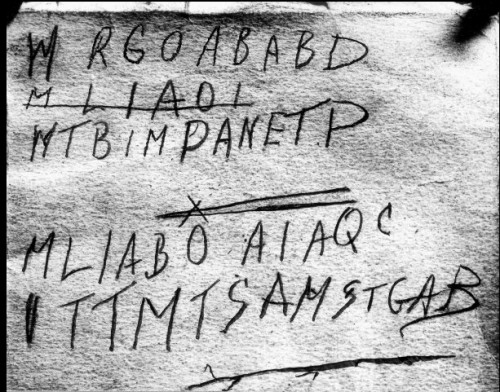
The code revealed by examination of the dead man’s Rubaiyat under ultraviolet light. (Click to see it at a larger size.) It has yet to be cracked.
That left the faint impression Sergeant Leane had noticed in the Glenelg Rubaiyat. Examined under ultraviolet light, five lines of jumbled letters could be seen, the second of which had been crossed out. The first three were separated from the last two by a pair of straight lines with an ‘x’ written over them. It seemed that they were some sort of code.
Breaking a code from only a small fragment of text is exceedingly difficult, but the police did their best. They sent the message to Naval Intelligence, home to the finest cipher experts in Australia, and allowed the message to be published in the press. This produced a frenzy of amateur codebreaking, almost all of it worthless, and a message from the Navy concluding that the code appeared unbreakable:
From the manner in which the lines have been represented as being set out in the original, it is evident that the end of each line indicates a break in sense.
There is an insufficient number of letters for definite conclusions to be based on analysis, but the indications together with the acceptance of the above breaks in sense indicate, in so far as can be seen, that the letters do not constitute any kind of simple cipher or code.
The frequency of the occurrence of letters, whilst inconclusive, corresponds more favourably with the table of frequencies of initial letters of words in English than with any other table; accordingly a reasonable explanation would be that the lines are the initial letters of words of a verse of poetry or such like.
And there, to all intents and purposes, the mystery rested. The Australian police never cracked the code or identified the unknown man. Jestyn died a few years ago without revealing why she had seemed likely to faint when confronted with a likeness of the dead man’s face. And when the South Australia coroner published the final results of his investigation in 1958, his report concluded with the admission:
I am unable to say who the deceased was… I am unable to say how he died or what was the cause of death.
In recent years, though, the Tamám Shud case has begun to attract new attention. Amateur sleuths have probed at the loose ends left by the police, solving one or two minor mysteries but often creating new ones in their stead. And two especially persistent investigators—retired Australian policeman Gerry Feltus, author of the only book yet published on the case, and Professor Derek Abbott of the University of Adelaide—have made particularly useful progress. Both freely admit they have not solved mystery—but let’s close by looking briefly at the remaining puzzles and leading theories.
First, the man’s identity remains unknown. It is generally presumed that he was known to Jestyn, and may well have been the man who called at her apartment, but even if he was not, the nurse’s shocked response when confronted with the body cast was telling. Might the solution be found in her activities during World War II? Was she in the habit of presenting men friends with copies of the Rubaiyat, and, if so, might the dead man have been a former boyfriend, or more, whom she did not wish to confess to knowing? Abbott’s researches certainly suggest as much, for he has traced Jestyn’s identity and discovered that she had a son. Minute analysis of the surviving photos of the Unknown Man and Jestyn’s child reveals intriguing similarities. Might the dead man have been the father of the son? If so, could he have killed himself when told he could not see them?
Those who argue against this theory point to the cause of the man’s death. How credible is it, they say, that someone would commit suicide by dosing himself with a poison of real rarity? Digitalis, and even strophanthin, can be had from pharmacies, but never off the shelf—both poisons are muscle relaxants used to treat heart disease. The apparently exotic nature of the death suggests, to these theorists, that the Unknown Man was possibly a spy. Alfred Boxall had worked in intelligence during the war, and the Unknown Man died, after all, at the onset of the Cold War, and at a time when the British rocket testing facility at Woomera, a few hundred miles from Adelaide, was one of the most secret bases in the world. It has even been suggested that poison was administered to him via his tobacco. Might this explain the mystery of why his Army Club pack contained seven Kensitas cigarettes?
Far-fetched as this seems, there are two more genuinely odd things about the mystery of Tamám Shud that point away from anything so mundane as suicide.
The first is the apparent impossibility of locating an exact duplicate of the Rubaiyat handed in to the police in July 1949. Exhaustive enquiries by Gerry Feltus at last tracked down a near-identical version, with the same cover, published by a New Zealand bookstore chain named Whitcombe & Tombs. But it was published in a squarer format.
Add to that one of Derek Abbott’s leads, and the puzzle gets yet more peculiar. Abbott has discovered that at least one other man died in Australia after the war with a copy of Khayyam’s poems close by him. This man’s name was George Marshall, he was a Jewish immigrant from Singapore, and his copy of the Rubaiyat was published in London by Methuen— a seventh edition.
So far, so not especially peculiar. But inquiries to the publisher, and to libraries around the world, suggest that there were never more than five editions of Methuen’s Rubaiyat—which means that Marshall’s seventh edition was as nonexistent as the Unknown Man’s Whitcombe & Tombs appears to be. Might the books not have been books at all, but disguised spy gear of some sort—say one-time code pads?
Which brings us to the final mystery. Going through the police file on the case, Gerry Feltus stumbled across a neglected piece of evidence: a statement, given in 1959, by a man who had been on Somerton Beach. There, on the evening that the Unknown Man expired, and walking toward the spot where his body was found, the witness (a police report stated) “saw a man carrying another on his shoulder, near the water’s edge. He could not describe the man.”
At the time, this did not seem that mysterious; the witness assumed he’d seen somebody carrying a drunken friend. Looked at in the cold light of day, though, it raises questions. After all, none of the people who saw a man lying on the seafront earlier had noticed his face. Might he not have been the Unknown Man at all? Might the body found next morning have been the one seen on the stranger’s shoulder? And, if so, might this conceivably suggest this really was a case involving spies—and murder?
Editors’ Note, May 16, 2013: Due to the recent spate of comments from trolls and readers misrepresenting themselves by impersonating others, we have closed the comments on this post.
Sources
‘Body found on Somerton Beach.’ The Advertiser (Adelaide, SA), December 2, 1948; ‘Somerton beach body mystery.’ The Advertiser, December 4, 1948; ‘Unknown buried.’ Brisbane Courier-Mail, June 15, 1949; GM Feltus. The Unknown Man: A Suspicious Death at Somerton Beach. Privately published: Greenacres, South Australia, 2010; Dorothy Pyatt. “The Somerton Beach body mystery.” South Australia Police Historical Society Hue & Cry, October 2007; Derek Abbott et al. World search for a rare copy of the Rubaiyat of Omar Khayyam. Accessed July 4, 2011.
Sign up for our free email newsletter and receive the best stories from Smithsonian.com each week.
517 Comments
Sorry, the comment form is closed at this time.


[...] gold-plated puzzler, all right. Confused? I’m afraid you probably still will be even after reading the full article here [...]
That’s absolutely fascinating. Thanks so much for posting it here, Mike.
Obviously a deep cover US secret services CIA agent.
The question one should ask are what was going on in the covert space in Australia at the time. I would start with a thorough going over of all the people in the case, it seems a few may have been likely contacts. The nexus is the book in the car. All lines radiate from that and one of the two individuals is likely involved. The nurse was likely a cover or contact established during the war years.
It may have been an espionage intrigue started during the war years and involving a post war covert operation with threads leading back to the Germans or the Russians.
There are a number of errors in the article. Two that spring instantly to mind are:
(i) At the time John Cleland was simply “Professor”, not “Professor Emeritus” as the article says.
(ii) The article suggests that “cyanosis” is a form of poisoning. This is incorrect. Cyanosis is discoloration of the skin that happens to all dead bodies. The Word “cyan” here refers to the blue tinge in the skin and *not* to “cyanide” as suggested by the write of this article.
There are other errors but that will do for now!
Our source for [i] is Gerry Feltus’s book (p.79), which describes Cleland as ‘Emeritus Professor John Burton Cleland, a legally qualified doctor in the Department of Pathology at the University of Adelaide’. We’d be happy to stand corrected on this if he is in error.
We have fixed [ii] to correct this misapprehension. Thank you for drawing it to our attention.
I stand corrected. Mr Feltus is correct. Cleland was Professor until 1948, then became Emeritus in 1949. As he didn’t get onto the case until 1949, he would have been Emeritus at the time. My bad.
The article above doesn’t say who the author is. Is that you Mike?
The Russian word for “rocket” is buried in that note, if you read it literally using the Cyrillic alphabet and allow the “n” (which looks as much like a “k”) to be a “k.” There are other Slavic-looking words in the note.
Of the 4 lines of letter code, the latter 2 lines represent
“My Life Is All But Over And I Am Quickly Cold
I Thank The Master That Saves All Men’s Souls That Gather All Below”
It is a red-herring suicide reference to obfuscate a spy murder.
I’m glad to hear people are still researching this very eerie case.
If anyone is ever brilliant enough to solve it, perhaps they can turn their attention to the Voynich Manuscript.
High-heeled shoes do not enhance calve muscles – in fact they make them more slender. Flat-heeled shoes does, and by the way dance shoes are rather flat heeled
As someone who has been involved with looking into this mystery for some years, and as an Australian, I am pleased to see it receive a mention on your illustrious website. Where, doubtless, some fine minds will contribute further insights. If only Sherlock Holmes had had the Internet!
Soon I will post a link to an Australian dry cleaning and launderers association site. There were laundry marks on the inside pocket of the pair of trousers the Deceased was wearing. Three separate sets of numbers.
All in all, I think Mike Dash should be congratulated most warmly for executing an excellent summary of this bizarre and tantalising case. Well done Mike and thank you. Thanks to the Smithsonian mag blog site too.
Interesting, given the body’s age was late forties, there is no reference to additional items that could identify the body such as the presence or lack of dental work, scars, old injuries, medical conditions etc. Also not much information on how the body may give clues to the type of work or activities the person did e.g. were the hands rough or smooth, conditions of the nails, was he tanned or not compared to others etc (November is summer in Australia). It is definately a puzzler but it seems more information could have been gleaned when the body was examined.
The lack of detailed description is more a matter of shortage of space than it is of the shortcomings of the South Australia police – this article is already rather longer than we ideally wanted for this site in the days of tl:dr. The Unknown Man did in fact have several scars: three small ones inside the left wrist, one about an inch long inside the left elbow, and one (which might have been a boil mark) on the upper left forearm. His nails were well cared for and there was no sign he had engaged in heavy manual work. His teeth were quite peculiar; he was missing a pair of lateral incisors, and Derek Abbott notes this is an inheritable genetic trait.
Here is the link to the National Dry Cleaners and Launderers Pty Ltd website and their article on the mysterious laundry marks found on the pocket lining of his trousers:
http://www.nationaldrycleaners.com.au/
Attention Alex: If you go back to the end of Mike Dash’s article above, you will see a couple of links which might answer some of your questions. Failing that the Face Book site most certainly should. Nearly 300 photographs!
I say the poor fella was an undercover-sort, as well as my fellow-readers seem to think. To add intrigue to an already fascinating, real-life (or should I say ‘real-death’!) mystery, I suggest that the different flavors of cigarettes, his somewhat asymmetrical, good looks (for a dead guy), and the perchance notion he fancied (…and/or sought employment which required the wear of) women’s shoes, shoes of a dancer or entertainer. Perhaps, if an entertainer, the required uniform was complete feminine dress. This would be a good cover for someone dedicated & careful enough to not get caught.
Or suppose he was a regular Joe who preferred women’s dress, was discovered to really be a man? Even in 2011, there are some who are intimidated by those who seem to ‘buck against the norm’. Ahh. The guesses are endless!
Once again Dr. Dash has put to us, his readers,a delicious, irresistible mystery that is worthy of attention. At the very least, some good old-fashioned Hollywood-style attention would be fun, wouldn’t it? Thanks, Mike!
Where did the nurse work during WWII? If she was an army nurse maybe she was used by a spy to gain access or information on a military base or a particular patient.
Jestyn was indeed an army nurse during the war, and then worked in the North Shore Hospital in Sydney, which is where she met Alfred Boxall. By 1948 she was no longer nursing. Derek Abbott has collected a good number of details about her nursing career and his site should be your next port of call.
If I’m not mistaken, this case was an inspiration for Stephen King’s novel The Colorado Kid.
Steve O’Rourke, USA
Alex, the man appeared to have tanned legs quite high up close to his crotch. The inquest noted that it looked like and old tan that had faded a bit. The man had very soft hands & feet with no callouses. It seems he had a remarkable physique with broad powerful shoulders going down to a narrow waist, and had very high pronounced calf muscles like a ballet dancer. As Mike says, the lateral incisors were missing. But this means that his canines grew next door to his middle teeth, so there are no gaps. Most of his back teeth were missing, but that was normal in those days.
Perhaps I’m seeing the obvious, but it seems to me that the nurse and her husband may have had something to do with it. I could see him being the father of her child, he starts to blackmail her to tell the husband, gets the poison to keep him quiet, husband finds out, confronts the guy, poisons him, takes him to beach to dump body, tells wife to never acknowledge knowing him. Sees him dead, and memories freak her out, but remember to keep quiet. I wonder what the nurse’s husband profession was.
Strong calf muscles are also a sign of a long-time swimmer.
wow… very mysterious! i’ll be puzzling over this one for quite some time. be sure to post any updates in the case!
@Mike Dash: What do you make of the theory left above?
“My Life Is All But Over And I Am Quickly Cold
I Thank The Master That Saves All Men’s Souls That Gather All Below”
Interesting…
Most of those with an interest in this case seem to agree that the letters in the dead man’s Rubaiyat are some sort of initial code. Derek Abbott has used the code as an exercise for University of Adelaide students, who have been tasked with analysing it, with interesting results – see the video summary here (and there’s a much more detailed look, including an impressive collection of primary source material for the mystery that anyone who’s getting really interested in the case should access, on the university website here). But attempting to actually fit words to the code is fraught with difficulty, because it means attempting to put oneself into the mind of a total stranger who lived in quite a different time and place.
My feeling is that it’s possible to get four or five words of what looks like quite good sense this way – I quite like “My life is all but over”, for instance – but that all such attempts get strained over a longer sequence of letters. There’s another quite believable interpretation of the fifth line, which might begin: “It’s time to move to South Australia”, but again it’s hard to continue that promising start without producing an increasingly implausible word sequence.
Has anybody tried to track the font in the Tamam Shud slip of paper? Looks quite peculiar and might help to find the publisher.
Developed calf muscles = cyclist or bicycle infantry?
Surely the police can exhume the body and get some DNA
If I am murdered, I hope it is in Australia. These detectives take their investigating seriously!
The font used in the copy of the Rubaiayat looks Celtic. This was a fashionable script not only for books related to Celtic themes, but for books related to Oriental themes.
@Courtaud; @Ajlin
I think the font is meant to look ‘Arabian’ – though in those days there was nothing like the wide variety of types available to us today, so it’s entirely possible it was nothing of the sort. Certainly the type most closely resembles a font called Uncial, which was based on the Irish script of the same name and hence designed to look like handwritten “Celtic” writing – so I think you are correct in your identification.
The type is definitely distinctive and, yes, it can be used to help track down the publisher. Derek Abbott explains how on his Facebook page; to avoid making you go through the hassle of logging on, here’s what he says:
One possible interpretation of this bit of information is that the W&T book was such a cheap paperback edition that the printers didn’t much care what paper stock they printed it on. They may have loaded their machines with whatever scrap or surplus stock they had to hand, so it’s possible the same edition of the book appeared on several quite different grades and colours of paper.
My first impressions of this case:
* He appears Russian, perhaps Jewish. A Soviet wartime spy?
* Clothing labels removed is SOP for covert operations.
* No ID is also SOP for covert operations.
* Nurse Jestyn was clearly familiar with the deceased and was privy to his identity.
* His Rubaiyat copy appears to be a spy tool, not a genuine book.
* Indecipherable codes written in the Rubaiyat.
With these facts alone, one could conclude that he was a spy possibly seeking to re-connect with his old contact (Jestyn) for unknown reasons. He was promptly liquidated in the process by someone in government intelligence with access to rare poisons which would hide their crime.
Just my take!
This is a truly fascinating case and made for a great read. Thanks so much for posting it.
Re: comment 27 made by cheryl
They really went to great lengths, didn’t they? As I read along I couldn’t help but wonder why. An anonymous corpse on the beach is undoubtedly an intriguing mystery, but when you imagine the time and resources that went into solving this particular case to no avail… it strikes me as strange that they would have gone to all the trouble. Slow crime day? Astoundingly curious detectives? Does anyone have any insight on this?
Indeed, very captivating.
Twins.
I don’t think it is possible to assume any ethnicity from this man’s looks, other than that he is white. His ancestry could be anything from the Baltic to the British Isles (though not very Mediterranean). He’s got the remains of a pasty in his stomach – a meat pie probably bought from a vendor at the beach. That implies he went there to meet someone. After all, he isn’t exactly dressed for the beach, so perhaps the meeting was decided on at the spur of the moment, otherwise he might have been more inconspicuously dressed. Again, the inappropriate clothing would make him more visible to a contact.
He is seen moving earlier – but this isn’t verifiable. Let’s say he was conscious as he fell ill – if he was a native, it would have been natural to seek help. If he was there under suspicious circumstances, and he would have known that he was, then he would not have wanted to draw attention to himself until he had seen his contact or accomplished his mission. Then he might have tried to get help for himself. However if he spoke another language, he would be giving himself away.
The evidence of the “dancer” legs – why did someone think dancer rather than bicyclist or other sport? What else develops the legs more than other body parts? Scottish dancing? Cossack dancing? Horseback riding? Running up and down stairs on a ship? Are there healed injuries which could point to something? Why are his scars not mentioned?
Who hears about him? Does his death send a message? The noting of repairs to a coat looking like “American” type stitches is probably a red herring, because where did all the garment workers (mostly) come from in the US, the kind of tailor who might repair a coat in those days? From the Baltic areas and the Pale of Settlement. You’re not going to have distinctly “American” stitching in an industry dominated by people from Prussia, Poland — so the coat repairs could still be Russian.
A lot of emigration to Australia in those days, wasn’t there? That it might be a solitary man without family would not be impossible. Why is it that we are led to think of him as a spy rather than a smuggler? How do you distinguish between them in their tradecraft? What if what he had on him got stolen and he was killed? Is the suitcase really his? Unless you break down all the evidence and check for the biases of the investigators at the time, and their knowledge of their world, adding your own updated knowledge, it will be impossible to get a sense of who he was. When the Soviet Union first fell, it was learned that Julius Rosenberg really was a spy. Maybe someone knows this guy too. Unless he was a smuggler, dealing in diamonds or something, and got burned by his contact.
This article was brought to my attention by one of my blog regulars who reads a lot of esoteric stuff (but its nothing to do with my blog so I won’t link it). He knows I’m Australian so wondered if I know anything about it.
Just spent a few hours reading and watching some YouTube links someone cited and any related links. This one from the ABC’s Stateline mentions getting DNA evidence and being able to determine his likely surname from their DNA database. They also had a professor mention his unusual ears, which may or may not go along with his unusual teeth.
I don’t have a facebook account so I could access that link but I do have some further questions.
1) Given his ears and teeth, are those features specific to certain types of Europeans or just a random genetic deformity that appears from time to time across European people?
2) The suitcase issue struck me as odd. The photo above is in colour, so it must have been taken well after it was found but the Stateline report mentions it had been lost or destroyed. How did they determine that it was his? By fingerprints? If so, did they find any other fingerprints (apart from their own)?
3) Do they still have the cigarettes or were they ever tested for toxicology?
4) The Glenelg book: was the torn strip of paper with Tamam Shud on it actually from that book found in the car? The article just says it must have come from somewhere else.
Was the book fingerprinted? Why did the police assume that the number was a phone number and that it was a local one? It did turn out to appear to be a correct assumption, but was it really?
Why did it take so long to determine the publisher? Surely the book had an imprint that would have listed those details. Unless it was a book used by spies.
5) Jestyn’s neighbours: were they questioned? Did they identify the man from his photograph? Did they mention any characteristic features like an accent, etc.?
6) Jestyn’s husband: what did he do? Could he also have worked in intelligence?
7) If the cipher for the code letters is a first letter one, then the existence of the Q is extremely valuable since it is so rare. Few English words begin with Q. However, I agree with “c. lawrence” that it is irrelevant.
@ Taryn: Adelaide is a small town (although it is the capital of South Australia). Apart from the Beaumont children disappearance (1966), I am unaware of any major crime issues in Adelaide until the Snowtown murders. So you can assume that the police did have a lot of spare time to spend on this.
Some of my questions appear to be answered by this Wiki page. The piece of paper was from the book.
@ Musings: A pasty isn’t a meat pie but similar to a Cornish pastry. Contains mince meat but not gravy as a pie would. The shape is entirely different too.
The clothes he wore would have been normal street clothes for the time. Perhaps for a salesman or a businessman. Or someone going to church or to see someone relatively important.
If he was Australian, I would guess sport for his legs. Cricket or rugby being the most likely. He probably wasn’t tall enough for Aussie Rules (but you never know). However, they drew a lot of attention to the calves, like they were unusually developed.
Note that the coat mentioned wasn’t repaired. See the Wiki link I cited previously. It says it was made with that style of feather stitching that could only be machine made in the US at the time.
I don’t think he was an immigrant. If he was, his English would have been quite poor and people he dealt with would have noticed that and mentioned it to the police but there seems to be no notes about it. I would guess he was a native English speaker, so went about his business unnoticed.
Even if he had an American accent, that would have been unusual and noticed too.
The suitcase puzzles me. Was it his or a plant by someone who murdered him? It could be a red herring. The only connection is the orange thread (unless there was a fingerprint match).
The remarks are that a merchant seaman of third officer rank might possess those items. Was this ever confirmed by the police by asking one? The modified knife is unusual so its purpose might be a clue.
A quick round-up to answer some of the questions posed that haven’t already been dealt with in this comments thread:
@ Marie Deever. Gerry Feltus refers to Jestyn’s husband as “Prestige Johnson” without explaining why he chose that very unusual first name for the pseudonym. One imagines there was a reason.
“Prestige” does not seem to have had one particular job and had some links with the criminal world. Derek Abbott’s information notes:
Abbott also notes that Prestige may have had some involvement in the housing crisis that hit post-war Australia, which would imply he dabbled in property development. He’s also known to have had links with the town of Broken Hill, and here Abbott notes:
@ Terry. So far no DNA analysis has been done. The embalming fluid used to preserve the dead man’s body would apparently have damaged the DNA in his cells, but there are two other possible sources: his bones and teeth ought still to yield a match, and there are also some ginger-coloured hairs embedded in the plaster bust taken of his torso. The hair roots would also be potential sources of a good DNA sample.
Recently a third party (presumably an amateur investigator, though we don’t know this for sure) made an application to exhume the body which was denied – only an application from a family member, I think, would be received sympathetically, though most likely the man’s family don’t realise there’s a mystery to be solved. There’s also the problem that even if the Australian police could be persuaded to match the DNA to their database, Somerton Man may not have been Australian at all…
Of course, today it’s possible to do far more than was the case in the 1940s and one thing that is now often used by archaeologists is a tooth analysis that can show where the person concerned was brought up. This is done by measuring the ratio of strontium and oxygen isotopes found in tooth enamel. The ratio of these isotopes, compared with the ratio of found in drinking water in various regions, can help determine where an individual lived when their teeth were forming during childhood. I’ve seen this used in British digs where skeletons have been traced back to origins in Germany and Scandinavia, so if the remains ever are exhumed, it would be fascinating to have a strontium/oxygen isotope analysis performed.
@ Spunchy. There is an alternate theory to explain why all the clothing labels were missing: perhaps Somerton Man was an indigent who purchased his clothing from charity stores. I have no idea if such shops routinely removed clothing labels, but it would square with him being found penniless – he had no money on him, and the police found only sixpence in his suitcase.
@ Musings. The identification of Somerton Man with the suitcase was indeed made because of the thread. This, incidentally, was a waxed orange Barbour thread which was not available in Australia – another intriguing clue. Its rarity, plus the fact that the suitcase was deposited in Adelaide station on 30 November, the date SM appeared in Glenelg carrying tickets that showed he had travelled from Adelaide, makes it almost certain the two were connected.
@ Gary Rumain. There is quite a long list of things one would have thought the SA police would have tried, and showing the neighbours photographs of SM and fingerprinting the book and the suitcase are high among them, but if they did any of those things, I’ve found no trace of the results. I think we can assume that some questions were asked about the possible link between SM and the sea, but with so many ports and so many ships (especially in the aftermath of WWII) it’s highly unlikely these were at all exhaustive.
Derek Abbott says that only 1-2% of the population share the ear type displayed by both SM and Jestyn’s son – which is that the usually smaller upper cavity of the ear is larger than the lower one. If the son also shared the lack of lateral incisors (which Abbott says he did), the chances of a link between SM and the child must be pretty high.
Since 1948 the police have unfortunately destroyed the physical evidence in the case, including the suitcase and the cigarettes, so it’s not possible to conduct further tests on them.
More on the case and its contents. It had been checked into the Adelaide station cloakroom after 11:00am on 30 November 1948. He would have had a check for this but obviously it wasn’t discovered by the police or they would have found the suitcase before railway staff notified them.
Did he throw the check away or was it taken by someone else? He also possessed no money by which he could return to the city. So he was either robbed or he planned not to return (i.e. suicide).
The suitcase contained a size seven red felt pair of slippers. These are too small for his height. Since he’s about my height, he should fit a size 9 or 9 and a half shoe (Aust. shoe sizes).
Were the other clothing items in the suitcase in his size?
Jetsyn’s son was born in 1947. One year before the Somerton Beach man died. Jetsyn died in 2007 and her son in 2009. Since both her son and the Somerton Beach man both had anodontia, there is a strong chance they are related. He could be the father or a relative.
According to the Wiki page’s timeline, there are some odd coincidences happening in a specific area of Sydney around the time Jetsyn was there.
Here is a link of Mosman on Google Maps http://maps.google.com/maps?hl=en&ll=-33.832708,151.236548&spn=0.035185,0.052528&t=h&z=15&vpsrc=6
The Royal North Shore Hospital at St. Leonards (or Gore Hill) is to the west of Mosman. Since its very unlikely Jetsyn owned a car, she would have had to have traveled by bus to get there. Either the 143 or 144 (assuming Sydney buses haven’t changed their route numbers). Both bus routes run via the hospital onto Mosman.
I’m puzzled what Boxall would be doing there. He lived to the south (other side of Sydney Harbour) and was in the army at the time. There are navel installations near Mosman but I’m not aware of any army ones.
It also says the phone number traced to Jetsyn was unlisted. Why? In whose name was the phone account? If Telstra has kept the old PMG records, the account name might be traced (assuming the number is known).
Lastly, look closely at this larger image of the code http://upload.wikimedia.org/wikipedia/commons/7/77/SomertonManCode.jpg The first letter on the last line doesn’t really look like an I or a letter at all. Its more like some vertical highlighting. Plus its spaced from the other letters. So the line might really begin TTMTS.
There’s some argument over the first letter of the first and second lines. It looks to me like a W that’s been changed to look like an M. Very odd.
I would like to see the phone number. There’s a chance the first two digits are represented as letters (very common at the time). Do they match the letters in the code?
I can’t say if it was his handwriting but was he a left or a right hander? (A small callous on the inner side of the first joint of the middle finger would indicate which hand he used if this was noted in the autopsy) That still doesn’t prove anything but if the note was in a certain hand and that doesn’t match the victim’s then we at least know its not his handwriting.
Mike, thank you for your response. I’ve had some more ideas.
The Wiki page states that after the war Jestyn had moved to Melbourne and married. It doesn’t say when or to whom. Since her son was born in 1947 and she remarried in 1950 (the timeline just says she married), was this to a different man?
Records should reveal the marriage details of the first husband. The name of the father of Jestyn’s son should also be on his birth certificate. This may provide some further clues.
I suspect that SM may have been Australian and from either Melbourne or Sydney. Checking the names on the above certificates may help – especially if the person or persons on them cannot be traced further. I’m basing this on a presumed relationship beyween SM and Jestyn.
Gary – Thanks for your comments. I had in mind a Cornish pasty actually, such I have bought in London. I might have called it a pie, but that’s just my American slang for a folded-over pastry such as children used to get in their lunchboxes filled with cherry and such, but not open and dripping. Also popularly called tarts, even though not open either.
I was thinking about something from a street vendor like those Indian samosas.
I see where you are going with the feather stitching – machine made.
He needn’t have spoken much. But when he did, his English might have been just fine no matter what his origins. This is the post-war/ cold war period. In a few years, there will the trial of Rosenbergs; Julius had a file in the Soviet Union – he really was working for them, as was (I believe this is the relationship) his wife’s brother. So that pair really were spies, and not just set up for propaganda purposes. Considering the later story also of Claus Fuchs and the spies in Britain (of course these were elite people), you could have some people who went to Russia from English speaking countries and who returned as spies, people of such low status that they caused little mention.
There is something really too coincidental to be ignored here: the nurse’s phone number being found in the book and then her self-serving declaration that she really did give the book to someone and his name (who conveniently had the book). How long would it take for her to backfill this story? She could put the cover-up into motion as soon as she was connected and use a Boxall to help her. Because that first book really did lead to her, nicknamed “Jestyn”.
All the stuff about his possibly being her child’s father – when was the child born? And isn’t it true that spies and smugglers reproduce just like anyone else? But the book contained cyphers, and that does not seem to involve a soap opera with returning lovers, but something else.
The key to this mystery is the other man who died in connection with a copy of the Rubiyat. The so-called 7th edition did not exist. What are the odds of two men dying with the same book figuring in the case? I’d say pretty long. Jestyn did not ‘almost faint’ because the unknown man was a lost lover. She was fearful of being exposed as a spy and investigation of the dead man would eventually lead back to her. An investigation of the Jewish man from Singapore will eventually reveal the identity of the John Doe.
Musings, about the pasty, Australia never had a very strong tradition of street vendors. We did have a few pie carts (very rare though). It was more likely SM bought it from a pie shop or cake shop. Or at a pub. Trouble was, none of these places would have been open much past 6pm in those days. Odd that the coroner didn’t realise that and more correctly estimated the time of death. Instead of 2am it would have been 9pm (he estimated that the pasty was eaten at 10 or 11pm. This means it was either cold or he got it wrong. If we assume SM ate it at 6pm, then 9pm the previous night makes more sense).
I have an American friend living near me. He once told me a story about when he first immigrated to Australia in the 1970s and worked in a country town outback at the time. He mentioned how locals got all excited about him and his accent as they’d never met an American in real life. So an American in Adelaide in 1948 would have really stood out. If he’d spoken to Jestyn’s neighbours, they would have notice the accent. I’ve had the same experiences in the US and Canada in the past decade. Not some much in the big cities but in smaller towns, my accent got noticed.
So my guess is he was either Australian, British or from New Zealand (less likely) rather than the US or Canada.
The contents of the suitcase suggest the merchant marine, which would explain where he bought the coat and thread. However, his clothes and physical characteristics suggest he was more upper class.
The missing clothing labels is a real mystery but it doesn’t automatically mean he was a spy. That would be too much of a giveaway. If he was murdered, the murderer could have removed them to prevent identification. Remember, a lot of the clues may be red herrings.
There are also clues in what wasn’t found – money, wallet, luggage check. Did he dispose of these? Or were they removed by someone else?
The Wiki page http://en.wikipedia.org/wiki/Taman_Shud_Case gives us some more details. Enough for me to guess that Jestyn’s son is somehow related to SM. I thought of using ancestry.com http://search.ancestry.com.au/search/category.aspx?cat=34 to search records. Assuming the name isn’t required, her places of birth and death and the years might be enough to find a match or two. And the son’s birth and death years will help narrow that down further. I’m assuming the father’s name is recorded and its not her second husband’s name or Boxall’s name.
Jestyn’s handwriting (allegedly) is in Boxall’s copy (I wonder if it still exists?) so that could be matched to the photos of the handwriting in the other copy. But I suspect the handwriting in that copy is SM’s. I suspect he got or was given her number and he wrote it down in the book she once gave him.
Don’t forget that the book was very rare. The police at the time couldn’t even find a copy to compare against. So the chances Boxall could find one would have been remote. However, Jestyn could have had a copy she could have sent to him.
Gary,
There were Army bases in Mosman. Georges Heights and Middle Head was one until only very recently. Primarily an artillery position for the defense of Sydney Harbour and sometime hospital.
In the 1940s, the buses would more likely to have been trams.
The suggestions that the man was a foreigner ignores a few facts about Australia at the time.
The first shipload of post War migrants arrived in Australia in November 1947. They were (generally) young men (av age 24) and their whereabouts were very strictly monitored (my father, who was on that first ship, had to report on a regular basis to the local police station – it is still possible to trace his movements around Australia through these records).
Foreignors were so noticeable that my father reported people following him down the street.
Migrant communities also tended – as a result – to be fairly tight knit. Again, although my father travelled far more widely than most, and to some extent ‘rejected’ the migrant community, if he didn’t make contact in some way regularly they would ask the police to look for him.
Given that someone who was noticeably foreign stood out in this way, you wouldn’t use anyone who had a foreign appearance as a spy, either.
So, if he was a migrant, he was pre WWII one – which would have meant, I would have thought, that he was highly visible in his own community.
Anonymity suggests someone who blended in with the crowd.
I suspect Jestyn may have been a classic honey trap, one whose relationship may have resulted in a child in the year prior. For whatever reason, Somerton Man gets left out in the cold with a burn notice. After not finding Jestyn at her house during the day, it would have been easy for Jestyn and her handlers to have arranged a rendevous at the beach that fateful evening. He dresses in his best suit expecting to have an amorous seaside reunion, only to be met by a man who will eventually poison him. Tragedy in its purest Greek form.
Another thought… The wedge shaped toes, large calf muscles, and legs of an athlete could be the result of extensive use of swim fins, which are uncomfortable even today. Imagine how they must have hurt your feet when crudely made with 1940s rubber and less sophisticated manufacturing. Maybe he’s just an abalone diver, or Perhaps it’s another indication of sophisticated training?
There’s a couple of things that have my attention. Catching a tram from the city to the beach to commit suicide seems very unusual and very public. Give it’s November, there’s a good chance alot of people would have been on the beach at the time. Glenelg was Adelaides closest and most popular destination for beach goers and well connected by the tram (about a 10 minute ride).
Further, the handwritten letters appear to be written by different writers or by somebody not well practiced in written English. Or they could be written with the non-dominant hand. If you look at the ‘A’ for example, it is barely consistent. I’m no expert however – just an observer. The ‘W’ also appears awkwardly written and the stroke weights (or maybe the degrees of pressure applied to the page) appear to vary.
I’m an Adelaide resident having lived here 35 years. I’d only once heard of this case before. I have a friend who is a handwriting analyst at a local forensic laboratory and will forward this to her to see if she can shed any more light.
Rick, good points about the trams and the army positions. But I don’t think these were bases as such. Just defensive artillery positions. I was trying to figure out how Jestyn would have met Boxall. He worked for Sydney Buses at Randwick before and after the war. I guess since there’s no obvious connection, they must have met via a social event or via friends.
Slim, would SM really have risked going to her home, which she shared with another man, for that? I think it unlikely. Wanting to see the child is more plausible.
Good point about the flippers. They still hurt my feet even today. But I doubt that they would have caused the pointed feet. That would have to form over a long period from childhood. The Wike page mentions his legs were tanned right up to the top – which is unusual because swimwear of the time wasn’t that high cut I think. When did Speedos first make it on the scene? Alternately, the feet may have been another artifact of his genetic deformity.
Australians have wider feet than most. This is due to wearing thongs (called flip flops in the US) and sandals in the long summer climate here – starting from childhood. I still recall an American lecturer at uni complaining about not being able to find narrow shoes to fit him. He was from New York. I remember having a brief discussion about this and finding out he’d never worn sandals as a child. So this fact may suggest that SM came from a cooler climate like the UK or the US.
Phil, one of my blog regulars, also from Adelaide cited this http://www.salife7.com.au/adelaide/places/historical/lost-suburbs The video on the page mentions lost suburbs and notes that North Glenelg used to be called St Leonards. Which, coincidentally, is the same suburb name in Sydney where Jestyn lived previously.
Use this image of the handwriting http://upload.wikimedia.org/wikipedia/commons/7/77/SomertonManCode.jpg as its larger and clearer. Following your observations, the two Gs are also different, there are 4 different styles of B, the O of the Q doesn’t look like the other Os, and the two Ss are different (one has serifs and the other a stroke through it). The only consistent letters are O and T.
However, there is another explanation for all this. The Wiki page says that they were “faint pencil markings” but the image doesn’t appear faint. Perhaps someone traced over the letters to bring them up.
Thanks guys, you have made the comments suction as interesting as the article itself.
I relented and joined facebook so I could see their photos. This one of the handwriting is markedly different http://www.facebook.com/photo.php?fbid=145551478846063&set=o.92730912666&type=1&theater
I don’t know where the extra details have come from as none of them are even remotely visible on the Wiki copy. (Disregard the greenish colour. I attribution that to the software that was used to add the highlighting circles)
No previous comments mention the GPO BOX number.
Also, it turns out Jestyn met Boxall in hospital, according to this http://www.facebook.com/photo.php?fbid=10150451284330026&set=o.92730912666&type=1&theater
Interesting graph and notes about circumcision http://www.facebook.com/photo.php?fbid=10150169262342926&set=o.92730912666&type=1&theater
One further resource:
An Australian librarian looks at the evidence. Lots of data mining leading to useful links. Includes Deep Web search results and the rather fascinating discovery that the word “Omar” appeared as a solution to a crossword clue in the Melbourne Argus no less than 11 times in 1948 – but not at all in any other newspaper. The final appearance of the word came exactly one month before Somerton Man’s body was found, but it began to appear again in 1949.
Of course this is highly reminiscent of the panic that took place in 1944 when it was discovered that several of the key code words devised to conceal aspects of the planning for the D-Day landings had begun appearing as solutions to clues in the Daily Telegraph‘s cryptic crossword.
In the article it says that the unknown man may have been poisoned by an extremely rare poison that was also used to treat heart disease, and that it could be obtained at a pharmacy. Jestyn was a nurse. Is it possible that Jestyn her self could have procured the poison and given it to the unknown man? Even if she wasn’t a nurse at the time the man died, she may have been able to convince someone she knew to give her the doses she needed. Are there local pharmacy records available for the time that show a prescription for one of these poisons, or perhaps a quantity that went missing? If so could these be traced back to Jestyn?
Mike Dash,
Thanks for linking to my blog article on the Taman Shud case. I just wanted to add two things:
1. I found the word ‘Omar’in the Argus crossword on 11 occasions in 1948. I want to stress that this is not really a clue that relates to the Taman Shud case, it just seems to be an interesting anomaly, but it was too interesting not to add to the article I wrote. I might put up a post at the Trove.nla.gov.au forums to ask if anyone there can explain it, but I can’t see any actual link to the case myself. As I indicated in my blog, I think the crossword developer was merely using the ‘Rubaiyat’ reference because it was in popular culture at the time (e.g. Gregory Peck used it in a film released in 1946, and Agatha Christie used it for the title of a book in 1942). My interest in writing about it was just to see if anyone who works as an indexer could possibly find something interesting in the digitised newspapers – i.e. could there be clues hiding in plain sight?
2. If anyone is interested in looking at some of the original articles on this in the digitised newspapers, many have been tagged with ‘Taman Shud’. It is also useful to look more widely at some of the stories in the papers at that time. There were daily Cold War stories from China, Europe, and Australia, and although we are fairly removed from it all today, it is easy to see from the papers that there was a real sense of crisis in 1948.
I don’t actually have a theory but sometimes the most simple explanation is the best. It seems unusual to me that if there was some sort of espionage involved that the man’s body would be left on the beach for the police to find.
Finally, the comments section here is a great resource for researchers, and very interesting to read. Although it is interesting to speculate, it is also important to remain respectful of the people involved.
Thanks everyone for posting.
Interestingly, some short while,(a few months,) after the appearance of the body of Somerton Man on the beach, 11 spies were uncovered in the Australian Department of Foreign Affairs. Could of course be co-incidental I suppose.
As one respondent pointed out, there are also apparently some issues surrounding the book found in the car and the shape of the piece of paper torn from that book.
Great Post Mike and others who have contributed. Could be that the investigation is getting close to a conclusion.
The most obvious problem with the slip of paper and the torn page in the book is that their shapes do not match – yet the police (in the shape of Len Brown, a former detective on the case) stated that they did.
Derek Abbott’s site has a photo of the last two pages of what is supposed to be the Glenelg Rubaiyat showing a very large tear on the final page which has removed the words “Tamán Shud”. Again, you need to join the Facebook group he runs to view this. Professor Abbott comments:
@ gary rumain #40 above. re bus routes 143 & 144, RNSH to
Mosman. Less than unlikely. In the 1940s she would have
used the very excellent electric tram (stretcar) service,
possibly door-to-door direct, or with just one change of
lines at Crowsnest. They started ripping out the trams in
the mid 50s, replacing them with buses.
Comment by Kit Pricha – August 22, 2011 @
@ Phil. The suicide theory is plainly less complicated and more believable than the spy theory, but it does have wrinkles of its own. The evidence seems to suggest that Somerton Man went to some lengths to conceal his identity before he died, but if we assume he planned to kill himself, we have to explain why he left his suitcase at the cloakroom at Adelaide station. Taking that action suggests he expected to return for it, yet the suitcase, like his body, seems to have been stripped of leads.
While it’s conceivable someone making preparations for suicide might strip his possessions of clues to his identity, doing the same to the suitcase and its contents prior to travelling makes no obvious sense if we take the “path of least resistance,” which is to assume that SM checked in his case expecting to return to it, went to find Jestyn to talk about their relationship and/or son, and as a result of that discussion spontaneously decided to kill himself.
There are certain bits of evidence that support the idea that the suicide was an impulsive decision – for example the lack of any cash, or means of getting cash, on SM’s body. He did travel with the money to return to Adelaide, though, since he apparently had enough to buy a pasty. To spend the cash you were planning to use to return to the railway station is a pretty final sort of thing to do. (Not that Glenelg was so far from Adelaide the distance couldn’t have been walked.)
I suppose we could modify the theory slightly and presume that SM had a pretty good idea that the meeting would not go well, and hence decided in advance to provide himself with the means to commit suicide in case it did not. You would have to assume some sort of thought process of that sort would have had to have gone on for him to have been carrying a rare poison such as digitalis or strophanthin with him.
But leaving the case implies there was also a good chance of his returning for it, in which case effectively vandalising his own possessions was a slightly strange thing to do.
Perhaps he got to Adelaide in a very depressed frame of mind, fully intending suicide, and leaving the case at the cloakroom was simply the easiest thing to do – easier than finding somewhere to dispose of it? That would tie in with the fact that the ticket he would have been issued for it was not on his body – he just threw it away.
But then again, the evidence of the two tickets to Glenelg in his pocket (one for a train, which he missed, and one for a tram, which he caught) has been used to suggest that between arriving at Adelaide and leaving for Glenelg, SM visited the local municipal baths to wash and shave. Someone capable of being that precise and proud of his appearance (see also the brightly polished shoes) doesn’t sound like someone depressed enough to dump a suitcase in the first convenient spot.
This just isn’t a case with any easy answers. Perhaps the real question is how much we’re all overthinking it. Most obviously, a lot of the mystery stems from the assumption that all the actions that led up to SM’s death were rational, intended and planned. But what if some of them were irrational, suicidal or mad?
[...] This is another brain-tickler, in unsolved criminal history. A man is found dead on a beach and no one can account for him or how he died. The more details that were found out, the more perplexing the case became! Read this excellent synopsis from the Smithsonian’s “Imperfect History” blog by click here. [...]
[...] while scanning through Smithsonian.com as a subscriber of their newsletters. The story is entitled Past Imperfect – The Body on Somerton Beach and the comments are as captivating as the article [...]
There is always the possibility that he had his wallet on him when he went to the beach, and that it was taken by some passing opportunist when he was dead or dying.
Is there any possibility that cause of death was incorrect?
If he was wearing someone else’s clothes from a charity shop the scrap of paper could have already been in the pocket?
Suzanne: The first minute I read your suggestion, the slip might have been in the second-hand clothes all the time, I got excited, and thought”Wow!”. Good point.
Then I gave it some more thought and thought, hey, didn’t they find a book in a street nearby with the slip torn out? Unless the Dead Man or whoever also picked up the book in a Second Hand shop at the same time as the clothes and later threw it away. But that still leaves the slip of paper dangling.
Nice distilation of questions and crystalised answers Mike Dash.Thanks.
Personally it seems like a dry n cut case. You have a man that goes to try and see his kid and it has already been stated that Jestyns new husband was into the criminal thing. Maybe the husband and wife plotted to kill SM to prevent the son from knowing the truth about his father. Maybe they stripped him of his identity. Jestyn was a nurse so it wasnt like she didnt have access to the drugs. But thats my theory!!!
The librarian writes, “It seems unusual to me that if there was some sort of espionage involved that the man’s body would be left on the beach for the police to find.” This is the point that jumped out at me. Why would one or more murderers take such elaborate precautions to obscure the victim’s identity — and then leave his intact body in a public place? Even if he was a deep-cover agent of some kind, there would have had to have been many people fully capable of recognizing him.
Hi guys For all of those who find this story fascinating you should get a copy of Gerry Feltus’s book “the unknown man” It is an invaluable source of material and gives a great in site into the lives of everyday Australians before and after the war. It is a good read. I don’t think you can get it in book shops outside of Australia, but Gerry posted mine and signed the copy. It was a nice touch. He is an ex detective with vast knowledge on this case. He does not reveal the identities of jestyns family, as his previous occupation would not allow this and to protect the living families privacy. The gentlemanly thing to do.
The web site for Gerry is http://www.theunknownman.com Their are a number of links.
I can’t resist commenting, as I grew up in Adelaide very close to Somerton Beach and my family occassionally discussed this case. It’s great to see it get some attention as I would love to see it solved one day!
Yes, Adelaide is a small-ish capital city but has an unusually high ratio of weird crimes and murders to its dubious credit. The Beaumont Children’s disappearance is the most famous until Snowtown in the late 1990s – but there are many more stories out there. Disappearances were frequent as I grew up in the 70s/80s (see Truro Murders, Richard Kelvin, and the so-called Family paedophile ring).
Adelaide’s provincialism, especially back then, also goes some way to explaining why we “want” this to be a spy murder, it’s much more exciting than a routine gay-related or otherwise domestic crime. It would be highly unusual for something of an espionage nature to occur in Adelaide, a city in the southern centre of Australia ringed by desert but a long way from the government and business centres of Canberra and Sydney. Unless, as someone noted it earlier, it could have been related to British nuclear testing at Maralinga, or a hangover from the War.
On a technical point, I had always heard that the key or ticket to the locker containing the suitcase was found on the man’s body, so there was more than the orange thread to link it to him. The City (where the locker was, at the central Railway station) is 8kms from Glenelg. The tram takes you straight from the centre of the city to Glenelg beach, and its about a 15 minute walk along the sand to Somerton.
I have to agree though that the elaborae activities used to remove labels from his clothes and posessions points to something unusual. Fascinating!
[...] The body on Somerton Beach still makes for an awesome mystery. [...]
Yes Ginger, Adelaide did have its share of bizarre murders and disappearances. There was an impression Adelaide should have been more “respectable” than other Australian cities, because they didn’t adopt the system of importing British convicts to do the hard work. Other colonies did. As for Adelaide people needing to fantasize about the Somerton Man being a spy because it would be more “exciting” than say, gay-related crimes, maybe….But…The very year of the Somerton Mystery (back in February actually)Britain’s MI5 spy agency sent two senior members to Australia to reveal to Prime Minister Chifley that the US and Britain had broken Russian KGB codes, and there was clear evidence of a spy ring in Australia.This was Top Secret, and not revealed even when the U.S. broke off sharing atomic secrets with Britain because of Australia’s bad security record!That was from 1947. When the next big KGB defector gave evidence in Australia in 1954, he said he did not know what Russian Army Intelligence (GRU) agents had been up to in Australia, but Woomera, rockets and uranium (all in South Australia) would certainly have been top priority.The GRU had some very experienced agents in Australia through the 1940′s and 1950′s.
There was a case in Sydney (where I live) a couple of decades ago where a young man’s body was left on the side of a road, near the airport. Despite the publicity nobody identified him but science having advanced somewhat since 1948, they were able to prove that a metal plate in his leg (from an operation on a broken bone) came from a particular area in one of the eastern bloc countries (I forget which). He remained unidentified but police at the time concluded that it was an organised crime ring killing and the man was left in a conspicuous position as a message to certain others. This case reminds me a great deal of that one – you’d assume that the killer(s) could hide the body quite easily if they had wanted to. The book also seems to be a clue to others out there who know what it means.
Our man did not have callous on either hands or feet and very smooth skin so I am leaning towards regular access to chlorine water or in other words, a pool. I mentioned this case with link on my blog so my readers (predominantly USA, Canada and UK) get to read about this fascinating Australian case.
I think there is something wrong with the Dead Mans suitcase belongings.He was neat,shaved, combs,chewing gum, fingernails clean. But in his suitcase, his clothes had tears, looked like they’d been worn and not washed. Pencils and tools all looked old and not looked after. Smooth-hand guy with tradesmans things, like cut down knife, screwdriver, scissors, brush. Don’t add up.Fit guy at the beach, dressed for a funeral.
Anodontia of the lateral incisors almost never occurs in isolation, but rather as one symptom of a broader syndrome. For example, Waardenburg’s Syndrome could account for the missing incisors, the unusual pupils noted by the coroner, the light ginger hair colouring and possibly the shape of the ears. Waardenburg’s would also indicate the possibility that he had a degree of hearing deficit. I’m not aware of a syndrome that would also account for enlarged calf muscles and pointed toes; it’s emtirely likely that these are acquired traits.
Just my two cent’s worth.
From observing dead man’s photo & related comments:
a) Heavy Slavic features, Russia/Polish.
b) Items found in case were placed to confuse investigators of victim’s identity.
c) Lack of violent evidence on body, leads me to suspect
untraced poison, i.e. [digitalis] in stomach contents cleverly prepared by someone with medical knowledge/background.
d) Resulting in FATAL heart attack!
Thank you.
What a fascinating article – and a fascinating debate :) I thought I’d add my thoughts.
The fact that flowers were left until 1978 interests me. Firstly, the fact that whoever sent them went to such trouble not to be found sending them – this suggests several possibilities: someone who read about him in the papers and felt bad for him (but then, why bother being so covert?), someone who knew him and didn’t want to be in the same kind of trouble, someone who was involved in his death (the killer, if it was a ‘hit’ whoever ordered it, and so on). It’s also interesting that the flowers stopped in 1978 – is this because whoever sent them died then, or became unable to continue sending them through a change in medical or economic circumstances? Or, if the man was a spy or somehow involved in smuggling or other types of organised crime, were they sent to draw someone out? If so, did they succeed or simply give up?
I’m no code-breaker, so I’m not going to embarrass myself with giving it a try, but I did wonder, given the possibility of naval / merchant navy / smuggling connections, whether the letters represented ship names, or locations etc. – similarly if he was involved in some kind of none-nautical organised crime. What if he’d simply figured out that something ‘dodgy’ was going on and gone to Jestyn for help?
I agree with mehitabel about the man probably being an immigrant – which would mean that he probably had a reasonable grasp of the language. (To be fair, he doesn’t look that Slavic to me, though admittedly, given the melting-pot of heritage that the UK is, I could be wrong). Also on the language point, if he were some kind of secret agent, surely approximating the local accent wouldn’t be too difficult for him, even if he were suffering the effects of the poison. Unless he decided not to ask for help – if he figured out he was dying and decided that there was nothing he could do – protecting someone, perhaps?
I’m not at all sure about the idea of Jestyn having a hand in killing him – her reaction as decsribed seems to have been more along the lines of surprise at his death than anything else. Surely someone who had gone to such lengths to conceal SM’s identity wouldn’t be phased by a police interrogation – similarly someone who acted as a ‘honey trap’.
Also, on the observation that Jestyn may have been a honey trap, who’s to say – if there is a spy connection – that she herself wasn’t a spy? Female agents certainly weren’t unheard of at the time.
On the suitcase: who’s to say that the killer (if there was one, and I think there probably was) didn’t take it from somewhere else – a primary or secondary crime scene, perhaps (maybe wherever they met, or the poison was administered / cigarettes were planted) and then drop it off at the station? It would certainly explain the lack of the check, and the attempts to remove any identyfying information – the possibility of matching the thread might not immediately occur to someone.
If this was a suicide, why would you go to the length of poisoning your cigarettes? There are much less complicated ways of doing the deed. Also, which is impossible to say without a re-examination of they now-destroyed evidence, were all the cigarettes contaminated? In which case, who would have access to that much exotic poison?
Incidentally, do we know why Sir Hicks preferred strophanthin over digitalis? If it was because of the availability of the former, what’s to say – given the possibility of foreign influence here – that the poison was not brought in from elsewhere? Also, given how common foxgloves are in various parts of the world (assuming, for the moment, that it was digitalis), how do we know that the drug wasn’t home-made?
Mike made an excellent point about his behaviour not necessarily being rational, which does rather throw a spanner in the works. Given the meagre amount of money to his name (assuming some opportunist didn’t rob him at some point between the pasty and death) he seems like a man in desperate circumstances. Perhaps he went to Jestyn to ask for help?
‘It is ended’ definitely seems to be a message to someone (unless, as has been pointed out, it had nothing to do with SM but was left in second-hand trousers). It seems, given where it was found, unlikely to have been left by the killer… If SM did leave it, could it be a message to Jestyn (or someone else), saying that whatever was going on had stopped (I keep returning to the idea that he might be protecting her and the child)? Or symbolic of the end of a particular job (i’m hesistating to use the word ‘mission’), or a career – crime or spying. Perhaps it was some kind of bizarre personal talisman (I know a few people who carry specific things around with them because they mean something to them – perhaps he had nowhere else to carry it). Of course, there is also the possibility that it had nothing to do with his death at all.
As ‘A Searching Librarian’ noted, it seems unlikely that the body should be left so publicly if secret agents were involved – there are more covert ways of sending that kind of message. It does seem more likely that if he was placed on the beach by the mysterious man mentioned in the police statements that it was intended as a warning by some variety of organised crime branch. I also wondered if, feeling and recognising the effects of the poison, he might make his way to somewhere like a beach to die – assuming that he felt nothing could or should be done. Perhaps the mysterious man was a well-meaning member of the public thinking he was drunk and helping him get there?
There is also the possibility that the efforts to remove his identity from both his person and his effects were in an effort to protect him or his family from something or someone – even something as simple as a ruined reputation. The person who sent the flowers, perhaps?
Anyway, I’ve probably bored you all to death by now. As I said before, an excellent article and an engaging discussion!
Thank you for a fascinating article and comments.
Some of the circumstances remind me of Dorothy L Sayers “Have His Carcase” 1932, http://en.wikipedia.org/wiki/Have_His_Carcase in which the victim is encouraged to behave in a mysterious way with the eradication of identification, notes, codes, and so on. So another angle would be that the clues and absence of clues are part of a scam, in which the victim’s sense of intrigue and greed are played on.
Just a thought.
Some have commented that Jestyn’s son had similar genetic issues and looks to SM with the popular theory being that SM is the boy’s father. One alternate thought would be that SM could have been Jestyn’s brother. This would help explain her shock at his death and the genetic issues that could run in the family. Just a thought!
Just a few points:
(1) As to the photo of the code itself, it it possible that the letters were darkened by the newspaper that may have originally run the photo of it? Photo editing was known to have been done in the past by newspapers whenever they ran a picture that possessed indistinct elements.
(2) As to the code, I think it entirely possible that the first letter of lines one and three are W. Note how the shapes of these letters differ from the M’s used in lines three, four, and five. Further, I think that the order of the lines could be either one-three four-five, or one-four, three-five. It is clear that line two was written in error (as if someone “lost their place” when copying down the text, however, whether this was a situation where line two was intended to be after line one or after line three remains to be solved. Logically speaking, I would guess that the scenario is that the crossed out line was meant to come after the line following, because if it was just a matter of miscopying the line, then why not cross it out and then repeat it over again? More likely it was meant to come after line three. One-three, four-five, then seems most likely with two discarded totally like so:
WRGOABABD
WTBIMPANETP
MLIABOAIAQC
ITTMTSAMSTGAB
Whether this is some form of substitution code or whether it is a big anagram using the first letter of a number of words also remains to be seen.
(3) In regard to the missing clothing labels, I find this most intriguing. In the mid-90s, one of the guys I went to university with was ex-US Army. One of his compulsive habits, as I recall, was to take all the tags off everything he bought. He mentioned this to me when he was sitting in the student lounge one morning taking all the tags off of his backpack. He said that it was a habit he picked up in the service; the reason was to prevent identification (presumably by enemy soldiers) should he get careless and leave belongings behind. He also showed me the inside of his parka — he had taken all the tags out of it too. I have also known people to remove any identifying marks from items they donate to charitable organizations for resale by them, such as removing clothing labels or cutting their names out of books, or even removing whole pages if there was a dedication written there — not that my book example has anything to do with the Rubiyat in this case, mind you.
(4) In regard to the items in the suitcase, I have always seen mention of the fact that there was a spool of orange Barbour thread found inside, and the fact that such thread was not sold in Australia, but I have never seen any information as to where Barbour thread is made or sold. I assume we are talking about a product of Barbour Threads Ltd, located in Lisburn, UK. Perhaps it could be ascertained where Barbour did sell its thread outside of the UK, if at all for some more possible insight as to the origin of SM. Another thing to check is whether Barbour had any contracts with the British military to supply thread during the war. Also, orange seems like a strange color to use when repairing one’s pants, but perhaps that is all that SM could find to get the job done, but perhaps orange thread had a certain use that SM was involved with, hence his accessibility to it.
(5) I have to agree that the tools found in the suitcase hardly go along with items that may have been used by SM especially when one regards the description of the condition of SM’s hands. This would suggest that the suitcase wasn’t his, but then there is that bothersome presence of the Barbour thread in the suitcase and on SM’s pants. But then, that could mean that only the thread was his, and the other items belonged to someone else. Is it possible that he may have “found” the suitcase elsewhere. As well, I see no mention (although I may have missed it) of there being any sewing needles present; supposedly if SM’s pants were freshly mended, he would surely have kept the needle.
(6) As to SM having no money and nowallet, I suppose it is possible that he either lost his wallet or that it was taken from him at some point. The need for personal identification was just as important at that time as it is today.
One other comment: Much has been made of the fact that SM at the time of his death was smoking Kensitas cigarettes, which were contained within an Army Club cigarette packet. The question asked by most is that while it can be understood that some people might put a cheaper cigarette into a packet from a more expensive cigarette, why would someone do the opposite, ie, put an expensive cigarette into a packet from a cheaper brand. That’s a good question, but the answer might be disappointing.
During World War II, when everything was rationed, one of the things that many companies did was come up with alternate packaging for their items in order to try to cut down on the use of needed resources. Many cigarette companies sold their product wrapped in cellophane; purchasers could then put the cigarettes into a cigarette case or into whatever packaging they had held onto.
As Australia in the late 40s was still undergoing rationing on many items, this could be one reason for the discrepancy between cigarette and cigarette package brands.
I’d bet on suicide. From the description of his last moments, seems like he swallowed poison, sat on the beach, lit one last cigarette, and waited calmly to die. If one really wanted to OD on a prescription drug, it wouldn’t be hard to swipe some from an acquaintance’s medicine cabinet.
It does seem likely that the “unknown man” was a covert or clandestine intelligence agent – but much more likely that he was Russian (or other Eastern Bloc) than from the United States (or other Western country).
The article makes no mention of ASIO (Australian Security and Intelligence Organisation) which was established in 1949 because of concerns about Soviet espionage activities in Australia.
If ASIO had any interest in the case (which seems very likely given the trade craft paraphernalia associated with it), then ASIO’s records might reveal more about the unknown man. With the changes to Federal Freedom of Information legislation earlier this year, those records might now be accessible.
Regarding the “code”, I believe it is too short and unclear to try direct attacks and I would first concentrate on *how* it was written. Does it look like it was written on a moving vehicle? It seems to me like it is most likely that the crossed out line was deleted because it was a mistake and the correct line is the following similar one. He wrote O and started the vertical stroke of the B and then realized he had transposed the correct BO to OB so he crossed it out, did another line and then again the crossed-out line correctly. So I would ask the experts under what conditions is this type of mistake most likely to happen?
For example, if my code is the first letter of every word or every line of a poem I know by memory it seems like this error is unlikely. If I am doing some kind of computing, like with a Vignere cypher, the probability goes up exponentially. How about listening to characters being broadcast over radio and they are later repeated as a group? (Like trying to write down the lirics to a song by leaving the line when you fall behind and then going over the entire song again.) Given the text is so short it may be that it can never be decyphered but I believe a lot of information could be deduced without cracking the message itself.
Even if the message was cracked it would be so short that it may shed little light on the case. It may be that the code was not a message but a key in which case it is useless without the cyphertext.
It seems to me the authorities left a lot to be desired in their proceedings. The loss or destruction of evidence over the years, the deference given to Jestyn, etc. Jestyn was the person who could have told us something about the man but she is gone and that information is probably lost forever.
@SDchen. It is unlikely the dead man would be Jestyn’s brother as he would be identified by now. He was much more likely to have been a recent migrant at the time.
@Mike. Jestyn was not an army nurse. If you recheck all the info on her there is no evidence for that. In fact it seems there is doubt that she even received nursing qualifications.
@Mike. Interesting why Gerry chose the name “Prestige” as it doesn’t sound like the sort of name you’d give someone who is involved in a bit of low level crime. You made a good point. Here are some random thoughts:
1) Gerry could be alluding to him being ambitious and wanting some sort of prestige.
2) In Adelaide there is a car yard called “Prestige Motors”
and it seems he dealt in WWII black market items including cars. Maybe cars was his main thing? So the name “Prestige” may simply be an allusion to cars. An in-joke only people from Adelaide would understand!
3) Maybe Prestige’s real name was an odd sounding name beginning with a P such as: Padget, Peregrine, Phineas, Pomeroy, Prescott, Prospero, Procter, Preston….or something like that. Who knows?
Or maybe it’s all of the above and Gerry was making a very clever pun all all aspects? Smart guy!
After having read a lot of information about the so-called Tamam Shud case, I’ve reached some conclusions but at the same time some questions have arisen.
One of the first things that drew my attention was that most “dramatis personae” of this bizarre story remained out of the stage from the very beginning.
-What happened to Keith and Roma Mangnoson?
-What happened to Gwenneth Dorothy Graham and the man she went with to her house the day she committed suicide? (Three years before the SM was found dead)
-what happened to Tom Keane? Did he ever appear to claim that he was still alive? Why did the SM have some stenciling stuff among his belongings? Did the real sailor Tom Keane and the SM agree to swap something? Did the SM give the sailor a symbolic amount of money for his identity? Why did the SM have a tie with the name T.Keane on it? Wasn’t that important enough for the cops to investigate the reason why a missing person had apparently a tie with his name in another man’s suitcase? There are some things here that I can’t really understand. I repeat, wasn’t that important? I’m trying to understand the reasoning of cops at that time. Let’s see. An unknown man has a tie with a name on it but it’s not his, it’s a missing sailor’s tie. However, according to this sailor’s shipmates, that tie wasn’t his either. Besides, the SM has some stenciling stuff but his hands show that he hasn’t worked on a ship (or done any hard work). What’s the meaning of all this? Any idea?
Someone, I can’t remember who, told that the fact of having that peculiar ear and having anodontia were just symptoms of something else. I’ve been searching about those physiological characteristics. In medical terms, it’s called ectodermic dysplasia. Mainly it affects men because it’s a genetic problem in chromosome X. The disease is transmitted from mother to child. It affects skin, hair, nails, and teeth. There are more than 150 variants of the same disease and it’s divided in turn into four main groups, it depends on what physical characteristics the person has developed:
-tricodysplastic (lack of body hair or at least having little hair on eyebrows, chest, legs, etc)
-onicodysplastic (nails are affected and they show strange forms)
-dentodysplastic (teeth have an uncommon shape, they seem inverted cones like those of a shark)
-hippohydrotic (the patient can’t control his own body temperature and needs special care and the most important thing: they can’t tolerate warm places because this can result in death. They have no sweat glands so their bodies cannot regulate the quantity of water to refresh when it’s warm around).
Other interesting features are:
-respiratory infections
-white or quasi-transparent skin
-low nasal bridge (the bridge is lower than in a normal nose, it’s compared to a saddle)
-pointed ears with a bigger cavum and a smaller cymba (Prof. Derek Abbott’s observation)
-a fissure on upper lip, which is also thinner.
-prominent pointed chin and wide forehead
-wedged toes or even fusion of toes
-deafness
After this, have a look at the Somerton dead body: his eyebrows, his eyes, his pointed ears, his chin and specially the bridge of his nose. Of course, I don’t mean all these physical features appear at the same time in the same person. But the person, as I said before, will develop those belonging to one variant or another, among the four possible.
I hope you haven’t fallen asleep after this explanation and sorry for such strange medical terms and for my awkward English.
At this point in time late 1948 Asio was in it’s infancy or still not officially commissioned.
This murder/ professional hit was the catalyst and motive to start Asio in Australia.
A person employed or hired by the Intelligence Services at the time was most likely instructed to carry out this clandestine kill using a very rare poison or a person who had knowledge and access to such a rare poison derived from a plant.
The mystery man in question was most likely a Merchant Seaman/ Deck Officer rating/ rank and probably of UK origin.
At the time of his death he would have probably been on shore leave as it was most likely his ship would have been in port at the time of his death or sailed on without him.
The suit case found in the cloak room of the Railway Station was probably a set up or red herring along with the removed clothing labels to throw the police off the trail.
I believe the police at the time knew more than meets the eye with this particualar case and they also knew that Security Intelligence was involved so they did not push too hard with their investigations. They where very easy on Jestyn when they interviewed her and they could have obtained more vital information from her during the course of their preliminary investigations.
The mystery man was probably single with no or very few family ties, most likely a loner and therefore no one to this day has ever come forward. He was a typical John Doe.
He was a very fit man for his age however it seems starnge that he was a smoker? even though smoking was quite fashionable during that era.
He may have been or a spy and on the other hand he may have been a person who met foul play and made to look like a spy to justify the kill which the soon to be Asio would have asked no questions.
Given time i believe that this long time mystery will be finally solved.
It could be the nasty work of a serial killer psychopath? with a Security Intelligence background with expert knowledge on exotic poisons and plants.
Probably the same person who killed the young boy and threatened both his parents the following year in 1949.
He may have went on to kill or murder other people as well ? if he was a serial killer psychopath as that is their general modus operandi.
I’m just thinking outside the box !!!!!!!!
The Somerton Man was very likely the Father of Jestyn’s son.
Jestyn was very likely a spy and also a registered nurse who worked for Intelligence at the time and some time earlier before Somerton Man’s death murder Jestyn would have been having an affair with him. Jestyn may have opened her mouth and told Somerton Man too much ie about her real background and a few security secrets which probably leaked out and hence a hit/ kill was necessary and Jestyn would have received a severe reprimand etc from her superiors. A trap and date was set up for Somerton Man to meet Jestyn and her son at her address as Jestyn only lived 800 metres from where Somerton Man’s body was found and the local ASIO hit man did the dirty work and the rest is history.
Somerton Man was possibly a spy? and Jestyn most likely knew the man who killed him.
Jestyn was most likely connected to the death by poison of George Marshall in 1945 who died in similar circumstanes as the Somerton Man.
The Police at the time knew that this case involved a Spy and Intelligence connection therefore they played or watered down their investigations and where very soft on Jestyn otherwise they where told by the Intelligence Service of the day to go easy on the case and just make it look like they where doing their job in the eyes of the public and then sweep it under the carpet.
The person who went to the Police about a year later in 1949 in regard to finding the copy of the book inside his car with the identical cut out of the words Taman Shud found on the Somerton Man inside his secret pocket of his trousers was most likely the same person that killed via poison the Somerton Man as his identity and occupation where supressed and the reason for the supression was also supressed as the reason most likely for this is because he was also a spy or security intelligence operative for the newly formed ASIO.
This was the cold war era and anyone suspect of being a communist or having any connection or associates who where communists would have been regarded as a major national security threat or a spy and they would have been watched like a hawk 24/7 and if necessary killed in such a way so as to look like either a suicide, heart attack or accident so as to not arouse any suspicion. That is the dark and sinsiter side of all World Security Agencies and each has it’s own operatives who specialise in this nasty field and that is what happened to the Somerton Man on that fateful day way back in 1948.
Sadly he was in wrong place at the wrong time and had a short affair with Jestyn otherwise he would have not met his tragic fate.
Is there a possible occult ritual killing connection concerning the Somerton Man?
Greetings Fellow Posters:
What if the real identity of Our Somerton Man turns out to be that of a: “NAZI RUNNING AWAY From His MURDEROUS PAST?!!!”
Thousands of Hitler’s Henchmen rapidly made their way to South America before/after allied troops surrounded Germany.
My belief is the somerton man was an innocent man who had no spy connections and was a former friend of jestyn and the father of her son who on that fateful day went to visit jestyn to see his son. I believe that jestyn knew the man who murdered somerton man and i also believe that the same person responsible had at the time a security intelligence background and training and made the somerton man look like a spy with the suitcase at the railway station and the unknown poison along with the secret code note found in somerton man’s pocket.
I would say it is highly probable the somerton man was a seaman who worked on ships ie an officer and he would have been of US or UK origin.
The catylst or motive for his murder was to help justify the setting up of ASIO in Australia.
All the recent comments by Carmen, Jack, Peter, Albert and Andrew are interesting for their discussion of the spy hypothesis, in my opinion. I particularly like Albert’s reference to “the local ASIO hitman”. To keep a hitman on the payroll in each region, would have meant a hectic round of “bumping people off” Albert. I think we must keep this “spy theory” in perspective. Though, yes, there was a raging Cold War happening; yes, in Europe and elsewhere, people were being murdered for their spy involvement;but not in great numbers.I think the spy theory has been raised to point out that such things were going on elsewhere, (spying, secret squirrel activities,codes and breaking codes, poisoned umbrellas,spy versus spy stuff). But, at this stage other than the fact the dead man’s identity has been successfully kept secret, that an unidentified poison was involved, that some kind of jumbled lettering like a code was found, that labels were removed from his clothes, that his wallet, passport, money and hat were missing ….there has been no secret service file found with his photo in it. Nothing to officially link Somerton Man with spying. It is just that historically, spy versus spy games were actually happening in most Western countries – including Australia – at that time. The definite link so far, has not been made.If it was a spy-kill, it has this far been – as they say in Spyland- a successful “deniable operation”.
The guy was in the wrong place at the wrong time and he was lured to his death by a cunning person who had a contract to kill this guy and make it look like he was a spy by the method he was killed ie untraceable plant poison, tags removed from clothing and suit case left at railway station along with a bullshit code planted in the victims pocket.
This resulted in making it virtually 100% credible that the guy was a spy and remember it was the cold war era come commo paranoia so the cops closed the door on this case fairly quick and this was the catalyst to start ASIO in Australia in the following year in 1949. Commo back then was like pedophile today ie despised, low life, enemy, bad, evil, sick etc. It was a communist witch hunt in that era.
ASIO then and now had operatives in every capital city and territory in Australia and some with specialist covert black ops training for this purpose. Fact. They have branches in every city in Oz. Their HQ is in the ACT.
And with regard to spy agencies like ASIO you can have a 9 to 5 job with an outside employer and when they need you they contact you and there is full time operatives as well.
The man who murdered somerton man was a cold blooded killer and an expert with exotic poisons. He was also a serial killer, psycopath and narcissist.
He was a very cunning and clever man with a higher than average IQ with a military background.
This man would have went on to kill more innocent people in Adelaide as he was most likely a local man. He may have somerton man’s ID in his pocession this very day?
He may possibly be still alive today although he would now be an old man.
Maybe a death bed confession by this man will finally put closure on this mystery along with many other unsolved murders in South Australia.
I had heard recently that somerton man was a British soldier in World War 1.
He was born about 1900 and ww1 was from 1914 to 1918 and he would have been the right age at that point in time and history.
Maybe somerton man could be traced via is ww1 service as there would be military records and possibly some old military photo’s of him in uniform that could connect him and possibly solve this long term mystery and nip it in the bud.
As far as an investigation perspective it would be a good starting point.
Secondly how about the south australian government posting a $500,000 reward for information leading to a conviction of the offender, now that may bring someone in the know out of the woodwork to give vital information and evidence to the sa police.
And finally somerton man’s body should be exhumed and even though he was embalmed with formaldehyde there is still a possiblity of dna evidence that may put final closure on this case. It well worth a try unless the sa government has something to hide and they know the facts and they don’t want the public to know?
Jestyn was a spy and a nurse and Somerton Man was the father of her son. Somerton Man knew that Jestyn was a spy and he knew way too much and was seen as a threat to her, otherwise he may have potentially exposed her identity and the fact that she was a covert spy so a contract was implemented to kill him and make it look like he was a spy or an enemy of the state and not a cold blooded murder and the guy who killed him was a psychopath and a cold blooded killer and the same guy who killed the young boy in 1949 with an untraceable plant poison. The Killer would be a local man living in Adelaide. It also possible that Somerton Man knew the killer before his death as the other 2 guys who where killed under similar circumstances in Sydney and had a connection with Jestyn.
Jestyn may have said to the killer ” This guy ( Somerton Man ) knows you killed those 2 guys in Sydney” so the Killer was exposed and he then had to kill Somerton Man as he risked being incriminated or reported to the Police.
There is more than meets the eye with this case.
Yes Jestyn knew the somerton man and the somerton man contacted her in regard to travelling to Adelaide. Jetsyn then organised with the killer/ murderer to kill somerton man as the killer was known to Jetsyn and he was the perfect man for the job or hit so the killer booked a room in a hotel opposite the Adelaide railway station with his death kit or tools of the trade and when somerton man arrived at the train station the killer tailed or followed somerton man down to Glenelg and Jetsyn’s house and then a bit further down to Someton Beach where Somerton met his fate.
The SA Police and the SA Government know a lot more however they have swept it under the rug as there is more than meets the eye with this case.
Here’s another possible scenario:
Jestyn’s reaction when seeing the face of SM reminded me of the movie ‘Niagara’. What if something similar happened here involving a love triangle with the killer being either Alfred Boxall or the man she was living with and later married? It would also explain why Jestyn never caved and finally revealed who SM was. She was way too involved and was trying to protect herself and her son as the murderer was close to her and could easily kill her too and/or reveal her dark secrets. All four — SM, Boxall, Jestyn, and the man she was living with could have all known each other from the war and been involved in spy related activities. Jestyn was romantically involved with all three men so they probably at least knew OF each other if not more directly.
If you’ve never seen ‘Niagara’ I mean… SM and Jestyn were secret lovers, obvious due to the fact he fathered her son. So SM and Jestyn plot to kill her current flame — Boxall or the man she was living with — (Jestyn supplies the poison to SM to carry it out). However, the other lover/spy figures it out and kills SM instead with that same poison and blackmails Jestyn to keep quiet forever either by threatening to expose her plot (and her illegitimate child (a big stigma back in those days) or simply by threatening to kill her, too. Maybe to cover his tracks he sent Jestyn a note ‘from’ SM that told her he couldn’t carry out the murder and was leaving instead. The killer removed all traces of SM’s identity and threw in red herrings to lead the police to suspect suicide (typical spy smarts).
The killer just didn’t figure on the police being able to trace the book back to Jestyn, so never expected she’d find out SM was murdered. Her reaction of nearly fainting at seeing SM dead seems to indicate more than just seeing a past lover — even the one who fathered her child — turn up dead. It seems to indicate a bigger shock — perhaps realization that Boxall or the man she was living with found out her secrets and killed SM.
SM and Jestyn are defiantly tied together, and the witness seeing one man carrying another on the beach at the same time SM died suggests a love triangle that ended in murder, with spy connection undertones.
The Killer would have been quite a lot younger than SM and Jestyn. The young killer at the time would have probably lived in Adelaide.
It is also possible that the young killer was a new recruit for the then National Spy Agency which was ASIO the following year. He was most likely chosen to kill SM and he would have had a very comprehensive knowledge of plants, poisons, toxins and the methods of adminstering the lethal dose of the untraceable plant poison along with training in the art of making SM appear to be a Spy or having a Spy connection and being able to cover his tracks very well.
The killer could still possibly be alive today and most likely still living in Adelaide. He may have killed other people as well over the years and has not been caught or arrested to date as he would be a very cunning and methodical person.
Fascinating case. I have scores of questions and issues in regard to it.
1) How certain are we that the tox screener was proficient enough/screened widely enough to truly get both an adequate and accurate result when searching for toxins or poisons. I don’t know how such screening was done back in 1948. We seem to have no records produced as to which tests were performed, for which substances. This gentleman could have ingested something truly mundane, yet deadly, that did not come up on whatever screening was pursued. Does anyone have knowledge of the type of the screening that was done then? Would everything have come up? From pharmaceuticals, to heavy metals, to ethylene glycol?
2) Was this just a local coroner who did the autopsy? Surely the time of death is wrong. The man was obviously already dying on the beach at 7pm the previous evening when seen by the man and his wife. He didn’t stop a few hours later and eat a pasty (or pastry, or whatever it was). In fact, it’s difficult to imagine him eating at ALL very long after administration of whatever type of contaminant was used to kill him.
3) Where does it show that his ears and the child’s ears have the same defect? If that’s the case, it would be too large of a coincidence to ignore unless both were from some insular community walking around Adelaide in the 40′s and passing genetic defects around. In any case, dna taken now could tie him to relatives with that defect in Australia or elsewhere. If it is ectodermic dysplasia (good research, Carmen), that’s an x-linked disorder that occurs in 1/10,000 births internationally. I think that means that he couldn’t have given it to the son, the mother would have had to do that. Which means that if they were both spies, maybe they both came from the same little spy hometown somewhere. That disorder could explain the ears, the teeth, and wedged toes.
4) Also, do we know that a T. Keane existed? I didn’t see that portion on the documentary, and if the article above mentioned it, then I must have missed it. Did anyone check with the ship to see if the clothes in the luggage belonged to T. Keane? Maybe SM killed Keane, stole his money and other belongings, and then used some thread he found in Keane’s things to mend his own coat, or maybe he gave the coat to someone else to mend, with the thread. Maybe someone else mended it for him with the thread, then gave it back to him with some extra thread, in case it tore further. Maybe he snipped out the labels of the clothes so they couldn’t be tied back to Keane, but needed the tie for his meeting.
5) I tend not to think of this so much being an organized crime type hit because they would have just shot him and either left the body, or hidden it somewhere. No bothering around with poison.
Further, I doubt it’s a suicide. Who buys a ticket they aren’t going to need? Who eats a meal they won’t need before offing themselves?
This code reads:
1st line: Number 124 (MRGOABABD)
2nd line: This is a mistake and crossed out (MLIAOI)
3rd line: IORSN Keijo 16 (NTBIMPANETP)
4th line: Naser beset c (MLIABOAIAQc)
5th line: Soon open 5? Omer (ITTMTSAM5TGAB)
Explanation:
Line number 1: Number 124, this represents a numbered cable sent by Moscow to its Russian Emnbassy in Canberra Australia, between the months of August and September 1948. The number fits in exactly with the Venona Cables released on the net by America. The last one released by America in the Australia stream is from Moscow to Canberra Cable Number 104 dated 5th June 1948. The Russians numbered each of their cables sent starting with the number 1, at the beginning of each new year. So if it took till June 1948 to reach number 104, then the average is about 17 cables per month (give or take). So August to September 1948 would be very close to being right for number 124. The Russian codes in these cables were broken by the Americans early 1948 and it remained a TOP SECRET that they had been broken for at least 30 years. It became known as the Venona Project (It’s on the net)
Line Number 2: This is a mistake, the writer started to write the 4th line here made a mistake realised it was the wrong section (above the line) and crossed it off.
Line Number 3: IORSN Keijo 16. The IROSN stands for ‘independent online radio station network’ it is an Acronym (Google it!) Keijo, is the name given to Seoul in Korea in the early 1900′s when Japan ‘annexed’ Korea and they renamed Seoul ‘Keijo’ Keijo was the name the whole world used till 1946 when Japan was dispossessed of Korea and VERY slowly the word reverted back to Seoul. ’16′ I believe is a site in Keijo known only to the Commonist Spy Networks in Australia and Keijo. This line is probably ordering a Radio Network for area 16.
Line number 4: Naser Beset c, Naser I believe might be a Russian Code word for Australian Army Intelligence. In 1948 in Australia a Secret Russian Communist Spy Leader named Walter Sneddon Clayton (Russian Code Names ‘c’ and ‘Klod’) had managed to infiltrate many Australian Government Departments with dozens of communist spies. The Departments were leaking like sieves. Clayton was also involved with Communist Unions and with people working at the CSIRO in Sydney. One other Communist by the name of Wilbur Christiansen (Russian Code name ‘Master’) was one of the worlds leading radio physicists. Clayton was reported as saying ‘Christiansen is working on a special project for the Communist Party and doing a good job of it’. There were also other prominant Communists working with Christiansen. Christianson, I believe, may have been building secret illegal radio/communication equipment to help the Russian/Chinese/North Korean’s. With the help of Clayton, the Australian Communist Maritime Unions and others they were exporting illegal radios etc to North Korea to help it prepare for its 1950 invasion of South Korea. The Russians were known to have very poor radio equipment. In 1948, another Australian Communist spy who had worked in the Department of External Affairs in Canberra was transferred to the UN in New York. His name was Ian Milner (Russian Code name ‘Bur’). In 1948 Milner spent considerable time in Korea in Seoul (Keijo) working for the UN, I believe he was probably busy setting up secret North Korean Spy Networks in Seoul, in preparation for the 1950 invasion. What ever he and Christiansen were up to they were up to no good. I believe this cable number 124 is Milner ordering a radio network for Keijo 16, from Christiansen. The FBI in New York hold a file on Milner which they refuse to release.
Also in 1948 the Australian Attorney General Dr Evatt, who is now suspected of being a Russian Spy, was Secretary of the UN. and Head of the Department of External Affairs in Canberra. He and Milner worked together at the UN and in Canberra. Australia was leaking so much that America stopped sharing its classified information with it for some years.
Also in about June 1948 two army officers were visiting Christiansens workshop inspecting radios etc when Christiansen and a Dr Green tried to extract secret army radio codes from them. The two officers reported back to their Commander who called in Army Intelligence (?Naser). Army Intelligence then demanded an investigation into Christiansen and Green. Up to that point, another secret Communist spy (yes there were 1000′s of them) by the name of Alfred Hughes (Russian Code name ‘Ben’) was in charge of the Communist Investigation Branch of the Commonwealth Investigation Services in Sydney. His job was to look at and report on any Communist activity!! Up till the two army officers complaint he had been able to sweep a lot of things under the mat, but this time he was unable to do anything, Army Intelligence (Naser?) were in control. So the warning in the code: “Naser beset c” If Army intelligence got onto Christiansen and Green, then Clayton who had very close ties with them would be next! As it happened, nothing happened anyway.
The small ‘c’ at end end of the 4th Line is clearly defined and written in the Omar Code. It is the way the Russians referred to Clayton.
‘Beset’ means to harass. If Army Intelligence (Naser?) got onto Christiansen & Green then Clayton would be next, he had very close ties with them.
Line number 5: Soon Open 5? Omer. This is self explanatory when the Australian Spy Network got an order to “soon open Omar” they obviously had to open their probably special, secret Communist printed Omar Books and follow their instruction regarding verse 5? I am not absolutely sure it is a 5 but believe when one looks at verse 5 in Omar it talks about hiding things and burying them in the sand. Clayton spent most of his time organising clandestine meetings and organising hiding places for illegal Communist equipment, coordinating it with secret Communist members. He had a network of secret drops and hiding places and delivery services and used codes. He mixed with known KGB Agents in Sydney and Canberra. It is reported at one stage he had an illegal Communist printing press ‘buried in a ‘chook’ (chicken) yard. In 1947/48 the Communist Party of Australia tried to buy a small exporting business in Sydney. This would have been ideal for the exporting of illegal radios etc. The other reason it might be a 5 is Europeans usually write their 7′s with one or two small strokes through the 7, I think this might have been done to a 5 by its Russian writer to distinguish between a 5 and a S.
The Omar code is a very crude substitution code made up by Clayton. The Russians had top secret codes, they were only sent to their Embassies around the world. In those Embassies only one or two trusted people could read them, those trustees then worked out who the cable was for, and in the Russian Canberra Embassy it was then translated into the Code Clayton had made up and sent to that person. There is no way the Russians would allow all and sundry, particularly the spy networks to have their top secret codes. It was too dangerous, America would have had it in no time. So the Omar Code is actually a Clayton’s code, the values are this:
Code Letter A=E, B=R, R=U, M=N, G=M, O=B, T=O, S=P, L=A, Q=T, c=Clayton, E=J, P=K, D=G, I=S, N=I
I believe the line that divides the code represents that the top half above the line is an actual (or part of) Venona Cable Number 124, while the lines below line are internal warnings to the Australian Spy Network. The original Omar went missing and it is my bet it is locked up in a big safe in some organisations basement. I am not the first to break this code, Australian Security broke it about 9 months after Somerton Man was found.
As I have deciphered this code word by word into English, logically and statistically there can be no other word interpretation. Save your time searching codes, it’s home-made, and very crude to say the least.
You will need to read this a few times to understand its complexities. None of Claytons Australian Communist Spy Ring members were convicted of anything, let alone treason. This was because to convict them, the contents of the Venona Cables would have had to be released. At that time the world was teetering on an Atomic War, and there was no way the Americans wanted Russia to know it was reading their secret codes. So everything had to be hidden about the Omar code. A lot of the spies lived full and happy lives in Australia, some still waited for the next Communist revolution. Christiansen repeatedly visited China and they loved him. Hughes left the Security Services and rejoined the New South Wales Police where he worked till he retired. Clayton dreampt of a new revolution, went ‘fishing’ when his spy ring was exposed (but not the Venona Cables) in a Royal Commission, and went into hiding when the Omar book was found six months after the Somerton Beach man was found. He lived till he was 90 spending most of his ‘retirement’ fishing. He died in 1997. Milner defected behind the Iron Curtain just before the outbreak of the Korean War and lived there for the rest of his life, never returning to the West. The Somerton Man’s identify had to be hidden for all the reasons above, there was a world war threat, and there was no way the ‘Powers that be’ were going to release his name and the code in his Omar book.
I think I might?? know who the Somerton Man is, but need help because the information needed needs to come from Russia.
Finally the Russian that wrote the code made a spelling mistake in the last line of the code he has spelt Omar as OmEr.
I would have to concur that the victim was a spy of some sort either American or British. The pointed toes and strong calf muscles would be indicative of someone who grew up around a cattle ranch and was raised wearing western style “cowboy” boots.He obviously entered the country under the guise of a businessman which would account for his stylish clothing. It was the habit of spies and mafia assassins at that time to remove all labels and personal ID when on assignment. The name Boxall would be a cover name used by a particular group as an identifier and the book was rare and therefore used as a common key. Jestyn may have reacted the way she did because she may have presumed that she was the target or that the man was someone she knew from a previous life probably working on the fringes of an intelligence group during the war.Maybe at one time her job was to provide logistical support for people on assignment. The fact that her phone number was in the copy of the dead man’s book was an indicator that she was his contact in the event that the assignment went sideways. By the time he attempted contact he must have known that someone was on to him and needed some type of assistance. Also keep in mind that not only the KGB but former Nazi intelligence groups were very active in that region at the time. If he had a stencil kit my guess would be that he had already shipped something out of the country. I wonder if the British were missing any rocket scientists during that period.
There is possibly a Jewish Connection. A few years ago it was discovered that stones were being placed around the SM’s gravesite – a Jewish Custom (although this was discounted by authorities due to SM being uncircumcised. ) However it still may be a possibility. This theory also ties in with George Marshall being Jewish. I believe the man’s features to be Eastern European.
from another website i found a code that was used in “lost” the tv series that i feel may have a plausible explanation.
the numbers 4 8 15 16 23 42
a plausible solution due to time of case
if you take the numbers and and replace them with the difference between each in the series you are left with this next set of numbers.
4 7 1 7 19
what i then did was add the first 4 numbers to attempt to correlate them with the alphabet. i realized as i was adding them all that i could come up with 2 identical numbers.
19 and 19 (4+7+1+7=19)
i then cross-referenced them with the alphabet and came up with 2 letters.
SS
there has been speculation that he may have been a spy and if my decoding is correct then it would prove such. Just a plausible answer to that code nothing more.
This could be a major breakthrough in this case.
Having spent many, many hours researching and reading on the subject, it struck me that perhaps there was something that has been overlooked in the evidence that was at hand. My focus was the code and more importantly what it was written on.
By further analyzing and then digitally improving the image of the ‘Code Page’, I have been able to identify some very interesting markings and what appeared to be writings in various locations on the page. The writings are mostly in a cursive style and are back sloped, some of the words written are legible as are numerous sets of 4 numbers with an X suffix. Other markings include small circles with either a number or a symbol within them.
We have been working on this aspect for some weeks as part of a recently formed group all with extensive previous knowledge and experience of this case.
We are very confident that the page does carry additional information in the form of miniature writings. We have been able to identify a number of words used which include some that possibly refer to one or more Venona cables. It is important to bear in mind that this is an ongoing task and we have chosen to share and make this available to others so that they can undertake their own research.
Personal thanks are due to Gerry Feltus the author of The Unknown Man for his input and advice.
The improvement of the Code Page has been limited to adjustments in brightness and contrast and using a process to bring up the dpi to create a sharper image. No other kinds of manipulations or touching up of the content has been used.
For those interested there is an image file at http://www.sblc.com.au/tshud/Code_14412.zip
It is fair to say that when we first released this page it was treated with skepticism and disbelief. It was suggested that it was a case of Pareidolia. It is decidedly not the case, we have been very thorough in ensuring that any background ‘noise’ in the image has been minimized or eliminated so that we have a clean image that we work with and that each instance of writings is checked by the team to ensure that what we are seeing is real.
We think this represents the first major breakthrough in this case in many years. The work continues and it would be good if other serious and open minded people were to join us in this task.
In Canada, a man with highly developed calf muscles and matching trained physique would be called a professional hockey player. In 1948 ice skates were still of the kind that had to be laced up real tight and a person’s feet and legs up to the knee would be affected by it if he skated a lot. It is no secret that the USSR military and security polices were full of athletes; it was a complaint at various Olympics that these men could not be amateurs since they were trained by the Soviet military institutions. In any case, as someone else remarked herein, the man’s photo shows Russian features. Omar Kayham was a persian poet and no doubt popular in the Soviet satellite states with names ending with “stan”. It is also no secret that paranoid Stalin had spies everywhere including Australia during & after WWII. I think the man was a redundant Soviet spy who committed suicide by biting down on his own emergency poison pill, which many spies carried in those days. He just happened to have a copy of his favorite book of poems on him at the time. “It is over” meant his usefulness had ended and it was time to go. The mixture of human pathos and spy lore would make a great John LeCarre novel…
Based on the tradecraft, code and Venona links which seem increasingly plausible, it wouldn’t surprise me in the least if SM turned out to be a Russian Illegal. Jestyn could have been his co-Illegal with whom he had a child (not unheard of), his handler, his source or his Live Letter-Box (LLB). Given the fact that she was allowed to remain in-situ after SM’s death and not recalled to Centre, it seems likelier that she was one of the latter two – which could make their baby a possible vulnerability. Perhaps someone/something was compromised and SM was eliminated as a security risk. No need to obfuscate the body or the murder – the KGB often wasn’t too concerned about subtlety in these matters.
I’d love to know more about Jestyn’s early years and war history. The fact that the Police were reluctant to press her further (at least publicly) suggests that another entity (ie. ASIO or its precursor) claimed primacy in her interrogation.
As for the strange thread, stitching, shoes etc, Line N officers around the world were often tasked with sourcing clothing, material and effects for the expressed purpose of supporting an Illegal’s legend and/or camouflaging his or her past.
I just learned about this case today, and no disrespect to folks who have spent much time studying it.
What are the odds of a random dead guy being an advanced cryptographer? Pretty slim.
Also, looking at the photo of the writing, it seems unlikely that every marking (like the line and tiny x) was studied. The letters seem to have been written in some haste…
Occam’s razor would tell us to look at a simple explanation… I think there’s a good bet this is a first letter code. How about the following??
With Remembrance Great Of A Bright And Beautiful Dream
Whatever The Best Intentions My Plans Are Not Ever To Pass
My Life Is All But Over And I Am Queerly Calm
I Think That Makes This Sad Affair Mean Some Thing Good And Beautiful
I grew up in Adelaide and have a few things to add that haven’t, as far as I could see, come up so far. A pastie in Adelaide is a vegetable filled pastry, folded over. It contains no meat at all. Moreover for many years these were sold at a cart that stood outside Adelaide railway station, which was open until around midnight — late at night it was one of the few places that were open.
The second thing is that Adelaide was the destination for a great number of Nazi war criminals who were taken in to the immigrant community and hidden. I went to school with the children of some of these people and have heard since then of many, many more. It is simply not true that in 1948 Adelaide was an innocent place that would have been no interest to spies — either Russian or German, or Jewish. (I have personally seen things in Adelaide that, looking back on them, make the hairs on the back of my neck stand on end.) I don’t say that all of this HAS a Nazi connection, but I wanted to throw this out there because it has not been mentioned.
The suicide explanation strikes me as wildly implausible — it just does not fit the facts. The espionage explanation strikes me as the only tenable one. I agree with Katie (post 108) that Jestyn was also a spy and probably her husband as well — that he had criminal connections however suggests that he was a low level figure.
Also Taman Shud was taken up as the name of a heavy metal rock band in the early 70′. I guess they read it in the newspapers. Irrelevant to thye case, but relevant to Australian culture.
This may interest the readers:
https://www.change.org/en-AU/petitions/solve-the-taman-shud-mystery-by-identifying-somerton-man
as per the spy hypothesis:
i can understand why any identification was removed from the stored material most likely belonging to SM. but how would an assassin have been able to remove all the tags from what he was wearing when he was found?
it seems as if SM still had some consciousness after the intake of poison. if he were murdered by someone why did he 1/ allow himself to die w/o any intervention; or 2/ if he was certain of the type of poison used & that there was no antidote why, in the time he had left, did he not at least write his name on something he was wearing, say, or–if he knew the perpetrator–both his name & the assassin’s name? why did he not inform any authority –or even any passerby? i get lost here, i’m sorry–it just doesnt seem to make any sense.
Iam reading about this case fot the first time. Intriguing, to say the least, leading to much conjecture when so many facts are not known/have been hidden, the most obvious, to me, being:
How did SM’s book get into the back of the car? Why did the police protect the identities of the two men who handed in the book they found in their car? Have their identities been reealed to date and if so, what is now known about them? That this was not done, makes it likely that the police did not consider this to be a case of murder but something else…if not suicide, which it appears not to have been. Could the damage in SM’s internal organs have been caused by radiation? From the nuclear testing sites? Was his body tested for this? If not, it is not too late as this radiation will still be present. Also it is not too late to take DNA samples from the remains of both Jestyn’s son and SM to verify their relationship, as well as SM’s likely origins, assuming the police can be persuaded to authorise this. Arranging a petition to the police with this as the main focus might be useful. Is anything more known about T Keane? Any photos, origins, family, more about his specific work, why he disappeared, etc? Any DNA trail? To link to SM’s DNA? Fascinating reading, calling for justice on behalf of this unidentified man…..certainly something was not right.
here, in britain, theres probably not much i can do except keep a look out for a relevant copy of the ‘rubaiyat’ and come up with half sensible suggestions. to me, the ‘code’ looks a failed attempt to decypher something, perhaps something extremely urgent for the person involved, and this would explain some of the other factors.
im intrigued to read that mr cramer thinks he discerns a defunct airline number of some kind. therefore, it may be worth considering the case of the other notorious ‘coded message’ from the same time, STENDEC, the last word of a flight that went missing over en route to argentina in 1948. the plane was found a decade ago, but the message never decyphered. just a thought.
by the way, i note that copies whitcomb /tombs ‘rubaiyat’ have been offered on ebay and similar websites within the last few years. wirth looking for perhaps.
Part A: The Most Likely Solution
WRHODMEETTIMPATSTG or in plain English W.R. Hodgson: Meet Tim P. At St. G. There are other possible solutions to the last eleven letters. This will become a bit clearer in Part C.
Part B: Background
To arrive at an answer, realize that the Rubaiyat has stanzas with four lines per stanza. The first, second, and fourth lines rhyme with each other, and the third line does not. So the pattern in the Rubaiyat is AABA. In the code that the dead man left behind, however, we see ABAB in the first line, and AB exists in two other places as well. What this means is that lines one and three are related to each other, and lines two and four are related to each other.
Now that we see the purpose of having AB substrings in the code, we no longer need these substrings to decode the message. This leaves us with:
W R G O D
W T B I M P A N E T P
M L I O A I A Q C
I T T M T S A M S T G
Part C: Methodology
In order to compare lines one and three, I reasoned that the lines should have the same length. To achieve this, I move the ML at the beginning of line three and place it at the end of line one. This gives:
WRGODML
WTBIMPANETP
IOAIAQC
ITTMTSAMSTG
Let us look at lines one and three first. Line one is what I call a reference line. We are decoding line three, but we use line one as a check on our guess.
Reference line: WRGODML
Encoded line : IOAIAQC
Decoded line : WRHODME
W.R. Hodgson was the Secretary of External Affairs of Australia at a time when the Soviet threat was very real. He was asking the recipient of the memo (perhaps the soon-to-be dead man) to meet somebody. That somebody will be determined by examining lines two and four. Notice that five of the seven letters in the decoded line match the reference line. The letters in the encoded line do not seem to matter. The purpose of the encoded line seems to be to help establish that the appropriate length of lines one and three is seven.
Now let us look at lines two and four. My belief is that the decoding here is somewhat different than in the previous example. Essentially, both lines two and four are reference lines.
Reference line one (line two) : WTBIMPANETP
Reference line two (line four): ITTMTSAMSTG
Decoded line : ETTIMPATSTG
Notice that nine of the letters on the decoded line match a character on one of the two reference lines. The other two letters are educated guesses. Perhaps “decoding” is an inappropriate term for the method used to get “ETTIMPATSTG”. I would prefer to say that some characters match the reference lines and the rest are masked (i.e. they do not match the reference lines). As I mentioned at the beginning, there are other possibilities as well. We should note that Tim P. could be Tim S., Tom P., or Tom S. St. G. probably refers to St. George. St. G. could also be St. P. which would refer to either St. Peters College or St. Peters Church.
If we put together the first decoded result (WRHODME) with the second decoded result (ETTIMPATSTG), we get WRHODMEETTIMSATSTG.
We might want to know who Tim is. W.R. Hodgson, Tim, and the dead man undoubtedly knew each other. It would have been nice if the message gave more detail. For example, what was the meeting about?
The coronor’s report of 1935 stated “He died on the shore at Somerton…” I suppose this was assumed since someone claimed they saw him alive at that location, apparently lifting his arm or waving. He may have been smoking, bringing the cigarette up to his lips and letting his hand down, but if he had already injested some kind of poison by then, I wonder why he would have been smoking or had the presence of mind to light a cigarette. I don’t recall if matches were found in his pockets. In spite of all that was said about him being alive on that beach, is it at all possible he was deposited there after he was poisoned. It is too bad there were no photographs of that scene where he lay, with any footprints showing if he’d been dragged there. I agree it was strange that he was wearing dress shoes and a suit and tie in that climate and on the beach where people generally were more casual, even in those days.
A local young Adelaide man was responsible for the murder via an exotic plant based poison. This same young person at the time (1948) was Navy trained with a high security classification. This was on the cusp of ASIO starting in Australia. The motive behind the death or more accurately the murder of Somerton Man was to justify the setting up and commencement of ASIO in 1949.
It was a Black Operation to make Somerton Man appear to be a Spy. He was not a Spy. He was a Merchant Seaman. He knew Jestyn and he was the Father of her son.
Jestyn knew the man who killed Somerton Man as this same man who knew Jestyn lived in Adelaide and he would often visit the Glenelg and Somerton beach area.
He is a sociopath and a psycopath, very cunning and very methodical. If he is still alive today he would be in his 80′s.
He also killed or murdered the young boy via the same method in 1949 as the boys parents where going to go public and name and identify Somerton Man.
The guy could be English, the eating of a pasty may attest to that.(or even Welsh) I doubt you could have bought a pasty on a beach, I have been to hundreds of beaches and have yet to see anyone selling pasties. Maybe he bought the pasty from a local butcher or cafe before walking to the beach. Just because he ate a pastie does not imply he went to meet someone, it could be he just felt hungry.
I will save you 100 hours of time. First, exhume the body and collect DNA. Next, sequence the DNA. This will tell you who he is, where he’s from, and what diseases he had. It only costs a few thousand dollars. Next, sequence the DNA of Jestyn’s relatives. The code for the secret message is hidden in his DNA sequence.
@Gary Rumain
Unaware of any major Adelaide crimes since the Beaumonts other than Snowtown???
Seriously? Never heard of Von Einem or the family murders?!
Geez.
#1
In some sources available on the net it says a police officer hardly noticed what we now know as the code because it were faint pencil markings. but the wikipedia image of this code are all but faint. and in German school I learned that a pencil is that kind of thing you have to sharpen now and again. in the pictures of the code however you can see where the “pencil” stops, that is you see small chunks of ink causing reflections in the copying process. my point is, it’s obvious that the handwriting you see on the picture is a biro. it would be disastrous if a police officer went over the pencil markings with a biro to make things “clearer”. is anybody able to shed some light on this? is it just a language problem between german school english and australian english? i hope the dark writing is a result of the copying process, which would make sence because some areas of the paper are also blackish due to shadow variations or some other trivial reason. on the other hand it’s hard to believe that you can put so little pressure on a biro that the result is easy to oversee by a policeman.
#2
it is said that there is an alternate version of the code in which you see other markings that aren’t invisible in the wikipedia picture. the links are broken. i registered at facebook to see them just to find out that the requested page is no longer available. where can i see it?
http://www.ebay.com.au/itm/Rubaiyat-Omar-Khayyam-Whitcombe-and-Tombs-Framed-Print-/280994417635?pt=AU_Home_Decor&hash=item416c928be3
Here is someone selling the methuen 7th edition of Rubaiyat just this year .. http://www.trademe.co.nz/books/rare-collectable/other/pre-1950/auction-450278826.htm
It all seems so obvious now.
Good morning, with all due respect to those who have tried to link all the known facts of the Somerton Man case – I would like to present a plausible fiction based on known historical facts. Ms Kerry Greenwood (Aus) is about to release her book on the mystery and an article in the Sydney Morning Herald magazine (Good Weekend) last weekend tweaked my curiosity.
So I put this together yesterday. I hope you enjoy it.
http://petebowes.com/2012/11/25/the-somerton-man-their-best-soldier/
I found the following newspaper reports that seem to report potentially important material that seems to have been forgotten over time. The first newspaper report is very strange – clothes and other material found in the water at Somerton Beach on the Monday before Somerton Man died. I note that the suitcase left at the train station did not contain any extra socks. The clothes found in the water include several pairs of socks. I also note that a seaman “T. Keane” was in the crew aboard the Clyde which was at Adelaide at the time Somerton Man died.
The Advertiser Monday 29th November 1948 Page 6
Mystery Somerton Find
The discovery near the water’s edge at Somerton yes- terday of a man’s three-piece suit, sports trousers, a shoe, several pairs of socks and an overcoat is being investigated by police. With the clothing was a rifle stock without a barrel. The articles appeared to have been in the water for some time.
The West Australian Wed 19th January 1949 Page 25
SOMERTON MYSTERY Detectives’ Lines Of Inquiry ADELAIDE, Jan. 18: Detectives investigating the Somerton body mystery believe that the dead man might have been employed as a station hand and that their next clue will come from another State when inter state police have checked on the name of “Keane” or “Kean.” Their reason for following this particular line of inquiry is that the knife, scissors and stencilling brush found in a suitcase recovered from the cloak room at the Adelaide railway station could have been used by a man employed in handling sheep. The dead man might also have been employed on the steamer Clyde, which is now at Port Adelaide. This was suggested today by a person who thought the dead man might have been a person known as T. Reade, once a member of the crew. A seaman known as T. Keane was still employed on the vessel and it is thought possible that Reade, if he were the dead man, might have obtained some of Keane’s clothing.
The West Australian Tue 3rd May 1949 Page 4
DEAD MAN’S IDENTITY Clue To Adelaide Mystery ADELAIDE, May 2: After widespread inquiries lasting five months, police believe that they now have a definite lead to wards establishing the identity of the man found dead on Somerton Beach on December 1. An Egyptian who speaks seven languages and is em ployed by a city butcher has identified the name “Keanic” written on the tie worn by the dead man who he believes is a Slav, probably a Bulgarian. It was previously thought that the partly-obliterated tag was “Keane.” Acting on this fresh evidence police have sent the man’s de scription under the new name throughout the world. Circum stances of the case have at tracted worldwide interest. The City Coroner will conduct an inquest on a date to be fixed.
Brian, do you have you copies of these newspaper articles?
possible cause of death to SM could be blue ring occy toxin administered to end of final cigerette… after all if SM was from overseas as everybody seems to suggest why not spend your final moments at the beach having a ciggie and looking out to your homeland?
Reports of mosquitoes around man’s face interesting as Female mossies locate blood host by exhalation of carbon monoxide. A dying man may omit more but a dead one omits virtually nothing. Some reports mention review of forensic data by Sir Cedric Stanton Hicks. Whilst a civvy he was co-opted into army as Nutrition expert and had rank of Major. There were around 300 US soldiers based in Adel for a few months and part of considerable war support effort (long way for bombers to come) was the creation of city’s first major cotton mill for military purposes. The origin of unusual thread could be excess from there. Agree swimmer for skin smoothness but what about ex soccer player? All legs no hand damage like basketball, cricket other football types. Widepread sports choice, esp in Europe.
Why did Somerton switch Plans to travel to Glenelg? I don’t believe he missed the train to take a bath.
robbo – agree with you there
A few thoughts:
1. If he missed the train to Henley Beach, why not wait for the next train rather than get the bus to Genelg? If he had business in Genelg/Somerton, it makes no sense to get a ticket to Henley beach because Henley is no closer to Genelg than Adelaide station is. My guess: He just wanted to go the seaside and he didn’t really care which beach.
2. Is there any record of the phone number written in the book? Phone numbers at the time where 4 or 5 digits prefixed with an abbreviation (ie in letters) of the local exchange. When the exchange was obvious in context, only the number part would often be given.
If the exchange prefix was written, it seems likely some comment would have been made about whether to letter shapes match the letters in the “code”.
If the prefix was not written then it is no surprise that it matched a nearby phone number; it would have matched a nearby number at any local exchange anywhere in the country. In this case, the whole JEstyn soap opera is an irrelevant distraction.
3. The most obvious explanation for the state of his clothes is that some of them were second-hand as you would expect for someone trying to look good on a tight budget. It was common for people write their names on the maker’s labels; if you bought second-hand clothes, you would remove the previous owner’s label. It is not true that none of his clothes had labels. Several items had maker’s labels of common Australian brands. Sorry but there’s no spooky spy-stuff here.
4. It seems to me that the most obvious interpretation of the so-called “code” is that someone was trying their hand at composing a quatrain in the style of the Rubaiyat and jotted down the initial letters as an aid to memory. It has the same quatrain format – two pairs of lines each of about ten word and the letter frequency is similar to the initial letter frequency in the Rubiayat. Again, no spooky spy-stuff. If this really was a life-or-death code, it is short enough to be memorized.
5. That the poison could not be positively identified simply reflects the primitive state of drug analysis in the 1940s. The two most likely candidates based on the symptoms (digitalis and ouabain) were heart medications available in any chemist shop. There is no reason to think that the poison was “rare” or “exotic”.
The Boxall Code. Boxes All.
Wait for the book. It’s done.
‘ It’s quite a melodramatic thesis, isn’t it? ‘ said Boxall.
He wasn’t wrong. Saint Gab went out blazing.
I cannot access the facebook webpage linked in here, can someone send me the photo of Jestyn’s son that apparently in the facebook link?
A few things occur to me here:
1) He does not look Eastern European to me. Maybe German, but mostly he looks Scots. The light reddish hair and light eyes fit with that.
2) The anodonta and oddly light eyes point to Waardenburg Syndrome, not ectodermic dysplasia. It appears that Jestyn’s son possessed the same ears, and the anodontia- about 1% of the population has those traits, and the chances that a coincidental appearance is very, very slim. BTW, are there any coroner’s photos of his mouth? Some of the photos of anodontia are downright terrifying.
3) The clothes sound far too sharp (as per the coroner’s record) to be secondhand. And the shoes would have fit correctly or there would have been blisters or calluses, etc. on his feet. Which tells me that the shoes were his. He seems to have taken some care with his shoes and clothing. Also, he certainly was not in ballet. Have you ever seen their feet? Downright gross. His are described as not having calluses at all.
4) What were the delivery methods for digitalis, etc. then? Would there be vomiting or convulsions? And upset stomach, perhaps why he ate the pasty?
And my main question:
Is there any possibility that he was mistaken for Boxall?
I wish to add this further information to my blogg Number 100, In line 3 of the code (NTBIMPANETP) I now wish this to read: NTBIM = IORSN = Independent online radio station network
PANET = KEIJO = Old name for Seoul in Korea between 1912 and 1946.
P = K 16. As P = K in my version of the code and P is the 16th letter of the alphabet all the writer of the code had to do was write ‘P’ to get K 16. K16 is an American/Korean Airforce Base situated on the outskirts of Keijo (Seoul) and I now believe the North Communist Spies were installing a Independent online radio station network at Keijo K 16, RIGHT IN THE MIDDLE OF AN AMERICAN AIRFORCE BASE. This code, I believe is ordering this network from secret communists building radios etc in Australia and sending them to North Korea. The other alternative to this might be that the North Korean Spies were sending information to the Australian Communist Spy Network advising them of the type of communications installed at K16, allowing the Australian Communist to build radio interceptions so North Korea could ‘listen in’. Either way the Communist spy networks were up to nogood
Just an observation-which, to some people may seem dumb! But, with stones being placed on the SM grave (Jewish tradition) SM does have a look of the actor Harvey Keitel. Perhaps he was, after all, a Bulgarian named “Keanic”? Did the police investigate the person in the Strathmore Hotel? Why did the SM buy a ticket to Henley Beach then later bus it to Glenelg? Why did he not stay in the city? Didn’t any station staff remember speaking to him/type of luggage he was seen with? If he was at the Strathmore Hotel were any papers signed? The questions go on
See Barry’s decoding-message # 113. is it beyond reason that “Tim” could be the T.Kean(e)?? How does anybody know that SM arrived by train? (What about airline routes into Adelaide, I presume not very many in 1948) Anyone can walk from North Terrace into the City Station and leave a suitcase I presume without proving they’ve just got off a train? Which hospital did “Jestyn” work at, the RAH or the local one at Glenelg?
I just want to be sure I understand a few things correctly…
1) Jestyn did give a copy of the book to Boxall and a copy to SM?
2) The book found in the car by the two brothers is the copy that matched the torn piece of the page found in SM’s pants?
I wasn’t sure if it was only confirmed that she gave a copy to Boxall and it’s a mystery how her phone number ended up in the other book.
What a great mystry!
Those statements are most likely both correct, so far as we know.
Jestyn never actually admitted to the first, but she gave a copy to Boxall during a brief relationship, and hence it has been speculated that Somerton Man was another of her boyfriends.
The newspapers of the time confirmed the second statement. Again, the speculation is that Somerton Man deposited the torn copy in the car, perhaps through an open window, after tearing out the words Tamám Shud – but speculation is all it is. There are dozens of other ways the book could have ended up in the car.
Pete,
I can’t put my hands on the photocopies, but the newspaper articles can be seen on the TROVE site.
Pair of trousers in the suitcase had sand in the cuffs-according to the police. Had SM already been to a beach? Did SM & Boxall know each other all along & fell out over “black market deals”? Why did Teresa use “Jestyn”, does this name have a special significance?
Envelopes & airmail stickers in suitcase but, no writing paper? Does Prosper McTaggart Thomson fit somewhere in this puzzle? If the SM was taken to the beach how? In a car, Hillman Minx perhaps?
It is not correct to say, as you have in the photo caption, that ‘No other copy of the book matching this one has ever been located.’ As the inquest report shows, a Detective Brown was able to almost immediately make a match, identical in font and size, between the words on the scrap of paper and those of a popular edition of the book in a city bookstore.
A search was done of public libraries around Australia in an unsuccessful attempt to find a copy with the words torn out, but this lack of success is not significant since the vast majority of copies of the book would have been privately owned ones.
The story about the finding of the book is very questionable. How could the men remember where the car had been parked on a precise day seven months previously? How could they so accurately identify the placement of the book with this time and place? Why had they not locked the car? How could each of the men assume that the other owned the book – If the driver’s friend had been carrying the book, surely the driver would have noticed it. Why would the ‘Somerton man’, given his propensity for anonymity, draw attention to himself by opening the car to leave the book inside, rather than simply leaving it in a bin if he wished to discard it?
Note that the edges of the scrap were not matched to the last page of the book, rather the paper in both were found to be of comparable type. At best the evidence that the book had anything to do with the dead man is very tenuous, at worst, the whole thing was a hoax – a not uncommon occurrence in such high profile mysteries.
George Marshall dead in May 1945 with a copy of The Rubaiyat”-do we know what edition that copy was & what happened to that particular copy? SM had felt slippers/snazzy suit-do we know what ships were at Adelaide in November 1948 any from Singapore/HK area?
A profile photograph of Prestige shows that his cavum was smaller than his cymba (ie “normal” ears). Apart from having a smallish chin, and being tall, Prestige does not look like Somerton Man. The only photograph of Jestyn that I have been able to locate isn’t very helpful, but it does indicate that her hair was very dark and she was short and plumpish (in her mid thirties at the time). Apparently not a good fit for a relative of SM, but I know of Finnish families where a brother is fair, well built and tall, and the sister is dark, dumpy and short, so this difference in appearance does not rule out a family connection.
Prestige had brothers and a sister, but at present I have not been able to discover much about them that is relevant. Prestige had a serious criminal conviction when he was young, and appears to have been involved in black market activities and dodgy practices during and after WW2. He was released from the army on medical grounds that sound spurious. Perhaps he was suspected of black market activities and it was decided that he was more trouble than he was worth? I note that there were an unusually large number of court martials in the area where he served (Ordinance workshops in Victoria) and I expect this was because of the access to petrol and other black market good from the Ordinance stores.
Prestige had brothers and a sister. and was of Scots Irish extraction.
Jestyn’s father was an interesting character. He was born in England 1886 and his first marriage was in England in 1909. He moved to Australia soon after and moved back to England at least once during the 1920s and 1930s. He married for a second time in Australia to a woman who appears to have been Australian born. Jestyn’s father was a businessman in the perfumery and manufacturing chemist area, and described himself once as a “pharmacologist”. He was of Scots extraction and I note that digitalis is a drug that originated in Scots Irish folk medicine. Digitalis is an Irish plant.
So, was Jestyn “into” herbal medicine? Her father died in Sydney in the 1960s.
I find the use of the term “digitalis” by the forensic scientists a bit strange. They seem to be implying that the digitalis drugs were administered as an herbal mixture rather than as a “pure” pharmaceutical preparation (tablet). I note that the vegetable matter (digitalis leaves etc) would probably go unnoticed when mixed in a pasty (which is a type of vegetable pastry, something like an apple turnover in shape but filled with vegetables such as peas and carrots).
Alf Boxall was involved in action behind enemy lines during WW2, and the record of his service appears to have been suppressed. This suppression of clandestine war time activities was not uncommon (I don’t know why, but I know of other similar cases, even in the Vietnam War. And I have person knowledge of a major cover up concerning the manufacture and testing of chemical weapons in Australia during WW2).
The “stranger” who visited Jestyn’s home in Glenelg-could that have been Alf Boxall? Was it Alf Boxall who left a copy of the “Rubaiyat” supposedly in the car for it to be found? Did “Jestyn” have an older brother?
The SM bought a train ticket, left a suitcase in the railway station and bought a bus ticket. From what I understand he would have interacted with three different people at least. Strange thing, it is to me, is that none of these three people mentioned he had a foreign accent or his English was not very good. If he had been an alien, surely one of these three people would have remembered? Which, suggests to me that the SM did not buy any tickets or leave his suitcase in the railway station, it was done by someone who did not draw attention to himself, for obvious reasons, someone who was very careful & cunning, who could that have been I wonder?
Re: Doxastic comments 28 November 2012
I agree with the well thought out points 1 to 4, including the conclusion under 2 that ‘In this case, the whole JEstyn soap opera is an irrelevant distraction.’
Regarding point 5, the difficulty with the two likely candidate poisons is, as Hicks conceded when questioned at the inquest, that they normally cause vomiting and convulsions, and the body and its surroundings showed no sign of either.
In his summary at the adjournment of the inquest in June 1949, the coroner stated that the man had most likely died of poison. Presumably he declared the cause of death unknown when he closed the inquest in 1958 because this inconsistency still left some doubt.
Margaret Price wrote a book about the Royal North Shore Hospital in Sydney. There is a list of nurses who graduated throughout the 1920s onwards. If “Jestyn” finished her taining in late 1945 what name did she use? Margaret Price’s book has no record of a J. Powell graduating in any year at the RNSH. Perhaps “Jestyn” started her training at the RNSH and finished training at a “satellite” hospital linked to the RNSH? Or, did “Jestyn” use an alias for years or, more likely the hospital authorities were “ordered” not to list her name in the graduates roll. After all, who among her nursing friends, would know her as being involved in George Marshall, Alf Boxall & SM later on in 1948? It would be good to know which nursing friend introduced her to Alf Boxall the the Clifton Gardens Hotel, her nursing friend might have been able to positively confirm “Jestyns” real name?
How come “Jestyn” got involved with the “Prestige” guy? Apparently, he was well known for being a shady character within SA, always being in trouble in court etc. Did “Jestyn” give 3 copies of the book to Alf Boxall? There is a discrepancy reported in a newspaper that Alf Boxall gave an unsigned copy to his wife in Dec 1944, yet he had a copy with the poem written at the front of his copy by “Jestyn”. Is it possible that “Alf Boxall had a spare copy either given by “Jestyn” or, more likely scenario is that he bought, as a special gift to “Jestyn”, a First Edition then he found out that she
was married?
I have found that simple image processing of the high resolution image of the code at https://www.eleceng.adelaide.edu.au/personal/dabbott/wiki/images/0/00/Code_1.jpg
shows that in several places the strokes that form the letters of the “code” continue for some distance over the paper. Quite a distance in some cases. Very strange.
Although the page was said to have been examined under ultra-violet or infra-red light to accentuate the faint writing, I think the writing was enhanced by oblique lighting and the letters of the “code” were traced onto a transparent overlay, or by some similar method. From memory, the East German intelligence services developed an electrostatic device to accentuate faint impressions on paper, but this sort of apparatus does not seem to have been used in the West until much later.
If you look hard at the high definition image you will probably be able to make out various digits and some letters. These digits seem to be grouped in four figure numbers, and that fits with Adelaide telephone numbers in the 1940′s. If we can uncover some telephone numbers it should be possible to discover the owners, and maybe shed some light on who wrote these telephone numbers.
The faint impressions of numbers and letters within image of the “code” that have not been emphasised on an overlay can be sharpened up a bit by using any image processing software. I used the free program ImageJ because that is what I had at easy reach on my computer. I used combinations of shadowing and overlaying positive and negative images with different directional shadowing to accentuate edges.
I have noted that several of the letters of the “code” have faint additional strokes. For example, the terminal misshapen “c” of the second last line now looks like a capital “E” when the faint lines are included. Very strange indeed.
I can make out a possible telephone number, “O”, or “Q” or maybe “G”, 2583.
It is a pity that the book has gone missing because there are modern techniques (such as the Electrostatic Detection Device – see Wikipedia) that would probably reveal a lot more.
I have identified Jestyn and Prestige, and traced their respective relatives in the hope that this might throw some light on the SM mystery. At present I do not wish to identify Jestyn or Prestige, for reasons that will become obvious.
Jestyn’s father is described as a “chemist” or a “pharmacologist” in various electoral rolls that I have checked between 1925 and 1963. He was involved in some sort of pharmaceutical manufacturing business in the 1930′s and other pharmaceutical and chemical based businesses. And, his father was recorded as a “druggist and chemist’s assistant” in the English census. Pharmacologist were even rarer in the early twentieth Century than they are today.
The mid 20th Century dictionary definition of a “pharmacologist” is “one who studies drugs and their effects on living organisms”, and the definition of “pharmacology” is “That branch of science dealing with drugs, their origin and composition, identification and effects on living organisms” (Hackh’s Chemical Dictionary, 1944).
This might explain why the police appear to have gone easy on Jestyn. It is quite possible that Jestyn’s father did ad hoc forensic pharmacological work for the police (albeit in another state – New South Wales) and the police did not want to upset the daughter of someone that they saw as “one of us”.
That could explain other apparent failures to follow up obvious lines of inquiry. One that has intrigued me is how Alf Boxall knew Jestyn’s “married” name and address only a few months after her move to Adelaide, particularly in the light of her claiming she did not want her husband to know about Boxall. And why would Jestyn and Boxall want, or need, to keep in touch? Adelaide was a day and a half train trip from where Boxall (married) lived and worked. Something does not add up. In fact, there are so many things that don’t add up with this case that I now suspect that the intelligence services were, and still are, involved.
Re the code could it be that MLIABO, with a X over the O, mean MAILBOX?? “The Argus” newspaper dated 17-11-56 has a picture, I believe of “Jestyn”/Teresa in front of a car that Prosper Thomson was driving in a car rally Adelaide-Melbourne. The article does not name any of individuals in the photo, which is strange?, but, the particular car was owned by Prosper. He had a car garage/dealer at 222 Pulteney St, Adelaide and frequently advertised in “The Advertiser” which also shows his telephone number, is this how Alf Boxall found out “Jestyn’s” whereabouts by posing as a car customer?
Yes, it could be “mailbox”. I am now certain the the “faint pencil markings” are actually indentations in the paper from writing on an overlying sheet of paper. I wonder if pages had been torn out from the copy of the Rubiayat found in the car? If this is so, then it would lend some support to the idea that somebody was ditching incriminating evidence. So, uncovering any phone number, addresses, mail box numbers etc from the photograph of the “code” may be very informative.
I think you are correct in assuming that “Jestyn” is the lady in the photograph, and I agree that the fact that she is not identified is strange. She probably requested that she not be identified, but why?
I note that Prestige Motors did not do much business, based on the paucity of advertisements. Prestige Motors did not trade for long, and Prosper mainly dealt from home. And, he was also pursuing other business activities. The impression is that he was into anything to turn a quick buck.
It would be interesting to know if the telephone number used by Prosper. X3239, is the same as the unlisted number found in the Rubiayat.
There are a number of things that bother me about the Somerton Man case; a number of things that don’t ring true.
The actions of the South Australian police to be completely at variance with usual police procedures of the time. Unless the police realised early on that Somerton Man was an illegal. That would explain the detailed police investigation, and may also explain why some obvious leads were apparently not followed up. I say apparently because I believe that many of the details of the case have been redacted, probably because the case is still of interest to the security services and/or the police.
There is evidence that a high level “illegal” was operating in Adelaide in the early 1960′s.
In 1962 the Australian Security Intelligence Organisation “ASIO” found that the Russian ambassador to Australia, Ivan Fyodorovich Kurdyukov “Ivan Skripov”, tried to deliver a state of the art high speed radio transmission device to somebody in Adelaide. Check the Wiki article on Ivan Kurdyukov for more details.
The “Ivan Skripov” case is unusual, even by espionage standards, because the ambassador was directly involved, and because the need for clandestine radio communications implies extreme urgency of the information to be transmitted. The only other case that I am aware of at this time where the Russians were found to be using high speed radio links for agents was the Portland spy ring case (check Wikipedia for details). Unfortunately, ASIO decided to prematurely abort the case because they were so interested in discovering the technical details of the high speed sending device . The illegal in Adelaide was never identified.
You could ask why the events of fifty and more years ago would be of interest to the Security forces, or the police. But, there it is clear that superannuated intelligence operatives can run amok and use their specialist knowledge for personal gain. The actions of the KGB officers who found themselves unemployed after the fall of the Soviet Union is a case in point. These discarded agents have run amok around the world, especially interacting with criminal groups. I wonder if the Adelaide group (if it was a group) have either indoctrinated their children into clandestine work (now working for the Chinese perhaps?) or set up criminal organisations?
For me, the “smoking gun” that suggests that the police and/or the Security services are still interested in the Somerton Man case is the fact that I checked for files in the Australian archives about ten years ago and found that there were three files listed in the index. Unfortunately I did not follow this up and I have lost the indexing details (hard disk failure), but when I checked recently there is only one file in the index, and I am sure that this file (which deals with a search for individuals named Keanic) was not included in the three I located ten years ago. To me this strongly suggests that those three files have been redacted. The question remains, Why?
The Barrier Mail (Broken Hill, NSW) 23/4/1953 Page 12
Police clue on beach death.
Adelaide: Detectives have a new clue to the Somerton Beach body riddle.
A Cheltenham woman has told them she met a Norwegian, shoemaker, whose description checked with that of the dead man, at Kangaroo Island, 21 years ago.
The Norwegian (Charles Mikkelsen) was then employed at Jensen’s guest house, American River.
Detectives R. L. Leane, and L. Brown have been told that Mikkelsen often quoted the last verse, which ended with the words “Tamam Shud,” from the Rubaiyat” of Omar Khayyam.
A scrap of paper bearing those words, evidently torn from a copy of the “Rubaiyat”, was found in the Somerton body’s clothing.
I find it strange that this does not appear to have been reported in any other news papers. Strange.
Charles Mikkelsen re-entered into Australia at Port Adelaide per Tancred on 9th January 1932 after an absence of eighteen months. He had previously resided in Australia for five years (1925 to July 1930). His description was:
Norwegian born, single, born 17th July 1902 in Bausjorden (spelling?), Norway.
Height 5 foot ten inches. Fair hair. Blue eyes. No distinguishing marks.
Occupation: Seaman
No relatives in Australia.
Friends: 1) T. Blee Edward Street Paynham
2) Hicks ——-? Clare
Permanent address abroad: Solberg-Villa, Solberg, Bergen, Norway
Proposed permanent address in Australia: c/- Mrs Jacka Marlborough Street, Brighton
Maintenance/employment guaranteed by: W. Brussler Merbein, Victoria
Previously resided in Australia for 5 years.
Date of leaving Australia July 1930 from Melbourne
I have previously tried to trace any of the people mentioned, without success. And, I can not find any subsequent trace of Charles Mikkelsen apart from the mention in the newspaper article above.
I think that Charles Mikkelsen is a good fit for Somerton Man. I note that he was described as a shoe maker in the newspaper article, and I am reminded of the discussion regarding his shoes. Also, I suspect that he was probably very athletic, particularly when young, Wouldn’t extensive cross country skiing and ice skating lead to high, well developed calves? I doubt that there was much else to do at Bergen when he was growing up. And, if his father was a shoe maker, that would explain his well looked after feet.
Does anyone know what sort of scars a shoemaker of that period would have? From memory Somerton Man had some small scars on one of his arms.
The poison would have been in a tincture, Jestyn was never her name, the code in the back of the book is not a code, none of you fine people will get anywhere near it without reading Gerry Feltus’ book, TheUnknown Man. Because there is much more there.
You will meet Ina Harvey, you will learn that the day was not overly warm …. you will learn that the rail ticket on the case went missing, you will wonder where his hat went, you will wonder how he smoked half a cigarette when he was almost dead.
You will wonder at the man seen looking down on the body for f.i.v.e. minutes.
You might imagine seeing a head that has been embalmed for 6 months, embalmed before its deterioration became too great.
These unconnected Somerton bones, and men wandering about in that field of bones, picking up this one, and that one, and seeing if they fit – then discarding them and finding the third, looking back for the first two, finding a fourth.
It can be done, and it has been done
In respect of Alf Boxall, his war service file is easily accessible online from the Australian National Archives.
He did not operate behind enemy lines, and in fact his later requests for medals were denied due to lack of sufficient experience in operational areas. His only intelligence work was a short time as an observer when on a ship off Darwin. His was misleading in the youtube clip interview (in 1978) by Stuart Littlemore, in that he did not correct the assumption contained in the question, that he was in Intelligence. His war service as a mechanic/ small ships engineer based in Mosman would allow him to meet Jestyn at the Clifton Beach hotel. He must have had an affair with Jestyn ( why else get such a gift, so enscribed ? ).
Jestyn must have handed these out to her lovers, and when she was questioned by police in Adelaide about the book, she nominated Alf Boxall knowing he was still alive. I think the “unknown man” was the father of Jestyn’s child, and turned up in Adelaide to see his lover and child, and found that she was with another man “married”. So he either committed suicide ( most likely ) or was murdered.
Jestyn had either the knowledge or access to the poison.
I think this a triangle about affairs of the heart, not a result of cold war espionage.
Greg, what makes you think she was promiscuous?
I’ll have to give you something to think about by the look of it ….. The unknown man’s wallet was missing, so was his cloakroom stub, and so was the railway sticker on his case.
Do you think that the man who killed him might have redeemed his case? … for enough time to open it up, put ina few objects etc, and give it back before the 24 hour period was up?
possible???
I do need to get Gerry Feltus’ book.
I assumed Jestyn – if not promiscuous, was no Mata Hari, but had a number of relationships, ie Boxall, whoever the father is of her child born out of wedlock, and her telling police she was married ( when not ), and then subsequently marrying another man.
I am assuming that the child was related to the “unknown man” due to the ear/teeth characteristics.
It would seem that Jestyn was not straight with the police, who seemed to go lightly on her. Today on such an investigation ( amongst other things ie dna ), there would be no protection of the “family” name.
I agree that someone ( either the man himself ), or his murderers went to some care to make him unknown.
if the poison was digitalis, did Jestyn grow foxgloves? – very Agatha Christie.
Greg, all you needed was a tricky ticker – and a pharmacy
I notice that Jestyn’s son(?) died at a relaively young age in 2009. Was the cause of death due to a genetic heart condition inherited from the unknown man – apropos the “tricky ticker”??
Jestyn’s father was a pharmacologist for a number of years-she was a nurse put them both together and….Seems strange that Jestyn was not at home when she had a visitor in the street asking about her or, am I reading into this too much? Why would Jestyn marry a well known “dodgy” car garage owner who was probably into more than just selling & hiring cars. I wonder if the SM, when raising his right hand, was trying to get someones attention?
Where did that info about her father being a pharmacologist come from Clive?
- and I wonder whether the waving arm was in fact a futile attempt of SM to get the smoke off his collar, where it had fallen.
Mike Dash has kindly emailed the copy of Abbotts FAQ on Prestige but it looks like the site has been shut down, I can’t get the full read on all the enquiries. Anyone know any more?
- and the opposite of prestigious, is notorious …
Byron’s note # 150 mentions “Jestyn’s” father & his work. If you were dying on a beach why would you be bothered about removing cig smoke/flakes from your collar? I wonder if Prestige hired someone to get rid of someone from Jestyn’s past either with or without her knowledge?
When I first started on this I thought it was espionage straight away. Here’s a fellow dodging trains and buses, not wearing a hat when most men do – add to that the flavour of the time with Philby loose in the UK, the yanks deciding that the poms were to suspect to deal with, and Australia as well – and with a library of Le Carre, Household, Littell, Furst,I went for the obvious and thought – Yes!!! Spies!!!
The Rubaiyat is being used as a one-time code pad thinks I, after all they were printed everywhere, even in Madras, or Russia of course, and the Russians always used the one type of identifiable paper for this exercise – and of course it’s one thing to deliver a coded message to a cut out and know that he will deliver it to yet another cut out who will then deliver it to the Russians. That’s always the route spies take.
- and of course in order to know that the coded message has been received by the right party, the Russians send back a slip of paper torn from the message book. Once this has been identified as being from the original stock in Aus, they do it all over again with confidence.
However -
once the Americans infiltrated the ring and substituted their own copy of the Rubaiyat as a code pad and sent it off to the Russians, full of some bogus material, the Russians recognised that the book was not one of their ‘ special ‘ editions and when they sent the confirmation slip back, from the American copy, they killed the Australian cut out at this end and left the slip with him as a message to his masters –
I thought, well that worked, and then I started looking for something other than imagination to bed it down into a book that will sell millions. Like facts.
Couldn’t find any, so I gave that up and went for the tragic love story angle, and along that way I found something new, a couple of things in fact, like bright shining pearls – and you know what that meant don’t you .. a full deconstruction of every known fact and circumstance I could find and build into a referenced database, to hold it all together. A database that can be interrogated and referenced and improved when any new fact appears.
Like Jestyn’s dad being a druggist (yesterday), and PJ being a sadistic thug (two days ago), and Boxall being a very disappointed man, and SM with his muscled legs, and year-old suntan, and how easy it would be to change the name reade to keane, or kean on a clothes label, and how hard it would be to identify an embalmed body, embalmed almost at the stage of decomposition.
The only thing I can’t find is Prof Abbotts FAQ site, some of the participants there onto a couple of things.
Meanwhile, it’s carry on.
Interesting that “Jestyn” found herself pregnant by the end of 1946 and went to live with her parents in Mentone, Vic. (“Prestige” enlisted into the army at Mentone, Vic in 1941 & was discharged in 1943). Early 1947 saw “Jestyn” moving to Adelaide to be near “Prestige”. I wonder how long both he & she had known each other before 1947? If she was pregnant by the “SM”, how did she support herself? Did “Prestige” give her money & his wife “Queenie” found out?
Pregnant by SM, how would that have happened Clive? … (yeah, I know, but forget the obvious) … where does SM fit into the facts?
How did he meet her, and where …. and for a man to come and see his son means that there must have been some decency in the fellow, you reckon?
I previously said that Jestyn’s father was a pharmacologist. Actually, the pharmacologist was her uncle (her father’s older brother), but that does not change things much.
Today I made an unsettling discovery, which may not be anything, but … the coincidence is too great to disregard. Jestyn’s older brother married a Beaumont in Victoria in 1942. At this stage I don’t know if there is a family connection to the Adelaide Beaumont family, or not. But, I note that the surname Beaumont isn’t common; perhaps a incidence of one in five thousand in Australia?
The Beaumont family lived at 109 Harding Street, Somerton Park, only a short distance from Jestyn. Too great a coincidence?
And, it is Australia Day to boot!
Yes, I do think that whoever the father of “Jestyn’s” son was did feel a certain responsibility for her. Just a coincidence that, presumably, “Jestyn” fell pregnant Oct/Nov 1946 and Alf Boxall arrived back in Australia in Oct 1946? “Jestyn’s” father born in 1886 and the man looking down at the body at Somerton Beach “in his 50′s” one and the same person? Checking to see if the SM was still alive I wonder? When the photo of the “SM” was shown in the local paper why did “Jestyn” not contact the police and tell them she knew him if she had nothing to hide? Did “Prestige” threaten her because of his previous history with the police and did not want his name dragged into the investigation? “Jestyn’s” reaction later when she saw the plaster cast of the “SM” would seem to confirm she knew him & with her telephone number found in the book she had to be very cautious as to what she admitted to the police. Then again the police, for some reason did not exactly “interrogate” her. Giving Alf Boxall’s details to the police, was “Jestyn” trying to divert attention to Boxall, even though Boxall had his own copy of the book given to him a few years before?
How hard is it to believe that PT killed SM?
He was big enough, but what would have been his motive, jealousy? … and Jestyn’s reaction was two things, muted shock, and suspicion.
Re: Beaumonts of Harding Street, Somerton Park-not sure if they are related or not, but the Beaumont children who disappeared at Glenelg,in 1966, lived in Harding Street. Grant & Nancy were their parents.
Was “Jestyn’s” initials E.S.,I wonder?
If PT did indeed kill SM then no wonder “Jestyn” was in shock and had to get the police away from looking further in her direction, hence Boxall’s name being offered. The thing I can’t understand is she offered no explanation of how her telephone number, supposedly, was in the the book found in the car months later and, why did she lie to the police about being married? Worst still is why the the police accepted everything she told them as gospel?
I have trouble with jestyn sticking with PT if she knew he was responsible, there might have been someone else involved there, he was by all accounts a shady bloke with suspect links – the killer is my problem. Not Boxall, not PT, not random, I still don’t think there was any spy business – not suicide
I don’t think “Jestyn” would have stuck with PT,if he was the killer, she wasn’t married to him at that time. The only other thing I was thinking in this regard was that PT found out about something in “Jestyn’s” past & she kept quiet? Re: George Marshall? Byron’s note # 149 mentions letters/numbers, if “2583″ is correct then the “C” in front C=Central; could have been the number for Prestige Motors in the city? Apparently, PT lost a Tudor gold watch in Adelaide per a reward advertised in “The Advertiser” dated 18-12-48-& to ring X3239. Did the shipmates of T. Kean mention anything about a watch I wonder?
Scenario: PT travels to and from Broken Hill doing a little business here and there and using his contacts with the boys back in the ordinance outfit, flogs a bit of explosives to gold and opal miners up there, shady fellas, maybe for a few hundred quid he gets a fella to do a special job in town for him, nice and quiet, and all the label stripping is to keep J on the quiet – the phone number in the book was overlooked, not seen, too faint – but then, who had the book?
Just wondering if, PT’s business wasn’t exactly full of customers, how he made a living especially after the war when money was in short supply? I wonder how his tax records looked at the end of the 1940s? Regarding the book and the telephone number would it be too much to imagine that “Jestyn” copied the number in the back of the book and posted it to the SM? I don’t suppose there are any examples of handwriting from any of the individuals involved, Jestyn, PT, Boxall & SM available to examine??
Just a few thoughts,all along it seems to have been assumed that it was Boxall who wrote to “Jestyn”, when she went to live with her parents in Vic. All we seem to know is that “Jestyn” wrote back to advise she was now married, even though at that time (1947) she wasn’t & probably was telling the letter writer not to bother her again. Questions come to mind as to how the letterwriter knew her wherabouts/parents house-was it via the RNSH where she did her nurse training? “Jestyn” never confirmed, as far as I am aware, who actually wrote to her in the first place nor was any address offered. Regarding the unused Henley Beach train ticket-is it stretching the imagination too much to suggest that while PT was at work, following a telephone contact with “Jestyn”, the SM bought a train ticket & rang her at home to confirm a meeting place, “Jestyn” told him hubby was out & to buy a bus ticket to St Leonards? (Her telepohone number was not in the book?) She gave him a location of her address & told him she would meet him when the bus arrived or, gave him directions to get to her street? SM eventually found her street but, did not have her actual address, hence the neighbour at the flats being asked “Jestyn’s” whereabouts, speculation is if the neighbour gave the SM “Jestyn’s” address or pretended not to know? SM misses the meeting with “Jestyn”, it would be good to know where “Jestyn” was on 30 Nov 1948? Perhaps SM was hungry & ate the pastry in Glenelg?
Jestyn’s uncle (her father’s older brother) appeared in a court case in Queensland as an expert witness in area of the chemical analysis of poisons. It is just too much of a coincidence.
A few more thoughts, what if, the SM arrives in Glenelg, finds “Jestyn’s” address & knocks on the front door. The situation could have gone two ways, either he waited & no one was at home or, possibly PT was at home. If no one was at the house did “Jestyn” leave a key in the mailbox as previously arranged? Or,knocked on the neighbours door. If PT was at home, did the SM pretend he was looking for someone else in the street and leave or, did PT invite him in to await “Jestyn’s” return, admittedly, the last part of this scenario would seem highly unlikely as PT would have realised who the SM was. However, it would be very convenient with “Jestyn” out of the house, perhaps it was her idea in the first place to get the SM to her house & while he was on his way, to disappear taking the child with her?
What is the link between Boxall and the Unknown Man?
This is the killer question that must be answered for anyone who is trying to put it together. There is answer, and it’s in the known facts.
I reckon I found it first. I gave it to Gerry Feltus last week and he’s gone very quiet, for a policeman, that means he is pursuing a possible line of enquiry.He might be the second to find it.
I did read somewhere that “Jestyn’s” son had joined a ballet company. Lambert Ballet Co. was touring Oz in 1948 & with the SM having wedge shaped feet & well developed calf muscles?? As you probably guess, Pete, I’m running out of thoughts! You’re in the driving seat-don’t run out of drive.
Clive, this is treasure mate, and the wedged shaped feet are at the very core, but you will have to look at what is already well known … documented, recorded.
I can’t give it away, there is a book in the making.
Pete, I don’t/wouldn’t expect you to give anything away, I’m sure that everyone who has sent in their ideas/answers etc about this saga are eagerly awaiting your tome, I know that I am looking forward to the revelation. If everybody else, including yours truly, can’t work this “thing” out, we’ll just have to wait! Anyway, with my previous noye about “Jestyn’s” son and ballet-there was a Graham Powell, who in 1972 was about 25/26 years old-I wonder?
Clive, a change of emphasis. If the unknown man didn’t kill himself, then of course someone else did – for reasons of jealousy ? or elimination of the competition.?
It’s reasonably well known that PT was a petty criminal, and may have had the ear of someone higher in the chain. What’s not to say that the unknown man, as well as being the father of the boy, was not somehow criminally engaged himself, and in true fashion, was whacked and had his assets taken.
Gun running, black market, ex- servicemen, seamen, ports ….. criminals.A healthy mix Clive.
Pete, point taken-perhaps the SM wasn’t so innocent after all? As you say a healthy mix-certainly something to think about!
The dancer’s name was Robin.
I note that PJ advertised for an auto Winchester, model 63 or similar in 1949. Protection?
Clive, this is the direction I’ve taken, and there is a possible link between SM, Boxall and PT here – and an explanation for the name tag removals.
One question, the ‘code’ that was just faintly imprinted on the back cover of the book ?
Not clear on that, I’m ok with the phone number.
I have found a photograph of Jestyn’s brother, and it clearly shows that the cavum of his ear is larger than the cymba. This is also the case with both Prestige and Boxall.
For what it’s worth I think the ballet company was called Rambert.
This discussion needs some more participants, and that will only happen when someone blows in and puts forward the beginning of a scenario , a complete narrative that covers nearly all of the known facts.
So howabout I start off with Clive, me old mate – and BD.
The wedged foot : Google dystonia of the toes.
War service: In what arm of the services in WW2 was such a disability overlooked.?
I you manage find the answer to that question – then you will be in for a ride – and believe me, after all this time we have a story.
Signing the exhumation petition will be a good step forward in solving the mystery. perhaps the only valid step. https://www.change.org/petitions/solve-the-taman-shud-mystery-by-identifying-somerton-man
or this:
Why does the phone number in the book have to be Jestyn’s, who else was living there?
Pete, I know your’re going to laugh at this but, does the word “Nackeroos”mean anything?
NAOU. North Australian Observation Unit. Boxall’s outit. The Nackeroos.
maybe there was a guy there with a funny gait ……
With PT having criminal tendencies, I wonder if, somehow, “Jestyn’s” uncle, the pharmacologist, was blackmailed or “persuaded” to do a job or two for PT & his friends. Perhaps this is the reason “Jestyn” was so muted at the sight of the plaster cast, I wonder if PT threatened to do some mischief to a previous lover/competitor, if “SM” was both-then his death did away with two problems.
Reading about Gwenneth Dorothy Graham who, apparently killed herself after the inquest on George Marshall. Interesting that George advised her about another person (she was interested in?) George described him as “evil and ruthless” I’m wondering if George was describing PT by chance? Seems strange that George was found dead with a copy of “the book” on his chest and, apparently took his own life by poison in May 1945. A few weeks later Alf Boxall is given a copy of the same book by “Jestyn” who later married PT. I wonder if PT was around the Sydney area in 1945?
Do a job .. ?
Clive, are you saying that a respected pharmacologist whacked SM, because he was blackmailed, or something?
This is not where we want to be Clive, we want to searching for the link that binds Boxall, Jestyn, PT and SM.
We want to be able to hypothesise, to create a yarn that covers the known facts, not make stuff up like old Uncle. Though you could be right……..
Digitaline was commonly available, so was morphine, and cocaine – and killing a man so silently and so well took great skill.
Sorry, I was thinking out aloud! Can’t help thinking though the fact that “Jestyn’s” uncle was a “respected” pharmacologist would be an ideal “shield” to hide behind? and I suppose that “Jestyn” was experienced in using needles? I wonder if the poison was injected into the pastry he ate? There is an pub not far away at Glenelg South called “Broadway Hotel”, perhaps he bought the pastry there? Not sure about SM but, the other three were all linked to the army one way or another. Perhaps the SM was one of the “Nackeroos” and attached to the same unit as Boxall. They stay in contact , even when Boxall is transferred and meet up in Sydney, on leave, in 1945. Boxall takes the SM to the Clifton Gardens Hotel & both meet “Jestyn” and have drinks. Boxall returns to service leaving the SM in Sydney, still meeting “Jestyn” for drinks? She knows that Boxall is married so-no future in that direction. However, the SM is not married perhaps? & she takes a shine to him. He returns/leaves the army and drifts? Returns to Sydney, possible he worked on a ship, takes up with “Jestyn” and soon finds herself pregnant. Some reason or other he does not “do the right thing” and disappears, “Jestyn” in the meanwhile, meets PT, who has a business & seems to have a good future, considering how things are in 1946. What PT does not tell “Jestyn” is his shady past & dodgy dealing etc. Boxall(?) writes to her, or was it the SM(?) tells the writer she is now married & doesn’t want to return to the past. Boxall accepts the fact even though he feels rejected, If it was SM, he would be, perhaps, distraught especially if he knew she had had is child….. Well that’s my theory of how this thing panned out prior to Nov 1948. It’s just my theory, and I could be totally wrong, not could be but,probably totally wrong!!
The Code looks daunting as so many people over the years have tried to decipher it or interpreted it to match their own interpretation. Byron’s Note # 149 mentions micro letters/figures only revealed with difficulty in seemingly groups of 4 letters/figs. Question-do certain letters in the code have letters or figs within that particular letter? What I’m getting at is, for instance do all the letter “A”s in the code have just micro letters and all the letter “B”s have just micro figs? Or, are the micro letters/figures mixed in any of the code letters regardless of their position in the code? Trying to figure out if the letters in the code itself are in any particular order and whether the micro letters/figs dictate their position in the 4 lines of the code, that’s assuming that the second line of the code was crossed out. Is it possible, I wonder if the code letteras can be further enlarged to try & reveal further information, Byron did a very good job on his Note # 149 example-can it be stretched a mite more?
the small ships company repatriated ordinance from the south west pacific area, boxall’s outfit. PT worked in ordinance in victoria.
I like looking for for links clive, pearls.
Re: Notes 149 & 175-Refer to telephone “C2583″ this was a telephone number in the city but, not at Pulteney St. Interesting that PT’s adverts for cars at Prestige Motors never had a telephone number to ring; just the address in the city. It would seem that from 1949 onwards he was only working fr home with X3239 being the number to ring. I wonder if that was to keep an eye on Jestyn? Byron’s Note # 168 says Jestyn’s older brother married a Beaumont in Victoria-surely Jestyn’s brother would have used his surname once married?
The Nackeroos Clive, were a group of coast watchers who travelled from Katherine to The Gulf, on horseback, out in the bush for up to two months at a time. Mostly Queensland bushmen and local tribesmen, blacktrackers. For Boxall to survive that, as an Englishman, and a champion motor bike rider, would have been an accomplishment. Boxall would not have been a man to challenge, and Jestyn responded to that. I think he was a bit of a refuge for the lovely lady, because lovely she was.
The phone number visible on the book, the phone number that reached the nurse, her number in the directory. This is one of the unalterable linking incidences that have been long settled. Has nobody ever thought that the telephone number may have also been the one to reach someone else?
Damn it! I thought I’d got the answer, obviously not, Pete! Yes, on reflection Boxall might have survived a week or two then the reality of living,breathing & surviving in the bush would have caught up with him. I’m wondering if “Jestyn” knew little in this saga & was almost a “patsy” in what was going on all around her? But, with a relative being an expert in poisons it would seem that all through the years she has been the one fingers have been pointed at as either less than honest or, indeed , the actual murderer. Perhaps, she really was under PT’s thumb & could do little about it or, she had to go along for the sake of her son. I would imagine that Boxall would, perhaps, in some way have been a father figure, kind, reassuring etc. Someone who could discuss poetry, literature and world affairs on a high level-pity, you could say, that he was married otherwise “Jestyn’s” life might have taken a different track?
Clive, the small ships company was responsible for repatriating war materiel from the supply and ammunition dumps throughout the South West Pacific, they brought it back to Australia and warehoused it.
Some was to be kept, some belonged to the Americans. Heavy machinery, the stuff you need to build airstrips, vehicles, everything an army needs.
Thompson sub machine guns. By the crate.
Do you think that there may have been a little corruption about at the time Clive? Not unusual to have a few fellows looking for a quick quid in all that loading and unloading and warehousing and distributing – not to hard to have something go missing, like a few crates.
Then what do you do with them? Who’s going to use a few crates of Tommy guns – nobody in this country used sub machine guns to hold up banks, history would have showed that, and America has always had plenty of guns.
Who do you reckon would want them?
Pete, I’m thinking of the stones on SM’s grave and a possible connection with the black market, in particular the fact that Israel was founded in 1948 and what lengths the Israelis went to for weapons, support etc. I might be wrong but, the Israelis were using old transport planes from WW2 to fly in supplies-any supplies whether legit or not, also used ships to bring in supplies etc. If this is the case & involved the SM then you can see why the SA authorities did not seem willing to dig too deep as to what was going on? Both Arabs 7 Jews were arming themselves to the teeth in 1948, I wonder if the SM was involved in all this-that he wanted a bigger slice of the cake & ended up dead or, was he playing both sides against each other, organising crates of arms to go to one country and being paid to sell to anothyer? Just my theory, and you know how my theories turnout!
Don’t forget the Irish Republican Army Clive, they had a lot of support in America and were so desperate for weapons they raided The Irish Army’s ammunition fort in 1939 – when Germany failed to deliver them weapons in the 1940′s they would have been competing with the Israelis for guns.
We are almost sharing the same theory here, but how do his wedged feet fit into the plot?
Another thing. Jestyn’s house in Glenelg. Rented or owned? Nobody knows. So howabout SM financed the whole move from Mentone – being a good fellow with a few quid and wanting the best for his son.
Mentone was a nice town by the sea, Glenelg was a nice town by the sea, nurses don’t earn much.
- and Prosper, the cad, came along for the ride.
Emnity.
Motive.
Certainly the Irish could have been involved in gun running etc. Am also thinking about the war in China going on at the same time, not too far from Australia? Wonder if the SM worked in Customs by chance & was being paid to “look the other way”? The crates would still have to be have delivered wherever they ended up-usually by ship I would imagine. Possibly the SM had a freight business moving supplies around the country-false papers were easily created for customs to stamp without checking what “machine parts” exactly meant? I presume the telephone number mentioned is X3239-the Glenelg home number? Does anyone have Keith Magnonson’s war record or,know where he served? With PT apparently, not using the Pulteney St garage business in 1949 onward (?) I wonder if he used it for other purposes-probably for illegal storgae? & wonder if that’s where the SM met his death. would have been ideal as PT had access, I presume 24/7 & who would think of using a city business for illegal activities? Regarding the wedge shaped feet-still thuinking!
TROVE.nla.gov.au/result?q=clifton+ship. shows crew photo dated 06-11-45 taken on “Stradbroke 2″ ship operated by 12 Aust Small Ships Coy at Clifton Gardens, operated as a hospital ship. If SM had a “funny gait” wouldn’t that have been noticed by people? Wonder if the SM was the occupier of RM 21 at the Strathmore-using the needle for a medical condition?
Pete – Jestyn and Prestige’s house was rented. The set of maisonettes was sold in July 1946. They rented one, but by June 1948 they were advertising to buy a house of their own, and they were still doing this until June 1949. They were willing to throw into the deal the tenancy of the maisonette, which they described as low rent.
Everyone, please sign the petition: https://www.change.org/petitions/solve-the-taman-shud-mystery-by-identifying-somerton-man
Barry, I signed …… What did they buy after the maisonette? Nice place in town?
Clive, if it was distonia the only needle that works is Botox, and that wasn’t around in 1948. He may not have had any limp, or gait, as his shoes were evenly worn and his feet had no bunions or callouses.
plus, I know that the nurse’s name is around somewhere, but is Jestyn a combination of Jessica and Kirstyn?
One of the many puzzles in this case is, why,when & where did the SM go to in 1946? Did “Jestyn” keep her pregnancy from SM? If, on the other hand he was aware of it, why didn’t he keep in touch? Did his job take him away fr Australia for long periods? One of the puzzles is when “Jestyn” was questioned about Alf Boxall and the “book” she was reported as saying that she gave it to Alf in hospital-which wasn’t the case, I wonder did she make a slip of the tongue & was really talking about the SM in hospital as a patient? Another puzzle is, as Gerry Feltus shows in his book, the size of the “book” handed into the police by Ron Francis-If it was that size the SM could not have fitted it into his pocket? Were there two copies of the book, I wonder?
Clive
1946 – Boxall was still in the Army, perhaps SM was still in the services.
The book given in the hospital. This was from a newspaper at the time, and possibly mis-reported.
The early rubaiyats were all small soft covers, like a school text book.
I’ve got more …
Whatabout this big fuss about missing labels, this Le Carre tradecraft, this spy business.
The only clothes a seaman needed to label were his working gear, the stuff that went through the ship’s laundry.
SM was wearing his going ashore gear, that stuff wasn’t labeled because it didn’t need to be, if he wanted that cleaned he did it himself, same goes for the stuff in his case.
The only labels they found were on one singlet and a laundry bag – Kean(e) – or Reade with a fade.
Motive, we need a coherent motive for the murder: love and greed, or jealousy and greed, or just greed.
Barry, I signed… Pete with newspapers mis-reporting events/paperwork, I’m thinking about Boxall’s wife stating she was given a copy of “the book” in Christmas 1944 with out any inscription, shown, apparently, to a reporter in 1949 & Alf saying “Jestyn” gave him “the book” either in June/Aug 1945 with the poem written inside the cover. Reason why I bring this up is that I’ve been looking at “Jestyn’s” poem and a letter that Alf Boxall wrote on 23 Mar 1960 regarding wartime medals, he thought he was entitled to for his svce in WW2, posted to Victoria Barracks in Melbourne. Both the letter “d” in the poem/letter look similar, and the letter “p” also look the same in the poem/letter?
Clive, Boxall’s service record has him on leave in Oct 1946 – deplaned in Brisbane, no doubt headed for home.
Jestyn had her baby nine months later, after leaving Sydney and the possible stigma of an illegitimate birth.
I don’t reckon Boxall was the father -
Reported chest infection, February 1942
Reported Hemoptysis, February 1942
Reported Pneumonia, July 1942
Reported Mild Asthma, August 1942
Reported Sinusitis, August 1942
Reported Bronchiectasis, June 1943
Reported Sinusitis, July 1943
Reported Shell Shock, September 1943
This is PT’s service medical record – and how far is it from a wild guess to think a guy that sick might have a weak heart – and weak hearts need medication, from time to time
“Jestyn’s” poem inscribed in Boxall’s copy of “the book” includes the words ..”but was I sober when I swore”….I’m wondering if these words are more significant than they seem-if “Jestyn” was involved in spying/government activities, as some theories seem to suggest, perhaps she was wishing she hadn’t “sworn” to do as she was ordered-just a possible new angle? Gerry’s book also mentions Ina Harvey & her “wait” of 34 years before revealing her thoughts of the guest in Room 21, it’s even stranger when you read that she was a relative of the undertaker involved in this case. I know Adelaide’s a small city (I live in Adelaide)but, a bit of a coincidence?
Clive, what do reckon of the ‘needle’ that Ina’s man found in the doctor’s case in room 21 or23?
How do you see what he found, a sewing needle, a hypodermic needle, a hypodermic syringe and needle?
Which one of the three do you think she meant, remembering that is was only her man who saw the thing?
Pete, seems like another frustrating possible lead surfacing years later. Is it possible that the man was on some kind of medication and had to inject himself? I wonder why Ina felt it was necessary to send another person to check the man’s room, was it simply because he had no luggage with him or was there another reason why Ina felt she had to investigate? I don’t think it would have been a sewing needle, most individuals recognise a sewing needle when they see one, however, if they was some Orange thread in the case that would have been very interesting! Ina, unfortunately, does not say why she had to investigate, I just wish she had noticed any “features” which he had i.e. hair colour,shoes,clothes, even if the Strathmore Hotel’s signing books still existed, there would be no guarantee if the name, he used, was correct or not. With the railway station opposite the hotel, I suppose it’s more or less correct to assume he would have arrived by train, then again maybe that was too obvious? I was also wondering as any artist done an impression of how the “SM” would have looked in real life, from the police photos?
Other questions that’s come to mind:
1. What happened to the Blue Box Ina was given a s gift?
2. The same for the black case left behind in the hotel room?
3. What happended to the clothes found in the sea at Somerton Beach, day before the body was seen?
4. What it Ina who was placing stones on SM’s grave?
5. I wonder who answered the phone at Glenelg when the police found “Jestyn’s” phone number in the back of the book and they rang that number?
6. Is it possible that SM was an ex-naval diver, hence the wedge feet & well developed calf muscles?
7. If the police knew the time of the bus, by matching the ticket, when it departed from the City down to Glenelg, why didn’t they request passengers to come forward who were on that particular journey, if they could use the newspapers to show the SM’s photos, why not do the same for the passengers?
Landladies of the day always had a man to do their bidding, and report back – I have this from an 88 year old war veteran – pneumonia sometimes is related to certain heart conditions – which may be treated with digitalis – I have this from a google enquiry.
Prosper Thomson was a consumptive.
This case and the people involved with it seems to get more and more strange. I’ve been reading “Curtin’s Cowboys”, about the NAOU during WW2. Alf Boxall’s old unit, apparently. The authors, Richard and Helen Walker, I presume, got all the names, places checked before publication? Reason why is that an “Alec Boxall” was in the NAOU unit and he was a motor mechanic by trade. Either the authors did not get all the information checked or, Alf had a relative in the same unit, serving in the same area? To be honest, I am presuming that the authors made a mistake and it was never amended before publication, on the other hand if there was an “Alec Boxall”?
I think it is worth mentioning that the sunset was 7:13 PM on that day.
According to witnesses, he died between 7:00 and 7:30 PM.
I think he was going to watch the sunset on the beach.
I believe that the cigarettes were poisoned. He went to the beach and decided to smoke a cigarette while watching the sunset.
He did not realize that his cigarettes had been replaced with poisoned ones earlier that day.
The house in Moseley St was it rented from a private landlord, agency etc? One of the many questions in this case is, if PT couldn’t get re-married to “Jestyn” until 1950, did “Queenie”, his first wife, move out of the Glenelg home? If not, where was “Jestyn” living prior to the marriage? I wonder if “Queenie” divorced him or, was it the other way round?
PP81-Poison cigarettes may have played a part, the problem is that Gerry’s book describes a man walking on the beach carrying the body of a man over his shoulder, about 10.00PM on 30 Nov 1948. Unfortunately, no description is available of the man carrying the body. Witnesses between 7.00 & 8.00PM saw a body lying against the seawall but, none of them actually saw his face. After 8.00PM, if the man lying against the seawall “disappeared” this would fit in with the later information about a body being carried on the beach, however, if the “original” body by the seawall was still there-why carry another body on the beach? There doesn’t appear to be any logic to be seen carrying a body on the beach.
Following on to my previous note. Perhaps the following may have happened, it’s extremely unlikely but, what if the man seen lying against the seawall between 7.00 & 8.00PM was actually a drunk & had nothing to do with this case. After 8.00PM the drink, tiredness wears off, he gets up and ambles home, remember it’s getting dark. One of the people involved in the “SM” case notes the position of the drunk as he was lying on the sand, the colour of his clothes etc. This person then goes away to outline a plan to others, by this time the “SM” is probably poisoned and near death. Later that night the “SM” body is carried onto the beach, suitably dressed as per the drunks clothes and he is propped up against the seawall. Job finished, John Lyons goes for his early morning swim and is convinced that the body is the same as he saw the previous night, even though he never saw the drunks face.
we gotta do better Clive, there’s a book in this.
The only way to get poison into the cigs was to inject it – about 4mils (?) of tncture of digitaline – that would be a very wet smoke Clive. Plus they had only that one day to do it – can’t see it.
The digitalis glycosides, and glycosides in general, would not survive heating to the temperatures that are involved. I very much doubt that poison was administered in the cigarettes for a number of reasons. I say this as a professional who has worked in the area of pharmaceutical materials, the chemical analysis of pharmaceuticals (including digitalis drugs) and pharmacology (to a limited degree). As an inquisitive teenager with copies of several nineteenth century pharmacopoeias and books on poisons, I made various digitalis extracts. I probably tested these on myself, but I can’t remember any details because it was 50+ years ago. I do remember giving myself a scare when I drank some of the aconite extract, and that put an end to the Hunterian self experimentation. Later I was involved professionally in the clinical trials of pharmaceutical products, particularly as regards bioavailability.
Yes, the “drunks scenario’ is a bit over the top perhaps? One of the puzzling things, amongst many , is did anybody see the “SM” sit down by the seawall, if the earliest time he was seen was 7.00PM, although it would be starting to get dark, surely some witnesses must have seen him at the seawall prior to that time or seen him arriving? With the “SM” being a heavy smoker I wonder if he was given the poisoned cigs to smoke over a short period of time? Other interesting things are his shoes were very clean for someone on the beach and the trousers found in the suitcase had sand in the cuffs. The clean shoes would suggest he arrived at the beach by transport? If he died about 8.00PM on 30 Nov 1948 when did he purchase the pastry? I presume, since he travelled on the 11.15am bus to Glenelg he purchased the pastry at Glenelg 12.00-1.00PM? Was it possible that he took the pastry to his destination and someone injected the pastry? I suppose the other main question hanging over this matter is the reason why the “SM” visit Glenelg-had a meeting been arranged with him to see PT ot “Jestyn” or, did the “SM”, being an old flame pf “Jestyn” found out where she was living and out of the blue arrived at her house only to be met by PT?
Question for B Deveson: If someone was on Digitaline as medication for a heart condition,and was taking it orally as a tincture, how much would it take to be a fatal overdose? 4 / 5 mIlls?
Please don’t try it before you answer .. heh heh
Clive, I’m pretty much convinced that the fellow seen carrying a man was carrying SM, the times may be a little mixed up but it’s too close to be a coincidence … if he was seen then there probably was enough daylight left – and it has been reported widely that that particular day was hot, when it was only about 72 degrees – 82 is hot, 72 is just nice.
If the poison was in the pastry and, say the “SM” ate it-how long would it be before the poison would have taken effect-4 hours? Alf Boxall married Susie in 1937. One of my previous notes mentions Susie showing a Sydney reporter a copy of the “book” without an inscription, apparently given to her by Alf at Christmas, 1944. I wonder if this story has some credence as “Jestyn” gave Alf a copy of the “book” inscribed to him in June 1945-How did Alf explain to Susie who this “Jestyn” person was? Did he secret the “Jestyn” copy away & gave Susie a “normal” copy of the same “book”?
Re the witnessess who saw the man carrying the body on the beach-Gerry’s book confirms this info and Gerry actually spoke to the witness, how come the witness says it was a man being carried, but could not give a description of the man carrying the man? Been checking old telephone books and it would appear that Prestige Motors were still advertising up to 17-12-48 & Southern Motors advertised on 27-11-48 both at 222 Pulteney St-was PT the owner of both? The telephone number was W1015. Prestige Motors were still in the local telephone book in Aug 1949 but, not in Aug 1950. It would appear that PT never had his name in the telephone book, the name for the address at Moseley Street in the telephone book was: ‘J E Thomson, Sister’ from at least Aug 1948 through to Aug 1950. Between Aug 1950 & Aug 1951 both “Jestyn” & PT(?) moved to a property in Partridge St, Glenelg (rented?) The telephone book entry for Aug 1951 shows the name as: ‘J E Thomson, Sister’ and the telephone number as X3930. In 1960 Southern Motors had moved to 61 Hindmarsh Square, Adelaide. In 1967 a Thomson Motors was in business at 262 Pulteney St, Adelaide-another PT enterprise? (By Aug 1950 a ‘A.Sutton’ X3239 is listed as living at the Moseley Street address) In 1995 a ‘J E Thomson’ was listed at an adress at Hazelwood Park.
Hi all, I’ve been following this post and comment thread with quiet interest, but just wondering…is this a case of most commenters knowing “Jestyn’s” full maiden name, but just not mentioning it publicly? (I see Prosper Thomson and his first wife’s names are used openly.)
When I heard it could be figured out from public information recently, I did some digging and am pretty confident I’ve come to the correct answer that matches public records and cross-checks with the pieces of family information in Byron’s notes mentioned upthread.
I have identified “Jestyn” and the nurse training, at RNSH, would appear to be correct.
If the “SM” was carried onto the beach, since the “SM” was pretty solidly built, it would have to have been done by someone used to carrying heavy loads, I doubt if PT would have done it?
The man at the Strathmore, apparently, checked out on Mon 29 Nov or Tues 30? If he checked out on Mon 29th-where did he spend the next 24 hours?
Hi Helena, I think your’re correct,that most people taking an interest in this case know “Jestyn’s” birthname. I only discovered her true identity by searching old Adelaide telephone books (at the State Library)and Margaret Price’s list of nurse graduates confirmed the name. Gerry Feltus knew who she was & interviewed her a few years before she died. He mentions that her relatives were not aware of her involvement in this case and, as a mark of respect, would not disclose it in his book. I think that most people still take that view today.
Hi everyone, I am a relative of P Thomson. I am a descendant of one of his brothers. I was just wondering to what extent people know the names of my Uncle and Aunt. I have been receiving unwanted emails and Facebook messages. I understand that people find this case fascinating and want to solve it (I dont not have a problem with that). Please could people be more considerate when posting names as the implications are quite large. I am just a protective family member that is just looking out for my family. I am aware that certain members of the nurses family have complicated medical issues and the unwanted stress is not good their health. Thankyou.
Fair enough Val, all we have are Boxall, Jestyn, SM and PT – plus the mystery man who carried SM to his spot by the wall, that’s my view.
PT was well known in town so not him, Boxall was in Sydney – so we have the Third Man – lookout John Buchan.
Pete,
4 or 5 mL of standard Digitali tincture would cause almost certain death in 4 to 8 hours. But people are quite variable from a pharmacological point of view and death under some circumstances could take longer. It depends upon the dose and other factors. So, SM possibly ingested the digitalis (if it was digitalis; keep in mind that there is no conclusive proof that digitalis was the poison involved; but I think it probably was) about lunch time r early afternoon. There are very sensitive tests for digitalis in hair samples so it may be possible to discover if SM was indeed taking digitalis.
So sorry to hear that people are pestering you, Val; the internet seems to have cottoned on to your uncle’s name, but I haven’t seen “Jestyn’s” real name anywhere online, and don’t intend to post it. Wishing good health to her family.
Thanks very much for the reply Clive; appreciate knowing what the consensus is regarding etiquette. (I was interested to hear how you got there – I followed quite a different trail of records.)
(How I wish “Jestyn’s” son was my granddad; I’d be knocking on the Coroner’s door to demand DNA testing and find out whether SM was family!)
Val, I’m sure that I speak for everyone interested in this case and have made comments on this site, that the last thing anybody wants to do is to cause any upset and distress to yourself and your relatives.
So,if the SM arrives in Glenelg about Noon, buys a pastry and dies on the beach between 19.00 & 20.00 the time period would be about right? The only thing about this scenario is the pastry must have been contaminated pretty sharpish after he purchased it, or, was he invited out for a snack? The Alf Boxall interview in 1978 is interesting due to the answers he gives to the questions,he comes across as almost reticent admitting his duties during WW2. I don’t believe he shows any interest/curiosity in asking Stuart Littlemore about the events in 1945+ does anybody else think it’s strange that Boxall seemed evasive in this matter?
Clive, how else could he have had the poison delivered if it wasn’t in his smokes, and wasn’t in the pastie?
There must be another way
- it would be pretty hard to get it into his beer in a bar too, everybody around looking on – it was a busy day at Glenelg on the 28th.
How would you get it into his mouth?
THere is no positive link with JEstyn or PRestyn what so ever. THe telephone NUmber found in the back of the Whitcombe & TOmbs edition was also an interstate number at the time, and also several Army/military service numbers for people at that time to. Do we know that JEstyn wasnt in intelligence ? PRestyn has also been mentioned in other blogs and websites stating that he was sterile and unable to have children. This is false and misleading . I have documented proof of a child with his first wife QU—–!
i also have Dna EVidence proving that he had two more children, making 3 in total. THe only link that you can hypothesize with ease is that- Yes the UNknown Man was found in close proximity of the residence of JEstyn and PRestyn. SEcond – that the number found in the rubaiyat was the same as J & Ps and many others at the time.THirdly that they all liked Pasties.
I have always found this case fascinating and I have been researching it for months. I do think there is a Ballet connection. I think that I have found Jestyns grandaughter and her mother. Turns out at one stage the mother was a famous ballet dancer and her daughter has tried to follow in her footsteps. Its a tragic story her life stems from New Zealand and her story is also unique. I also took note from Gerrys book of the inmate in a New Zealand prison called ‘Collins’, A New Zealand connection perhaps. There are plenty of articles and information online about them, turns out they have a long history of fraud and deception (The court file on them is very interesting). I was chatting to another dedicated researcher online who informed me that an Adelaide University Identity flew the the mother and daughter down to interview them. Given their previous records of dishonesty can they really be counted as providing credible information about Jestyn and her husband.
Apart from Alf Boxall, who knew the nurse as “Jestyn”, who else involved in this case knew her by that name?
The man at the Strathmore with the black case & needle, I wonder why he left them behind in his room when he checked out, was he the “SM” or, someone who was paid to do the poisoning? Ina Harvey had a couple of words with him and she noticed he ‘murmured’ could he have used that as a disguise to his origins?
Hi JEstyn48, No positive links? I don’t suppose they’re are if you disregard the unusual ears of “Jestyn’s” son and the “SM”, that she gave a copy of the Rubaiyat to Alf Boxall inscribed with her name, another copy of the same book is found in a car at Glenelg-a piece torn out of this copy is found on the body of the “SM” who is found on the beach about a quarter of a mile from “Jestyn’s” house, the confrontation with the plaster cast of the “SM”, her reaction speaks for itself and why lie to the police about being married? The truth may well be that someone in the past was determined to “frame” “Jestyn” and her family, hence all fingers pointing to her & PT?
Pete,A stupid answer, I know, but the poison any chance it was potato chips?!
Like others, I find this a truly fascinating case (thanks to Mike D’s splendid essay) and I have spent the past week investigating what is known to be fact and what is conjecture. I should state that I am loathe to jump to conclusions without irrefutable evidence to support them. However I have a few questions:
The copy of Boxall’s Rubaiyat contained a signature which is referred to as ‘Jestyn’ or ‘JEstyn’. However an inspection of the inscription leads me to dispute that. I base this on comparison with the rest of the quatrain which the woman ‘JE’, and those who have studied this case know who I am referring to, quoted in the copy produced by Boxall’s wife. In particular I would ask the ‘Somerton Man community’, if I may refer to it as such, to look again. Does the ‘s’ match those in the quotation? Furthermore the ‘n’, or so interpreted, to my eyes appears more like ‘ro’. It could be something else but I honestly do not believe it is an ‘n’. Therefore, I ask, is there any real evidence that ‘JEstyn’ was a pet name? Or was it something the woman agreed with when it was put to her?
There is one other matter which has caught my eye: In a letter to the editor (see TROVE The Advertiser Adelaide, SA Tuesday 10 November 1953) a reader suggested a link between Somerton Man and Wirth’s Circus. I spent a most interesting hour looking into said circus and note that it was entirely possible for SM to have completed a show in Melbourne on the 29th, and there was a performance, and to have travelled overnight to Adelaide. I will let readers investigate Wirth’s as I did and discover circus life attracted a gallery of colourful characters who for any number of reasons wish to find sanctuary.
Finally, after reading the coroner’s report of June 1949, I have to say that Adelaide police did not exactly cover themselves in glory. For example, tram conductor Holdernesse, who issued the ticket that was found on SM, was not interviewed until the Saturday before the inquest opened, almost 7 months after the ticket was found, which rather beggars belief. Unsurprisingly, he had no memory of it. There are other examples of how detectives failed to investigate properly, particularly their questioning of the woman. Her partner (and of course at that stage PMcT was not her husband) was known to police. Was he an informer, I wonder? But now I’m making the mistake of moving into the realm of conjecture. So many questions, and so little in the way of answers.
Clive, the name Jestyn must be linked, somehow, to the verse she wrote inside the book – I’d imagine that Boxall would have understood why she called herself that, and it might have had something to do with the relationship they had in Sydney.
I don’t think they were anything but friends, but special enough friends to warrant a lunch together on the day she gave him the Omar – Platonic / Jestyn – there has got to be a link somewhere.
Somebody must know his name, there must be someone who missed a loved one. And with those killer calves and muscular body what woman could say no!.I personally think the Somerton Man is so sexy. *G*
Cathy, I’m thinking of a young Audrey Hepburn here, we have to talk about Ina Harvey.
Ina Harvey, the landlady of the Stratham Hotel in Adelaide, kindly relinquished many fond memories of a man who came by her hotel for a couple of days before your sexy and muscular chap with the killer thighs (I had those once), was carried to the beach to die.
Ina spoke to the Press twenty years later, about this man with his doctor’s bag that contained only a needle. A needle without its barrel.
He must have made an impression on her – this is what she said of him during the interview.
He had an air of general refinement.
He looked distraught, a beaten man.
I thought that he was a professional man.
He spoke very quietly almost in a murmur.
He certainly didn’t murder the Queen’s English.
He was so tired he could hardly speak.
He had a general air of refinement.
He never talked about himself.
We had a couple of conversations.
-
When he left, he gave her a small blue vase.
This took two interviews, Ina struck gold there.
I hope you’re still here Cathy, because I reckon that that old girl was a plant, and she planted the thought that has been growing away in me for quite a while.
How could she make up something like a doctors case with just a needle in it – this lady had prior knowledge of how SM was dosed, and she gave it away the only way she could.
Hello to every body, great mystery.
Has there been a confirmation of the other telephone number found in the book? Is it a bank or financial institution?
Possible “Jestyn” name link is that a Justin Huntly McCarthy translated quatrains in late 1800s (1889)? I wonder if “Jestyn” had noted his name and adapted it for herself? Looking at the poem inscribed in Alf Boxall’s Rubaiyat, well, not the actual poem but the number 70 on the left and below the writing, the figure 7 reminds me of the letters G and C in the code found in the back of the Rubaiyat in the car at Glenelg, both the figure and letters seem to have a small line, at the top of each, descending for a very small distance-same writer? Gerry Feltus in his book, unsurprisingly, defends the police and their investigation into this case but, you can’t help thinking there was a reason why the investigation never seemed to get anywhere, perhaps the police knew about the people involved and, as Leo suggest, PT was an asset to them?
Re: Ina harvey, her brother was the undertaker and didn’t he notice a small mark on one of the “SM”s index fingers after he had emalmed the body, a mark not noticed previously? With regard to the police investigation I could not believe it was months after the body was found that they noticed how clean & shiny the “SM”s shoes were. no sand or scuff marks, and concluded he could not have been walking around Glenelg all day, surely that would have been pretty obvious from the time the body was found? Unless, of course, someone changed his shoes! With regard to “Jestyn” telling the police she was married, when she wasn’t, the police, apparently, accepted this as fact. Did the police, I wonder, check her story out, without informing her and when they realized who she was living with did not take it any further?
Does anyone know anything about Ronald Francis, the chap who found the copy of the Rubaiyat in the glove box of his brother in law’s car? I remember that ten years or so ago the brother in law was described as a dentist in a newspaper article, and I note that the car was usually parked in Jetty road, which is a plausible location for a dental or medical practice. A doctor, Donald C. Dawkins commenced practice at 25 Jetty Road in January 1946 (Advertiser 7th January 1946 page 10). Do we know exactly where in Jetty Road the car was parked?
This chaps seems to be Donald Campbell Dawkins who was born about 1916 in South Australia and graduated in 1939. He married a Margaret McFadden and his father was Percy Dawkins of Willaston, South Australia.
Also, the newspaper article (in The Weekend Australian) claimed that SM had eastern European dental work (fillings I presume).
Instant scenario:
PT has to be treated for his heart condition with a glycoside, the doctor who prescribes the medicine has his practice on Jetty Rd. There is also a pharmacy there, they dispense the tincture.
SM is poisoned {in the toilet of the Glenelg Hotel just around the corner} by persons unknown and for reasons unknown, and as he is carried / helped to the beach his killer tosses the book into an open car window on the way – any car.
He has already slipped the TS into SM’s fob pocket, he has his wallet and cloakroom ticket – now all he has to do is settle SM on the beach down so it looks like he’s sleeping off a drunk.
On checking through my notes I have found that the car in question was parked outside a pharmacy in Jetty Street. There were at least three pharmacies in Jetty Street (Fisk’s, The Pier Pharmacy and National Pharmacies) and the pharmacist/owner of one (The Pier Pharmacy), a Lionel Peter Nuun, was accused of fraud against the Commonwealth in 1952. I also note that the Pier Pharmacy had a resident chiropodist, a Robert W. Fox, in 1948. Coincidence?
I am going to get to the point. I have significance circumstantial evidence that this case, The Beaumont Children case and the Mangnoson case are all related. In my personal opinion I think the Somerton man was a paedophile who sexually abused children. The pharmacist provided drugs to sedate the children that were being sexually abused. I think Jestyn was set up by a Paedophile ring. And I think her son was a target to be taken away and sexually abused.
B. Deveson, Had dinner in Jetty Road tonight and thought would checkout # 25. It would appear that 25 Jetty Road is now a “Subway” and is on the corner of Jetty Road & Durham St. Moseley Street faces directly across from this junction, it’s probable that dentist parked his car on the Durham St (sidestreet). Another interesting thing is that the other end of Durham Street joins off Anzac Highway opposite to where the “SM” would have got off the bus. So, I presume he walked down Durham St, crossed Jetty Road and down Moseley St. How did “The Weekend Australian” find out about “SM”s teeth?? If this information is correct then I suppose the spy theory may be correct after all?
Jestyn’s sister married a South Australian (his parents were living at Morgan) during WW2. Jestyn may have moved to Adelaide to be closer to her sister. Her parents were living in Mentone, Victoria, at the time and her two brothers were in the army.
Pete, If the killer(s) threw the book into an open car window, just to get rid of it, I presume he/they hadn’t noticed the writing at the back of the book? Otherwise he/they would have destroyed the book to ensure whatever secrets it held would never have surfaced. That still leaves the reason, why tear out the Tamam Shud motif and put it in the “SM’ fob pocket? I can only think that the translation of Tamam Shud “The End” was a coded warning to certain individuals,in 1948, who read newspapers about the slip of paper being found, to those individuals it would not be just a couple of foreign words.
Denbigh-Russell, Joy [nee Vida Joyce Allen-Jones] (British subject [born in Australia]) (SPY) Jestyns friend
In reply to comment 267:
Is there any supporting evidence for this? I note that Joy Denbigh-Russell was killed on 30th April 1941 when a German U-boat sank the Nerissa.
http://de.wikipedia.org/wiki/Nerissa_(1926)
Further to my previous comment, when she died she was known as Joy Denbigh Stuart-French.
See Trove for details of her wedding in August 1940
http://trove.nla.gov.au/ndp/del/article/30585720
Somebody killed SM and left a message in his pocket that what they did was The End of something. Something apart from SM’s life.
His dead body was message enough for that.
Clive, I have fond memories of good food in Glenelg! I have located part of the Weekend Australia story. Unfortunately it is not dated and the reference to the eastern European dental work must be in the bit I am still searching for. The story was titled “The man with no name” by Janet Fife-Yeomans. She doesn’t say what, or who, her sources were.
Fife-Yeomans says that there were two telephone numbers; Jestyn’s and Alf Boxall’s! If this is correct then it puts Boxall back in the frame. The only conclusion is that SM knew, and was in contact with Alf Boxall.
The article also says that the car belonged to ….”a local doctor or dentist, the records of this have gone missing and memories differ …”.
And, to confuse things even more …”In the back of the book were four cryptic lines that could have been a code, and two telephone numbers. One of the telephone numbers belonged to a nurse at Sydney’s Royal North Shore Hospital. The other was for an army lieutenant, Alf Boxall.”
I will continue to hunt for the missing pages. The relevant Weekend Australia was from the period 2000 to 2003 I think.
http://tamamshudcase.blogspot.com.au/
Hi Paula,
I found the following blog this morning after doing some online research. It will be interesting to see how it develops.
Anne
http://tamamshudcase.blogspot.com.au/
Hi B. Deveson, I’ve been checking old telephone books again! and I found that Dr D C Dawkins had a practice at 23 Moseley St, Glenelg from Feb 1946 through to Feb 1947 at least. Telephone # was X3017.Not 25 Jetty Rd? (Fisks Chemist were at 25 Jetty Rd from 1946, telephone # was X2044). By Aug 1951 Dawkins was now at 150 Jetty Rd, Glenelg and he lived in Partridge St, Glenelg. Telephone # same as above. (Bit of a coincidence perhaps that “Jestyn” was also living in Partridge St by Aug 1951)? Pier Pharmacy were at 14 Moseley St from Feb 1946 to Feb 1947 at least. Telephone # was X 1171. National Pharmacies were at 62 Jetty Rd from Feb 1946 onwards. Telephone # was X 1789.
Strange also that “Jestyn”s telephone # was not in the Adelaide phone book from at least 1957-1958+
If the book was found a few days prior to [SM]‘s death doesn’t this show that [SM] had been in Adelaide before?
I believe they could remember when the book was found because it was after they had visited the RAAF pageant at Parafield (November 20th). It was quite a big event.
There is an interesting article in today’s Guardian (a UK newspaper). It concerns spies, the Cold War and identity theft.
http://www.guardian.co.uk/world/2013/mar/08/polish-spy-assumed-identity-orphan
Although the incident took place during the 70s and 80s, I believe identity theft by intelligence services took place before that time. In the case of SM his identity was apparently never discovered, which poses a number of questions. Could it have been taken from him? Or was it the case that if his identity had been established and published then another man could have come forward and said, ‘Look, I’m still alive’.
I presume that the telephone number “belonging to a nurse at Royal North Shore Hospital” was the Glenelg # X3239? and not the actual Hospital telephone #? Was there a date in the Rubaiyat found in the Dr’s car I wonder? I’ve never seen any information about finding a date in this copy, even the copy that “Jestyn” inscribed did not have a date-we only have Alf’s word on that. So it would seem that the code in the Rubaiyat found in the car was someting between “Jestyn” & the “SM”? I presume this also would include the micro writing/figures, apparently found within the “normal” code letters, I wonder if the micro writing are to do with bank account numbers etc? Are we certain that Alf Boxall was in Sydney at the time of the murder, after all, nobody in Adelaide would have recognised him. Perhaps “Jestyn” & Alf Boxall were being blackmailed by the “SM” and it was arranged for him to visit Adelaide on some pretext/plan?
Sorry! my previous note “code something between “Jestyn” & “SM” was meant to “Jestyn” & Alf Boxall!
I think Ms Janet Fife-Yeomans got the Boxall / Jestyn numbers in the back of the book wrong.
The lady is a reporter, they can fluff their lines.
You want to check, check G Feltus. Nothing in his book.
Hi Clive, I should have added that the information regarding the finding of the Rubaiyat in the car came from Detective Brown’s notes made 12th May 1987. The notes says “Summary …… Threw book into motor car outside chemist shop.” and “Chemist at Glenelg found Rubaiyat of OK on back seat of car.”
A Ron Francis is identified in other documents as being the brother in law of the owner of the car (presumably the pharmacist or doctor). It is a bit strange that the brother in law was named, but not the chemist/doctor. If we can trace Ron Francis and find the name of his brother in law we will at least have established which pharmacy was involved. I think Ron Francis may be Ronald William Francis, a draughtsman who was living at 76 Rossall Road, Somerton in 1970. His wife was Patricia Margaret Francis.
I note that the owner/pharmacist of the Pier Pharmacy (Lionel Peter Nunn) was charged in 1952, along with Doctor Brian Patrick Punder, with fraudently obtaining antibiotics. I wonder if Dr Punder might have been an abortionist? Antibiotics were still in short supply and highly controlled in 1952. It might be informative to see if this pair got into any other trouble.
“A Dr Punder”-was working at Calvary Hospital Oct 1950 (The Advertiser 05-10-1950 P38) delivering babies-same Dr Punder? Punder is an unusual name so I reckon B P Punder & Dr Punder are one & the same. A Dr Punder was doing the same job at Glenelg Community Hospital in Aug 1952 (Chronicle 21-08-1952 P42). Another coincidence is that Dr B P Punder also lived in Partridge St, Glenelg. Seems that Partridge St is getting a reputation! On a more serious note, Paula/Anne have touched on the “SM” being a child sex abuser-is that the reason why is body was below the seawall opposite the Crippled Children’s Home-it could have been dumped anywhere along that stretch of beach but, I don’t recall anybody querying why that particular section.
Judging from the information in the intelligence file she seems to have been cultivating military, intelligence and social contacts. But, she could have been working for anyone, including the NSW Special Branch. Very interesting if she was a friend of Jestyn. I note that Joy (Valda Joyce Jones) was born at Warracknabeal, Victoria, but her father owned the grazing property “Ranella Park” at Angle Vale. So, there is a South Australia connection. Jestyn’s sister lived on a grazing property at Morgan, South Australia.
Something to keep in mind is that the KGB had a highly placed agent in the NSW Special Branch. Needless to say, during WW2 and immediately after the SB found absolutely nothing against the local communists and the communist party. It later emerged (from Venona) that the Sydney based communists (Waler Seddon Clayton etc) ran what was probably the most dmaging espionage ring during WW2. The secrets leaking through Sydney prolonged the war in the Pacific, and also in Europe. The Australian code breakers found highly sensitive intelligence that was sent from the Russian embassy in Canberra to Harbin, from where the Russians relayed the Allied war plans to the Japanese. It is known that the Russians told the Germans of Allied plans.
No evidence was found to support the allegations made against Ms Denbigh-Russell, and yet you still call her a spy. That is libel.
I am sure you would all qualify for a discount on a bulk order of tin foil hats.
Debra, I’m not sure if I qualify for a tin foil hat but I do agree with you that evidence is required to support these allegations. I have yet to see any posted here regarding Joy Denbigh-Russell. And where is the evidence for a connection between her and the former nurse (AKA ‘JEstyn’)? If such evidence exists I hope someone will oblige, otherwise one is left thinking that it doesn’t.
The chemist killed him!
In his Hillman Minx, with digitaline drops from his very own shelf, and the book fell out of SM’s pocket as he was helped out and carried to the beach.
He also dispensed digitaline to PT for his bad heart, Jestyn used to go and pick it up when she took a walk to the beach with her baby – this is why her name was suppressed.
Ina Harvey,how much was she involved in this case? How come it took her 34 years before she spoke about the guest at the Strathmore-Did she contact “The News” to say she had a story to tell or, did “The News” find out about something? If the chemist did the poisoning after all and, Ron Francis knew about it-no wonder he didn’t want the police to look in his brother-in-laws direction. Easy excuse to say book was found in the car & hand it in months later, even though he claimed they found it in the car about the same time the “SM” was found on the beach? If it was common practice for motorists to leave car windows open in Glenelg, in 1948, what were the chances of this book being found in a car that just happened to belong to a chemist, perhaps half a dozen cars might have been parked near the chemist shop? Question to this scenario is, of course, how did/was the “SM” in the car in the first place?
RE: Joy Denbigh-Russell
http://recordsearch.naa.gov.au/SearchNRetrieve/Interface/DetailsReports/ItemDetail.aspx?Barcode=5426846
Title
Denbigh-Russell, Joy [nee Vida Joyce Allen-Jones] (British subject [born in Australia]) [File includes newspaper clipping from the 'Daily Telegraph of 9 Aug 1940] [Box 210]
I found this file on the National Archives of Australia.
I note that in he information I received from producers of the Somerton Man documentary in the 70s
Alf made note of a “Joy”
To Jestyn 48 , i agree with the others that there is no proof about Joy Jones being a spy, she was suspected for it, but it was never proved.Alison Verco was friends with Joy Jones and The Nurse in question though. Is that what you are basing your theory on?
Pete, if the chemist was the killer why hand in the book to police and draw attention to himself?
Another thing I wish to discuss is the so-called code on the back cover of the book. It’s clear to me from studying the high-res version of the image (as found on Wiki) that police chose not to select a number of characters. For example, there is what could be a ‘P’ behind the very first letter of the top line, a letter which has been given two interpretations, either a ‘W’ or an ‘M’. Moreover on the second so-called crossed out line, behind the ‘A’ there is another character, an ‘O’.
Moving to the top, above the first line, and between and above the first ‘B’ and second ‘A’ there is an ‘X’ and possibly either a ’3′ or a ’2′ to its right. These characters are smaller than the ‘code’ but clearly visible and certainly not micro-writing. Moving left, slightly to the right and above the first ‘A’, there is a ’3′ followed by a 0 (I read it as zero but it could a letter ‘O’). There are other characters, again smaller than the ‘code’, between the ‘G’ and ‘O’ with another directly above the ‘O’.
If only there was a photograph of the book before police set to work on it.
I know police found the nurses’ phone number but was it on this cover or some other part of the book? In other words, do these small characters I have mentioned represent that Glenelg number? Furthermore, newspapers at the time mentioned that ‘several’ phone numbers were discovered. Does anyone know the others?
Wasn’t Alf Boxall introduced to “Jestyn” by a Joy (girlfriend of a Queensland officer) in about 1945? Can’t be the same person?
‘ He (Boxall) was having a quiet drink when Joy, the girlfriend of a fellow officer, introduced him to her (Jestyn)
G. Feltus. The Unknown Man. Page 22.
The fellow officer was SM.
I can only think that the translation of Tamam Shud “The End” was a coded warning to certain individuals,in 1948, who read newspapers about the slip of paper being found, to those individuals it would not be just a couple of foreign words.
Clive, you have it in a nutshell.
Those individuals you mention, may not necessarily be spies. Women read newspapers.
Leo, If the chemist was the killer and he discussed the book with Ron Francis, his brother-in-law, not only is he openly admitting where he found the book, in his car, but,once the police were given the book he is almost, in a sense, challenging them to prove he was the poisoner. Probably the last person police would expect to turn up in a police station, with such evidence, in front of them, would be the person responsible. “Attack is the best line of defence”? Well, if “SM” was a Queensland Officer, this is a revelation,I note that PT (from Qld) had two brothers in the army-any connection I wonder? I’m wondering if the “SM” had a fancy for “Jestyn”, She was worried and kept in contact with Alf Boxall for advice, this would be true if the “SM” was the father of her child and he would not leave her alone despite the fact that she was going to marry PT-Did things get to such a state that the “SM” was threatening to visit her and take away his(?) child from the Glenelg propery as he had a low opinion of PT made his money?
Clive, Joy Denbigh Stuart-French died in 1941 but Joy can be short for Joyce. If it was another nurse from JEstyn’s year there is a possible candidate.
See:
http://www.eleceng.adelaide.edu.au/personal/dabbott/tamanshud/appendix_D_graduates.pdf
1945
George the dark Malay, with all the troubles in the world. Lying dead in the Mosman scrub for fifteen days, being torn around by rogue possums and wild rats, some semblance of a soft copy Rubiayat lying around him somewhere. A couple of pencilled asterisks by a particular verse. His Rubiayat.
” Ah, make the most of what we may yet spend,
Before we too, into the dust descend:
Dust under dust, and under dust to lie,
Sans wine, sans song, sans singer and sans end. ”
Omar Kayaam was selling well in those days. Blame the war. A book of romantic Persian verse to be sent home to the little woman, or the lonely bride.
George also had his poison, and his cup and flask – a lemonade bottle. Only the mountain top missing George; how you quested.
George was a marriage of great fervour to shifting hopes. And he was troubled to hell. There was his small book of poetry, ‘ Just You and I ‘ published and ignored.
The Bunbury doctors in Western Australia thought him insane and had him taken to the Heathcote Asylum after George had expressed his desire for the sea to take him.
George was a painter without a brush, a poet without a reader.
Talkative and philosophical at all times, ask me anything he might have said at some dinner table. He enthralled all who knew him well and there were many he entertained. He was kind, George, and generous to Gwen the hairdresser. Gwenneth Graham.
Gwenneth knew his heart. I’ve heard it said before that all hairdressers do that, know your heart.
Gwenneth bled herself to death in her warm bath not long after she was made to appear at the inquest into George Marshall’s suicide.
What isn’t clear anywhere are the questions they asked of this woman on that day. A Courtroom of White Men. A dead black man, his friend this white woman, the one who accepted his money. George’s gift to her. When he offered the money over lunch Gwen had laughed. George!
Three days later there was two hundred pounds in her bank account.
George.
Australia. 1945.
George had propped his head up on a stone to await his end. He would call that optimism for the eternal life to come. Nobly gone George, and good luck old lad. The convulsions would have thrown him everywhere.
This is how I see it.
Hi Leo, I think I know the name of the nurse you are suggesting, interestingly enough, she married someone called “Keast”. There was another nurse called Joyce who graduated in 1946. Although “Jestyn” graduated in 1945 her name is not on that years graduation list.
Pete, I’m sure I read somewhere that Dorothy Graham apparently dreaded having to attend the inquest.I wonder if she killed herself as a result of the questions put to her and the inuendo that she was more than a friend? Same poison as “SM” I wonder?
we have found an unbelievable discovery- could you please help – he looks like the reynolds ID/unknown man -GRANSKOG ERNEST FRANK : Service Number – V500310 : Date of birth – 01 Mar 1912 : Place of birth – NARPES FINLAND : Place of enlistment – LINTON VIC : Next of Kin – SCOTT A
Access status: Open
Location: Canberra
1939 – 1948 6237539
A714 9/4469 SURNAME – GRANSKOG; GIVEN NAMES- Ernst Frank; DATE OF NATURALISATION – 24 MAY 1940; PREVIOUS NATIONALITY – FINNISH; PLACE OF BIRTH – Narpes, Wasa Lau, FINLAND; YEAR OF BIRTH – 1912; PLACE OF RESIDENCE – Staffordshire Reef, near Ballarat, VIC; ADDITIONAL INFORMATION – Single— (/MICHAELSON ERNEST MICHAELSON Ernest Frank: Nationality – Finland: Date of Birth – 1 March 1912: Date of Arrival – 7 February 1931: Arrived per ERIDAN: Certificate Number 1: Date of Issue – 23 September 1939: First Registered at Linton0. he also looks a lot like MOULDER AUBREY CECIL.
thank you,
No, he doesn’t.
Clive, Marshall took Barbituric acid, it was commonly used for suicide in those days.
So both George Marshall & “SM” died of poison, 3 years apart & in different cities, both facing the sea. Both bodies had links with the Rubaiyat, one a complete book the other a scrap of paper. One body was, you could say “on display” on a public beach, the other body away from the public gaze and not discovered for a few weeks. It’s hard to believe that George would have taken his own life, despite all the knocks/disappointments etc he had endured in his life. Although the Rubaiyat was a popular book at that time and many copies were no doubt sold, was it just a coincidence that this book turned up in both cases? I just can’t help thinking that there is a link somewhere between these events. Then again, it could have just been a coincidence that George had the Rubaiyat when his body was found, being a poetic soul he may well have purchased a copy for himself.
“It’s hard to believe that George would have taken his own life, despite all the knocks/disappointments etc he had endured in his life.” Clive.
No its not – he was black, he was a poet, he was troubled, he had money,
he was gay
australia 1945
this is how I see it
Thinking out loud-if the “SM” was involved in child sex abuse and with Adelaide being Adelaide with a history of high society “coverups” in crime, dodgy lawyers etc. Perhaps the scenario leading to the “SM’s death was that a group of women(?)were going to reveal the actions of the “SM” and the “powers that be” in Adelaide made an example of him and, at the same time used the Tamam Shud motif, found in the fob pocket, as a coded message to say they had taken care of this individual and to keep quiet in the future about anybody else involved in those activities?
Amazing find Ian (298). Someone’s remembered the victim! If we could identify the deceased it might help find a motive and perhaps even lead to those responsible. Concealing SM’s identity must have served someone else, not SM. Once dead… he wouldn’t care. While I can see the similarities between Granscog and Reynolds, the age is somewhat ‘out’. SM was estimated at between 45/50 as I recall. And was a Death Certificate ever issued for Granscog, as that might settle it. While ‘they’ may not be a match, the witness that signs Granscogs’ Discharge Papers is the same chap that signed for PT, and perhaps it’s this that had Granscogs’ file catch your attention. That name pops up again in the Mangnoson case, and maybe those unlikely odds make it something worth exploring further. So just who is the witness; any connection or just random coincidence. I was only alerted to this site recently. I’ve since noted a few contributors have stepped up for their family members. I think it’s appropriate then, I do likewise for Mr. Reynolds, as I found his I.D. back in mid 2010 and sent it to Macieg Henneberg to follow up. Until someone else, presumably his family, come to claim Mr. Reynolds, I guess I’m it. Ian you must have spent ages searching records and just maybe you’ve found a common thread.
I’ve yet to read Gerry Feltus’ book but hope to rectify that very soon. However, given what I have read I cannot help but suspect Adelaide police of being either negligent or acting in a way which raises the suspicion of a cover-up.
When interviewing a suspect, a homicide detective – and whatever else it may have been this was a homicide – should adopt the position that the person they are talking to is lying and from there it’s a case of giving them room to prove otherwise. ‘JEstyn’ lied to police when she claimed she was married. Once that lie was revealed any investigator would think, ‘what else is she lying about?’ Furthermore I don’t buy the ‘I was too embarrassed to tell police as I was an unmarried mother.’
The fact she was treated with kid gloves is not how police usually behave. They suspected poison and once it had been established she trained as a nurse then surely alarm bells would ring.
I should add that I lived in Adelaide during the 1960s and the local police were not exactly known for their sensitivity. One officer was a good friend of my father and I heard enough tales to know they could, and did, act very tough indeed if the need arose. I see no reason to think Adelaide police in the late 1940s were any different. Gerry Feltus has gone on record saying he believed ‘JEstyn’ was hiding the full extent of what she knew. He was an experienced police officer and they tend to have a sixth sense in these matters.
Were Adelaide homicide detectives in 1948-1949 so negligent that the woman who should have been a suspect was allowed an easy ride? I think not. So my question is why?
Confirmation of some details.
THE MAIL (Adelaide) 23rd July 1949 Page 2
Torn book gives new hope in body case
…… The finder of the book today handed it to Det.-Sgt. R. L. Leane. On the last page the words ‘Tamam Shud’ had been torn out. On the back of the book are several telephone numbers and a series of capital letters, written in pencil, the meaning of which have not yet been deciphered. As the scrap of paper found on the dead man had been trimmed, police were unable to identify the book merely by fitting it into the torn page. Proof will now rest with tests on the paper and the print.
THE MIRROR (Perth) 23rd July 1949 Page 3
MISSING RUBAIYAT TURNS UP IN S.A.
Adelaide, Today: Copy of the Rubaiyat of Omar Khayyam with a torn page, which has been sought by police throughout Australia in the hope that it might provide some clue to the identity of the mystery Somerton body, has been found in Adelaide. Last night an Adelaide businessman recalled that in November he had found a copy of the book which had been thrown on the back seat of his car while it was parked in Glenelg. ……….
THE ADVERTISER 25th July Page 3
New Clue In Somerton Body Mystery
A new lead to the identity of the Somerton body may have been discovered on Saturday when Det.-Sgt. R. L. Leane received from a city business man a torn copy of Fitzgerald’s translation of the Rubaiyat of Omar Khayyam said to have been found in his car at Glenelg about last November, a week or two before the body was found. The last few lines of the poem, including the words “Tamam shud” (meaning “the end”) have been torn out of the book. When the body was searched some time ago a scrap of paper bearing the words “Tamam shud” was found in a pocket. Scrawled in pencilled block letters on the back of the cover of the book are groups of letters which appear to be foreign words and some numbers. These, it is hoped, may be of assistance in tracing the dead man’s identity. The business man told Det. Sgt. Leane that he found the copy of the Rubaiyat in the rear of his car while it was parked in Jetty road Glenelg, about the time of the RAAF air pageant in November. He said he had known nothing about the much-publicised words “Tamam shud” until he saw a reference to them on Friday.
THE ADVERTISER 26th July 1949 Page 3
Police Test Book For Somerton Body Clue
Microscopic tests of a slip of paper found in the clothing of the unknown man known as the “Somerton body,” and the book from which the slip is be lieved to have been taken, yesterday established that the slip could have come from the book —a copy of Omar Khayyam’s “Rubaiyat.’” The paper in the book and that of the slip were found to be similar. Detectives handling the case will now concentrate on tracing another edition of the book to compare the words “Tamam Shud” (meaning “The End”) with those on the slip found in the possession of the dead man Yesterday the police inter viewed two suburban telephone subscribers whose numbers corresponded with those on the back of the book, but they knew nothine of the matter. Headquarters police are still making enquiries.
THE ADVERTISER 27th July 1949 Page 1
Army Officer Sought To Help Solve Somerton Body Case
Detectives investigating the Somerton body mystery yesterday interviewed a woman who had given an Australian Army lieutenant a copy of the “Rubaiyat of Omar Khayyam.” which she believed could be identical with the book found in a motor car at Glenelg last year. The book handed to the police was found in the back seat of an Adelaide businessman’s car in Jetty road. Glenelg shortly before the body was discovered at Somerton on December 1. The words ‘Taman Shud” had been torn from the last page of the book. Similar wording was printed on a piece of paper found in the clothing of the dead man. Tests made yesterday revealed that the piece of paper found on the body was of the same texture and color as the torn page in the back of the book. Yesterday’s discovery caused local police to enlist the aid of Sydney and Melbourne CIBs in an effort to trace the man mentioned by the woman.
The police have also forwarded to Army Headquarters, Melbourne, a copy of a series of letters printed in pencil on the back of the book. They believe that it is possible that the letters may be some coded message. Police located the woman from a telephone number, also written in pencil on the back of the book. The woman, who wishes to remain anonymous, told police that when she was nursing at the North Shore Hospital, Sydney about 31/2 years ago, she gave a copy of the Rubaiyat of Omar Khayyam to an Australian Army lieutenant who was serving in the water transport section. The woman said that she subsequently went to live in Melbourne, where she was afterwards married. After her marriage she received a letter from the man. She replied telling him that she was now married. Some time last year, she could not rememher the month, she was told that a man had come to some flats next door to her home and enquired for a nurse. She did not know, however,
whether this was the same man. It was after this incident that the body was found on the beach at Somerton, not far from the woman’s home. After seeing a plaster cast of the head and shoulders of the dead man the woman said that she could not say whether the dead man was the lieutenant she had known. It was pointed out yesterday that the features of the dead man had altered materially be- fore the cast was made. An amazing coincidence was revealed yesterday when another Adelaide business man called at police headquarters with a copy of the “Rubaiyat” which he had found in his motor car at Glenelg about the time the body was found. This book was a different edition. Between 4 p.m and 11 p.m. yesterday police headquarters received 49 telephone calls from people stating that they possessed copies ofthe “Rubaiyat.” In many instances the copies were not identical wiih that of the book linked with the case. Four or five were of the same publication.
In response to post 286. During your research of the brother did you find much information into his occupation?. From my searches I believe that he was involved in weapons dealing for some time.
Ernest Frank GRANSKOG died in 1993 aged 81 and is buried with his wife at the Ballarat Cemetery.
J. McINTYRE witnessed all of the soldier’s discharges at Caulfield during that period and was most likely an Army clerk.
Xlamb, perhaps you can tell us why you originally thought that the REYNOLDS ID card was connected to the unknown Somerton Man?
So the piece of paper reading the words “Tamam Shud’ (Adelaide Mail 23/7/49) wasn’t the perfect fit (like the missing piece of a puzzle) it had been trimmed, but was that with scissors or was it just reduced in size, tidied up. Tests for the paper and text were used for comparison and becomes the confirmation and proof they have a match. Much of this investigation centres on this book; why then does such an important piece of evidence go missing so soon after. Within a few years if my recall is correct. What became of the book, or who took it and why. Advancements in forensic science would surely have furthered investigations now. Why didn’t the book (and the suitcase for that matter) find it’s way to the S.Aust. Police Museum along with SMs’ plaster cast. Was it a joke that had gone too far, the pin is then pulled, and the evidence disappears. There could never be a prosecution (against anyone ever)if there’s no evidence. The book, the code and just about every other clue deemed important to the case vanishes. How could Police be so certain SM would never be named or that other valuable witnesses or information might emerge later, thus leading to criminal charges. And any evidence (serving either the Prosecutor or the Defence) would normally be required to be presented in Court.
So there were ‘two suburban subscribers telephone numbers’ on the back of the Rubaiyat-I presume one was “Jestyn’s” and the other Boxalls’s? Interesting that the report didn’t say one of the numbers was interstate? The Rubaiyat “found” in the back of the car at Jetty Road-was jetty Road the only place he parked his car? And if the businessman was so certain of the time period when he found it (late November) why did it take him so long to handover the book to the police? As for the destruction of the Rubaiyat/suitcase why was the plaster cast of the “SM” not destroyed at the same time, after all if ‘the features of the “SM” had altered materially’ before the cast was made, who would have been able to recognise him? Perhaps that’s the reason the cast was kept as the police presumed nobody would be able to identify him-all except “Jestyn” of course. It’s pretty obvious, from her reaction, that she knew who it was, despite her claim of not being sure, hence giving Boxall’s name as a getout card? The question is, of course, why were the police so reluctant to pursue “Jestyn” and, until that question is satisfactorily answered, she will remain under suspicion that she knew exactly was was happening on 30 November 1948.
Remember Tommy Read, the seaman who’s mates showed up to look at the body?
Thomas Harold Read – served with Water Command in 1945.
Alfred Boxall – served with Water Transport in 1945
Both men were in Wewak about the same time, when Boxall was on the Crusader.
There’s an image of Read on the NAA site, big bloke with a big jaw. Tommy Read.
Got him!
I claim it.
“So there were ‘two suburban subscribers telephone numbers’ on the back of the Rubaiyat-I presume one was “Jestyn’s” and the other Boxalls’s? Interesting that the report didn’t say one of the numbers was interstate?”
Why would you presume one of the numbers was Boxall’s? The report didn’t say that one of the numbers was interstate because it wasn’t!
“And if the businessman was so certain of the time period when he found it (late November) why did it take him so long to handover the book to the police?”
The piece of paper was found in April but not widely reported until the middle of July when the police were unable to locate a copy of the same edition. The person who found the book in his car handed it in the day after he read the appeal in the newspaper. He said that it was found about a week or two before the death of the man at Somerton and was around the time of the RAAF pageant. The pageant was on Saturday 20 November.
Gosh Debra (308)! A truly efficient (and succinct)researcher in action. You cleared up that GRANSCOG query re- H.C.Reynolds I.D., in a snap. Thanks! Hate to take advantage of your skills, but is there more we can learn about the witness(the presumed Army Clerk). A middle name, records to show if he ever served overseas prior to 1943/44. What year did he leave? Perhaps he was a bit worse for wear, given a desk job and retired from active duty. There’s already enough people speculating behind the scenes and I don’t really wish to add any more to what can’t be proven. It’s my belief the facts in this case may be sufficient to move it along though. When it comes to ‘names’ I’m rather resticted in what I can disclose, but I suspect some of you already know why I’ve an interest in the name/witness. You say this Clerk signed for all soldier’s discharges at Caulfield, but that doesn’t erase the possibility that he had personal relationships with some that came before him. It does water down connections somewhat though, if he’s not signing as anyones’ best buddy on the day (thinking PT). It may show he had access to records…photos I.D.s and sensitive information. He could also make a file disappear if asked or alternatively, pop something away for safekeeping if needed. Obviously I’m trying to narrow down from where the I.D. was sourced. It was in good condition, not dogeared or damaged thus unlikely to have come from a wallet. Also as Roma Mangnosons Maiden name was the same (different initials) I’m looking at possible ‘family’ connections. I note also that the Thomson name was raised by Keith Mangnoson as identity for SM…While Thomson also appears again as the husband of Jestyn. Can I just say also that continually dancing around everyones name is driving me nuts. How about everyone else? Are there any relatives out there that will give permission for their loved ones to be named. Conditional of course upon their being treated with dignity and respect. I had my name Published even though I continually stated I wished and needed to remain anonymous. I wasn’t protected as a witness and that really stinks!
Debra… You asked why I made the original connection between the Reynolds I.D. and SM. Unfortunately my answer can’t be as succinct as your question’ and I don’t know how much of my banter others can stand. It’s not one thing but a multitude and takes some time to explain. I put up 4 blogs under ‘The Cross Lamb’ because everyone asked me questions and I couldn’t continue explaning over and over. I hoped to continue the blogs and tell the whole story, but the Trolls came and killed me off. Dealing with their horrid behaviour, being threatened, stalked. It made me realise that sharing my account/speaking up, just wasn’t worth it. If I can just say for now that my father and his associates, mates (or whatever you want to call them)handled dozens of cadavers from the late 50s up until mid 77 that I and some of my siblings were witness to. We came forward to Police for these matters initially (mid 2006). The I.D. emergence was unexpected and came at the end of a process in sorting through what my father had told me (and my sister). The I.D. might have belong to any one of the dead adult males I’d seen, but the stories and puzzles my father weaved seemed to point to SM. I spoke to Mr. Henneberg at Adelaide University mid June 2010 and then sent it off. I left it in the hands of science, because I’m not the expert in such matters. Macieg was very kind to have helped. Hope that helps.
For quite some time many people have known the identity of those who have been mentioned in relation to the death of the unknown man. I see no reason why they should be named in public forums. While it is an amusing pastime for everyone to theorise about what may have happened in 1948 there is no evidence that any of these people were involved in the man’s death. If anyone does have evidence then they should communicate with the SA Police. Recently there have been a few people who appear to be unable to help themselves; perhaps it is tourettes, but I think more a case of “look at me, aren’t I clever.” Discussing their children, grandchildren, siblings and other family members is also inappropriate and has as much relevance to the case as their preferred breakfast cereal.
I think everyone should remember that these are real people with real families. Mr Boxall and the men in Jestyn’s family signed up to defend their country in a time of war and should be shown some respect.
Apologies for the link ..
http://petebowes.com/2013/03/15/somerton-beachs-dead-man-adelaide-1948/
There is a narrative.
Bravo Debra! Well said. Totally agree with you. This isn’t about collecting scalps, taking trophies. My point in appealing to those families under discussion was more a means of defusing what’s been escalating. There’s good responsible researching and there’s downright invasions of privacy. There’s been some cruel predatory behaviour that’s been causing distress for members I’m in touch with. I was suggesting family members might be better to step in, take control, rather than allow others to create scenarios, storylines, inuendo. I’m not sure about going to Police though. It’s been almost 3 years since I went to them with the I.D. and 7 years since we came forward for the body disposals of others we’d witnessed. I think you have to drop the bones on Headquarters’ doorstep before there’s any action…or you’re believed.
‘just maybe you may be able to put it all together.’
quote Gerry Feltus.
Debra – it is more than an amusing pastime, it involves research – months of it so far.
Let me list a few things not previously discussed here
SM may have had dystonia (of the toes)
Tom Read may have been Thomas Harold Read
Men with disabilities served in the Small Ships Company
Boxall served with the Small Ship’s Company
Tom Read, Alf Boxall and ship Crusader were all in Wewak at the same time
The 2/1 NAOU was an elite group of soldiers.
PT may have been prescribed Digitaline for his heart condition
The Crusader brought back munitions and other war surplus material from Wewak.
The IRA was actively re-arming after WW2
PT’s war service ended in an ordnance depot in Melbourne just as the Pacific war commenced
PT had some unfortunate incidents with the judiciary with regard to his frauds
and there is more …
Putting it all together means creating scenarios, story lines, and innuendo. The mystery is over 60 years old – and bookshelves are full of murder mysteries based on real events.
Xlamb, it will not go away
Jestyn’s birth name was Jessie Ellen Harkness. She was born in Marrackville in 1921. She changed her name to Jessie Ellen Thomson without actually being married to Prosper Thomson in the late 1940s. She married Prosper Thomson in 1950. In later years she changed her name again to Jessica Ellen Thomson. In her obituary that I located at the library she was known as ‘Jo’ to her family and friends. Her husband was known as ‘George’ to his family and friends. Her son was called Robin Thomson, and at one stage her was a Ballet dancer for the Australian Ballet. Jessica Thomson had a brother called Thomas Lawson Harkness. Thomas married Grant (Jim) Beaumont’s first cousin Clarice Beaumont. If people are not aware who Jim Beaumont is, he was married to Nancy Beaumont. They both had their children Jane,Arna & Grant abducted in 1966.
A link to an article on trove detailing the wedding of Harkness & Beaumont can be found here:
http://trove.nla.gov.au/ndp/del/article/75042999?searchTerm=thomas%20lawson%20harkness%20beaumont&searchLimits=
Does anyone know when the name of chap who handed in the Rubaiyat to the police (said to be “Ron Francis”) first appeared? It seems strange that his name has been released, but not that of his pharmacist brother in law. I note that Peter Lionel Nunn, pharmacist of the Pier Pharmacy, Moseley Square, is the brother in law of a Robert Edward Francis. Robert Edward Francis married Stella May Harris in 1934, and Peter Lionel Nunn had married her sister Gertrude Harris in 1920. So, it seem fairly conclusive that the Rubaiyat was found by Robert Edward Francis in the car belonging to Peter Lionel Nunn, and the car had been parked outside Nunn’s pharmacy in Moseley Square.
Pete, and Jestyn’s father was involved in a fraud while a director of a stevedoring company.
Yes, and the connection with the Beaumont’s is very significant. Jessie’s uncle, John Moir Harkness, was a pharmacologist.
I think you should contact the South Australian police and lay this before them. I was in the process of writing a letter to them detailing the Harkness Beaumont connection and other details but I am a bit reluctant. It is very significant that the Beaumont children were allmost certainly abducted by a man who was known to them.
I note that the man was described as being tall and blond. Prosper was tall (six feet one inch) and blond. Also, Jim (Greg) Beaumont was a Glenelg taxi driver and the Beaumonts lived only a short distance away from Prosper (at 90a Moseley Street initially). Prosper was also a Glenelg taxi driver. In my opinion Prosper must be rated as a suspect.
I wonder if Prosper was interviewed at the time of the Beaumont abduction? This might explain why the Thomson relatives are so sensitive to any details emerging regarding the family.
In the later “Family” case I note that drugs and a doctor were a noteable feature. Does anyone know the name of the doctor involved?
Back to Sommerton Man. Does anyone know about post office box numbers in the 1940′s? How can ‘Box LI ELT” be interpreted as a PO Box number?
The ADVERTISER (ADELAIDE) 31st AUGUST 1949 Page 3
Many Attempts To Decipher Message
Many telephone calls and letters have been received by police during the past few days from people who claim that they have deciphered the lettering which appears on the back cover of a copy of the Rubaiyat of Omar Khayyam. The book is a vital clue in the still unsolved Somerton body mystery. It was found in the back seat of a motor car parked at Glenelg shortly before the body was found last December. A man who saw a photograph of the lettering in “The Advertiser” on Monday, told police yesterday that he considered the writing was that of a child. Others, including persons in Victoria and Western Australia, have written to police, giving their “solution” or the possible coded message. A postal clerk of Alberton who told headquarters police last night that he had had considerable experience in decoding work, suggested that the lettering might be interpreted to read “Go to Bowden (or Brighton) Box LI ELT The police checked on the box number which, it is under stood, is a Bowden postal number, but enquiries last night failed to establish any definite lead to investigation.
It’s possible that some displaying Tourettes, developed the syndrome in response; a reaction to having family members placed under the Public microscope and we should all feel some compassion if that’s the case, but revenge has it’s limits. Making threats, altering records ‘just because you can’, it all wastes time for both Police and the victims. It obstructs investigation. Those involved and affected by this case would prefer a speedy outcome. Concerning Jestyn; everyone must be deemed innocent until evidence proves them otherwise…and guilt can not simply be determined by the ‘look’ she gave upon viewing SMs Cast. (remembering Lindy Chamberlands Public judgements). If the crime scene was manipulated to begin, engineered that way to throw investigatoins off, the guilty one/s have just walked away while others have carried the burden of explaination their entire lives. On the 21st. of March (next week) it’s expected that the Senate will pass the Criminal Cases Review Commission, Bill (CCRC). This will deal with a number of wrongful past convictions. Our current Appeals System does not accept new evidence, thus in need of an overhaul more fitting our times, and in light of what we now know. Our Laws, like people, cultures etc. are forever evolving and the Courts must keep up. Anyone with an interest in historic crimal cases (mostly murder), whether it’s thought to be solved or not, should follow what unfolds as a result of the passing of this ‘Bill’. There’s be some interesting cases for good researchers to unravel. Perhaps lend their skills.
Jestyn’s only guilt was that she knew SM and didn’t say so. His death must have come as a complete surprise to her, after all, he had come over from melbourne to visit, see his boy.
She and Boxall seemed to hold each other in good regard in ’45, he seemed like a sedate sort of fellow in the ABC interview – and Lawson appeared to want to protect her.
Fair enough.
- and there’s a pic of PT in the NAA archives, his enlistment mug shot. Smooth looking fellow. Consumptive.
Pete bowes, Sorry! There was no criticism intended towards researchers. What yourself and others have managed to uncover is really important/spectacular, and I expect a very tedious process and time consuming. I was talking ‘Trolls’. They can be quite frightening, disruptive. I think Debra was agreeing along those lines also. I know you contacted me on my ‘cross lamb blog’ and you were a gentleman…And I hope we’re all in this for the long haul. I’ve always believed that resolving this for SM will see other unsolved cases topple in behind. I wasn’t alive in 1948 so those events were not something I was witness to, but I was witness to a number of other crimes. What I saw, combined with other matters I know connect to my father/family can only mean they link together, thus the inquisitorial approach works well for this. Getting to the truth by gathering up all those links might build the bigger picture. And thinking ‘outside the square’ due to the bizarre nature of many of these crimes, is all part of that process of elimination. I’m not much of a researcher. My contribution was to work backwards in memory and detail each event I witnessed, hence the I.D. discovery for Mr. Reynolds. While we can’t yet be certain that the name on the card belongs to the man pictured, expert comparative examination shows it matches the chap found on the beach (just younger). I’m glad to see the Beaumont link emerge from another angle (moving forward)and relieved that some details for the Thomsons are finally up. Courage!
As I’m in SMs corner I’ll have a rant about those peodophile claims later. Meanwhile we should expect this victim to name SM immediately…or do they accuse a photo only.
Thomas Lawson Harkness the brother of Jessica Thomson (Jestyn) here is a link to a picture of him:
http://trove.nla.gov.au/work/161351191?q=%22Thomas+Lawson%22&c=picture&versionId=175892385
I also note the strange resemblance of Thomas Harkness and the image of the man suspected of abducting Joanne Ratcliife and Kirsty Gordon:
http://doenetwork.org/cases/images/RSuspect.jpg
Let’s just hope that if all the evidence is presented to the SA Police, they will look into it with a bit more interest than the first investigation. Pete, looks as if you’ve got the story in the bag, can’t wait for the book launch!
Clive, even got his missing false teeth sorted, and the hat, plus Prof Abbott’s scratches on his right hand –
btw, does anyone out there know of the American equivalent of the NAA (National Australian Archives) – a yank database of war records, by name and year and war. Photocopies of service records, pics, all that sort of stuff.
I have a name.
There is a link, and links must never be ignored.
xlamb, no problems here – and it’s pretty good seeing this place light up again – blame Clive for that
Note that Prosper’s and Thomas’s ears are not abnormal. Supposedly, Robin Thomson’s ear matches SM’s. Prosper’s and Thomas’s don’t. But what are the genetic factors involved? Dominant trait? Recessive? Anyone know?
William John Keith ellis.. Any relation to the beaumonts?
Pete…It’s Capitol X with lamb. A big cross for that extra support. Joking!!!
Sandra…A Nancy Ellis joined my site as a ‘Member’ some time back. I had no choice but to ‘block’ them. Someones insensitive joke I’d say. Damm ‘Trolls’ again. The way things are shaping up, a connection wouldn’t surprise me, but just because Ellis was her Maiden name, we obviously can’t jump to conclusions. If it proves to be ‘fact’ (and I recon you’ve already got that covered) there might be a way to put up a list. All the known/proven facts. Those things that can no longer be denied, diluted, dismissed or disputed. That’s been the practice so far, and I believe it’s why these crimes have remained unsolved for all these decades. And if we’re talking Family Trees/Names, my lot might take up one of those branches.
Although I can understand how the Somerton case is linked to the Beaumont family I’m not sure this is the place to discuss it. This is after all an attempt to put a name to the unknown man and discuss how he met his end.
I see no evidence nor any clear reasons why the death of SM is somehow connected to the disappearance of those poor Beaumont children.
For those looking for names of suspected members of ‘The Family’, some have been outed. To save you time, go to:
http://netk.net.au/AbuseCases/Abuse92.asp
http://www.adelaidenow.com.au/news/south-australia/doctor-with-alleged-links-to-the-family-identified-as-stephen-george-woodards/story-e6frea83-1226074925805
http://www.abc.net.au/news/2011-06-07/mother-goose-sex-trial-starts-in-adelaide/2749578
Oh and there’s this one:
http://www.abc.net.au/news/2012-12-13/former-tv-entertainer-sentenced-for-sex-offences/4425734
And that’s it.
Now back to Somerton Man!
Was he looking for a used car? Did he look in the Advertiser that day? Because if he did, he saw this:
The Advertiser Adelaide, SA Tuesday 30 November 1948
PACKARD. 1937, imported deluxe coupe, In Immaculate condition, done very low mileage. Inspect. Prestige Motors. 222 Pulteney st.
Did he inspect?
I think DA and eliminated the man on the Seaman’s Identity Card.
“In July 2010, we found a Horace Charles Reynolds with a 1900 birth-date. In July I tracked down his family in Tasmania and they positively identified the seaman’s card as Horace Charles Reynolds who died 18 May 1953.
End of story? Well, not quite. The supporters of the Reynolds hypothesis ask “what if this family is mistaken”? What if their Reynolds looks similar and they made a mistake?
“True. This is a small possibility to consider. But not a likely one. But one has to be thorough. So I requested the family to send a photo of their Horace Reynolds so we could check the match. Alas, they could not find any photos of him, however, they sent the photo on the left, which is his grandfather Edwin.
Notice the Greek nose and the hooded eyelids. Quite a close resemblance. But not enough to convince the die-hard Reynolds fan-club.” [Derrek Abbott - World Search for a Rare Copy of the Rubaiyat of Omar Khayyam]
I think this is the perfect place to discuss the missing Beaumont Children. They are connected to this case because of the Beaumont/Harkness connection. Also Ronald Francis who was interviewed in the press in relation to the book was married to Emma Merle Flavell.
http://www.genealogysa.org.au/?option=com_search&ref=search&id=3&s=ZnJhbmNpcw==&g=cm9uYWxk&c=&y=&r=MA==
After spending a whole day going through the Genealogy records. I found out that the pharmacist/doctor is a cousin of Roma Mangnoson. Roma Mangnoson’s maiden name was McIntyre. Her parents were Stanley McIntyre and Susan Potter. Susan Potters sister was Mary Potter, and the pharmacists mother was Mary Potter!
http://www.genealogysa.org.au/?option=com_search&ref=search&id=3&s=ZnJhbmNpcw==&g=cm9uYWxk&c=&y=&r=MA==
http://www.genealogysa.org.au/?option=com_search&ref=search&id=1&s=d2hpdGNvbWJl&g=amVzc2ll&c=&y=&r=MA==
Susan May Potter
http://www.genealogysa.org.au/?option=com_search&ref=search&id=1&s=cG90dGVy&g=c3VzYW4=&c=&y=&r=MA==
Pete Bowes
“Thomas Harold Read – served with Water Command in 1945″
Confused. Is this a fictional character or a real person? Army Navy or civillian? Can’t see him?
He got off the bus and walked by her home, then he would have gone into the centre of town, surely. Looking for her.
She was supposed to be home, this wasn’t a surprise visit, Prosper may have been well aware of it. That was not his baby.
She knew, Prosper knew? – who else knew, because somebody killed him.
Who was Kean(e)?
If he was an American, and he did WW2 service, his records are over there. I’m assuming that an American would not have his war records available in Australia. There are a few Keans in the NAA, though no records.
A Thomas Kean’s war service record for the period 1942 to 1946 might make for some interesting reading.
Pete, Thanks!!
Who was Kean(e)?
No – who was this bloke:
“Thomas Harold Read – served with Water Command in 1945″
“Both men were in Wewak about the same time, when Boxall was on the Crusader.”
“There’s an image of Read on the NAA site, big bloke with a big jaw. Tommy Read.”
phil, ya dill, WX 11312 NAA – I’m looking at his pic right now. He has a lantern jaw, looks like a big bloke.
Pete, Looked on US military website. A Thomas H. Keane. Jnr served in the US Army (Army # 31337895) Lived in Connecticut and enlisted on 28-07-43 Occupation: Surveyor. Cannot find anything else-the only problem is that his DOB is 1912! Cannot be the “SM”?
Re. comment 337:
This sounds like six degrees of separation and in a small city like Adelaide, during the post-war period, it’s an easy game to play. In fact I could link myself to it in under six steps as my grandfather lived in Glenelg at that time.
As I have stated, there is not one shred of evidence linking the body on Somerton beach in 1948 to the disappearance of 3 children in 1966 from Glenelg.
I respectfully suggest those who wish to do so would be better served looking for another forum and not one headed ‘The Body on Somerton Beach’.
Alister… I thought this was an open Public forum with a common goal…to get to the truth! I’ve seen sometimes that Government Inquiries will introduce a narrow “Terms of Referrence” as a means to shut out the information they don’t want to hear and more about covering things up and managing an outcome. You’ve nominated yourself as the authority and ‘the last word’ on SM have you! Do you intend to silence everyone that brings new imformation forward I wonder… FOR THE RECORD EVERYONE… Michael Hibbard, Past Co-Producer, Crime Investigations Australia (Fox Network), is aLso a researcher. He volunteered a good year of his own time searching for H.C. Reynolds family (U.S.A. Canada, the U.K. Austalia etc.). He followed up where possible in a process of elimination. Michael contacted Horace Reynolds family. They’re lovely people he told me, but they could niether identify the chap in the I.D. photo, nor did they have a photo of Horace. And he’d had no children for us to check for facial similarities etc. The family assisted by supplying a photo of their Granfather in order to help. This was sent to Prof. Maciej Henneberg at Adelaide University because this is his field of expertise. His expert opinion was the man in the picture they’d sent, was not related to H.C. Reynolds. Further more, his family volunteered that Horace was only a simple farmer (farmed with his brother if my recall’s correct) and that he’d never been outside of Tasmania, and he was never a Seaman. I can add to this that an independent research was carried out by Nick Pelling and other Members at Cipher Mysteries (U.K. based). From memory, a Cipher Mysteries member, Cheryl Bearden picked up on the Reynolds I.D./Sunday Mail article and I’m most grateful for all the hard work she and others did in order to expand on the little we knew about Mr. Reynolds. Alister…Are you saying their findings are nonsense also?
Pete Bowes wrote: ‘somebody killed him’.
I agree. On the balance of probability this wasn’t a suicide or an assisted suicide. SM’s death would have been painful and without an antiemetic it would have been messy. If he vomited, which I think he would have done, it must have been elsewhere, after which he was cleaned up and any obvious ID removed before being carried/taken to the beach.
In order to prove Robin Thomson was the son of SM there would need to be DNA testing and that seems unlikely to happen unless the Thomson family request it. Such evidence would give credence to a possible motive for SM’s murder or remove it once and for all. It would be an extremely difficult decision to make, but I can’t see any other way of making progress towards the truth of what happened and to help provide this man with a name on his headstone.
This was simply a copy and paste from Derek Abbott’s (now disbanded) group (hence the quote marks and reference), I am no expert on this case. I do however believe what Derek posted in the old group to be true.
Leo… Moderators have a very tough and thankless job but in the end they’re the Umpire and they decide. And I’m happy to leave such decissions with them. By the way; thanks for what you do whoever you are…And hopefully, your name’s not ‘Leo’!
(344)…Some of those on line ARE connected to both matters… by name. More recently D.N.A. tests have proven a link significant enough to isolate one particular ‘person of interest’ in relation to SM, and that person has already been interviewed by Police in connection to the Beaumont disappearance. The example of your Grandfather living in Glenelg (your six degrees theory), doesn’t compare really. What’s “already known” hasn’t progressed SMs case one bit for all these decades. SMs Inquest was left incomplete (as they were unable to identify him) and the Beaumont Children had no Inquest at all. If those responsible for SM were never caught, are you saying that they never went on to commit any further crimes. You’re positive of this, and you know it for a fact…And there is not one shred of evidence to link these 2 cases. And you are censuring anyone that says otherwise, and ‘respectfully’ suggesting they leave this site. If you already know everything about this subject and you know what’s needed to resolve SMs case, then why don’t you just tell us who SM is and who did it then?
Xlamb, moderators do decide although earlier today a posting slipped through their fingers which was subsequently removed from this forum. How it was let through I do not know.
I will stick to what I have said previously on the matter of postings to this conference. I’m not censuring, simply stating that SM was poisoned in 1948 and many years later 3 children were kidnapped. Apart from tenuous genealogical/geographical links, which are easy to find in a place like Adelaide, I have yet to see any evidence which leads me to think those possibly responsible for SM’s death are responsible for the kidnap and likely murder of children. But if you or anyone else has evidence to the contrary I would be happy to see it.
By the way, I can assure you my grandfather was a thoroughly bad man and linked to a number of criminal activities not only in Glenelg but over two continents. Unfortunately we don’t pick our family, do we?
Good luck with your case.
Kind regards
Leo
Clive, any chance of a link to that site please – and Leo, that’s what the missing hat was used for.
Leo…Sorry to see your father wasn’t great, either was mine. I’m curious about what you say went on view as I missed it. This isn’t my case by the way. I merely came forward with a piece of possible evidence in mid-2010 in light of my fathers past involvement in body disposals. I was previously referred to Police by Commissioner Ted Mullighan (since deceased)State Wards Inquiry in relation to the Beaumont matter. I’ve already been interviewed by Police for Beaumonts and so has my father. Police have since also followed up with him concerning Mr. Reynolds I.D.. If the I.D. doesn’t belong to SM, my father only needs to say so, then explain who it does belong to and how he came to have it. You really should read Jerry Feltus/Unknown Man, as he puts forward the known facts of the case and this served to rekindle Public interest in SM… Prof. Abbott then took Jerry’s work engaging his students to expanded on it. It would seem to me that his main interest in SM cenres around exhumation and a D.N.A. experiment, but he’s still waiting for Attorney General Rau to give him permission. My understanding is also, that he hopes to resolve paternity issues re-SM and Robin, and I believe a relative has kindly donated something to help. These matters are entirely seperate to the I.D. though and it’s good to have such a seperation of motives/interests. If you want to believe the incomplete research provided on Abbotts site regarding Horace Reynolds it’s really O.K. with me. It’s not a competition at all for me. It’s just a process of getting to the truth with everyone bringing what they have together and then putting it to the test. I was bringing my information forward to add to what others knew. I don’t wish to dominate this site by sharing it all and I’ve no interest in battles or egos. For those directly involved it’s a horrid business, and the sooner it’s all settled the better.
There has been a development in the case recently. A member of the family connected to ‘Jestyns’ son submitted their DNA to an ancestry project to determine the origin of their surname. The conclusion resulted in a surname that was an ‘uncommon foreign surname’. This match came up 26 times. The project have submitted relevant ancestry trees connected with the surname. A group of researchers for which I am part of, are working on the tree at the moment.
Again can I remind people to be respectful in regards to individuals and families connected to the ‘Somerton Man Case’ and others. The comment about ‘PT’ brother was unnecessary. The comments that the ‘Adelaide University Identity’ was making about ‘Jestyns’ family in an online facebook group was cruel and invasive it brought great distress to many people. Lets learn from the mistakes of this person and act in an appropiate manner.
Regards
Val
Pete, I found the information on: http://aad archives.gov
clicked on WW2, WW2 Army Enlistment Records Created 06/01/2002-09/30/2002, search. With “SM” turning up at the Moseley St address, if “Jestyn” had gone out, taking the child with her, did PT make an excuse for her abscence and offer to give him a lift?
A few more “Thomas Keane’s” on the US website:
Army # 31016807 DOB 1905 Eire-Enlisted 19-02-41
Army # 31232899 DOB 1911 Eire-Enlisted 14-11-42
Army # 31237619 DOB 1905 Eire-Enlisted 02-12-42
Army # 32498439 DOB 1904 Eire-Enlisted 09-09-42
I don’t think any middle name/initals given for these “Keanes”
Clive, that’s a tricky scenario right there – somehow SM ended up with the people who wanted to kill him when all he wanted to do was see his son, so they may well have been prepared for some time. Which means pre-meditation and motive.
- and done without her knowledge, possibly without PT’s, but with his assistance. Maybe.
This is where mystery writing bends about this way and that – all the blasted facts get in the way.
Pete, Judging by what we know about “Jestyn” I think she was prepared to meet “SM”, whether she told “PT” about the meeting is debateable-I can’t imagine he would have been exactly ecstatic, but, then again , he may have agreed if only to serve a more sinister purpose, unbeknown to “Jestyn”? Question is if “Jestyn” had agreed to meet with “SM” why was she not at home, was she called away at the last minute on some errand or deliberate false callout to a patient? this is assuming, of course, that she was meeting “SM” at Moseley St. If, she had agreed to meet “SM” somewhere away from Moseley St, as PT wasn’t aware, where did she agree to meet him? was he on his way to the meeting but, met with PT (?) and persuaded to go with him to discuss “matters” only to fall foul to his poisoner? Probably “PT” was involved somewhere but, being a “well known Adelaide car dealer” I can’t imagine him raising his head above the fence, so to speak. As for motive, perhaps “PT” was afraid that “Jestyn” & “SM” would get back together and he determined this would never happen, even if meant getting rid of “SM”?
Clive, maybe he rang from the station and PT picked up the phone. Maybe they knew each other, it’s not uncommon for a man and a woman living together, and where she has another man’s child, to have both men know each other. Plenty of that in my family.
So Pt picks up the phone and says ‘hullo, everyone is home, she’s busy with the baby right now, what train / bus are you going to be on?’
Then PT tells Jestyn that he wants to meet you in town and I’ll give you a lift.
That frees up the house, it’s empty, and it puts SM on the street in Glenelg. So he goes for a beer and a pasty.
Leo, if I was to swallow a glass of beer with a fatal 4 drops of digitaline – however it was dispensed in 1948, possibly in a small medicine bottle, possibly with a rubber and glass measuring cap.
Probably in a tincture. One drop when needed/ four drops is fatal
That, in a glass of beer –
.. am I a dead man in four hours?
Pete, your scenario seems very convincing! If “SM” told “PT” he was catching the 11.15 bus from North Terrace, “PT” would have worked out the time of arrival at St Leonards. Presumably, “SM” rang earlier that am so “PT” could get “Jestyn” ready for a trip in his car to the city. Probably coincided with “SM” catching the bus at 11.15-”PT” would have timed it so he drops “Jestyn” , with baby, outside/near the railway station, just as the bus disappeared around the corner onto West Terrace and St Leonards. “Jestyn”, anxious to meet up with “SM” waited & waited, then rang “PT” for a lift back home. She arrives home & “PT” pretends “SM” never arrived at the house/St Leonards and what a waste of time the arrangement had neen, or words to that effect. “Jestyn” is not convinced but, cannot think of any reason why “SM” didn’t turn up and, in the days when mobile phones were in the far future, there was no way she could contact him-he didn’t tell her where he was staying, either. If this scenario is a possibility, it still begs the question as to where the “SM” spent the day at St Leonards, presuming he arrived at about 11.45-he was still alive that evening.
Another thought, if “SM” wasn’t sure of Glenelg’s location, did he buy a train ticket for Henley Beach, then, at the last minute queried if Glenelg was next to Henley Beach. On being advised it was not, he promptly crossed the road from the railway station and caught the bus to St Leonards/Glenelg. Or, was the Henley Beach train ticket “planted” on him to to add to the confusion? If Thomas Keane was on the “Cycle”, I understand that it departed Adelaide on Sat 27-11-48 to Brisbane via Melbourne.
I think the tickets are ok Clive, he had to get out there somehow – what’s more perplexing are the contents (and lack -) of the suitcase and the name labels on the tie, bag and singlet.
Plus the missing luggage sticker
- and no socks, everything was packed but socks.
In the Merchant Service a man would have to label all the clothes that were to put through the ship’s laundry, but not his going ashore gear. That was his responsibility and not the ship’s – ergo, no label required for civilian clothes.
So That means that the labels on his bag and singlet are legit , but not the one on his tie.
Scenario:
The man who has his wallet also has his luggage ticket and he redeems (on the bench) the suitcase before the 24 hours are up, possibly while SM is dying on the beach, and he adds a label to a tie, and alters the existing label on the bag.
He also removes the socks, because they contain what he’s looking for, and he stuffs them into his pockets – about 2 or three pairs.
Why have a toothbrush/toothpaste in a suitcase if your staying somewhere? Was it a quick 24 hour visit as it would seem to imply which was extended by circumstances or, another “plant” to confuse investigators? How did he know what time it was-no mention of a wristwatch/fob watch either on his body/in the suitcase unless, of course, a timepiece was taken from him. It’s assumed that the suitcase was from another state but, it’s possible it was purchased in Adelaide, tags/labels removed “roughed up” a bit to make it look that it had been used previously, not too much, of course and “planted” at the station left luggage office? I just wonder if the clothes found at Somerton Park, in the sea, on Mon 29-11-48 are also linked to the “SM”, it’s just too much of a coincidence that 24 hours later he’s found on the same beach.
I was looking through Trove at articles on Prosper Thomson and I noticed an advertisment in the paper that Thomson had placed regarding a missing watch. Could the missing watch be connected to the Somerton Man?.. I wonder!!!!!
Note 275 from Alister queries if “SM’ had been in Adelaide prior to 30-11-48. With sand being found in the cuffs of his trousers, which were in his suitcase I’m wondering if this scenario is true. If the “SM” was staying at the Strathmore Hotel, did he leave his suitcase at the station left luggage office as he didn’t want any of the hotel staff “taking an interest” in his belongings. All we know is that on 30-11-48 someone stored the suitcase about 11.00 at the left luggage office, but, what we don’t know is the possibility that that suitcase had been stored before and later picked up by someone on several occasions? None of the railway staff would have probably remembered who dropped off or picked up a particular suitcase. Perhaps, either later on 30-1148 or the following day(s) the “SM” had fully intended to pick up his case but, events took a different turn.
Karen, what was the date of the advertisement?
Pete, See note # 175-probably same advert?
Apparently, Tudor watches were only introduced/manufactured from 1946 and company is an off shoot of Rolex, so must have cost a pretty packet just after WW2. Wonder if the missing watch belonged to “PT” and where he got the money to buy?
Thanks Clive, here’s a question for the purists – If you think that PT was somehow involved in the death of SM, for reasons of the heart, who was it who carried SM on the beach?
Nobody seems to have commented on the uses of the Barbour thread that was found in SM’s suitcase. This is a waxed linen thread that is rot resistant and wear resistant. It is, and was, mainly used in leather work, shoe stitching and book binding. It is unlikely that an average Joe would carry Barbour thread around with him. SM carried very few possessions and apart from the personal items (clothes etc) the other items appear to be related to his trade. So, I think SM was either a leather worker (saddle maker?), cobbler or book binder by training. That does preclude him slso being a ship crew member.
I note that SM was identified by one informant as a Norwegian shoe maker, Charles Mikkelson, who had been at Kangaroo Island in 1932. And the informant said that Mikkelsen was fond of quoting the last verse of the Rubaiyat. The Barrier Miner (Broken Hill) 23rd April 1953 page 12.
Police clue on beach death.
Adelaide: Detectives have a new clue to the Somerton Beach body riddle.
A Cheltenham woman has told them she met a Norwegian, shoemaker, whose description checked with that of the dead man, at Kangaroo Island, 21 years ago.
The Norwegian (Charles Mikkelsen) was then employed at Jensen’s guest house, American River.
Detectives R. L. Leane, and L. Brown have been told that Mikkelsen often quoted the last verse, which ended with the words “Tamam Shud,” from the Rubaiyat” of Omar Khayyam.
A scrap of paper bearing those words, evidently torn from a copy of the “Rubaiyat”, was found in the Somerton body’s clothing.
I note that SM’s shoes were well polished, were well fitting, and appeared to have been well kept. And SM’s also appears to have taken good care of his feet.
A Charles Mikkelsen disembarked as a crew member from the Tancred, a Norwegian cargo ship, 9th January 1932 and entered Australia. The Port Papers indicate that Charles had been resident in Australia about 1926 and was returning. The Tancred had sailed from Gothenburg and called at Perth, loaded lead concentrates at Port Pirie and then sailed to Sydney.
A Charles Mikkelsen arrived in New York as a crew member of the Eastern Sea 13th November 1924. The Eastern Sea had sailed from Sydney, but her previous port of call had been Adelaide.
The description of Charles Mikkelsen in the Adelaide Port entry papers 11th January 1932 (search for Charles Mikkelsen in the Australian Archives) fits that of SM. ie. 5 feet 10 inches in height. Fair hair. Blue eyes. No marks. A seaman returning to Australia. Formerly resident in Australia for 5 years. Left from Melbourne June 1930. Intends to settle in Australia.
So, for my money, there is a strong possibility that SM is Charles Mikkelsen.
I located a Charlis (Charles) Mikkelsen in the 1910 Norwegian Census and the date of birth is precisely the same as that given in the Adelaide Port entry papers (DOB 17/7/1902 at Vardø Herred). His parents were Tomas Mikkelsen born 23/8/1871 at Tranø Sogn and Hansine Mikkelsen born 1/12/1877 at Borge Sogn. There are two sisters listed in the census: Vigtorie born 25/2/1904 at Tromsø and Gerda born 22/10/1905 at Vadsø. Tomas was described as a “Kjendtman Kyst Lods” which seems to be a teacher of some sort (I haven’t been able to get a precise translation yet). This would fit with SM’s degree of education and refinement. It would also fit with the parents and children being born in different places.
And, as a final twist, I note that Keith Mangnoson identified SM as being a Carl Thomsen who worked with him at Renmark in 1939. Mangnoson said that Carl told him he came from a country (not further identified) with lots of ice and snow (ie. a Scandinavian?). Maybe Charles Mikkelsen changed his name to Carl Thomsen for some reason?
Gerry Feltus, page 156
“Barbour’s cards of cotton were very common during this period.”
Somerton man isnt related to jestyn.
Teresa powell is not the nurses name.
Abbott is barking up the wrong tree.
Yes jestyns son does have the same ears as the somerton man, but thanks to dna testing he is not his son.
Army club cigarettes didnt contain poison.
World search for a rare copy of a book called “rubaiyat of omar khayyam, shut down.
Alison verco was a spy.
Yellow or orange barbour thread?
Frank reece needs to answer for his crimes.
Roma mangnosons maiden name was mcintyre.
Orphanage ,check the crippled childrens home registers.
Mcintyre,key word to the whole mystery .
Jetty rd ,where he had a poison pastie.
England was where ps brother lived.
Somerton beach, right near glenelg.
T.keane was sheep dipped.
Yes there is books to be revealed.
No body will ever find out his name , but some know it already.
http://www.theaustralian.com.au/news/nation/dad-took-beaumont-children/story-e6frg6nf-1111113422136
MEMBERS of a South Australian family have claimed their father, who was a member of a 1960s pedophile ring, was involved in the abduction of the Beaumont children.
The family, who have made statements to the police but declined to be identified, say they saw the three children in the boot of a car the day they disappeared in the Adelaide beach suburb of Glenelg in 1966.
They defended their silence on Australia’s most enduring unsolved mystery, telling Foxtel’s Crime and Investigation network in a documentary aired last night that they grew up in an environment of trauma and abuse.
“I think you have to grow up in a family and have that much trauma and abuse … I can’t explain why it’s taken so long. You know, you live your life as an adult. You can’t live in your childhood forever,” one family member said.
Retired detective superintendent Mike Hagan said the claims were credible, according to a report today in The Advertiser newspaper.
Digital Pass $1 for first 28 Days .
. .
Jane, 9, Arnna, 7, and Grant Beaumont, 4, disappeared on January 26, 1966. Sightings of the three children were reported to police up to a year after their disappearance.
Investigations have linked Victoria’s longest serving prisoner, Derek Percy, 58, to a series of murders, including that of the Beaumonts. He was questioned almost 40 years after the disappearance in 2005.
Percy “remains a person of interest in the disappearance of the Beaumont children”, said Detective Sergeant Brian Swan of Adelaide’s Major Crime Investigation Branch.
The evidence, which includes Percy having maps of where some incidents occurred, was rediscovered in a cold-case investigation into the disappearance of Linda Stilwell, 7, from inner Melbourne’s St Kilda Beach in 1968.
http://www.tvtonight.com.au/2007/04/new-light-on-beaumont-mystery.html
A documentary to air on the disappearance of the Beaumont Children in Adelaide, 1966, will air new evidence pointing towards a possible suspect in the case.
Following Crime Investigation Australia: The Wanda Beach Murders and The Beaumont Children Mystery three adult members of a South Australian family who were abused by their father will claim he was involved in the disappearance of the Beaumont children.
The disappearance of Jane, Arnna, and Grant Beaumont from a beach in Adelaide is a long-standing and unsolved mystery.
One of the interviewees claims to have seen the children in the boot of a car. Producers of the documentary have advised SA Police of the interviews.
They will be aired following the premiere of The Wanda Beach Murders and The Beaumont Children Mystery on the Crime & Investigation channel this Thursday night.
Press Release:
FOXTEL’s locally-produced crime series Crime Investigation Australia will air an exclusive series of interviews that detail sensational new developments and disturbing allegations involving one of Australia’s most infamous unsolved crimes, the missing Beaumont children.
The interviews with members of a South Australian family will be aired as part of a special broadcast that will follow the world premiere of the documentary Crime Investigation Australia: The Wanda Beach Murders and The Beaumont Children Mystery on Thursday, April 26 at 7.30pm (EST) on the Crime & Investigation Network.
After seeing publicity about the program, the family members directly contacted Crime Investigation Australia producers claiming to have new information about the disappearance of Jane, Arnna, and Grant Beaumont, three children who mysteriously disappeared from an Adelaide beach on Australia Day, January 26, 1966.
Hosted by Steve Liebmann, this Crime Investigation Australia special will present excerpts from interviews with three family members, who sensationally claim:
* Their father sexually abused them;
* Their father was part of a paedophile ring operating in and around Adelaide in the 1960s; and
* Their father, a family friend, and others, were involved in the disappearance of the Beaumont children.
The identities of the family members will be disguised for the broadcast and Crime Investigation Australia has alerted the South Australian police to the claims and will make available to them copies of all the original interviews, conducted by the program’s Executive Producer Graham McNeice.
In the interview McNeice asks one of the family members: “do you firmly believe that on that day in January, January 26, that you saw the missing Beaumont children in the boot of that car?”
“Most definitely, there’s absolutely no doubt,” the family member replies.
McNeice also asks the family member why it has taken them so long to come forward if they believed they knew what had happened to the Beaumont children more than 40 years ago.
“I think you have to grow up in a family and have that much trauma and abuse. You can’t live with these things every day and I guess there is a point where you put it in a box and I suppose I had to survive psychologically. I can’t explain why it’s taken so long – you know you live your life as an adult – you can’t live in your childhood forever,” the family member says.
“There is no benefit for me. This isn’t an easy thing to go through because I’ve had to actually tell my own personal life which I don’t really want to be public. I’m still adjusting to it myself and I don’t really want to be seen as a victim. It’s much like the dignity for these children has to be preserved too, they’re not just something I saw in the back of the boot, that’s not who they were, however I have to disclose what I saw.
“I’m doing the best I can to sort this out and it’s been difficult, it’s been very difficult – it shouldn’t be so hard to report a crime and it doesn’t matter how long ago it happened – even if it’s a cold case it has to be treated in new ways, because we know more now.
“It was difficult as a child, I could never do anything about my position. Who was I going to tell – I always felt I was putting other people at risk.”
Another family member adds: “All the pieces started to come together – it was quite phenomenal really. My sister in particular she’s been incredible, her memory is fantastic and I understand that when you have something so traumatic happen to you, you remember it with such clarity it’s incredible, way back 30 years ago I can remember what my father was wearing when he abused me.”
Crime Investigation Australia also spoke with retired Detective Superintendent Mike Hagan, a consultant on the program, who after viewing all of the interview footage said the family members’ claims should be investigated further.
“What I see here is a lot of credibility in terms of what’s being said, in terms of the facts in issue,” Hagan says.
“At the end of the day what you are doing is searching for the truth and it would be a great miscarriage of justice if the truth is in this matter and we overlook it.”
If nothing progressed much further since C.I.A. went to air in 2007, it’s not due to our lack of trying, but thanks for going to the trouble in putting those articles up as a reminder. And nice to know there is support. The H.C. Reynolds I.D. turned up nearly 4 years later and after a process of going back over some of what our father told myself and my sister decades ago. What seemed like his ramblings and nonsense at the time, turned out to have substance once the I.D. was sent off to Maciej Henneberg/Adelaide University in June 2010. Police were informed of the positive facial match to the deceased (SM) by July 2010. It wasn’t until 20/11/2011 (18 months later)that the article regarding the ‘I.D. find’ appeared in Adelaide’s Sunday Mail, reported by Emily Watkins. I’d contacted her after seeing a previous article relating to the interest in SM generated by Derek Abbot. Ms. Watkins followed up my call by interviewing Mr. Henneberg for the Sunday Mail. Jerry Feltus had also meanwhile published his book ‘The Unknown Man’ at the close of 2010. Cipher Mysteries Nick Pelling has recently stated something about my ‘making sudden announcements and being utterly convinced that SM is H.C. Reynolds’. Well that can hardly be true when those time frames are considered. Quite the contrary, it all seemed so extraordinary I was filled with doubt. That’s why an Expert Opinion was first sought before even notifying Police… and even then, there could be no certainty that the man pictured on the I.D. face was in fact the same person as name…H.C. Reynolds. Another photo would need to be sourced from friends or family members to establish any certainty in true identity first. It was hoped that someone would see the Sunday mail article, either recognise the name or the photo and claim him. We can only test the I.D.’s validity via a process of eliminate really because so much time has passed (along with any living relatives that might remember him). Certain Cipher mystery followers meanwhile picked up SM and the Reynolds I.D. for further research and made it their own. At the time I was surprised no-one asked first, but as no-one has ownership over the deceased I was pleased that someone might help find his family and the necessary proof of identity. I never expected to be insulted in their closing comments though. I came forward with the I.D. in the belief I’d a duty to follow up my suspicions in light of what I witnessed of body disposals as a child. I didn’t know there’d be a contest of vested interests from others willing to go to any means to protect their deemed interest/investment in SM, or that the longer he remains unidentified the better for some. While the photo on the I.D. is a match to SM, the name still needs proof, and research so far hasn’t progressed that initial query. As for the Beaumont Children, it’s really these victims that need everyone’s support. As they’re unable to fight for their own justice, the living must protest on their behalf. The only way forward to resolve the mystery of their disappearance is via an Inquest, but that decision lies in the hands of Police and our Attorney General Mr. Rau.
Hi all.. I noticed that it was mentioned that there was a connection between Nurse Jestyn and the Beaumont’s. Jestyn’s brother married into the Beaumont family? If that is true I really feel the Police must be informed ASAP. This is a crucial link. What are the chances out of the whole of Australia that that her brother married into this family. It does raise very important questions. Two major coldcases are linked!
One of the many things that I find puzzling in this case is that “Jestyn”, when interviewed about her telephone number noted in the back of the Rubaiyat found in the car, readily told police she had given Alf Boxall a copy about 3.5 years before, in 1945. If she could remember that information that easily why the silence about giving a copy to the “SM” only two years or so before? selective memory? Or, is there a possibility that it was “SM” who gave copies of the book to “Jestyn” & Alf Boxall? The problem with the copy Alf Boxall had & the copy found in the car is both contain writing but, no dates and, apart from Alf’s copy with “Jestyn”s hand written poem, we have no idea in the “SM” copy who wrote the “code”, to whom it was intended and who understood the writing.
Regarding a possible link between “Jestyn’s” brother and the Beaumont children, I just wonder how far the police “dug” into the Beaumont family’s background near relatives etc when the children disappeared back in 1966. I also wonder if the Mangnonson case is linked somewhere in all this entanglement.
Clive…Just thought I’d point out there’s a show of compassion from 1st. Wife to 2nd. Wife in comment 372 re- cryptic Capitals (or is this stuff just getting to me!). A nice gesture though! I do wonder myself whether Jestyn was made the scapegoat from the outset. If she’d never mentioned the book she’d left with Boxall, who’d know any different. Why volunteer information that might draw suspicion to her. Also regarding the Code. I’ve read that it was left as very faint pencil marks. This has me question whether it was transferred or copied in the way we did things cheaply in 50s/60s. For Typewriters, Carbon paper was inserted between paper for a copy, but as kids (and I saw Adults do this also)you’d use tracing paper for maps etc., trace on one side then rub the lead pencil on the opposite side and transfer the image to your page. I’m sure everyone’s done it. Is it possible that the code was on some other piece of paper, then pencil lightly rubbed on the back so the impression is left on the book. This done between two people and deliberately, so both have a copy… or simply the marks were left as a consequence of using the book as a firm base to write on. If they wanted the code to be invisible, surely they’d have used the right ink. Like Natasha from ‘Rocky and Bullwinkle’.
Speaking SPIES…just how many are on this site for a start. How many take other peoples hard work re- SM and claim it as their own. And Debra you might like to pop next door to Nick Pelling/Cipher Mysteries and tell him to clean up those comments relating to me in order they reflect the truth. And a reminder….Mine was the “real life” experience, lived in ‘real time’. Not a life drawn from speculating codes and ciphers or from behind the safety of one’s Laptop. All the speculation, clutter and cyberspace babble can become so loud it can sometimes drown out the truth ever being heard. Everyone that comes to help solve this for SM should be acting in SMs best interests. Aimed at serving the deceased…not themselves.
Mangnosons…It’s my belief there’s a connection even if by “names” alone (note Comment 372 re-key). Clive Mangnoson Inquest report tells a very sad story and you can only feel compassion for all involved…but let’s not forget that a child died, this family and others were menaced (it’s reported)and lives were destroyed. Keith Mangnoson stated he knew SM as a Carl Thompson and although the spelling is different to our other Thomsons, who knew the spelling if Police never followed those claims up? Mr Mangnoson also lost his money and his house plan that night, then his son. One has to also wonder
what else SM lost other than his identity… or for a whole life’s work did he only own a suitcase…no labels. Gambling/extortion/blackmail/child exploitation or threats of. Thus if SMs death left a message to intimidate dobbers, the fate for the Mangnosons was the full stop. If recall’s correct I saw also that Roma was only 15 when she married. Too young for babies even in those times I think.
Paedophiles…I think the links and the odds will tell the story in the end. We’re now familiar with modern day paedophile networks in operation and examination of the past may simply show how things were done ‘old school’. Family networks with victims clueless to the manipulation via inter marriage…introductions…networking that served the perpetrators, while at the same time kept the abuse ‘in-house’ and managed within the family. Wickedness thriving under the cloak of love and trust. I came from such a family. You know the formula when you’ve lived it. The State Wards Inquiry (Mullighan Inquiry) showed abuse of children to be highly organised…later covered up. Abuse within the Church tells a similar story. Today the National Royal Commission will begin live via the Internet. I made my Submission back in November (re-Terms of Reference) and I’ve been contacted already. I’m told that they are treating claims seriously.
Tell Police ASAP…Rebbecca… The Police I went to don’t care! Otherwise something would have happened by now. They’d have been demanding an Inquest for Beaumonts long ago, and this State would never have considered introducing the ’1982 Statute of Limitations’ giving all Perpetrators pre-1982 immunity from Prosecution while we still had these children and others missing, and while the so called ‘Family Murders’ were also unresolved. Just like the process shown in other Institutionalised abuse cover-ups, there are those Police who try to expose the truth, but they end up bullied and out of a job. Police are just another Govt. Institution where things get shut down from the top end. Rein me in if subject matter’s going too broad…but I believe these matters are all interrelated, and were added on to and grew over decades. That there’s a bigger picture and very corrupt.
I have found a picture of ‘Thomas Lawson Harkness’ brother of ‘Jessie Harkness (Jestyn)’. It is on the National Archives site. The link to the picture is:
http://recordsearch.naa.gov.au/scripts/PhotoSearchItemDetail.asp?M=0&B=8852874&SE=1
And the description of the picture is:
Title : HARKNESS THOMAS LAWSON : Service Number – V215970 : Date of birth – 01 Mar 1917 : Place of birth – MALVERN VIC : Place of enlistment – FRANKSTON VIC : Next of Kin – HARKNESS THOMAS – Black and white ID photo – portrait – attached to parent item [sub item]
Date : 1939
Thomas Harkness was married to Grant (Jim) Beaumont’s first cousin. Jim Beaumont was the father of Jane, Arna & Grant Beaumont that were abducted in 1966.
I have submitted the information to the South Australia Police this morning for their attention.
Rebecca
Hi Xlamb, I knew that “PT”‘s first wife was called “Queenie”, I didn’t realize that # 372 was from his first wife, although I admit, as soon as I saw the name, the bells rang! As you say there was no need for “Jestyn” to have given the police Alf’s name, she could have just kept quiet about him. I suppose it would have been difficult for her to explain how the telephone number was in the book found in the car, although, of course, she wasn’t the only person living at the house. I remember typewriters in the 60′s and the carbon and tracing paper used in lots of offices, before computers came along. As for the code and all it’s meaning(s), I really don’t know what to make of it all. I’m presuming that “Jestyn” knew nothing about it, but the only issue here is that micro writing found within the code letters show numbers and “Jestyn” name, perhaps someone else was using her name as a code without her realizing?
I wonder if there is any possibility into looking at the background of Prosper Thomson. I think a visit to the local Court House could yield some answers. For a small fee they can search all their Court Cases going back decades. Perhaps the same could be done for his wife and his brother in law. I located Jessie Thomson’s obituary the other day, I am thinking to myself how many names can one person have? Born Jessie then she changed he name to Jessica but was known as ‘Jo’ to her family and friends. the same applies to her husband Prosper Thomson, he was known as ‘George’. I am in the process of posting all facts relating to this case. I will post them shortly. Thanks
Hi Rebecca,
I am glad you posted this comment. I too located the marriage of Thomas and Mr Beaumont’s first cousin. I bought the marriage certificate online today. I will upload it soon and provide a link to everyone.
Gretchen
I think it is time the Wikipedia page on the Somerton Man is updated with Jestyn’s real name and background and the Thomas Harkness/Beaumont Connection.
Article of Interest
Vic mum wants answers from insane killer
http://au.news.yahoo.com/latest/a/-/article/16521064/percy-may-not-talk-at-vic-girls-inquest/
Jean Priest has fought for years to force the prime suspect in her daughter’s disappearance – notorious child killer Derek Percy – to tell her what happened to her little girl.
She knows it’s a battle she may never win, but 44 years after seven-year-old Linda Stilwell disappeared, Ms Priest hopes to find out where her daughter’s body is, or at least get some kind of closure.
The inquest into Linda’s disappearance from the St Kilda foreshore on August 10, 1968, had been adjourned for four years while Ms Priest fought Deputy State Coroner Iain West’s decision not to compel Percy to give evidence.
She took her fight to Victoria’s highest court, which ruled in her favour and ordered the inquest be reconvened.
At a directions hearing on Wednesday, Ms Priest’s lawyer Elizabeth McKinnon said Percy should be the first of eight witnesses requested by the family to give evidence when the inquest resumes.
But Percy’s lawyer Cahal Fairfield said the inquest should first hear evidence from the other witnesses, including forensic psychologist Professor James Ogloff, who has had extensive involvement with Percy.
Mr Fairfield said the psychologist’s evidence could raise issues bearing on the question of whether Percy should be compelled to give evidence, if he wished to resist doing so.
“It’s a matter of fairness to him that he ought to be able to hear that evidence first,” Mr Fairfield said.
Counsel assisting the coroner, Kieran Gilligan, agreed that Prof Ogloff should go first.
Outside court, Ms Priest said it would be a blow for the family if Percy did not give evidence.
“I’m not expecting him to say anything, but I’d like him to be made to give evidence,” she said.
“We need to bury Linda with dignity, and we need to find some way to know that we’ve done everything we possibly can for her.
“That’s why we’ve fought for all these years, so that we can get closure, some kind of closure.
“I’m at the stage where it’s just sad to think that we’ve waited all this time, and we just need to know some answers.”
Mr West made an interim finding in 2009 that Percy, who is linked to some of Australia’s most notorious child killings, was in the area on the day Linda went missing.
But he decided not to compel Percy to give evidence because of concerns about its reliability, given Percy’s mental state at the time of the abduction.
That decision was upheld by the Supreme Court but was overturned by the Court of Appeal last year.
Percy was found not guilty by reason of insanity of the July 20, 1969, murder of 12-year-old Yvonne Tuohy, who was snatched from Warneet Beach, southeast of Melbourne. He has been detained since that finding.
He is also a suspect in the unsolved murders of 15-year-olds Christine Sharrock and Marianne Schmidt on Sydney’s Wanda Beach in 1965, six-year-old Alan Redston in Canberra in 1966, and three-year-old Simon Brook in Sydney in 1968.
He may have to answer questions about those deaths at Linda’s inquest.
Percy has also been named as a suspect in the disappearance of the Beaumont children – Jane, nine, Arnna, seven, and Grant, four – in Adelaide in 1966.
Good on you Rebecca…Very worthy of a Group Hug! Pretty sure I’m on Major Crimes ‘Most Hated’ Posters by now, so it’s great that you stepped up for these kids. Re- Royal Commission…This is a Royal Commission into Institutional Responses to Child Sexual Abuse and that means an examination of our Agencies of Law/ Police responses also. So it will be interesting to monitor what they do (other than file it…that’s been their practice so far). I don’t think it hurts to gather up what sits on the perimeters of SMs case, particularly if we can’t presently move forward much re- codes, spies, who did it etc.! Who knows we might learn more by working from the outside in. Better for now to bring forward the things that can be proven at least, while others can still ‘nut out’ Codes etc. meanwhile. SM still remains at the core of enquiries, but we can always broaden our understanding re-motives etc. It’s my belief these cases will all thread together.
Wikipedia update…Gill, if you’ve the time(depending on relative/respect). I think that not having names has worked against those under discussion. Same with SM…He’s been made generic, a brand and become Public Property, and a DNA sample… All these people had lives, families, feelings. Some served their country at War. P.S…Could you fix the bit on the Reynolds I.D. for ‘moi’ also please ( sent it to Maciej mid-2010 not 2011 as stated).
Re- frequent name changes… Jessica…Is it perhaps due to all the Publicity surrounding SM, even done on Police advise; for reasons of employment or was she scared/hiding.
“I too located the marriage of Thomas and Mr Beaumont’s first cousin. I bought the marriage certificate online today. I will upload it soon and provide a link to everyone.” Gretchen
Why?
Pete Bowes mentioned about Ina Harvey, the Strathmore Hotel manager hinting that she knew more about the “SM” and his fate than otherwise realized. I’m wondering if the same could apply to the person that Gerry Feltus discussed with as to seeing a body being carried on the beach that night, 30 Nov. That person confirmed it was a man’s body being carried but, couldn’t describe the man carrying the body. He was with 3 other people, one a man who’s name he couldn’t recall and 2 sisters who, apparently, went interstate. Call me cynical, but it sounds very convenient you can’t recall the names of the people you were talking to. I can’t imagine that seeing bodies being carried on Somerton Park beach at 10.00pm is a daily occurrence, I would have thought that an individual would have been curious as to what was happening on a public beach, even more so at that time of the night, surely, alarm bells would have rung in one of the 4 people?
Clive, there are a couple of things about that day that have been gradually mis-represented.
The weather, it wasn’t hot, the day was about 72 degrees – that’s normal.
The man being carried; the image there is of a man being carried in another man’s arms, or over his shoulder, not a man being supported by another man. I’ve carried a few drunks around from time to time, and it’s always been my shoulder under their armpit and my arm around their waist.
Not a big deal on Saturday night in Sydney, and nobody really notices.
Pete, thanks for that explanation. Obviously, the “SM” would have been still been alive. I’m just wondering about the timeframe on 30 Nov 1948 as to what happened, when & where, once the “SM” arrived in Glenelg. “Queenie” seems pretty positive that he ate/bought(?) the pasty in Jetty Road, if the son of “Jestyn” was not the “SM”s son, who was his father? Surely, if this is the case then the visit by “SM” was not about “Jestyn” and her son’s welfare but, more likely, something between “PT” & “SM”. Was “SM” blackmailing “PT” concerning his side of the family and “PT” arranged for his demise?
Thanks Debra for finding the eternal resting place of ernest frank granskog… It was not about him, it was about the person , Ernest frank Michealson “see naa” whom was being an identity theif way back then. His credentials exactly the same as granskogs.. And Michealson’s features similar to Reynolds ..his photo is up on naa.. That’s why granskogs name came up in the first instance ..the name michaelson. Just interesting…
Hi Jonstyn, see notes 298 & 370-Mikkelsen/Michaelson-very similar names & backgrounds-just a coincidence I suppose?
No that’s not a coincidence Clive ..that’s identity theft in the 30s.. Michaelson’s file has granskogs name on it for some reason . Compare Ernest frank Michaelson’s photo to master H. C.
Reynolds. Same? Similar? .. Brothers? ..related maybe? I will leave it to you
Pete,
I don’t think that cards of Barbour thread were common at the time (1948). My reasons for believing this are:
1) Barbour thread is thick waxed linen thread, not “cotton thread”. Similar cards of cotton thread were common (from memory of the 1950s). Waxed linen thread is difficult to sew with (speaking from experience with other waxed linen thread used in leather work), and the only uses are specialised ones.
2) The Barbour company did not sell its products, apart from industrial reels of waxed linen thread, in Australia. At the time Barbour was mostly manufacturing waterproof jackets. I assume that the local companies such as Drizabone (established 1898) had the Australian market cornered and Drizabone products were more compatible with Australian requirements.. Barbour jackets were, and still are, expensive, and more suited for European or North American climatic conditions.
Check by searching Trove over the period 1945-50 for any advertisements mentioning Barbour thread or products.
3) There is a reference somewhere (I can’t locate it at present) that the Barbour company said that they did not export the cards of thread to Australia. I presume that the police at the time would have asked the Barbour company about sales of the cards of thread. The card contains too little thread to be anything more than a repair kit for sewing on buttons and minor repairs. But it must have come with a Barbour product, most likely a Barbour jacket purchased overseas. I note that Barbour jackets were favoured by motorcyclists, and I am reminded that the clothes found on Somerton beach the day before SM’s demise, were supposedly dumped there by a car and motor cycle thief who had earlier stolen a motor cycle at Broken Hill. It seems to be too great a coincidence that clothing, including several pairs of socks (remember that the suitcase left at the Station appeared to contain too few pairs of socks), are found in the surf at Somerton beach the day before SM’s death.
THE ADVERTISER 29th November Page 6
Mystery Somerton Find
The discovery near the water’s edge at Somerton yesterday of a man’s three piece suit, sports trousers, a shoe, several pairs of socks and an overcoat is being investigated by police. With the clothing was a rifle stock without a barrel. The articles appeared to have been in the water for some time.
The follow up news paper report, which does not appear to have been reported in the Adelaide papers, is tantalisingly vague about several points. Did the suitcase and clothes belong to the owner of the motor cycle, or the car, or neither?
BARRIER MINER 29th November 1948 Page 1
Hectic Week End For B. Hill Boy
Adelaide. – During a hectic week-end a 17-year-old Broken Hill boy is alleged to have stolen a motor cycle from Broken Hill on Friday night and ridden it to Adelaide, abandoned the cycle in the sandhills at Glenelg, dumped a suitcase containing clothing and a rifle at Somerton beach, and illegally used a motor car at Port Noarlunga.
The lad told the police that he had dumped the clothes, which were found at Somerton yesterday.
Police found the clothes and a rifle with the barrel missing, but the youth said he had left them
in the suitcase. He said he walked to Port Noarlunga, where he was later arrested for allegedly having illegal use of a motor car. He appeared in the Juvenile Court today and was remanded until tomorrow week.
You’re right about the similarity in appearance to Mr. Michaelson, mostly about the eyes, but the age difference for SM is significant. The deceased on examination was determined to be around 45 years of age. There is mention of a scar on the lip, but nothing said about a mole and apart from other matching features re- the H.C. Reynolds I.D. photo, it’s this mole that Maciej Henneberg referred to as the unique identifier for SM. A matter of the science in the end and the science doesn’t lie… and he’s the expert in this field. There’s a good image of the ear for comparison though and also fingerprints (I’ve not seen fingerprints done on other documents). Enough perhaps to rule Michaelson in or out as SM regarding identity. Perhaps you should send it on to Maciej so Michaelson can be put to rest also. Just an afterthought. Tattoos were common enough back then and a mole could always be an add on (a spy thing/Marilyn Munro inspired) but the mole looks raised in the autopsy profile photo, and tattooists back then hadn’t evolved so far as to use implants in 1948.
Just realised that there’s no mention of a mole on the I.D. for H.C. Reynolds where it states… Marks: either. Michaelsons’ hairline is similar…very wild… almost ‘Kramer-like’ in his photo. Are you suggesting Michaelson may have lied about his age on this form (filled out in 1939) and he’s actually 10 years older than he states, and that’s because he’s taken Granscogs identity details. We have to presume that the estimated age of the deceased SM was correct within years…not a whole decade out. You would still need to know what happened to Michaelson…trace any possible issue of a Death Certificate, any grave etc. and source a photo match from a relative, to be sure/or to rule him out. Do you intend to follow this up further as a possible lead? I’d had Mr. Reynolds I.D. sitting under cellophane in a photo album for 43 years never really knowing who he was. And I still want to know the truth about him…whatever that is! That he was a match to SM made me feel very sad for him, but I can’t change those circumstances. If his name’s not Reynolds I’d want to know why the photo was placed on H.C. Reynolds I.D.. I did make a note to Nick Pelling/cipher mysteries, that the photo was stuck down so hard on the I.D. that I couldn’t budge it, and how could glue be so old and still be so strong. And I’ve no idea what type of glue they used back in 1918 or whether it had been stuck back down at a later time (before I grabbed it) sometime around or prior to 1967. He had such a sweet face and smile, that I’d rather not think of him as a fraud/identity thief, but I suppose that’s no worse than any of the other accusations that have been made against him. It’s been very much ‘blame the victim’ so far. Perhaps some people needed to flee there countries and their circumstances and others arranged it (identity theft). Taking another’s’ Identity is not the same as taking a life (not murder); and non can place judgement on another without first waking in their shoes. The World was at War and so many were suffering. Or maybe that is what spies do. I don’t know! I’ve always been open to any outcome and I’m still in his corner whatever that is. I’m his family (the man in the photo)until we find his Real Family. Everyone…even the dead/’name unknown’ need someone to act for them in the physical World, someone to love them and to step up for them. I’d like his Family to claim him/name him …that’s all!
Pity Moderator doesn’t correct spelling mistakes! My last posting was meant to read “without first walking in their shoes”. It’s not my first spelling error but it could have been worse (with an “n”). Well… looks to me to be as you say. Michaelsons document even has “Granscog?” written as a query and ticked as if scrutinised later; some small corrections added though. But too many details match and can’t be dismissed outright. Do you think death was deemed the appropriate punishment for such crimes in those times. And then to steal/erase the identity of the Identity Thief, and that was the message left and meant as a warning to others. Can anyone please reassure me that such Archive Records can’t be interfered with now though. I’d be so upset if Michaelson was some sort of Hoax. I know there were a few mischief makers that consider SM and others involved in the original Investigation as a bit of fun…a game. I truly hope this ‘lead’ can answer our questions. I once knew a J. McIntyre (said to be the Army Clerk that signs for both Prosper Thomson and Ernest Frank Granskog, and many others Debra states), but the one I knew is now deceased. While he served in the Army (WW2) I don’t know if he was also a Clerk; and if he’s this one! Keith Mangnoson also knew McIntyres, a whole bunch of them I expect, once he married into Roma’s family. So was it an Army Clerks job to query such Documents for suspected Identity Theft.
Blind Freddie can see from the photos that Granskog and Michaelson are the same person. The E and F in the signatures are also identical. There is no mystery, it was common for Fins to change their surnames.
“People often changed their surnames when they moved or for other reasons”
“In the beginning of the 1900s as Finnish nationalism grew, many Swedish and other foreign sounding names were changed to Finnish names. A law requiring permanent surnames for all Finnish citizens was passed in 1920.”
“All Finns had patronymic names. If they also had a farm name or a family surname, the patronymic name may or may not have been written out. The same person may have used a patronymic name in one record and a farm or family surname in another record.”
“When a soldier enlisted in the army, he was given a new surname. This name stayed with him as long as he served in the military.”
https://familysearch.org/learn/wiki/en/Finland_Surnames
Xlamb, glad you have viewed the doco, I am not comparing Michaelson’s photo at this stage to anyone else but Reynolds … Always trying to remember that Reynolds chin has no dimple, it’s supposedly a smudge mark on the old photo we get to see on the Internet. Can you confirm that. and yes lots of people changed their names some for the right reasons some not so.. I will try to get a photo of them side by side . Thank you and all the best in your quest to find him a name.
Keith Mangnonson mentioned working with a “Carl Thomsen” at Renmark. Interestingly, there was a Carl Thomsen enlisted (N186492) DOB: 07-06-06 but, he was born in NSW!
“The Advertiser” dated: 30-11-48 (Page 6) reports a 17 year old from NSW stole a car belonging to a Maxwell John McCormack. Nothing about a motorcycle/suitcase-I wonder what colour the suitcase was as a matter of interest?
Jonstyn…Don’t know how you managed to find this lead re- Michaelson. I’m guessing enormous amounts of research and a bit of good luck. It’s frustrating continually hitting brick walls and I think we all take the occasional reality check and ask ourselves “why are we doing this…the guy’s dead… Name or not, not much is going to change for him”, but I keep feeling we’re always just a hair’s-breathe away from a result, and if we just hang in there a little longer, we might just get to the truth. You know I almost didn’t send the I.D. off to Maciej because of that damn dimple. I’d no reason to think it wasn’t real, and I’d only ever known him with a dimple. It’s still hard to imagine him without it. It also suited him I thought. SMs photo looked to have no dimple, and that added to my reservations, plus there was a big age difference between photos and faces change over time. But I also wondered whether strong overhead lights might have been used for the morgue shot and maybe that prevented any shadowing effect on SMs face/chin. I also really worried I’d seem rather foolish to others for taking my fathers nonsense and puzzles seriously, and for daring to ask if the I.D. could be checked, but Maciej was very kind towards my request and he put my fears to rest. I’d witnessed my father (and others) handling cadavers as a child so if it wasn’t SM, I though it might have belonged to one the others I’d seen. Maciej had to make arrangements with the Police Museum first to photograph and examine the plaster cast, and back at the University there was a lot of ‘conferencing’ I was told, but it only took Maciej and his assistant Karen Anderson a few weeks of hard work to reach their positive comparative findings. Even after he’d faxed me some early results and later called to tell me the good news, I kept repeating “are you sure” over and over…It took a while to sink in. I also asked Maciej if he thought the mark on the chin was placed there deliberately in order to disguise this chaps identity, but he replied that he couldn’t say for sure. I realise now that even ‘intentions’ need proof, and anything else is a guess. Of course my father could help by telling us, and wouldn’t that make things so much easier. Gosh… such a long winded answer…Sorry! And thanks for your kind words.
So records state that Michaelson arrives in Australia in 1931, applies to be Naturalised in 1939/Passed 1940. Then he joins the Services in 1941. Naturalised due to War; to join up perhaps; but changes his name to Granscog to do it. He doesn’t serve overseas. The one detail that does remain consistent in the confusion of names is the age he states and D.O.B. 1/3/1912, and that doesn’t fit the age thought to be SM. That’s the big disappointment, but if he’s pretended to be younger, it may have served a purpose that we’re yet to understand. Can Michaelsons’ fingerprints be compared to SMs?
Reynolds (or whoever)also signed the back of the I.D. photo and this looks to match that on the I.D.. And just like my seeing the dimple, I had no reason to believe other than ‘it’s the same person signing’, but we need to turn to the science and the experts to be sure. There was mention of the backwards slant given to signatures and might hint to a ‘left hander’ but as an untested theory it remains as a query, until we know more. It can only be one hand or the other, but ‘left’ is less common. I’m still not sure who H.C. Reynolds really is. A Tasmanian chap I spoke to at the Cemetery (in 2010) assured me that Reynolds was buried there, yet others (Debra) states that he was cremated. So even the small things don’t add up for Reynolds. Either he’s burned or buried…it can’t be both. At this rate H.C. Reynolds looks like a tale of Identical Twins…err…Triplets. One in the ground, one up the chimney and one on the beach.
RE: Jestyn (Jessica Thomson)
While it’s not known if she had a relationship with Boxall (apparently it wouldn’t be out of character for her to do so, but Boxall was married and not known to have ever had an affair), we do know that she was in a loveless marriage to a man with whom she had little in common. At the time of Somerton’s death she had two young children, one of whom was just over a year old. Being a mother didn’t suit her well, and she found the life of the housewife to be very boring. She saw herself as an intellectual, Bohemian type and craved intellectual stimulation, something she didn’t get from her husband or young children. She later became a mental health nurse and passed away in 2007. Sadly, she was probably our best chance of ever finding out who Somerton was.
aye to all of that Leon, but why did he come to Somerton?
- and who killed him
Leon, JEstyns 2nd child wasnt born till much later . After the death of the Unknown man. And to say that Jestyn was in a “loveless ” relationship is a bit far fetched .You make that assumption from seeing that one photo of a letter written by jestyn do you? Most of the stuff you write on this site Leon looks like exact quotes from Abbotts site.
S2t3a4ya5w6a7yf8r9o10mJ11E12s13t14y15n!!!!
Burned
http://mail.srct.com.au:81/ASP/search_details.asp?RecordID=70565
Jestyn had a strained relationship with her husband. She tried to seek comfort and support from her sister. But even her sister gave up on her in the end. She craved stimulation and excitement which her husband could never provide her. She embarked on an affair with an Adelaide doctor with resulted in the birth of her daughter. Jestyn even stated to friends that her husband was not the father of both her children. She even stated in later years how ashamed she was regarding the way her family had turned out. All with major mental health problems and a low IQ scale. I think we all know who killed the Someton Man, It was her husband Prosper Thomson. It worked well for them, she could get rid of the man that was the father of her son Robin. And Prosper would then gain a wife and an ‘heir’ to produce to his father to collect an inheritance.
I worked out your code Sandra Vennings.
S2t3a4ya5w6a7yf8r9o10mJ11E12s13t14y15n!!!!
= Joel Leahy
The grandson of Jessica Thomson.
Sandra Vennings = Joel Leahy
JEstyn48 = Joel Leahy
And the rest!
By 1948 “Jestyn” was a “Sister”-do we know which hospital she obtained this title from? Re-the visit of the “SM” to Glenelg-what if the following scenario, highly unlikely I know, was that “SM” & “Jestyn” had used the Rubaiyat to pass messages to each other, in code, and his visit was a prelude to “Jestyn” leaving “PT”. “PT” found out about it and the rest is history.
Hi lmb X3239. The ph number that was researched to death in Adelaide was in fact also a phone number in Melbourne … Been looking in the wrong place for so long I had been blindsided.. When you track back that address and who lived in it it will blow you away.. You do need to visit the ph book Melbourne 45? A real chore. Hint dont start at the front of the book. Will
pass the info onto jerry. Verry exciting ..
How did he kill him Leon? Who carried him on the beach? Where was Jestyn on the day? What was the import of the slip of paper in his pocket? Why was the book in the Hillman? What is the code all about?
Stating that ‘ Prosper killed him ‘ isn’t good enough, we need a story to background the event.
This post is nothing but unashamed self-promotion, but I think it might interest anyone who follows this matter and who doesn’t mind a little fiction to help glue it all together. And I mean it all.
I have mined this thread thoroughly and there was gold to be found here, thank you for that.
When I mentioned to Derek Abbott that I would write this, he replied and challenged me to fit in the fact that the Unknown Man had fresh grazes on the inside of the knuckles of his right hand.
That’s in chapter ‘ some decorations involved ‘
This is the website, as it goes. Later on I’ll turn on the flash bang marketing wizardry.
Hopefully an e-book later this year. About $2 each, Australian. Hopefully a good read.
http://tomsbytwo.wordpress.com/
How can one person cause so much trouble for everyone. I remember the facebook site that Derek Abbott had set up, it has since been shut down. It was continually attacked by trolls and a considerable amount of stress was caused. The person that was identified as doing this was Jestyns grandson Joel. It seems that Joel is still continuing his strange behaviour on this site as well.
Some members of Derek’s site identified facebook profiles that Joel had set up to the point that he was having conversations with himself.
There was also a situtaion where a petition was created to exhume the Somerton Man. This petition was abused by Joel yet again and had to be closed down.
The behaviour is very strange and I really feel he needs to seek a Mental Health assessment.
Joel if you are reading this please understand that nobody cares about your comments or abuse. Everyone has had enough. Please could you do everyone a favour and ‘Get Lost’.
I’m betting that Prosper smoked Kensitas ..
I’m also betting that Prosper would have organised any mechanical transport required as he would have had access to various vehicles. Wonder if the Tudor watch was lost on that day also?
Jonstyn…I searched as best I could for the information you mentioned without success, and I’ve no time to source this particular phone book. If you believe what you’ve discovered is relevant to investigations you need to take your information to the Adelaide Major Crime Detective handling SMs case. I only came forward with the I.D. in light of other crimes I witnessed in later years (after 1948). I am not a researcher in this case. Other people have done all the research as my involvement there may be considered a conflict of interest or biased. There are also others with better research skills than me. The same applies to the Michaelson/Granscog Identity matter. As there is a profile shot of Mr. Michaelson that shows the ear… and also fingerprints, a comparison can be made to SM. The science should clear up any doubts. I can only suggest again that you take this information to Police. Then please keep us all posted on those results.
I’m also betting that SM had a beer on the day he died, in the pub across the road from the beach – in the public bar.
With someone.
http://tomsbytwo.wordpress.com/
The Argus 22nd September 1943 Page 8
Capable Woman. 45, wanted mind two, children while mother in hospital, November. Ring X3239.
The Argus 28th August 1943 Page 15
Woman wanted over 45 years, wash and clean once weekly. Middle Brighton. X3239.
The Argus 6th October 1945 Page 24
Wanted, Doll’s Pram. Brighton district. Ring X3239.
So, what can we make of this?
A young couple with two children in 1943 who live in “middle Brighton”.
The mother gives birth to a baby girl about “mid November” 1943.
I wonder who that might be?
Greetings Readers,
My name is Svetlana. I have been making contacting with some good people in Australia. I believe the unknown man who was found in 1948 to be my grandfather. I have many photos of him that I have aquired from my late grandmother. My grandfather went missing in during the war and my grandmother was left heartbroken not knowing where he is. My email is: svetlanakatyusha@hotmail.com
I hope to make contact with some good people who can assist me in identifying him with the information that I have. I have tried the police in my country but they dont seem to be very interested.
We just want to bring him home because we know in our hearts that he belongs to us.
Thankyou
Svetlana
Приветствую читателей,
Меня зовут Светлана. Я делал контакте с некоторыми хорошими людьми в Австралии. Я считаю, что неизвестный мужчина, который был найден в 1948 году, чтобы быть моим дедом. У меня есть много фотографий ему, что я приобретенных от моей покойной бабушки. Мой дед пропал без вести в ходе войны, а бабушка осталась с разбитым сердцем, не зная, где он находится. Моя электронная почта: svetlanakatyusha@hotmail.com
Я надеюсь, что вступить в контакт с некоторыми хорошими людьми, которые могут помочь мне в определении ему информацию, что у меня есть. Я попытался полиции в моей стране, но они, кажется, не очень интересно.
Мы просто хотим, чтобы отвезти его домой, потому что мы знаем в наших сердцах, что он принадлежит нам.
Спасибо
Светлана
If he was Russian he’d be smoking Sobranie, not Kensitas
Hi Светлана, I am really sorry I cant speak Russian. Is it okay to message you on your facebook link?
Pete if he was a spy he wouldn’t be smoking Sobraine FULL STOP! *G*
Cathy
Svetlana Svetlana Svetlana!!! You look so much like him!!! Can I message you?
Gary
Приветствую Гэри,
Приглашаем Вас к сообщению меня. Пожалуйста, свяжитесь с моей электронной почты, который является svetlanakatyusha@hotmail.com. Я использую facebook мой адрес указан в качестве моего сайта на мое имя.
Светлана
Greetings Gary,
You are welcome to message me. Please contact on my email which is svetlanakatyusha@hotmail.com. I use the facebook my address is listed as my website on my name.
Svetlana
Why was he in Australia Svetlana? Why was he poisoned? What did your grandfather do for a living while he was in Australia?
- and what was his name?
So the telephone number at 90A Moseley St, Glenelg (1948) was X3239 and the same number in Melbourne (1943+?)I wonder if the telephone number, at Glenelg, up to 1948 was a different number?
I post here before it’s above. I english not understand. I use my friend to help me write.
I would not know if he was poison, very question insensitive to me.
I have email contact from people and I try to respond.
I cant post here photo of grandfather. How do I do so?
I translate so many post to english, why are so many people in fantasy?
I direct my information to: Australian Federal Police
Canberra ACT
They help me I think.
Svetlana
I would suggest uploading your image to any commonly used image host (eg http://www.imagevenue.com) and then posting a link in the body of a comment.
Coming Shortly!
Another select range of Rubaiyat of Omar Khayyam Whitcombe and Tombs Framed Prints. Also replica copies of the Whitcombe and Tombs Rubaiyat will be hitting the production line and will be released for sale shortly. In the future “Somerton Man Hampers” will be available, more details about the hampers will follow soon.
In response to the Beaumont Children discussion.
The parents are still alive today in their 80′s. Mrs Beaumont has withdrawn from active involvement due to failing health. But Mr Beaumont and his family will still explore absolutely any lead given to them out of one last glimmer of hope.
A dedicated site to finding the children is at the following web address:
http://www.beaumontchildren.com
Send us an email!
If you know anything about the case that is not mentioned on this website, please let me know. I also welcome general feedback, criticisms and questions. The only questions I wont try to answer are the ones where the answers can already be found on this site.
Please note that I DO NOT want to hear from you if you had a psychic vision of what happened to the children, or if you had a dream that you think shows what happened to them. Since the involvement of Gerard Croiset in the case there have been hundreds of people claiming psychic knowledge. There is no consistency in the accounts given and there is not a shred of evidence that any professed “psychic” who had taken an interest in the case knows what they are talking about. The psychics are no better than hoaxers, one of whom I have fallen victim to in the past. Anybody with genuine information about the case should contact South Australia Police.
http://www.beaumontchildren.com/beaumontFeedback.html
I think:
1) The “code” ist not the encrypted message, but the *de*crypted message or at least part of it. Looks like the man used the copy of the book to decrypt a message and scribbled the letters as an aid to memory. Regard the double “MLIABO” line: Looks like the first decryption attempt of that line was not quite right, so he crossed it out and tried again. Thus, the “Tamam Shud” paper might have been the hint to the book as the key for some message. He obtained the book and decrypted the message in hurry.
2) I find it very interesting that the Russian word for “rocket” might be buried in the letters. To add some more confusion, the word in question might also read “paket” which is the German word for parcel, again assuming the “N” is in fact a “K” which does not seem absurd. The last two lines might contain more words in German: “Abo” and “Samstag”, which mean “subscription” and “saturday” (assumed the “tga” was not decrypted quite right as well). Assuming the decrypted message might be hidden in some superfluous letters the message might read (in German) “im paket abo samstag”, something like “in the subscription package saturday”.
3) This is pure speculation, of course, but the assumption that the bunch of letters are the message itself, not the encrypted code, looks quite logical to me.
Cheers!
Steve, any chance of a pastie in the hamper? – and of course, a pack of Army Club.
4) something more comes to my mind: “ab” without “o” could just mean “from” (temporal; thus: in the package, starting saturday)
5) ab might also relate to “Adelaide beach”
6) even if no German is involved, I still find it appaling to assume the letters are some kind of already de-crypted message
7) the bunch of letters somewhat resembles a partially decrypted Enigma message, i.e. decrypted using the wheels only, skipping the patch bay. Regarding also that Enigmas were given as a “present” to Commonwealth Nations after WWII making them think the machine’s encryption was still safe… hmmmm….
8) all that might be total crap. Still, the whole thing is truly fascinating.
AB also stands for Alf Boxall, and howcome a flourish on the last one?
Who is to say that the book wasn’t his at one time?
The first line of Code may be a record of a game called ‘GO’. It also matches the details given on the I.D for H.C. Reynolds. I believe it may represent two Players in a game of ‘GO’ (Japanese board game). AB is the abbreviation for Able Seaman (1978 Oxford Dictionary)or can be ‘A’ for Australian…B for British as opponents(it was a Seaman’s’ Identity Card No.58757). ABD can simply be ‘A’ for Age…’B’ for Born (birth)’D’ for Died (death) and the combination ‘ABD’ representing a calculation as such. You only need to know the year of death in order to know ‘A’ and ‘B’. Thus Died 1948… Age 48… Born 1900. Only someone that knew the deceased or had the I.D. card would know that it would calculate in such a way (The Reynolds I.D. card states him to be British and aged 18 and stamped 18th.Feb 1918). Thus the author of the Code could be satisfied that the game (GO)was truthfully announced without giving anything away. It could only remain secret by erasing the identity of the deceased. By looking up the game…’GO’… one can see the traditional way in which games are announced.
Looking at the last few letters on the final line of the “Code” TGAB/R- I wonder if the letters are actually TCAB and the they spell out “Take Care, Alf Boxall”?
Steve, I’ll forgo the pasty!
I also wonder if some people reading this just have too much spare time. That may be the solution to so many mysteries.
What a great write up by Mike Dash on the Somerton man mystery. Interesting comment Xlamb regarding the code written on the back of the book and the game of ‘GO’.
Dude, you misunderstand entirely.
Unlike a lot of mysteries, there is a lot known about this particular one – although it is hard to discuss this with someone who has not read the Feltus Gospel.
Gerry Feltus, copper in charge of the cold case and author of ‘The Unknown Man ‘
So much info there Dude.
A man has to be able to glue it all up together, especially now as Svetlana is about to tell us the name of her granddad.
Some guys play Wargames at night, others are here, because it’s harder.
I was taken to the Somerton Man’s grave when I was a child by an old relative. I don’t know my relatives name as my mum died when I was a child. I have started to explore my mothers family tree and see if I can identify this relative of mine. It could provide an insight into who this man was. He could be a relative or just a family friend, I really don’t know. She was a lovely old lady and used to wear thick fur coats. I agree with the Wargames comment Pete.
http://img247.imagevenue.com/img.php?image=196976565_482346_547567751954085_1747474106_n_122_243lo.jpg
My grandfather sister alive.
We send photos to Police in Australia.
We wait for response.
I need to copy photos to share.
Really!…And some people actually go to War Pete…They get real blood on their hands and the stench of death up there nostrils and they know from their own experience that death/murder is never entertaining…Not for the victims or for those that step up to seek them Justice. Some people like to mix the facts with fantasy and do this deliberately in order to lead others down a path of their own choosing and to take their audience in a different direction and away from the truth. It destroys trust. Murder…the suffering of others is not entertainment, and those affected by crime don’t choose to be made the subject material for opportunists and voyeurs. Unfortunately for SM, if the lines of reality become too blurred genuine contributors might be put off joining into discussion, fearing they’ll be made to look foolish.
James…Card Games, Board Games, Crossword Puzzles and Books kept people entertained back then (little money and no TV). My father and his mates would play this game ‘Go’ in the late 50s (also referred to as I-go (Ego)and a bit like Chess I suppose, but this was to hone skills, military manoeuvres etc. and how to outsmart your perceived enemy). By the 60s it seemed to adopt the name ‘Toy Soldiers’. I’m only following those things I witnessed combined with what my father told me. He always used a Dictionary and Encyclopaedia to put his puzzles together and hence the simplicity. Of course when it comes to the Code penned in 1948, I’ve no way of knowing what came first. Nor do I know whether the photo was placed on someone else’s I.D. and all made to fit. I only know where it’s been for the last 43 years and I’ve not tampered with it (other than to look under the photo, where I found a matching ‘Reynolds’ signature). What-ever the motive to begin re-SM, the investigation must have surely kept the perpetrator/s entertained for decades.
Xlamb, what’s not to say that a well researched fiction that covers all the known facts may possibly help in identifying the dead man.
You rush to judgement very quickly, but forget that a couple of facts have emerged here that were not previously known about the dead man – I’m not going to reiterate them as I’m sure you have read every post here with a fine eye.
Svetlana,
Please can you tell us what year/s your grandfather and his sister were born?
Pete…I’m only now beginning to read previous post, starting from the top. I came in to this late. I don’t know what the record is for ‘comments’ but this site might set one. I’ve no doubts about your sincerity and dedication in wanting to solve SMs case and nothing would ever progress further without the interest and the research from those like yourself. People would forget SM otherwise. I’d be reading your book if I weren’t involved in other matters and I can tell already it would make a worthy read. My situation is different though. I expect to, at some point, act as a witness in Court (not so much for SM though, as I wasn’t around as a witness/not born)…thus my keeping to the facts are important. Defence Lawyers look for every avenue to discredit a witness. You’d also be aware of cases where Lawyers are clever enough to send innocent people to Jail. The truth is often sidelined by ‘spin’ and ones’ Defence is only as good as can be ‘afforded’. Even for SM, should a Prosecution result due to research done by yourself and others, you wouldn’t want anything said on this site to muck it up. Even the Media must be careful that, in their effort to entertain readers and sell papers, they don’t ruin an investigation or overly influence the outcome of a Trial (Trial by Media). I’m afraid I’m not much fun. Perhaps I’m not suited to a site like this. I’m involved in the ‘real life’ situation and as such I can’t treat these matters in a light hearted manner. Real people died, and not only SM! This business spanned decades. SM wasn’t the end of it. Perhaps he’s just where the troubles began.
I’ve also seen disrespectful things said of Jess (jestyn) and I can understand why her Grandson would be upset. The Internet has created a new type of Purgatory for her. Had she terminated the pregnancy, no-one would know. Now her Children and Grandchildren see her pillared without proof of wrongdoing. Care must always be given before we accuse. Somehow I guess we have to keep SM ‘real’, particularly when there was so much hocus pocus about SMs’ case to begin. There’s a generation of people that think “Picnic at Hanging Rock” was based on a real story when it was always pure fiction. Truth can be eroded and replaced by fiction over time, if it’s not kept in check.
Xlamb, I think you’re correct about the end of the “SM” it was probably the beginning or continuation of something else? With regard to “Jestyn” and comments made by others, including myself, which, at times have seemed unhelpful/disrespectful etc. I can well understand how her relatives feel bitter/resentful to others etc, the following words may be met with derision/anger by some but,”Jestyn” since 1948 had plenty of time to speak to authorities about her knowledge of “PTs” involvement or otherwise, as far as we are aware, she did not contact the police nor leave any written statement. Why should she? people will say, I would reply, why not? Why not finally clear the air and provide a sworn statement detailing any information she knew about the events in Nov 1948? She did not help herself in this matter, sorry to be blunt but, her silence was “deafening”
Hi Clive,
You made a statement in comment 445
“”Jestyn” since 1948 had plenty of time to speak to authorities about her knowledge of “PTs” involvement or otherwise”
There is no evidence whatsoever to implicate ‘PT’ in relation to the death of the Somerton Man.
Hey Clive! I’ve had that I. D. since I was 12 and didn’t understand it’s significance until I worked through something my father told me 43 years later. I was witness to multiple body disposals as a child and young adult. Some of them were children. Even though I’d stepped up to help others with the State Wards Inquiry and Robyn Leytons Review (both of which resulted in reports and ‘recommendations’ never put into practice) and I jumped up and down a lot about child protection/abuse matters for others… I didn’t remember my own abuse until mid 2006, and it was this that triggered recall for everything else. My memory of those horrific events were totally lost until then. What do you think people make of that! What do you think they’ll say of me! Should have I allowed their judgements to keep me silent forever. I’d have been better off, but I’d say our silence was deafening! It wasn’t deliberate, but what difference did it make anyway. Myself and siblings all went to Police. I don’t recall them making that fact Public though. We had to go on Television or no-one would have ever known. So why do so many presume that Jess didn’t tell Police. The Public only ever know what Police want to tell them. No-one but her would know what her true circumstances were. It’s like you’ve seen a few letters, and you sum up her life. I didn’t know her but when it comes to making judgements…I’m obviously the wrong person to ask. I know what it was like to live in fear so I can understand how it might be for others (in real life). We are told that Keith Mangnoson spoke up about SMs possible identity, then his baby’s dead, he’s locked up as ‘crazy’ and his wife is threatened. To me that translates to… “anyone that speaks up about the deceased can expect big trouble, and they won’t be protected by Police”. She loved her baby, and she chose to survive, and maybe that’s her only crime. But why does the one female in this saga receive all the scorn…All the moral scrutineering falls to her. How is she continually held responsible for what you alleged are her husbands(or other men’s)crimes. If it was known that SM had Fathered her child she’d have been treated badly back then. In much the same way she’s being treated now. I personally think the story behind SM death (the Book, the Code, the Suitcase)was created to throw investigations off, thus it can’t be trusted. Everyone’s curiosity locked onto the fascinating bits of evidence, while the perpetrators snuck out the back way. I’m surprised SMs case isn’t used as a study model for Adelaide’s Psychology students.
You have a conspiracy theory Xlamb; every copper involved was in on it, the coroner, the embalmer, the railway, the court system – all the way back to Alf Boxall in 1945. Venona?
Fair enough, that makes you about as right as me, I have a theory too.
No need to beat people up about it though,
There’s no ‘beat up’ Guys and no need to get snitchy. It’s just that half the Worlds population are women and whether you’re male or female everyone that ever walked the Earth had a Mother. Worldwide; how many Dads willingly/happily raise other men’s children(a claim to fame for Jesus). Jess has undergone a character assassination of sorts. Maybe she wasn’t the perfect Woman or Mother in your eyes. The question is whether she was a murderer. Were there other incidences after 1948 that indicate she had the nature of a killer. As I’m female and a Mum/Grandmother I put forward a perspective I relate to. I have some empathy for her circumstances and what her Family endure now. If she did know SMs name it would have been great if she’d left a note to say so, but maybe she had to tell her son first…but didn’t know how. It was all pretty messy…too hard maybe (and she’d be judged once again). As for conspiracies I’m not saying these items of evidence didn’t exist, only that concentration on them may have left other options overlooked. Only a piece of paper was found on SM some time later (not the whole Book)and we don’t know who had access to SM or his clothing in that time gap(re-rules governing evidence/access etc. for 1948). Once found, that piece of paper triggered the connecting sequence that followed. The Book, the Code, the phone number = Spies. That’s a conspiracy also isn’t it! It may have all been a ‘set up’, that’s all! It doesn’t mean Police weren’t diligent. My Uncle was a Policeman then. The things that happened in the decades that follow could make better sense of the past, and of course I’ve the I.D. photo that matches SM and remains unexplained… and I’d like to see that matter resolved. I really can’t be bothered arguing over our different points of view. My involvement relates to what happened during the decades that followed. Like others I’m hoping Svetlana will soon show us a picture of her Grandfather. Knowing who SM is might better explain his story and the events leading up to his death.
Xlamb, anyone who has watched Lawson’s account of the nurse viewing the bust would see his absolute faithfulness when he describes her reaction – which is not the reaction of a Lady Macbeth.
She knew him, and she didn’t kill him .. and now we can move to some of the other possibilities. There are several, all underpinned by recorded fact. Police records. War records. Newspaper archives. Medical records. Wikipedia. Forums such as this one.
The Feltus Gospel. Have you read it Xlamb? If not I’m afraid you must, otherwise your theories may lack substance.
Dates and places. Men and women. The book is illuminating, it shines plenty of light on the conspiracy theories.
Xlamb, Sorry for my choice of words re”Jestyn” She was a young, intelligent woman in 1948. The police interviewed just the once, as far as we know. If “Jestyn” was afraid of disclosing information, then, yes, it’s understandable why in her case, silence was golden. But, her reaction to the cast of the “SM”?
Paul Lawson thought differently James, he met her too.
James…No person…no Family is that perfect but if you’re talking opposites to address some of the damage done…fair enough.
Pete…Of course I’ve read Jerry’s Book. I came forward with the I.D. in June 2010. Jerry’s later promoted his book in the Adelaide Sunday Mail 21/11/10. I contacted him re- the I.D. in the New Year 2011, and we’ve remained in touch since. But what on earth do you mean by stating “otherwise your theories may lack substance”. I thought I made it clear…I’m not a researcher, and ‘what theories’. I am merely trying to understand what took place and learn more about those people that you allege are involved/responsible in order to see whether there is any connection to what I witness in the following years in relation to my father and his associates, and in light of my having this I.D. photo. There are a number of things happening at present and I’m waiting to see how they shape up. Meanwhile I’ll leave the theories with you.
…Letter received from The State Coroner’s Court addressed to me…dated 26 August 2010.
I refer to and acknowledge receipt of your facsimile dated 20th. August 2010. Please be advised that we propose to take no further action in relation your letter.
If you have any further queries, please contact our office on (08)82040600.
Yours faithfully
Michele Bayly-Jones
Manager
…………………….
Where it states on the letterhead…YOUR REF
OUR REF
it is left blank. It’s not the first time this has happened. It’s like without a Reference No., the information…the Case in question, doesn’t exist.
Background…I had called the State Coroners Office in the lead up and I was transferred to Carl. I had requested to speak to someone (anyone) else, but was told “No!”… he was the only one I was ‘allowed’ to speak to (he’d was the same chap that handled our sisters death in 2009, and was on that occasion, unhelpful). As Maciej Henneberg had given his positive comparative findings in relation to the I.D. photo by July and I had since informed Police, I thought I should let the Coroner’s Office know also. My experience was…to be treated as a simpleton, and as if deranged. Carl had never heard of the Somerton Man or of any unidentified man, not from 1948 or any other time, nor was he willing to Google it to further his understanding, and I was rudely dismissed.
But for the sake of SM I gave it another shot. I faxed the information off in order the process be put on record. Later I received the above reply 26/8/10. At least I now had the evidence to show that the Coroner’s Office doesn’t really give a damn about SM. So I wrote them another letter to remind them they were the designated Authority in such matters and their duty to act on behalf of the deceased (as unclaimed he’d no Family to act for him)…I added that Adelaide was hardly ‘The Bronx’ and just how many unclaimed, un-named 1948 chaps did they have and I pretty much let them know their service and attitude was ‘crap’. It should be of concern to everyone that this is how the ‘Dead’ are regarded by The Coroners Office, and that once you end up on their slab you’re hardly able to complain about your treatment later. You can only ever hope others/family steps up for you. If there’s no-one (as was SM) and you’re left in the hands/care of the State, no-one’s going to fight for you. It may have also been the case for Police if there was no Family or friends pushing for a murder investigation and an outcome.
Just thought I’d share one of the battles I’ve had over SM. My observations and experience shows that those in Authority seem to resist acknowledgment or examination of SMs Case. Perhaps you should take what you know to Police to see what happens.
Clive…I think there’s something amiss with this whole business and we all feel it and good to keep an open mind while we see where this goes. God only knows what Jess was thinking when shown SMs cast. Perhaps she expected Boxall in light of the book connection, but recognised another she hadn’t expected and was gobsmacked…dumbstruck and needed to gather her thoughts or check with others before saying anything. And when it comes to ‘naming lovers’ and I don’t wish to be crude, but this also applies to the guys… If you’re single and out having fun, how many take names and addresses up front, just in case they end up ‘catching something’ or a baby comes later down the track. I don’t think human nature has changed that much from then till now. It’s always possible she knew the face, but not the name. In any case there seemed to be little follow up by Police and I don’t see too many female officers around to advise a woman back then. I think the Mangnoson matter was handled badly also. Perhaps there’s more Police did but the Public were never told (and the Inquest report had contradictions).
If anyone found out about SM/baby (and we’ve no absolute confirmation he was the father)it would be presumed she knew more and she’d be at risk, until that is, Police locked up the killer/s. It might also be why her name was suppressed, in order to protect her. I’m not saying she was a saint. I only know that as a woman I cringe at the dilemma. A possible ‘catch 22′ where she may have found herself boxed in from every corner. Or she realises when seeing SMs cast…that she’s been caught out…betrayed and humiliated. I’m told she wrote to her sister in regard to her children, her husband and her life, but such things are for her Family to reconcile… or share if they choose. I’m interested in knowing where she worked as a nurse, and if an anyone can help I’d appreciate it.
Xlamb, “We propose to take no further action….” Perhaps the following should have been added to the letter: “Because taking further action would open a can of worms and SA being SA, we could not allow that to happen. The local bigwigs want things to be just nice and innocent, no nasty state secrets to be known” Or, words to that effect. Didn’t Derek Abbott try to obtain further information and he was advised it had disappeared etc? The more you look into this case, with all it’s dates/locations the longer the shadows seem to be. As for “Jestyn” she was, seemingly, in a pickle and probably decided that it was best to keep mum. As far as I know “Jestyn” worked as a mental health nurse, in the 1960s, which would suggest Glenside as the best bet.
Moving on to the Mystery at hand, hopefully, would it interest anyone here to know that there are seven links in the timeline of events that have never been discussed as being (1) connected or (2) related to the death of SM?
(1) 1945
(2) Alf Boxall
(3) The Crusader
(4) Wewak
(5) Thomas Henry Read
- (6) and Read’s short Intelligence posting, in Wewak.
And of course, (7). The unidentified person who rang the Adelaide police and suggested that it might be a good idea if a couple of crew off the Cycle had a look at the body. It could be Tom Read rotting on your slab he might have said, whoever it was.
- of course it wasn’t Tom, he had a jaw like a lantern {NAA WX 11312}
Clive…To me SM examples just one of the ways a person can be made to disappear in our so called ‘civilised, democratic, and free society/nation. Not only was SMs identity erased, but all record of him also it would seem. And even in ‘present time’ nothing has changed. “Never heard of him”…you must have imagined these things(certainly you must be unhinged/crazy)and dismissed. So without a name and no Reference = no record of existence.. I guess I don’t exist in the system either if I’ve no Ref.no. Where are such letters and information put then? It just has me wonder if that was the case for any others that might have contacted the Coroners Office in relation to identifying SM years later up the track(even decades later), has it’s been left… ‘as if they never called’. Sometimes an informant has to wait for danger to pass. If someone (or their circumstances) have prevented them from coming forward, they must be safe first, move out, or wait till the one stopping them dies. Only then are they free to speak. But I expect they’d never hear back. Without records, and nothing to connect reports the information is lost. …………………………..
Re- Glenside Mental Hospital. Thanks for that! Back in the 60s it was called ‘Parkside’. My Mother sought refuge there on the evening 29/12/66. She was examined and found to be in good health on admission. She was fleeing her immediate circumstances and looking for short term protection. My father wanted her to leave the family home so he could take possession and move back in. Later that evening when she tried to leave Parkside Hospital, they stopped her. By morning she was found dead on the floor. Autopsy could find no abnormalities, and no cause of death (they tested for known barbiturates etc./ just the standard tests). Her Family demanded there be an Inquest into the her circumstances and cause of death, but this was refused by the Coroner. She was buried within days, 3/1/67. Her death Certificate states cause of death as “Natural Causes”…Age 34. Meanwhile secretly my Father had a girlfriend (age 21) and new baby waiting in the wings, and they moved in right away. He’d left our Mother and the family home the same night he had those 3 children in his boot. He took my older sister with him. In 1966 I’d told my Mother about the dead children in my fathers car boot. Both my sister and I were witnesses. My Mothers early and unexplained death was too easily dismissed and seemed to be covered up. I was only able to access her Hospital Records in 1994 due to a softening to ‘Freedom of Information’ Laws. But there’s more …and this will connect back to the Thomson Family, but I’d like to get permission to disclose the link first.
I am sure that Carl at the Coroner’s Office is highly trained in his job and knows how to act appropriately when dealing with members of the public. Alot of trust is placed on him and he has the authority to act accordingly.
I believe in the 1960s Jestyn worked at Parkside Mental Hospital. It is now called Glenside Hospital. She held the position of Head Nurse.
Has anyone read the book “Inside the Minds of Healthcare Serial Killers: Why They Kill by Katherine Ramsland?” It as brilliant read, A found mention of the book on Derek Abbotts site.
Xlamb, Dead at 34 due to “natural causes”. Surely there must have been a cause, anyone healthy, free of disease/accidents etc just doesn’t die of “natural causes”. Or, am I being naïve? It would seem that your father may have had “friends’ in high places. Whichever way you look at it, it’s all very suspicious.
Pete, Since Alf Boxall showed the NSW police his copy of the Rubaiyat, I wonder if he knew of anybody else who had a copy of the book & named them, especially if “Jestyn” had told him she had given copies to servicemen who might have been around at the same time as Alf. Why would the person pick out the “Cycle’s” crew in particular,was it just because it was in Port Adelaide or, the “SM” had once been a crew member?
Mark… Re- Carl: It was like dealing with a robot. He even read out clauses from some ‘Rule Book’ to show me he didn’t have to tell me anything, and could cease our conversation if and whenever he wished. It was a very demeaning experience.
Re- Jess as Head Nurse/Parkside. Can I find this on Public Records or any way I can confirm. Was she fully qualified for that position? Also under what name, as I’ve heard she changes names along the way.
Re- My father. The Hospitals reluctance to further examine or explain our Mothers death worked rather well for our father obviously (he got everything and she couldn’t tell on him). Hospitals never like their ‘duty of care’ and failings/unexplained deaths scrutinised nor the negative Media Publicity. And if there’s a cluster of unexplained deaths…it’s best to hide it! Although as husband and wife they were considered ‘separated’ from the day he left the family home, he was still listed as “Next of Kin”. This made him the only person ‘Parkside’ staff needed to deal with…and so convenient for everyone involved! Of coarse “Natural Causes” at age 34 is so far from normal I believe it may have been a murder…well disguised. I think it mirrors SM death (a poison hard to detect perhaps), and my father did have that I.D. back then… and I’d witnessed him handling cadavers (not just in ’66′/Beaumont Children, but these were the only ones where a big fuss was made after. I didn’t know who any of the others were). I don’t think it’s too late to have an Inquest for SM and for our Mother and for the Beaumont Children in order to get to the truth.
Mark…I’ve read “Medical Murder” by Robert M. Kaplan and based on similar subjects. Dr. Harold Shipman gives example whereby he begins killing in 1974 and doesn’t stop till jailed in 1998. Prosecution only sought for those murders they could prove, but believed to be responsible for hundreds. Just of interest I’m told our own State Forensic Pathologist Collin Mannock graduated in that same bunch (U.K.). He never did the exam to qualify for the position here though. It was thought he’d just learn along the way… South Australian style. Also covers Doctors involved in the Holocaust (WW2) and exposes other Countries that have used their prisoners and mentally ill for experimentation. America more recently admitted to using the Homeless and residents of Mental Institutions for this purpose also. And State Wards here reported likewise during the State Wards Inquiry. I don’t think Australia has behaved any differently in exploiting its most vulnerable citizens. It’s only that our past is still in the process of being exposed. Maybe this site will help.
If anyone here is a member of Ancestry.com there are some great pictures of Prosper and Jessica ‘Jestyn’ attached to a public family tree. It’s really great to finally put the faces to the names.
Your story is very interesting Xlamb and my heart goes out to you in these tough times.
Marg
Thanks Marg…You’re very kind. I’m not that tough and you’ve made me feel a little teary.
Marg,
which family tree? I can’t find it. TIA
Silly question I know but, why did Jessie sign Alf’s book as “Jestyn”? was it because Alf thought his wife might start asking questions? Doesn’t make sense because Alf’s wife could have asked who “Jestyn” was. Newspapers later reported that Alf’s wife had her own copy of the book-without any writing in it. Also, the copy of the book found in the car at Glenelg, apart from the “Code” and telephone numbers found in the back, was there any other hand writing in that particular copy?
I am sure Mrs Thomson had her good reasons for signing the book as Jestyn Clive.
I think that if I went to view the bust and I saw him I think I would drop my head as well! He was not exactly attractive.
And for the record I doubt there were any shenanigans between Mrs Thomson and the Somerton Man. It was well known that Mrs Thomson detested smokers.
Being 4’9 she also was drawn to tall, attractive, muscular men like her husband. She liked to feel safe and protected.
Clive… Maybe she’s single, just out having a drink, a bit of flirting and fun and she signs “Jestyn” to set some boundaries, all said in ‘jest’ (jesting/joking). She partially incorporates her name, her ‘tag’, like a graffiti artist might do these days. She’s being friendly and not wanting a rebuff to offend, and he’s married.
Debra states in comment 312 there was no Interstate phone number as has been suggested, and the piece of paper was found in April but not reported till mid-July, and this is when the chap hands in the book saying it was found a week or two before the deceased was found (around the time of the RAAF pageant/held on 20th. November. That doesn’t fit with the idea that SM discards the book prior to settling on the beach. The time line is a long way out.
Sandra, Your last sentence about “tall, muscular men…would put “SM” in the frame-despite him being a smoker?
Clive, As I stated in my last sentence Mrs Thomson detested smokers. The Somerton Man may well have been muscular and tall. But Mrs Thomson’s husband stood well over 6’2 tall and that is what Mrs Thomson appreciated in a man. She was also an impeccable lady when it came to image and standards. Those gaps in in the Somerton Man’s teeth would have made her run a mile. I can just hear her saying ‘Oh My, The food that would be caught in those ugly things’.
Sandra Beech: Prosper McTaggart Thomson had a war medical record that showed him as a near consumptive. He was discharged in 1942 with bomb shock, yet he never served outside of Australia – and in 1942 the Pacific war had just started.
That was also the year Boxall enlisted, and he went straight up to the Top End and patrolled the coast in boats and on horses.
Xlamb, No doubt that Jessie had a clever way with her signature in the book. If the book was found 10 days before 30 Nov, then either the “SM” was already in Glenelg and returned later? Or, the date given to the police was correct,so the person who handed over the book to the police had an alibi? Or, since the car was parked at Glenelg, someone locally dumped the book and we all know who lived at Glenelg.
I Think the men who handed the book in are full of crap!!!!!
If you ask me, i think they are the ones who have framed Jestyn.
I think that Lawson just wanted his 15 minutes of fame when he made up the story about Jestyn’s reaction to the bust. He and Ina Harvey should have been nominated for Academy Awards.
Why would you show a person a white plaster bust that looks nothing like the man when you have perfectly good photographs?
Clive…I’m relying on Debra here, but the sequence of events leading up to SMs death is often presented as having taken place all on the same day (SM as a stranger in town), before SM takes up position, or is carried to the beach to die. A weeks difference(approx.)may mean there’s no train journey thought to be from Melbourne/or Pt. Augusta (or from anywhere else). That could change the likelihood of SM owning the book and it could also ruin the Woomera spy theory, (for SM anyway). The tickets don’t identify its user, so it could have been acquired from anyone (one purchased/not used, the other ticket disgarded by any passenger and picked up. Done at the time the suitcase is checked in by another, possibly the assailant. There was no evidence found on SM to alert investigators to a suitcase in storage. SM may have simply been lured into a trap any time, even days earlier. The piece of paper placed in his pocket, and the meaning ‘Taman Shud/The End’ holding significance for his killer and not the victim, not suicide. There may have been a score to be settled with the car owner and others associated to him (the Chemist, the Doctor, that Family)and signified by tossing the book in the car to shift blame or wanting to cause them trouble, symbolic or ‘revenge/getting even’. Premeditated and all personalised to the mind of the one responsible for SMs fate, same as the ‘Code’. If there was prior knowledge re- SM/Jess+baby, her phone number is left on the book as a lead, meaning the target would have already been selected and stalked. If the piece of paper was meant as a message, whoever did this risked being disappointed had it not been found, or it’s placed in the pocket later (re-access to SMs clothing/evidence)in the hope the connection would be made eventually. Thus all the evidence and the crime scene has been manufactured and left for Police and the Public in order they come to their own conclusions. SM could have been made to disappear entirely (weighed down and thrown off the jetty). Instead he was left out to be found and I believe this was deliberate. Concealment only came via clothing labels, suitcase, no wallet etc. Perhaps the killer was feeling aggrieved, there’d been some perceived injustice and was wanting some attention. Just putting forward a different scenario if time line has changed re-book (and not much on T.V. tonight).
Sandra…As the young man I thought SM to have quite a pleasant face and smile. To mock someone regarding their outward appearance, particularly a victim is unkind, but I’m sure you already know that.
Yes Ina I agree with your comment Mrs Thomson was clearly framed. It breaks my heart to see this strong outstanding good member of the community slandered and her character menaced is this way.
RE:
Sandra Beech: Prosper McTaggart Thomson had a war medical record that showed him as a near consumptive. He was discharged in 1942 with bomb shock, yet he never served outside of Australia – and in 1942 the Pacific war had just started.
http://www.theunknownman.com/author.html
The following is an extract from Gerry Feltus – The Unknown Man Website.
The following general comments are but a few selected items that have appeared in the public internet forum presumably to support some of the above mentioned theories or studies. (1) Prestige, the husband of the nurse left the armed services early due to illness, possibly as a result of ‘shell shock’; (2) his first wife did not have any children during their marriage; (3) after their divorce his first wife re-married and had a family; (4) Prestige may have been sterile and therefore he was also not the father of a daughter later born to the nurse during their marriage; and (5) his wife, the nurse was promiscuous. I provide the following in respect to these theories/comments: (1) Prestige did not participate in any action zone and his illness was not associated to ‘shell shock’; (2) this is not correct and there is evidence to suggest otherwise; (3) this is correct; (4) the daughter is very similar to her father; and (5) not a very nice suggestion.
“Sgt. R. L. Leane received from a city business man a torn copy of Fitzgerald’s translation of the Rubaiyat of Omar Khayyam said to have been found in his car at Glenelg about last November, a week or two before the body was found.”
“The business man told Det.Sgt. Leane that he found the copy of the Rubaiyat in the rear of his car while it was parked in Jetty road Glenelg, about the time of the RAAF air pageant in November. He said he had known nothing about the much-publicised words “Tamam shud” until he saw a reference to them on Friday.”
http://trove.nla.gov.au/ndp/del/article/36677719
Debbie, I don’t think it was shell shock either, but he had convinced the army medical examiner that that was what he had.
I have a copy of his medical record, Shell Shock, trauma – it makes illuminating reading for a big strong handsome muscular man.
Debbie, one more thing, Thomson worked in ordnance, that’s weapons and bombs, firing ranges and grenade bunkers, lots of big bangs.
Well posted Debbie! I am glad there are more people out there that are willing to step up and support Mrs Thomson. The Retired Cop/ Book writer Gerry is the first place people should go to if they want information on the Somerton Man instead of cackling on about stupid garbage that is not true.
Sandra good to see to see you posting on here. I will fully support all the other comments made by Sandra & Debbie. We are a group of researchers who have been following the Somerton Man Case long before internet forums came along. We are firm followers in Gerald Feltus’s book (We believe in the facts and only the facts.
“I have a copy of his medical record, Shell Shock, trauma – it makes illuminating reading for a big strong handsome muscular man.”
And I have a copy of a Whitcombe and Tombs Rubaiyat of Omar Khayyam and a copy of Geralf Feltus’s book makes even better reading than a war service record than Jestyn family paid for and left online by mistake!
It’s taken me a week to fully digest the intriguing discussion, research and insights above and my thoughts go out to all of those who have been burnt, one way or another by it and related events, especially witnesses who were no more than innocent bystanders. Even with the (dis)advantages of being fresh to this mystery, 60 years hindsight, the impressive research/testimony of others, a bit of my own digging and a preference for Ockham’s Razor, I have to say I am leaning towards the idea that PT killed his wife’s former lover and tried to frame the pharmacist and/or even his wife.
But I haven’t quite shaken the “Cold War” theory either, given his “European” (rather than Australian) characteristics and appearance (e.g. dental work, if that isn’t a myth), as well as his sophisticated and inappropriate clothing, and the coincidence with the setting up of Woomera, as well as its sister complex at Salisbury, about 35 km(?) from Somerton.
Anyway, I would like to add a few observations/queries.
1. First, the Somerton-Boxall nexus has never quite gelled for me. “Lindy Chamberlain syndrome” has been mentioned re Jestyn/Teresa/Jessie/Jo. Good point. Might not Alf Boxall make an even better “Chamberlain”? Unless I’m missing something there is no hard evidence of a direct link between SM and Boxall(?) Can we do better than the following: both of them knew Jessie, both had copies of a book that had cult popularity back in the day, Boxall didn’t present we l in interviews (which could be shades of Lindy C again) and Boxall did know someone really called “Tom Read”? Or have I missed something? Otherwise I am inclined to think Boxall was a red herring thrown in by Jessie, who knew he couldn’t implicate her (or Prosper) and also wouldn’t have the death pinned on him.
2. We are in solid ground in thinking that the war played a part in the life of SM, as it was obviously the defining event of his generation. If anything linked him personally/directly to men like Boxall and/or Prosper it may well have been WW2. However — with all due respect to the impressive creative powers of Pete Bowes and at the risk of stating the bleeding obvious — there were probably several men in Adelaide in 1948 called T. Kean(e), Tom Read(e), Tim Reed, __ Solomonson, Carl Thompsen, H. C. Reynolds and/or minor variations of these — who had served another Allied country, merchant navies, or were in “reserved occupations”/deemed unfit/otherwise excused from military service. If SM was ex-Australian services, or borrowed a name from a wartime mate, there are dozens of potential matches for the above names on the World War Two Nominal Roll (ww2roll.gov.au), as well as echoes of the “main actors”. For instance, as others have noted the Army had a real Carl Thompson (NX60351) and a real Carl Thomsen. The second Carl was in a tank unit that I believe never left Australia and — like Prosper Thomson — Carl Thomsen was an armourer. I point this out only to show how easy it is to come up evidence for hypothetical connections that likely won’t stand up to scrutiny.
3. The “T. Kean(e)” labels, the removed labels and at least one witness who “identified” SM, all suggest to me that he was “logrolling” from one pseudonyms/stolen surname in classic crim (or spy) style: e.g. “Tom Kean” could easily later have became “Keane” and/or could also have become Read, while both could become “Reade” or “Tim Reed”…
Xlamb, You’ve certainly got a grip on this case! The only piece of evidence tying the “SM” man with the Tamam Shud book found in the car is the piece of paper found, eventually, in his pocket. AS you mention, the piece of paper was secreted away in a fob watch pocket, not obvious when his clothes were searched. I wonder if that was deliberate to cause a delay in finding that slip of paper( for whatever reason?)-why not place it in an inside trouser pocket of jacket pocket? The fact that his body was not “dropped off” at sea is also strange I also think that the location of his body was significant,after all it could have been left in a side street-why leave it on the beach for public display?
Anybody seen photo of Svetlana’s grandfather yet? Possibly the “SM” was involved in a black market racket and knew too much, hence his demise or, was he about to spill the beans regarding something going on in Adelaide?
Mary, i agree with you there. There is so much false and disheartening information relating to the character profiles on Jestyn And Prestyn. Facts are what solve cases/mysteries not half baked hypothesis designed to defame the memory of such lovely people. Lets bring it back to basics once again. The phone number that was found in the book relating to the Adelaide nurse did not have a name next to it. Advertisements were placed in Newspapers with the same Number X3239 in 1948 from persons other than Jestyn. There were other telephone numbers in use in Australia at that time .There were also Military service numbers with the same sequence of letters and numbers as the nurses/Jestyns phone number. I am not saying it is or is not her number .I am just stating that we should not be so quick to jump to the sound of a police report made 65 years ago. Good work to you Mary ,Sandra , Debby and Xlamb , great Researching going on :)
Yes Clive…It’s all down to that tiny piece of paper. Whoever it belonged to, whether it’s planted much later or not… had it never been found this site would be blank, pretty much! The Newspapers wouldn’t have had much of a mystery to report either, and the best stories would have dried up once ‘The War’ left the front pages. I think Rupert Murdock took over the reins in the 50s. His Father got his first big break here in our South Australian Newspapers during SMs time-frame. Even now I’d like to know just how much may have been embellished back then for a good read, and to sell papers, because we’re still using those past reports as our source of research (trusting these are truthful). Thus we’re like a record stuck in a groove (the one created from over 60 years ago, THAT DIDN’T SOLVE ANYTHING (sorry for shouting), so we can never move the case forward. I’m not here for a gossip, I want to see this and other cases resolved. Perhaps Mr. Murdock should lend us a hand, if that is, he still remembers our little speck on the World Map; as there’s a few things he left behind that remain unfinished.
“Has anyone seen Svetlana’s Grandfather”. Well No!…But I might have seen a few of her friends. I checked her ‘Grandmothers photo’ site 3 times (to see what’s new)but on 2 of those occasions there were young woman dancing erotically. The first lass was in bra and panties. Next time it’s a different girl, looked like she was dressed for a wet T-shirt Comp; so I switched off. If I want to see a naked woman I’ll disrobe and look in the mirror. Perhaps it’s just some glitch at my end, but I didn’t want to hang around for the show, or check that site again. For the sake of “research” I guess someone should check. We may have been “Had” by the exploiters/porn. Well I have anyway. Has this happened to anyone else?
Xlamb wrote: “Has this happened to anyone else?”
I’m sure it has.
I strongly suspect Svetlana was a troll. She/he wasn’t alone either.
Tom Collins – If PT was indeed responsible for the death of SM, who was it who carried him onto the beach?
Not PT, he lived in town and may have been well known, so somebody else – an accomplice – and if that was the case, where was PT that afternoon / evening?
At the luggage office? With a laundry marker?
This is indeed a choice bit of mystery, howabout an ebook later this year. The whole shenanigin, from start to finish.
Hi Xlamb. You cant say things like that. I have read back from when Svetlana came on and when she last commented. It was actually the author of the article Mike Dash that came on after Svetlana and suggested the photo sharing software that she used. Have you taken the time to email Svetlana on her email address? also if you click on her name she is clearly available on facebook. I sent her an email a few days ago out of interest in relation to her grandfather and I did get a response. She is in contact with the police and was informed not to speak with anyone else at this stage. She comes across as someone who is trying very hard but has little understanding on the English language. Even if her grandfather is not the Somerton Man I applaud her for making the effort in identifying him, and/or resolving some unresolved issues in her family.
Leo wrote: “I strongly suspect Svetlana was a troll. She/he wasn’t alone either”
Leo I took the liberty of inviting Svetlana to the facebook group that I am the admin for. She has been slowly interacting with us for the last week.
Xlamb I suggest you book your computer in for a service!
Mary
Xlamb, Wonder if “Svetlana” also has the initials of J.L? After discharge from the Army in 1942 what did “PT”
do for a living-return to selling cars? I realize the following may sound dumb but, “SM” was murdered for some reason, he didn’t die from overeating. Whoever had their hand in his demise, whether it was a single person or a few people involved, which sounds the most likely course of events, it was well planned. Could it have been an element of the Intelligence Service involved in this story, using false/fake items to deceive the local police?
Philthedeal perhaps Mr Lawson couldn’t show Mrs Thomson the photos because a pigeon had stolen them for the day and time warped them to the future and altered his face using alien technology. It was released by a man called Gordon and it used its beak to steal the photos and take them back to a secret underground chamber under Adelaide University. Then strange things took place. It’s all rather bizarre. If you do a strange dance and march 40 paces in one direction in a camp manner towards the somertons mans grave flapping your hands a time warp process takes place. Also if you look closely at this sentence I have just written you can see the words Jestyn written in every single letter I have typed.
It has never been asked – why Sir Cedric Stanton Hicks, Professor of Physiology and Pharmacology at the University of Adelaide, was reluctant to say Strophantin out loud at the Coroner’s inquest in June 1949. He handed about a small hand written note instead. This is common knowledge. GF 99.
Why?
Because it was commonly available, to the ordinary individual, he said. This poison that most probably killed the bookkeeper.
But the Professor was not quite right all the way there, because a pregnant women is not an ordinary individual, and a woman who does not wish to become pregnant uses Strophantin.
Common indeed.
A bottle in every bathroom, on Moseley Street.
Everyone…When my own blog went up I was hammered by Russian dating lines/services and porn, as well as threats from others to say they were coming to pay me a visit. They reeled off my kids names, my home address and ABN. Consequently I felt forced by the ‘trolls’ and their intimidation to take my information down. So I think I’ve every right to tell others about the more recent experience and ask if it’s happened to anyone else as a check, and Clive did ask the question “anyone seen a photo of Svetlana’s Grandfather”. I did say that it may have been a glitch at my end. So perhaps it’s a hang over from before, Russia being the key. I’m still not sure why Svetlana put up a photo of her Grandfathers sister instead though. Also Luke, I’m not on Facebook and I don’t speak Russian.
Mary…If as you say you’ve been in communication with Svetlana for the past week, you’d surely have enough details to confirm or eliminate her Grandfather as SM. You’d also have a name. I’m still waiting on results for the Granskog/Michaelson matter and wondering whether that was all just a wind up. And let’s not forget those accusations that SM was a paedophile (Paula 263 and Anne 272), where the details are “coming soon”…but nothing ever did. Some people treat SM as a ‘play thing’ and that begins to make everything else very hard to trust. A photo of Svetlana’s Grandfather could easily be compared to the morgue shots of SM and the photo on the I.D. as the younger man. Svetlana could post or email a copy to Maciej Henneberg at Adelaide University, as he has the expertise she needs and I’m sure he’d help.
Mary Lyons wrote: “I took the liberty of inviting Svetlana to the facebook group that I am the admin for. She has been slowly interacting with us for the last week.”
Out of interest, what did that prove?
Luke/Mary…Clive asked the question first. I’m asking as well. And as you say you’re in touch with Svetlana…Have you seen a photo of her grandfather yet? If a photo’s too hard to post, she can write his name. Has she done this yet?
- seeing as how you are moderating more than you should – I’ll go back to trawling for information on this most mysterious incident. I’ve given this site too much already.
Please thank Mike Dash for being kind enough to answer a few of my earlier emails; the book will be a $3 ebook sometime later this year. About 20,000 words. At best it should be entertaining.
Thanks again
pete bowes
Xlamb, the more that is posted here about Svetlana the more I believe she/he is a troll. Furthermore I don’t believe you need to check your computer and you are right not to trust some of the postings to this forum.
Operating a blog always runs the risk of attracting bottom-feeders, although there are ways of minimizing troll activity. Unfortunately it requires a little knowledge of how these things work and I fully understand why many bloggers give up the fight.
Svetlana’s input here (and subsequent lack of it) is classic troll behaviour. As for claims she has been warned by police “not to speak with anyone else at this stage”, forgive me if I roll my eyes while muttering ‘how convenient’.
Pete, I look forward to the ebook!
Re the the “Second Man”: I get the impression that Prosper wouldn’t have been short of contacts who could walk a “drunk mate” along a beach? (And considering what Xlamb has revealed about her dad…..) If the “Second Man” was also well-dressed, he and SM probably did look like been seeing off another mate at a funeral (as Eeee-vent-you-a-leeee suggested above) and a pub. Two “maudlin drunks” staggering along a beach would be even less likely to attract attention enough to attract a second glance?
If the killer/s got into the left luggage, it tends to suggest that the suitcase & contents, by the time they were noticed, had become a red herring, i.e. perhaps the killer/s put the lot there, not SM, and/or they believed that SM had no real ties to a real T. Kean(e)?
Pete, I really hope your book does well (have to be worth more than $3 though). I’ve been following all you’ve (and Clive)have said and I recon for a number of things you’re on the right track. I’ve not said too much on it as I’m coming in from the other end and don’t wish to muck up anything should there be a Prosecution, meaning I’d be dragged into it/Court.
Leo, I’m pretty lame when it comes to this technology. Only got a start in 2011, and a bit shocked to see so much written about SM.
As for Svetlana, if she goes to Federal Police they’ll only send her back to State Police in Adelaide. There is already a specific Detective (Major Crime) handling SMs case and Svetlana is best to deal with him. I’ll email him with her details. From my own dealings, this Officer has never told me ‘not to speak with anyone else’ re-SM. When I told him I would continue looking into matters, I was told I was free to do so, only to be mindful not to upset their investigations. And Police knew about the blog and they’ve never interfered. When a case is this cold I’m sure they’ve no problem with the Public helping. I don’t think Police can solve anything without the witnesses, the researchers etc. and they have to justify every cent they spend, so current cases come first (before they also become cold). They’re time poor. If Svetlana came forward with a matching Grandfather photo for SM they’d be delighted. Svetlana has the feel of being ‘managed’ and that’s not a good sign.
the cast: The names have been changed to protect the innocent, and thanks for the good wishes
.Prosper McTaggart Thomson plays McTighe
Latham plays Latham
Patrick Heenan plays himself
Alfred Boxall plays himself
Doug McCimber plays Doug McCimber
Bill Stanner plays himself
Mordecai plays himself
Tom, the American, plays the bookkeeper
Jessica Harkness plays Teresa
George Marshall plays himself
Susie Boxall plays herself
Major R.J. Chestnut plays himself
Christopher Palmer plays himself
Percy Watson plays Percy Watson
Queenie Thomson plays herself
Ina Harvey plays herself
George Aldous plays George Aldous
Gordon Strapps plays himself
Paul Lawson plays himself
Laurie Elliott plays himself
Thomas Henry Read plays himself
John Le Carre plays George Smiley, who plays himself
John Le Carre plays Peter Guillam, who plays himself
Coroner Cleland plays himself
Stuart Littlemore plays himself
I’ll be updating the tomsbytwo blog regularly – trolls notwithstanding, they are becoming a nuisance – maybe Svetlana will show up.
James: if you are a relative of PT, I can imagine how trying it would be to read this stuff, but…I think we call it as I see it in this forum. I also think it’s pretty clear I didn’t mean that that either SM or the bloke carrying him was really drunk (although one or both of them could have been.
It has been pointed out on this site that the apparent loss or destruction of the physical evidence, and nearly all of the file material relating to this case, is unusual and suspicious. But there is a possible reason for this, and this reason, if it is indeed the reason, casts fresh light on the Somerton Man mystery.
In 1977 Justice James Michael White of the Supreme Court of South Australia was commissioned by the Premier, Don Dunstan, to report on the activities of the Special Branch, which was a semi-secret section of the SA police force detailed to conduct intelligence work on possible subversive activity.
Justice White’s report was extremely unfavourable regarding the activities of the Special Branch, and it was disbanded and the intelligence files destroyed (28,500 files according to one source).
So, is it just coincidence that nearly all the Somerton Man case material apparently disappeared about this time? If there is a connection, then it indicates that the Special Branch were involved in the Somerton Man investigation, and this would indicate that the police believed that there were security implications.
One way of discovering if this is the case, or not, is to look at the police involved in the case. Were any from the Special Branch? I don’t know, but it might be discoverable even though the identities of Special Branch officers were generally not made public.
During WW2 intelligence regarding subversive activity was handed to the military, but with the end of WW2 this responsibility was handed back to the South Australian police (ASIO did not start up until early 1949) who established a “Subversives Section” in 1947. This was re-named “Special Branch” in 1949.
Interesting about a possible connection with secret files and “SM”. Perhaps Gerry Feltus may be able to shed some light as to what/whom identities were involved in the Special Branch? One question from this saga is that a neighbour of “Jestyn” had someone knock at the door asking about “Jestyn”, do we have a date, was it on 30 Nov or, earlier? If Special Branch were involved was it one of their members, not “SM”?
BDeveson: interesting thoughts.
One point though: it is a misconception (a very common one) that before ASIO was formed the federal government had no “secret police”, with a domestic/civilian security and anti-espionage role, and that state police special branches alone handled these matters.
In fact, there had been various units known by the umbrella term “Commonwealth Police” since 1916. The relevant unit in 1946-1948 was the Commonwealth Investigation Service (CIS), which had offices in every state capital. CIS handed the anti-espionage role, among others, over to ASIO in 1949. Another unit was the Peace Officer Guard, which had a few stations in SA at the time (mostly linked to Woomera).
So the formation of ASIO could be seen purely as a “smoke and mirrors” response to pressure from the US and UK over the Venona cables etc.
The NAA has a lot of possibly relevant CIS/ASIO files for the period. But there are no guarantees that any relevant ones have survived and been transferred to NAA.
http://www.naa.gov.au/collection/fact-sheets/fs33.aspx
As every detail about “Jestyn’s” life has been well researched, I imagine someone must know what she did for a profession for the year 1966?. Which hospital was she working at in Adelaide in South Australia?. I am sure Derek Abbott would know the answer to the question.
There is a very interesting file in the NAA – it contains a transcript of all the takes made during the production of the 1978 TV program concerning the Somerton Man mystery (ABC report “Inside Story”. Interviewer Stuart Littlemore). Lionel Leane, Len Brown, Paul Lawson and others, were interviewed by Stuart Littlemore. The material is in the NAA. Search for “The Somerton Beach story” 1977 Series number C673. Item bar code 7937872.
There is much material that wasn’t used in the final cut of the program, and some of this material throws light on the SM mystery.
I have noted some of the interesting matters.
Page 40 – “…… chemist had his car parked in Jetty Road, Glenelg, near the Pier Hotel ….. discovered …. this book in his car – had been thrown into his car …. on the 30th November 1948.”
Page 44 – Brown believes that Lionel Leane “may have” the relevant copy of the Rubaiyat.
Page 44 – there were two phone numbers written on the back of the book. The first one is clearly Jestyn’s, and the second is a “business” (identified as a Bank in other documents).
Page 40 – “You rang them both? (phone numbers written on the back of the book). “Yes”.
“Both were Adelaide numbers?” “Yes” (Brown)
Page 45 – “… it’s most unusual” (taking a plaster cast). Brown said that this was the first time such a plaster cast had been used.
Page 51 – A strange reaction from Lawson. Who are the “them” that he and Stuart are referring to here? Why was it “tender ground”?
S – “did any of them think they knew him? (Somerton Man)
L – “I don’t know. By the way, you’re on tender ground (laughs).”
S – “Explain why?”
L – “Cut it boys.”
S – “Well don’t worry about them.”
L – “No, I/m not going on with that part of it.”
Page 61 – “I think that he suicided ….. suicide because back about 100 yards from where he was sitting on the seat, I found a hypodermic syringe.” Leane.
Page 62 – Stuart. “So what happened to the hypodermic syringe, do you remember?”
Leane “”It’s all down there in the place, still.” (from later in the interview “the place” he is referring to seems to be the police storage facility.)
Page 64 – “Police have it” (the hypodermic syringe). Leane
Page – 175 “…. destruction of the centres of the liver lobules.” I am surprised that this was not followed up. It indicates that SM had either suffered a significant infection/disease, or had previously been exposed to toxic materials. I remember (but can’t find the reference) that one of the pathologists (Dwyer?) commented that there was unusual pigment in the liver. It wasn’t the usual sort of pigment that comes from age, disease and exposure to usual toxic materials (such as alcohol), and the pathologist could not identify the cause of the unusual pigment (he ruled out malaria from memory). I am reminded that the pathologist also mentioned that SM’s pupils were irregular and of differing sizes. There are various diseases and injuries that can cause this, but nobody appears to have followed this up.
Page 157 – Patrick James Durham, the police photographer and finger print expert gave evidence regarding photographing and finger printing SM’s corpse. But, strangely in my view, Durham was not asked about photographing the “code” in the Rubaiyat. As I have mentioned previously, the images of the “code” clearly indicate that the writing was present only as indentations in the back cover of the Rubaiyat. This point is important because it indicates that the rear page was torn out before the book was apparently thrown away. The fact that Durham did not mention photographing or otherwise dealing with the “code” and telephone numbers possibly indicates that he was not directly involved in this aspect. But, if he wasn’t involved, who was, and why? Durham was the logical person to handle this sort of investigation. Perhaps the Rubaiyat was examined by some other group, and that is why the confusion (both infra-red and ultra-violet methods have been mentioned)? But the evidence clearly points to an oblique lighting technique to enhance indentations.
Interesting facts indeed! Hypodermic Needle found near a seat where the “SM” was sitting (?) is “Leane” getting his facts mixed up or, was he referring to someone else involved or, was the needle a “plant” placed near the spot after the body was removed? If the “SM” injected himself wouldn’t he have the needle nearby or at his side, not 100 yards away? For some reason reference to a needle found nearby seems never to have been reported all the publicity seems to have gone on the Rubaiyat found in the car, all very odd unless the police knew it was a “plant” and, therefore, did not investigate-wonder how long it took the police to find the needle? Reading the transcript from the NAA file, Lawson would seem to have been very cautious in his reply hence the “tender ground” remark-I wonder just how much Lawson and the others in this group knew and not revealed? “Tender Ground” was this meant to imply that the Secret Branch was involved?
Hi Everyone:)
I lived in Ferris Avenue Somerton Park as a Child, Went to Paringa Park Primary…Was just looking thru some old family Pics of the Beach there around Ferris avenue and the Crippled Children’s Home….Brought back memories
Just curious on an old pic i have with my dad and brother at beach it shows a walkway from home to Beach..was there steps at all from home to Beach at any time?
Im a researcher Genealogy etc so love looking thru old pics too.
I have become very interested in the Beaumont Children case.
I have to make one thing clear to people who’s coments I found offensive.
The Beaumonts had only allowed their children to go to the beach on their own on one seperate occasion, and even then their father had gone and parked nearby for half an hour and watched them play to make sure they were ok.
No family member or friend came on the program to speak on Jane’s behalf.
From what I know about Jane Beaumont she was a young girl who was very protective of not only her siblings but her friends as well, and would never had trusted a stranger or would have accepted anythin from him either.
the person who took them was no stranger to them.
the chidren always went to the beach with their father, as their mother didn,t like the beach very much.
who ever took them would have made friends with them and their dad , just like some you would see at the beach , when you went for a swim.
This man though had his own reason as to why he befriended this family, and they ended up paying the price for that .
A child will accept a ride from someone they are familiar with or know very well, they,re not to know the person intend to harm them.
Regards
Cathy:)
Re-Government Appointment of Acting Supreme Court Judge White and his investigation and report on Special Branch. This subject is well covered in Stewart Cockburn’s book “The Salisbury Affair” (first published in 1979). It can still be found in many second-hand book shops and well worth reading. The then South Australian Police Commissioner Harold Salisbury (1972 till ’78′)was rudely sacked as a result of investigations. It’s my believe Commissioner Salisbury was sacrificed in a Political fiasco designed to serve the egos of others (those in positions of power)and South Australia lost a very good man for doing what in many cases, boiled down to collecting clippings from the local social pages, and not so much ‘secret spy business’. After protests from Police and the Public, the Mitchell Royal Commission was engineered in order to further drive home to the Voters, ‘that the Government never gets it wrong’. It was a good result for the corrupt, the crooks and deviates who I’m sure celebrated, knowing they could safely continue their activities as no-one would stop them.
Another book ‘Grossly Improper’ covers the 60s and 70s and penned by Des Ryan and Mike McEwen. These two books should be read in conjunction I think.
In the end there’s still no perfect system, but in terms of Police and Politics we should always question who’s really in charge. When it comes to fighting crime and corruption, if a Government can sack a Police Commissioner for merely doing his job, we should all be a bit worried. In addition, when it comes to Police ‘stuff ups’, whether past or present, the Public have a right to know the truth and the Government of the day must ensure they serve the Public first.