February 3, 2012
Nice Things to Say About Attila the Hun
![]()

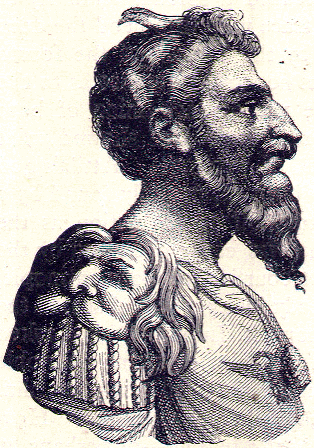
An 1894 engraving of Attila from Charles Horne's Great Men and Famous Women, an image adapted from an antique medal. In depicting Attila with horns and goatish physiognomy, the engraver stressed the diabolical aspects of his character.
He called himself flagellum Dei, the scourge of God, and even today, 1,500 years after his blood-drenched death, his name remains a byword for brutality. Ancient artists placed great stress on his inhumanity, depicting him with goatish beard and devil’s horns. Then as now, he seemed the epitome of an Asian steppe nomad: ugly, squat and fearsome, lethal with a bow, interested chiefly in looting and in rape.
His real name was Attila, King of the Huns, and even today the mention of it jangles some atavistic panic bell deep within civilized hearts. For Edward Gibbon—no great admirer of the Roman Empire that the Huns ravaged repeatedly between 434 and 453 A.D.—Attila was a “savage destroyer” of whom it was said that “the grass never grew on the spot where his horse had trod.” For the Roman historian Jordanes, he was “a man born into the world to shake the nations.” As recently as a century ago, when the British wanted to emphasize how barbarous and how un-English their opponents in the First World War had grown—how very far they had fallen short in their sense of honor, justice and fair play—they called the Germans “Huns.”
Yet there are those who think we have much to learn from a people who came apparently from nowhere to force the mighty Roman Empire almost to its knees. A few years ago now, Wess Roberts made a bestseller out of a book titled Leadership Secrets of Attila the Hun by arguing that—for blood-spattered barbarians—the Huns had plenty to teach American executives about “win-directed, take-charge management.” And Bill Madden reported, in his biography of George Steinbrenner, that the one-time owner of the New York Yankees was in the habit of studying Attila in the hope of gaining insights that would prove invaluable in business. Attila, Steinbrenner asserted, “wasn’t perfect, but he did have some good things to say.”
Even serious historians are prone to ponder why exactly Attila is so memorable—why it is, as Adrian Goldsworthy observes, that there have been many barbarian leaders, and yet Attila’s is “one of the few names from antiquity that still prompt instant recognition, putting him alongside the likes of Alexander, Caesar, Cleopatra and Nero. Attila has become the barbarian of the ancient world.”

The Hun empire at its peak, superimposed on modern European borders. The approximate position of Attila's capital is marked by the star. Map: Wikicommons.
For me, this question became immediate just last month, when an old friend e-mailed out of the blue to ask: “Was A the H all bad? Or has his reputation been unfairly traduced in the course of generally rubbishing everything from that period that wasn’t Roman?” This odd request was, he explained, the product of the recent birth of twins. He and his wife were considering the name Attila for their newborn son (and Berengaria for their daughter). And while it may help to explain that the mother is Greek, and that the name remains popular in some parts of the Balkans, the more I mulled over the problem, the more I realized that there were indeed at least some nice things to be said about Attila the Hun.
For one thing, the barbarian leader was, for the most part, a man of his word—by the standards 0f his time, at least. For years, he levied annual tribute from the Roman Empire, but while the cost of peace with the Huns was considerable—350 pounds of solid gold a year in 422, rising to 700 in 440 and eventually to 2,100 in 480—it did buy peace. While the tribute was paid, the Huns were quiet. And though most historians agree that Attila chose not to press the Romans harder because he calculated that it was far easier to take their money than to indulge in risky military action, it is not hard to think of examples of barbarians who extracted tribute and then attacked regardless—nor of leaders (Æthelred the Unready springs to mind) who paid up while secretly plotting to massacre their tormentors. It might be added that Attila was very much an equal-opportunity sort of barbarian. “His main aim,” notes Goldsworthy, “was to profit from plunder during warfare and extortion in peacetime.”
More compelling, perhaps, is the high regard that Attila always placed on loyalty. A constant feature of the diplomatic relations he maintained with both the Eastern and the Western portions of the Roman Empire was that any dissident Huns found in their territories should be returned to him. In 448, Attila showed himself ready to go to war against the Eastern Empire for failing to comply with one of these treaties and returning only five of the 17 Hun turncoats that the king demanded. (It is possible, that the other dozen fled; our sources indicate that the fate of those traitors unlucky enough to be surrendered to Attila was rarely pleasant. Two Hun princes whom the Romans handed over were instantly impaled.)
It would be wrong, of course, to portray Attila as some sort of beacon of enlightenment. He killed Bleda, his own brother, in order to unite the Hun empire and rule it alone. He was no patron of learning, and he did order massacres, putting entire monasteries to the sword. The Roman historian Priscus, who was part of an embassy that visited Attila on the Danube and who left the only eyewitness account that we have of the Hun king and his capital, saw regular explosions of rage. Still, it is difficult to know whether these storms of anger were genuine or simply displays intended to awe the ambassadors, and there are things to admire in the respect that Attila accorded Bleda’s widow—when Priscus encountered her, she held the post of governor of a Hun village. The same writer observed Attila with his son and noted definite tenderness, writing: “He drew him close… and gazed at him with gentle eyes.”
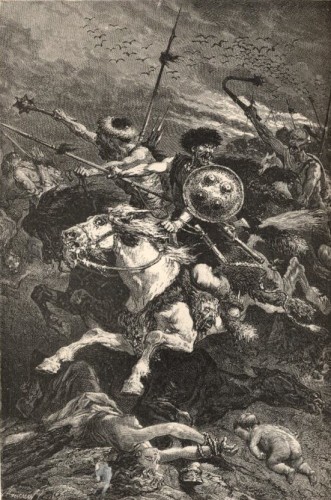
Huns charge at the Battle of Chalons–also known as the Battle of the Catalaunian Fields–fought near Paris in 451.
The discovery of a rich fifth century Hun hoard in Pietrosa, Romania, strongly suggests that the Hun king permitted his subjects to enrich themselves, but it is to Priscus that we owe much of our evidence of Attila’s generosity. Surprised to be greeted in Greek by one “tribesman” he and his companions encountered on the Hungarian plain, Priscus questioned the man and discovered he had once been a Roman subject and had been captured when Attila sacked a city of the Danube. Freed from slavery by his Hun master, the Greek had elected to fight for the “Scythians” (as Priscus called the Huns), and now protested that “his new life was preferable to his old, complaining of the Empire’s heavy taxes, corrupt government, and the unfairness and cost of the legal system.” Attila, Priscus recorded, also employed two Roman secretaries, who served him out of loyalty rather than fear, and even had a Roman friend, Flavius Aëtius, who lived among the Huns as a hostage for several years. Aëtius used the military skills he learned from them to become a highly proficient horseman and archer, and, eventually, one of the leading generals of his day.
Most surprising, perhaps, the Hun king was capable of mercy—or at least cool political calculation. When he uncovered a Roman plot against his life, Attila spared the would-be assassin from the hideous fate that would have awaited any other man. Instead, he sent the would-be assassin back to his paymasters in Constantinople, accompanied by note setting out in humiliating detail the discovery of the Roman scheme–and a demand for further tribute.
Attila remained a threat to both the Western and the Eastern Empires, nonetheless. His armies reached as far south as Constantinople in 443; between 450 and 453 he invaded France and Italy. Oddly, but arguably creditably, the latter two campaigns were fought—so the Hun king claimed—to satisfy the honor of a Roman princess. Honoria, sister of the Western emperor, Valentinian III, had been sadly disappointed with the husband that her brother had selected for her and sent her engagement ring to Attila with a request for aid. The king chose to interpret this act as a proposal of marriage, and—demanding half the Western Empire as a dowry—he fought two bloody campaigns in Honoria’s name.
Of all Attila’s better qualities, though, the one that most commends him to the modern mind is his refusal to be seduced by wealth. Priscus, again, makes the point most clearly, relating that when Attila greeted the Roman ambassadors with a banquet,
tables, large enough for three or four, or even more, to sit at, were placed next to the table of Attila, so that each could take of the food on the dishes without leaving his seat. The attendant of Attila entered first with a dish full of meat, and behind him came the other attendants with bread and viands, which they laid on the tables. A luxurious meal, served on silver plate, had been made ready for us and the barbarian guests, but Attila ate nothing but meat on a wooden trencher. In everything else, too, he showed himself temperate; his cup was of wood, while to the guests were given goblets of gold and silver. His dress, too, was quite simple, affecting only to be clean. The sword he carried at his side, the latchets of his Scythian shoes, the bridle of his horse were not adorned, like those of the other Scythians, with gold or gems or anything costly.
So lived Attila, king of the Huns—and so he died, in 453, age probably about 50 and still refusing to yield to the temptations of luxury. His spectacular demise, on one of his many wedding nights, is memorably described by Gibbon:
Before the king of the Huns evacuated Italy, he threatened to return more dreadful, and more implacable, if his bride, the princess Honoria, were not delivered to his ambassadors…. Yet, in the mean while Attila relieved his tender anxiety, by adding a beautiful maid, whose name was Ildico, to the list of his innumerable wives. Their marriage was celebrated with barbaric pomp and festivity, at his wooden palace beyond the Danube; and the monarch, oppressed with wine and sleep, retired, at a late hour, from the banquet to the nuptial bed. His attendants continued to respect his pleasures, or his repose, the greatest part of the ensuing day, till the unusual silence alarmed their fears and suspicions; and, after attempting to awaken Attila by loud and repeated cries, they at length broke into the royal apartment. They found the trembling bride sitting by the bedside, hiding her face with her veil…. The king…had expired during the night. An artery had suddenly burst; and as Attila lay in a supine posture, he was suffocated by a torrent of blood, which instead of finding a passage through his nostrils, regurgitated into the lungs and stomach.
The king, in short, had drowned in his own gore. He had, Gibbon adds, been “glorious in his life, invincible in death, the father of his people, the scourge of his enemies, and the terror of the world.” The Huns buried him in a triple coffin—an iron exterior concealing an inner silver casket which, in turn, masked one of gold—and did it secretly at night, massacring the prisoners whom they had forced to dig his grave so that it would never be discovered.
Attila’s people would not threaten Rome again, and they knew what they had lost. Gibbon puts it best: “The Barbarians cut off a part of their hair, gashed their faces with unseemly wounds, and bewailed their valiant leader as he deserved. Not with the tears of women, but with the blood of warriors.”
Sources
Michael D. Blodgett. Attila, Flagellum Dei? Huns and Romans, Conflict and Cooperation in the Late Antique World. Unpublished PhD thesis, University of California at Santa Barbara, 2007; Edward Creasy. The Fifteen Decisive Battles of the Western World, From Marathon to Waterloo. New York: Harper & Brothers, 1851; Edward Gibbon. The History of the Decline and Fall of the Roman Empire. Basle, JJ Tourneisen, 1787; Adrian Goldsworthy. The Fall of the West: The Death of the Roman Superpower. London: Weidenfeld & Nicolson, 2009; Christopher Kelly. The End of Empire: Attila the Hun and the Fall of Rome. New York: WW Norton, 2010; John Man. Attila the Hun: A Barbarian Leader and the Fall of Rome. London: Bantam, 2006; Denis Sinor, The Cambridge History of Early Inner Asia. Cambridge: CUP, 2004.
Sign up for our free email newsletter and receive the best stories from Smithsonian.com each week.


Good article. It’s worth noting that the Germans brought on themselves their identification with the Huns. The association dates to July 1900, when Kaiser Wilhelm addressed troops gathered at Bremerhaven on their way to intervene in the Boxer Rebellion in China. Believing himself to be speaking in private – and unaware that a reporter had secreted himself and a notebook on a nearby roof – the Kaiser cut loose:
A transcription of this horrible speech, telegraphed to British and American newspapers, caused a minor sensation. The German chancellor, Von Bulow, appalled, described it as “the worst speech of the period.”
Unlike the august authors of the sources cited in this excellent article, my book, Leadership Secrets of Attila the Hun was never intended to present a history of Attila or the Huns. It is a book that casts Attila in the role of a protagonist who formed a formidable confederacy out of previously unaligned tribes and consequently became the most powerful force in Western Europe during his reign as King of Huns. In that role, the Attila in Leadership Secrets of Attila the Hun teaches his tribal chieftains and warriors time-tested principles of leadership that transcend cultures and era. Nothing in the book suggests the use of underhanded or brutal techniques. All of its lessons are ethical and posits techniques that highly-successful leaders apply today.
German admiration for the Huns of course goes back at least as far as the medieval Nibelungen-Lied, one of the sources of Wagner’s Ring des Nibelungen, though Wagner omitted the Attila (Etzel) part of the story, which describes the revenge taken by Siegfried’s widow on her blood-relatives when they visit her and her new husband Etzel at the latter’s court. Fritz Lang’s film of this epic offers a fascinating representation of the king of the Huns.
Just beg that friend not to call those children Attila and Berengaria. Please. Please.
A very nice book, The Night Attila Died, shreds the myths about his death and makes a good case that he was killed by a plot involving the Romans – the Byzantines out of Constantinople – working with some high placed Huns. The method used in the book is philology, the old inductive method of examining evidence to determine what might have generated it.
The name “Attila” is a Gothic word meaning “little father”
or “daddy”. I not sure if anyone knows what his “real name” was. The so-called “Hunnish hordes” were largely composed of various East Germans such as Ostrogoths and
Burgundians. The Huns themselves were a small group from
Central Asia probably Altaic. There were never enough actual Huns to make a self-respecting “horde”.
In the pictures I have seen of Attila the Hun he doesn’t
look very Asiatic, however I have no idea if these repre-
sentations were accurate.
Once again we see something presented as a new discovery, when in fact everyone in the know has been aware of it for centuries. Edward Gibbon, introduced as the conventional wisdom that our bold researcher has to knock down, says that Attila’s followers knew him as a ‘just and even an indulgent master.’
I think “presented as a new discovery” is a bit harsh. What is old news to historians can be new news to those who haven’t studied the subject, and the essay is very much written with that in mind. If you re-read it you will see it makes absolutely no claims to startling originality.
What glibly revisionist twaddle. The facts presented are reasonably well known but the inferences drawn from them are entirely counter to logic and reason. It is doubtless true that powerful leaders of the classical world were brutal by our standards. Nonetheless, the difference between the level of civilization, rule of law, economic advances, artistic achievement, academic learning, etc. in the Roman Empire were eons ahead of what prevailed in areas ruled by ‘barbarians’, especially nomadic ones like the Huns. Similarly, there is a gaping chasm between imperialist warfare for conquest – bloddy though it is – and a state and people based entirely on armed robbery and rape.
“He and his wife were considering the name Attila for their newborn son (and Berengaria for their daughter). And while it may help to explain that the mother is Greek, and that the name remains popular in some parts of the Balkans…”
A joke, surely? I would be appalled that a Greek woman would want to name her son Attila. Turkey, with deliberate precision and grim malice aforethought proudly named its brutal 1974 invasion and ethnic cleansing of Cyprus “Operation Attila.” The British Daily Mirror aptly used a giant one-word, front-page headline to describe these Hunnish Turkish invaders – “Barbarians!”
The linking of Attila and Berengaria in one pair of siblings is even more extraordinary. King Richard Lionheart of England married Princess Berengaria of Navarre in Limassol Castle. Yes, that’s in Cyprus – and Richard then gallantly gave the whole island to his wife as a wedding present.
Your friends can probably strike Cyprus off the family vacation list if they do this.
Regarding the comment made by LJ – Rome was in many ways a
predator state which inflicted a tremendous amount of misery and destruction on others in it’s history. According to Joseph Taintor in his work “Collapse of Complex Cultures” the standard of living in the Roman Empire fell steadily during it’s rule. In the western Roman
Empire he states that agricultural production fell 80%. Famine and pestilence became common. He also says that in
the sixth century in Italy after the fall of the Roman Empire living standards actually rose under the rule of the
barbarian kingdoms. These kingdoms were not exactly utopias
but people lived better under them than under the late Roman Empire.
Also the actual ethnic Huns are pretty much a non-issue. There were never enough of them to be of any significance
and as far as I know no genetic trace of them has been found in the European population.
The “Huns” of history were actually mostly East Germans. Also in the end stages of the Roman Empire the Roman army
became mostly composed of East Germans and real power in the later Roman Empire was actually yielded by generals in the Roman army who were themselves mostly Latinized Germans.
So in many ways the later “Roman” Empire wasn’t all that much different from the suceeding “barbarian” kingdoms.
This is an interesting essay but I marvel that its author never mentions –since the link is so linguistically obvious–that the Huns were the indigenous people of what is now Hungary. Hungarians regularly name their sons Attila and Ildiko (with a k) is a very popular girls’ name. I’d choose it over Berengaria, a five-syllable tongue twister it would be cruel to saddle any little girl with.
I named my first pet starling Attila. Why? Well starlings have a reputation for being rapacious conquerors but are very nice to their own flock (me in this case). They originate from the same part of the world as Attila. And the bird had so much attitude I knew it would not be suitable to name him after anyone below the imperial level. It seemed to fit!
I had three Volkswagen Beetles–Attila I, II, III. Almost conquered Italy with one.
Remark on Comment 12 – No the Huns are not the “indigenous”
people of Hungary. There were people of various sorts in the area called “Hungary” long before the tiny group of
people from Central Asia called the “Huns” appeared for a
brief moment in European history. The (to Europeans) exotic appearance of the small number of ethnic Huns in
Attila’s “hordes” certainly made a striking impression on
the “Romans” however Attila’s “hordes” were basically made up of East Germans.
The Magyars came hundreds of years later and there is no known connection between the Magyars and Huns other than that they both came from the east.
While the Magyars imposed their language on some of the people they conquered, genetic studies of modern Hungarians have not found any genetic evidence of them.
Apparently their numbers were too small to have left a genetic trace.
It is true that in past times Hungarians thought they were
descended from Huns but this a myth. Because of this myth
the name “Attila” became popular but aside from the fact that Hungarians have nothing to do with Huns the word “Attila” is neither Hunnish nor Magyar but a Gothic
word meaning “daddy”.
By the way the actual region historically referred to as Hungary does not coincide with the present boundaries of
the modern European state of that name.
Truly enjoyed this article. One thing certain about past and present figures able to sway masses (for good or evil), is the ability to some how have such appeal or spiel as to cause such obedience, if not devotion. While fear has its place in motivating people to follow leaders, I think that, just as humanity is complex, so too, their reasoning processes. Loyalty, for example, can go a long way in massaging persuasive muscles. Likewise fear, promises of better things to come (real or imagined), and also the need to ‘fix’ things can excite mobs and gangs, alike. If we can identify what is wrong, assign blame, then remove whatever is the catalyst (again, perceived or actual), hope can be renewed and saviors are born. Until, of course, they are relabeled as tyrants…
While “Atilla” may be undesirable as a given name for a boy (as Ghengis, though Conan seems to be popular among a certain demographic and Alexander is perfectly acceptable), “Berengaria” would probably be considered an acceptable and interesting girl’s name.
As for its being a “five-syllable tongue-twister”, I expect the common usage would be “Berry”, a charming and perfectly appropriate nom de femme.
The mere presence of this article, if its not actually a joke, causes me to again lament the future of our present society.
Name children after Attila? His ‘refusal to be seduced by wealth?’ You must be joking? I particularly enjoyed the defenses of this guy by comparisons to other cheats and murderers. Please try to see the big picture.
Only someone with horribly bad character could believe that Attila had any good quality.
Historians tread a fine line sometimes. One is taught that the cardinal sin is to judge any person, or any society, with reference to 21st century values. From that perspective it is plainly ridiculous to demand that fifth century nomads conform to our ideas of civilisation and honour. To insist that it is impossible Attila had “any good quality” when we know so little about him–and when the sources we do have were written by his enemies–seems especially unwise.
Equally, there are plainly some cases where failure to render some sort of judgement is moral cowardice.
In the case of Attila, historians from Gibbon onwards have seen things to admire in him and refused to merely condemn him. That’s nearly 250 years’ worth of scholarly opinion. I do not consider it an example of “bad character” to bring those views to the attention of Smithsonian readers, for many of whom he is little more than an idea–a turn of phrase.
Mike, I like how you framed your point.
But I don’t feel that it’s necessary, today, to conceive of reasons to admire fifth century leaders who specifically achieved reputations as rapists and murders. Nor is it an optimal idea to name children after them.
Why should we? Today, we know of far more positive examples of leaders. How about Martin Luther King, Gandhi, John F Kennedy, and so on?
Were the Huns Turkic?
While there are indications, from its scant remnants, that Huns’ language was probably Turkic, there is insufficient evidence to be certain of their ethnic origins. One problem is that the Hun empire was a confederation of a number of different nomad groups in which the Huns themselves were in a considerable minority. The once popular theory that the Huns were identical with the Xiongnu, a nomad confederation that had been driven from the northern borders of China a few centuries earlier, is now largely discredited.
Does anyone know if his grave has ever been found?
This article is well written & well researched. Why barbarians like Attila are hated in history? OK, Attila was a killer and even Genghiz Khan but why atrocities of Alexander- the Great & Julius Ceasar are not taught in History Books, just because they are icons for Europeans. History should be unbiased but it’s sad that it isn’t.
I don’t think it is a bad idea to name a kid Attila. My name is Attila. I’m an Asian American and its suits me fine. Just because Attila does not conform to Western Culture does not mean that it is bad or “immoral”.
I say do it.
I also think that the Western readers have a biased view on the Huns and Attila. It might be racial but the Huns are view much more harshly than their western counterparts. Germans or the Goths are viewed as enemies of Rome, but the Huns get a much more animosity from its audience.
Don’t want to make it political, but I think it is better to be open minded and see other views with an unbiased view.
Interestng article and interesting comments. The remark from Jim Hobelman contains the most facts. There are two options here, first “..the Huns were the indigenous people of what is now Hungary..” which is not true and the second opinion is “..in past times Hungarians thought they were
descended from Huns but this a myth.” which isn’t true as well. The truth lies somewhere between as usual. There are guessings where the hungarians came. One thing is for sure we (I’m a hungarian) were coming from the far east and we were a “confederation of a number of nomad groups”. Anything else is very-very unsure and controversial. The origin of the Huns is something like that, they came from almost the same area from inner Asia and at first the name of the “tribe” was hsziungnuk or hiungnuk. Around the 5. century they arrived to the area of the Carpathian mountains and settled down to the territory of the present Hungary. So it is very obvious that we mixed with the Huns but either way we surely have something from them. In other hand the source of our language (hungarian) is remains in the same darkness, no one exactly knows what is the origin of the hungarians nor the huns. The original source could be the same.
“Does anyone know if his grave has ever been found?”
Unfortunately never despite of the huge efforts of the hungarian archeologists. They assumed that his coffin was buried in the bottom of the Tisza. That is the second largest river in Hungary (I just live next to the shore of this river). Obviously the river is continously moving so no one is actually searching for his grave in the river. :)
I was born and raised in Hungary.
My name is Attila. So was many of my classmates’.
To the … who thinks it’s a bad thing. Attila is an awesome name. Everyone with the exception of the ignorant uptight in some western places love it.
So your child will be Mohandas or Karamchand in the western world? Good for you.
How about Henry, Mary, Elizabeth, Isabella, Irma, Joe, Max, Leo, Hussein, etc..etc. Those are OK, right?
He was a strict military leader.
Was he cruel in 400AD? No doubt about it. In a world and at a time when mercy was luxury, when either you conquered or got slaved, yes, he was. Genghis Khan, Bonaparte, Stalin, half the Roman emperors, the British, Spanish Royals and a load more people did the same or a lot worse and with a small exception I can’t hear about them other than praises.
What’s puzzling is that we still don’t know how much is TRUE from what his enemies in that time said about him.
We accept it though – even if those are mostly boogie man stories – because they are more interesting to some people.
Do you want to judge him by what his people said or what the conquered, tax paying countries said? Sure. How about the opinion on the USA by the millions of ppl whose life was ruined by US weapons and/or bombs?
Bottom line, it was impressive that from a little orphan boy he became a fearless warrior king.