
Meat Helps Human Populations Grow
A new study links eating meat to shorter periods of nursing, allowing women to bear more children
/https://tf-cmsv2-smithsonianmag-media.s3.amazonaws.com/accounts/headshot/science-erin-wyman-240.jpg)
/https://tf-cmsv2-smithsonianmag-media.s3.amazonaws.com/filer/20120425102020smallmeat.jpg)
Did eating meat allow humans to take over the world? Things are never that simple. But in some ways, the answer might be yes. A new study links meat-eating to shorter periods of nursing in humans relative to other apes. By weaning kids off breast milk quickly, women could bear more children, allowing human populations to expand.
In traditional societies lacking birth control, women tend to nurse their babies until about the age of 2. Chimpanzees, on the other hand, allow their offspring to suckle for about five years. Orangutans are even more generous; they don’t wean their offspring until after age 7. Scientists have wondered why humans are such weird primates in this regard. It turns out we’re not so weird when you consider that we’re also carnivores, say Elia Psouni of Sweden’s Lund University and colleagues.
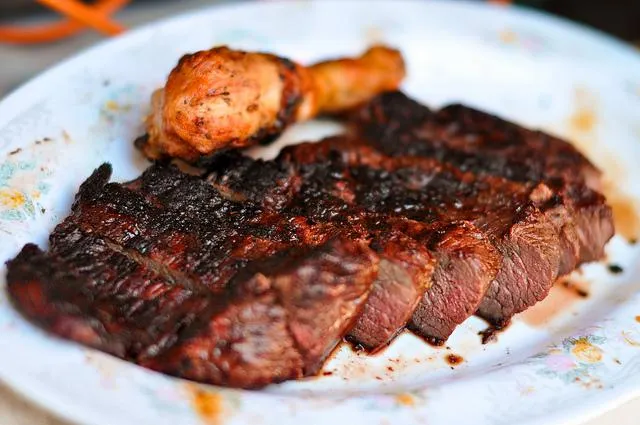
The researchers created a model of lactation time using data on factors that affect development from 67 species of mammals. The results showed carnivores tend to wean their offspring earlier than herbivores or omnivores. Here’s why: Once the brain reaches a certain stage of development, mothers no longer need to nurse their infants. Carnivores seem to reach this stage sooner than herbivores or omnivores, presumably because their nutrient-rich diet leads to better milk, the team reports in PLoS ONE.
Although most of us tend to consider ourselves omnivores, we qualify as carnivores under the team’s definition: animals whose diets are at east 20 percent meat. (The diets of modern hunter-gatherers range from 20 to 50 percent meat; chimp diets average only 5 percent animal flesh.) Further confirmation of the team’s hypothesis comes from the predictive power of their model. The model suggests humans should stop lactating once a child reaches 2 years and 5 months. The average time of weaning in 46 traditional human societies was 2 years and 4 months.
This isn’t the first time meat has been linked to early weaning in humans. Anthropologist Gail Kennedy of UCLA made the connection in the Journal of Human Evolution (PDF) in 2004, but came to a different conclusion. Instead of the brain being developed enough at the time of weaning, Kennedy suggested human babies had to start eating meat early to get enough fuel to grow a large brain. A mother’s milk alone wasn’t nutritious enough to get the job done.
Regardless of how meat-eating led to shorter nursing periods, the effect was the same: more babies. Lactation acts as a natural birth control, so putting an end to suckling makes a woman fertile again. By decreasing the time between births, women could have more children. As the researchers put it, this had “profound effects on population dynamics.” In other words, it helped increase the number of people.
/https://tf-cmsv2-smithsonianmag-media.s3.amazonaws.com/accounts/headshot/science-erin-wyman-240.jpg)