
Did Africa’s Apes Come From Europe?
Fossil evidence hints that the common ancestor of gorillas, chimpanzees and humans evolved in Europe
/https://tf-cmsv2-smithsonianmag-media.s3.amazonaws.com/accounts/headshot/science-erin-wyman-240.jpg)
/https://tf-cmsv2-smithsonianmag-media.s3.amazonaws.com/filer/20120606115016picresized_1338232507_6442740433_c2d9dd0f4c_z.jpg)
Europe is not where most people would search for the common ancestor of chimpanzees, gorillas and humans. But that’s exactly where one team of anthropologists thinks the grandfather of the African apes came from.
But before we explore the origins of African apes, it helps to know how to identify a paleo-ape in the fossil record. The most distinct physical traits that all living apes share are the ones that help the animals swing through trees: long arms; a broad, flat chest; a short, stiff lower back; and long, curved fingers and toes. They also lack a tail. These traits didn’t evolve all at once, however. The world’s earliest known ape—the 20-million-year-old Proconsul from East Africa—had a monkey-like body, but aspects of the wrist and the absence of a tail indicate Proconsul did indeed sit at the base of the ape family tree.
By about 17 million years ago, apes appear in Europe’s fossil record. In a recent issue of Evolutionary Anthropology, David Begun and Mariam Nargolwall, both of the University of Toronto, and László Kordos of the Geological Institute of Hungary describe Europe’s fossil apes and why they think Europe was, in a sense, the motherland of African apes.
The ancestors of European apes probably came from Africa as part of a wave of mammals that were attracted to the continent’s subtropical forests. During the early part of the Miocene, the epoch that spans roughly 23 million to 5 million years ago, the two land masses were connected by land bridges that crossed the ancient Tethys Sea (a more expansive version of the Mediterranean). The first European apes, which lived 17 million to 13.5 million years ago, were Griphopithecus (found in Germany and Turkey) and Austriacopithecus (found in Austria). Both apes are known mainly from teeth and jaws, so we don’t know what their bodies looked like. But they did have thick dental enamel, another ape-like characteristic.
By about 12.5 million years ago, the first apes that really resemble modern great apes emerged in Europe and Asia. Those in Asia gave rise to that continent’s sole living great ape, the orangutan.
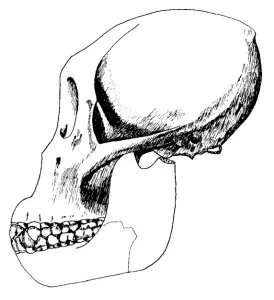
And those in Europe might have given rise to today’s African apes. A good candidate is Dryopithecus, first unearthed in France. Features of the ancient ape’s arms indicate it could probably swing through the trees like modern apes do. It also had a large frontal sinus, an air pocket in the forehead that produces mucus (also the site of dreadful sinus infections). This trait ties Dryopithecus to African apes. Gorillas, chimpanzees and humans all have a frontal sinus; orangutans, found only in Asia, do not.
Other European apes from around this time also shared characteristics with today’s African apes. For instance, Rudapithecus, an ape that lived in Hungary about 10 million years ago, also had a frontal sinus as well as a bevy of other characteristics seen in African apes, such as brow ridges and a downwardly bent face.
Begun and his colleagues think an ape like Dryopithecus or Rudapithecus returned to Africa and established the lineage of modern African apes. They point out the timing makes sense. The features that characterize gorillas and chimpanzees today evolved first in Europe, two million years before they appear in the African fossil record.
Apes may have left Europe in the later Miocene as climate change made Europe uninhabitable. The rise of the Himalayas made the continent much cooler and drier. Starting 9.5 million years ago, deciduous woodland replaced subtropical forests, and many tropical animals died out.
Luckily for us, at least some escaped before it was too late.
/https://tf-cmsv2-smithsonianmag-media.s3.amazonaws.com/accounts/headshot/science-erin-wyman-240.jpg)