
Thinking About the End of Film
Film is dying, according to several reports. Or maybe it isn’t. Alexander Payne, among others, chimes in
/https://tf-cmsv2-smithsonianmag-media.s3.amazonaws.com/accounts/headshot/daniel-eagan-240.jpg)
/https://tf-cmsv2-smithsonianmag-media.s3.amazonaws.com/filer/20111202034024Hiawatha_thumb.jpg)
Several recent articles have reached the same dismaying conclusion: film as a medium is doomed. First came a report that, starting in 2012, Twentieth Century Fox International will no longer ship 35mm prints to Hong Kong and Macau. Only DCI-compliant digital formats will be available. Then came Debra Kaufman’s sobering article for Creative Cow: Film Fading to Black, a detailed account of how companies like ARRI, Panavision, and Aaton no longer manufacture film cameras. (Devin Coldewey added his own take on Kaufman’s work for TechCrunch.) Several sources reported on financial difficulties facing Kodak, one of the most storied names in film (try WHEC.com’s “Is Kodak in trouble?” for some hometown perspective.)
Julia Marchese of the New Beverly Cinema in Los Angeles went so far as to start a petition, Fight for 35mm, stating that, “The major film studios have decided that they eventually want to stop renting all archival 35mm film prints entirely because there are so few revival houses left, and because digital is cheap and the cost of storing and shipping prints is high,” adding that, “I feel very strongly about this issue and cannot stand idly by and let digital projection destroy the art that I live for.” (As of today, she has collected over 5,700 signatures.)
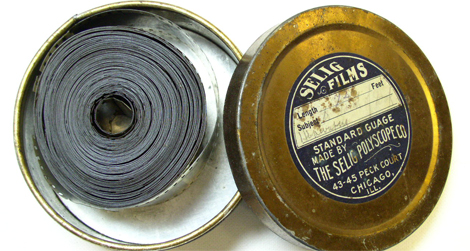
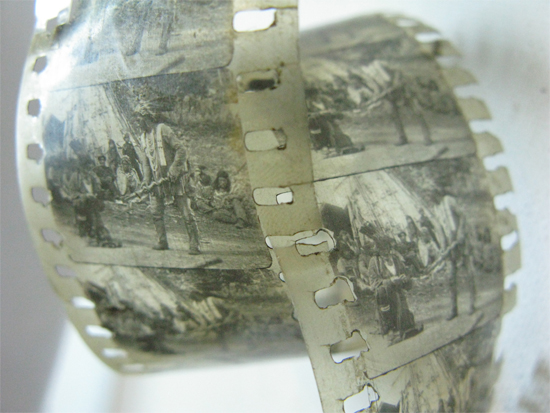
A Pictorial History of Hiawatha before restoration.
In a more metaphoric than practical sense, New York Times critic A.O. Scott weighed in with Film Is Dead? What Else Is New?, citing doomsayers like Roger Ebert (“Video commands the field”) and Anthony Lane (“Enjoy it while it lasts”) before suggesting that film is “fragile and perishable” in part because it is based on nostalgia.
If you need more concrete proof of how film’s dominance in culture has eroded, take the sales figures for Call of Duty: Modern Warfare 3: $400 million in a day. That’s more than most big-budget films will gross in a year, if they ever reach that point. Or read Film Journal‘s How do we win back younger moviegoers?, which presents some eye-opening statistics: the 12 – 24 age group, once thought to be the backbone of the film audience, purchased only 32% of movie tickets in North America in 2010. That’s down from 60% in 1974.
The sudden confluence of “Death of Cinema” reports is surprising, as predictions of its demise have been around for decades. Radio was supposed to kill off movies back in the 1920s, for example, then television was suppossd to do it in the 1950s. In his book 2007 The Virtual Life of Film, D.N. Rodowick argues that, “As almost (or, truly, virtually) every aspect of making and viewing movies is replaced by digital technologies, even the notion of ‘watching a film’ is fast becoming an anachronism.” But “new media” are themselves based on cinema, “the mature audiovisual culture of the twentieth century.” So what we know as cinema will continue to exist even if film is replaced as a medium.

A Pictorial History of Hiawatha retained its imagery for over a hundred years despite significant damage. Courtesy Julia Nicoll.
Ironically, it turns out the film is an excellent archival material, far more stable and reliable than any existing digital archival platform. (The photos accompanying this article show A Pictorial History of Hiawatha, filmed in 1902–03 and restored in 2009 by Julia Nicoll for Colorlab. Even in its deteriorated, pre-restoration shape, the film retained its images.) Stored properly, film can last for decades, something that cannot be said about floppy disks or Iomega Zip drives. Two-inch, reel-to-reel videotape used to be the broadcast standard for television. Only a handful of playback machines still exist. For that matter, when was the last time you viewed a 3/4-inch videotape?
Film has a tactile beauty that digital lacks. I guess it’s a similar contrast between print photographs and digital ones, between writing with a fountain pen or on a computer. Few would pass up the speed and convenience of new technologies. It’s much easier laying out an article with InDesign than physically cutting and pasting galleys onto dummy pages, just as it’s easier to edit with Final Cut Pro than with grease pencils and gang synch blocks. But I miss the physical contact that the old methods entailed, the tape splicers and take-up reels, the linen-lined bins filled with strips of film.
Earlier this week, Alexander Payne, director of The Descendants, spoke to me about the film vs. digital divide. “I attend a lot of festivals,” he said. “When I see movies projected digitally, and then I see them on film, they look better on film. Film has a warmer feeling. Flicker is better than glow.”
Payne acknowledged digital’s incursions. “In the US theaters project at about a 50-50 ratio of film-to-digital, Norway is about 90% digital, Iceland I think is 99% or getting there,” he said. The director also admitted that watching film can be a dismal experience “if the projectionist has turned the bulb down to save money, or doesn’t know how to frame the film.
“But I think we’re losing something. I remember an interview Jean Renoir gave about medieval tapestries, where he said something to the effect that the more codified and standardized a medium gets, the closer it comes to death.” Digital processes are “trying to approximate the medium’s representation of reality—’Look how real it is,’ they say.”
Payne had just attended a screening of the restored version of The Life and Death of Colonel Blimp, calling it a “transformational” representation of life. “Why can’t we have that?” he asked. “I had to fight tooth and nail to make my next film in black and white. Interestingly, I have to shoot in digital in order to give it a filmic look. I’m going to screen black-and-white films like Ordet, not just for the cinematographer, but for the whole crew. I’ll say, ‘I want one shot, just give me one shot that looks like that.’”
On at least one level, Payne doesn’t believe that film is dying just yet. “Say you’re a teenager, and you want to be alone on a date,” he said. “Where else are you going to go on a Friday night?”
/https://tf-cmsv2-smithsonianmag-media.s3.amazonaws.com/accounts/headshot/daniel-eagan-240.jpg)