
The Never-Ending Tussle Between Box Office Hits and Award Winners
Blockbuster movies often lose out at the Oscars, while winners can’t find enough viewers
/https://tf-cmsv2-smithsonianmag-media.s3.amazonaws.com/accounts/headshot/daniel-eagan-240.jpg)
/https://tf-cmsv2-smithsonianmag-media.s3.amazonaws.com/filer/20120127030121Artist1_thumb.jpg)
While writing Wednesday’s post, I got into an argument with my editor about The Artist. I wanted to write that moviegoers don’t like it very much, and he countered that the film has received 10 Oscar nominations as well as generally excellent reviews.
And yet average customers—the ones who may not read film reviews and who may know next to nothing about silent film—have shown little inclination to see The Artist. At the same time, they are showering hundreds of millions of dollars on films like Mission: Impossible—Ghost Protocol. The Weinstein Company must be feverishly arguing about what is holding people back from The Artist. Are moviegoers afraid of black-and-white movies? Are they afraid of silent movies? Or are they afraid that The Artist is the kind of “art” that tastes like medicine, something they are supposed to take because it’s good for them?
It’s difficult to reconcile the two approaches to cinema, roughly art vs. commerce. Is a film that makes a lot of money a success? Or should we judge a film by the awards it wins? If the former is the answer, then Avatar, Titanic, and Harry Potter and the Deathly Hollows—Part 2 are the best films ever made. If it’s awards that count, put the 1959 Ben-Hur at the top of the list, along with Titanic and The Lord of the Rings: The Return of the King.
The industry itself is confused, and you can trace that confusion back to the very first Academy Awards ceremony in 1929. Hollywood executives awarded Wings, a popular aviation epic, something called “Outstanding Picture, Production” and Sunrise, an F.W. Murnau drama that is considered a classic now but which did poorly at the box office, “Unique and Artistic Production.” A similar situation arose in 2009, when box-office champion Avatar competed for Best Picture against critical darling The Hurt Locker.
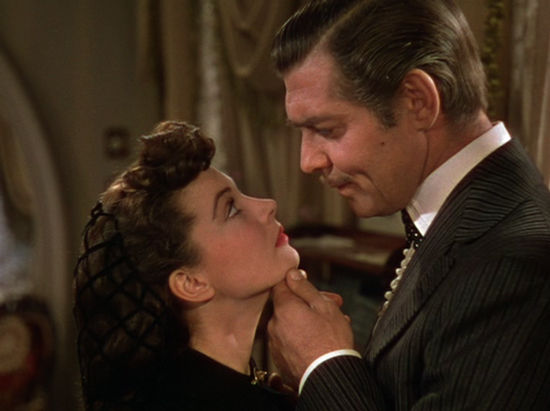
Gone With the Wind: Oscar-winner, box-office blockbuster.
I had a blast at Avatar and Titanic, but I don’t think any critic would argue that they are the best that cinema can do. And Ben-Hur is probably my least favorite William Wyler film, one that damaged his career. (As his daughter Catherine Wyler told me in an earlier post, “There’s no question he was written off by the critical community with this film.”) For that matter, I am ambivalent about several other acknowledged classics like Shane, Gone With the Wind and The Birth of a Nation.
Viewers are too, and who can blame them? When they’re supposed to be watching The Hurt Locker, they are more likely to be found at Avatar. Like how I’ve managed to read every Elmore Leonard novel without yet cracking open my wife’s copy of Greek Tragedies.
Critics often aren’t much help, pushing films that regular viewers don’t like while ridiculing box-office hits. In effect, they are questioning the ability of moviegoers to distinguish between good and bad. Action films in particular face a critical bias. Back in the 1970s, long before he received Oscars for films like Unforgiven, Clint Eastwood used to receive the same drubbing critics would give to Sylvester Stallone, Bruce Willis, and Jason Statham. (“God forbid!” Bosley Crowther wrote at the possibility that A Fistful of Dollars would have a sequel. Renata Adler said The Good, the Bad, and the Ugly “must be the most expensive, pious and repellent movie in the history of its peculiar genre.” And here’s Roger Greenspun on one of Eastwood’s signature roles: “Dirty Harry fails in simple credibility so often and on so many levels that it cannot even succeed (as I think it wants to succeed) as a study in perversely complimentary psychoses.”)
To be fair, even blockbusters can leave a sour taste. Although it earned over $800 million, director Michael Bay admitted that Transformers: Revenge of the Fallen wasn’t very good.
On the other hand, no matter how hard critics insist that one film or another is deserving, customers can still ignore them. The New York Times wrote several articles about The Social Network, promoting it early on as “the film to beat for best picture at the 2011 Academy Awards.” Voters felt differently, giving the Oscar that year to The King’s Speech instead. Is one film better than the other? Viewers didn’t care much either way. The King’s Speech came in at 18th on the box-office rankings for 2010, behind Megamind and Little Fockers; at $96 million, The Social Network did even worse, falling below Yogi Bear and The Expendables.

Dodsworth: critical favorite, box-office disappointment.
The history of cinema is littered with films that should have been hits but weren’t. In 1944, producer Darryl F. Zanuck released Wilson, a close to three-hour biopic about President Woodrow Wilson, and spent a ton of money on publicity. Wilson received ten Oscar nominations, and won five awards, including Best Original Screenplay, but it was a resounding flop at the box office.
Or take Dodsworth (1936), one of the most mature and compelling portraits of a marriage ever to come out of Hollywood. Based on a Sinclair Lewis novel, produced by Samuel Goldwyn, and directed by William Wyler, the film received seven Oscar nominations. And yet Goldwyn complained later, “I lost my goddam shirt. I’m not saying it wasn’t a fine picture. It was a great picture, but nobody wanted to see it. In droves.”
Even D.W. Griffith struggled with his titles. He had so much trouble with 1916 epic Intolerance that he extracted an entire movie from it, which he released as The Mother and the Law.
How studios get you to spend money on their movies is too broad a topic to cover here. But it’s worth pointing out that producers use several strategies to try to gauge a film’s success, like focus groups who discuss their likes and dislikes after preview screenings. Exit polls told executives that The Social Network was not clicking with viewers (who recently gave bad grades to Steve Soderbergh’s Haywire). Exit polls come too late in the process to salvage films, but they are a good indication of whether to continue pouring advertising money after them. Many directors disdain focus groups, some insisting on contracts that give them “final cut” no matter what the polls say. But the practice extends back to the silent era, when comics like Harold Lloyd and Buster Keaton would test their films before audiences in order to refine jokes and gags.
Each polling methodology has its flaws. One of the most notorious sneak previews in Hollywood history took place in March, 1942, when RKO executives showed a 131-minute version of The Magnificent Ambersons to viewers in Pomona, California. The reaction was overwhelmingly negative. As RKO chief George Schaefer wrote, “It was like getting one sock in the jaw after another for over two hours.” While director Orson Welles was off working in Brazil, RKO took an ax to the film, whittling it down to 88 minutes and releasing it as the second-half of a double bill with Mexican Spitfire Sees a Ghost. The lost “director’s cut” of The Magnificent Ambersons ranks with the nine-hour version of Greed as prime examples of lost masterpieces.
The choices for this year’s Best Picture Oscar may not be as stark as in earlier years, but it will be interesting to see if the winners reflect the tastes of Academy members or of the larger moviegoing public.
/https://tf-cmsv2-smithsonianmag-media.s3.amazonaws.com/accounts/headshot/daniel-eagan-240.jpg)