
Boxing Robots of the 1930s
Jack Dempsey boasted he could tear apart a robot opponent “bolt by bolt and scatter its brain wheels and cogs all over the canvas”
/https://tf-cmsv2-smithsonianmag-media.s3.amazonaws.com/accounts/headshot/matt-novak-240.jpg)
/https://tf-cmsv2-smithsonianmag-media.s3.amazonaws.com/filer/201112131010141934-April-Modern-Mechanix-470x251.jpg)
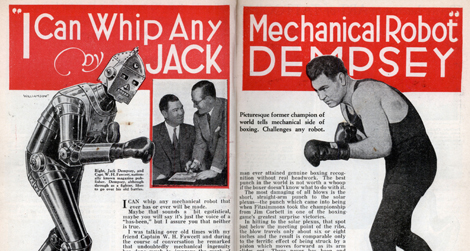 The Rock ‘Em Sock ‘Em Robots toy is both a vivid and lukewarm memory of my childhood. I remember playing the plastic fighting game with my friend Matt (apparently Matt was quite a popular name for boys born in the early 1980s in the suburbs of St. Paul) and being terribly underwhelmed. There’s just about nothing cooler than fighting robots (unless it involves Hugh Jackman), but banging on chintzy plastic buttons that give you all of two options (left punch and right punch) and one outcome (the robot’s head pops up) left much to be desired. Originally introduced in 1964, Rock ‘Em Sock ‘Em remains a popular toy today, but I can’t help but think they could’ve taken some advice from those who were dreaming up fighting robots in the 1930s. Who would’ve thought that the 1930s was the Golden Age of boxing robots?
In the April, 1934, issue of Modern Mechanix and Inventions the “mechanical robot” goes toe-to-toe with boxing legend Jack Dempsey. In the article Dempsey relays a conversation he had with a friend about what it would be like to fight a robot. According to Dempsey — who says he could tear one to pieces “bolt by bold and scatter its brain wheels and cogs all over the canvas” — the main deficiency of a boxing robot would be its lack of brains.
“The reason is simple: Engineers can build a robot that will possess everything except brains. And without brains no man can ever attain championship class in the boxing game. It is true enough that we have had some rare intellectual specimens in the higher frames of boxing glory, but I can truthfully say that no man ever attained genuine boxing recognition without real headwork. The best punch in the world is not worth a whoop if the boxer doesn’t know what to do with it.”
The January, 1931 issue of Modern Mechanics magazine (a publication that changed names many times in the 1930s) ran a short story about two brothers in California who had created a robotic boxing match. The illustration that was included in the piece is quite evocative that of the Rock ‘Em Sock ‘Em toy:
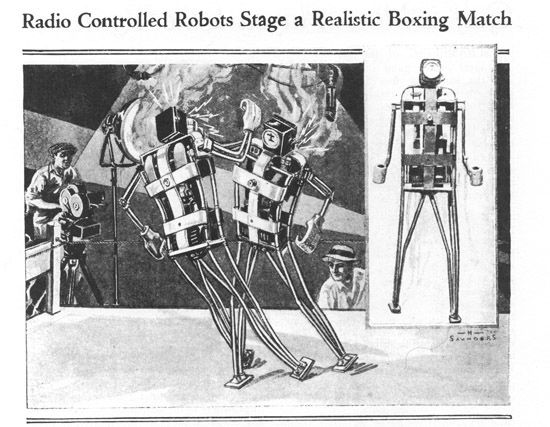
Two pugilistic robots, built by the Veronda brothers, of California, recently staged a furious six round boxing match in which they slugged each other’s metal bodies with all the realism of a human fight. The actions of the mechanical fighters were controlled by short wave radio. At the height of the fray, however, the wires got crossed somewhere. With smoke rising from their innards the fighters lost their heads and began lashing out wildly, dealing terrific clouts with both fists. Finally one robot went down and the other collapsed on top of him.
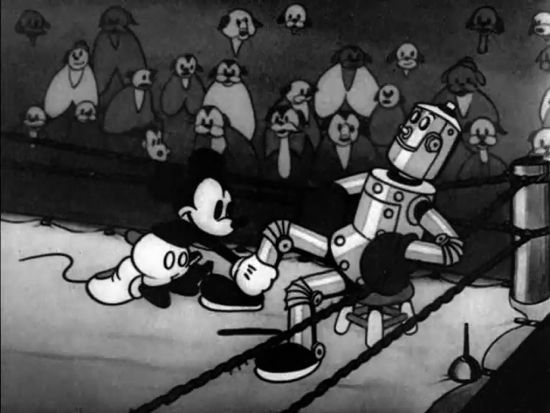
In June of 1933 Walt Disney released a short animated film titled Mickey’s Mechanical Man, starring his still relatively new hero, Mickey Mouse. In the film Mickey builds his own robot to fight a gorilla named The Kongo Killer — a reference to the movie King Kong, which had been released earlier that year. In this “Battle of the Century” which pits man against beast, the usual animated hijinks ensue, but it’s interesting that neither the gorilla nor the robot are in very good shape by the fight’s end. You can watch Mickey’s Mechanical Man on YouTube.
Al Capp’s syndicated comic strip, Li’l Abner had a strip that ran in newspapers on July 18, 1937 which featured a fighting robot. What drives this robot to fight? According to the professor who invented him, “My robot is perfect — except for one flaw — he becomes a savage murderous machine of destruction in the presence of smoke – simple tobacco smoke.”
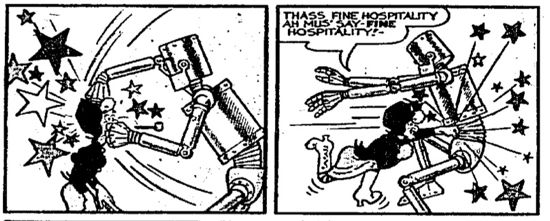
It’s interesting to notice the shift in attitudes toward smoking in the 1930s, when U.S. tobacco companies had started to spend a great deal more money on advertising in the wake of alcohol Prohibition and the temperance movement. The robot in this comic most likely represented those who opposed smoking. As K Michael Cummings notes in his 2002 paper “Programs and policies to discourage the use of tobacco products”:
At the turn of the century the anti-smoking movement in the United States was motivated mainly by moral and religious beliefs, although medical objections against cigarettes were beginning to be raised. Both Thomas Edison and Henry Ford voiced concerns about the detrimental health effects of cigarette smoking. In the first quarter of the twentieth century groups such as the Non-smokers Protective League, The Women’s Christian Temperance Union, and religious leaders joined forces to prohibit the sale of tobacco and alcohol. However, the negative backlash against the federal prohibition on alcohol coupled with the more pragmatic approach of allowing governments to tax tobacco as a way of controlling its use resulted in the rescinding of most state and local prohibitions against tobacco.
By the 1930s efforts to limit smoking were fading away, allowing tobacco manufacturers to compete vigorously against one another by spending tens of millions annually in advertising to promote their brands. Cigarette advertisers were successful in associating smoking with images of health, athletic performance, wealth, and social standing which helped fuel a nearly three decade long increase in the prevalence of smoking.
/https://tf-cmsv2-smithsonianmag-media.s3.amazonaws.com/accounts/headshot/matt-novak-240.jpg)