
Mobsters Tremble Before the Crime-Fighting, Red Flying Gondola
Science-fiction pioneer Hugo Gernsback predicted that, as long as police officers were stuck on terra firma, criminals always would have the edge
/https://tf-cmsv2-smithsonianmag-media.s3.amazonaws.com/accounts/headshot/matt-novak-240.jpg)
/https://tf-cmsv2-smithsonianmag-media.s3.amazonaws.com/filer/201201060220581936-air-police-patrol-470x251.jpg)
The first known case of aircraft being used in police work was in 1919, when famed Canadian aviator Wilfrid Reid May flew a detective in pursuit of a dangerous fugitive from Edmonton to Edson (landing in a town street). In the decades since, law enforcement aviation units have utilized planes, helicopters, blimps and, most recently, unmanned aerial drones.
Notably absent from that list are heavily-armed flying gondolas. But that’s precisely the idea presented in the February, 1936 issue of Everyday Science and Mechanics. An article by editor Hugo Gernsback–considered by many to be the father of modern science fiction– predicted that, as long as police officers were stuck on terra firma, the mobsters always would have the edge:
The automobile, as a quick get-away instrument in crime, has assumed vast proportions during the past decade. Notorious gangsters and their henchmen are always using high-powered automobiles and, unfortunately, they are often able to outwit local police and state troopers after the crime has been engineered. Very frequently, the license number and a good description of the car is obtained by the police but, as a rule, so much time is lost in distributing such information from Police Headquarters that the criminals can make a clean getaway. Usually, the crime car is abandoned a little later, after the gangsters have changed to another.
Gernsback, who was a pioneer in the field of radio and helped to popularize the word “television” in the United States (he’s sometimes mistakenly credited with coining the word), couldn’t help but mention the advances short-wave radio had made in assisting police of the era. However, Gernsback acknowledged that more than just better communication would be needed to stop the gangsters of the future. Our noble author is also sure to mention that the gondola is “streamlined,” a popular design choice for the 1930s, when even humans were determined to be outfitted for the fast and aerodynamic future.
It is true that short-wave radio, in connection with police cars, has been able to decrease crime somewhat; but this is true mostly in large cities. Once the fleeing gangsters take to the rural highways, it is usually impossible for the police to overtake them.
A means is here proposed to enable the police to move quickly about, and apprehend, criminals, via airplane. A number of municipalities now have airplanes, and most of them are being equipped with police radio. But it is one thing to notify an airplane that a car is heading in a certain direction on the highway, and another to stop the car by airplane. The reason for this is that the modern airplane cannot come too close to the ground and, even if it did, it could do so for only a very brief space of time, measured in seconds. Suppose we have instead a police plane equipped with a separate gondola, which is streamlined, and which can be lowered from the plane by a steel cable. By means of the plane’s engines, the gondola can be lowered or raised quite rapidly, while the plane can fly from 300 to 400 feet above the ground. The gondola, which swings free, except as it is supported by the steel cable, can assume a partially independent motion of its own, because it has a rudder and elevators to steer it, like a glider. It can, therefore, independent of the airplane, veer to the right or the left, and even turn about in the opposite direction, should this be necessary. The mobility of the gondola is, therefore, greater than that of the plane.
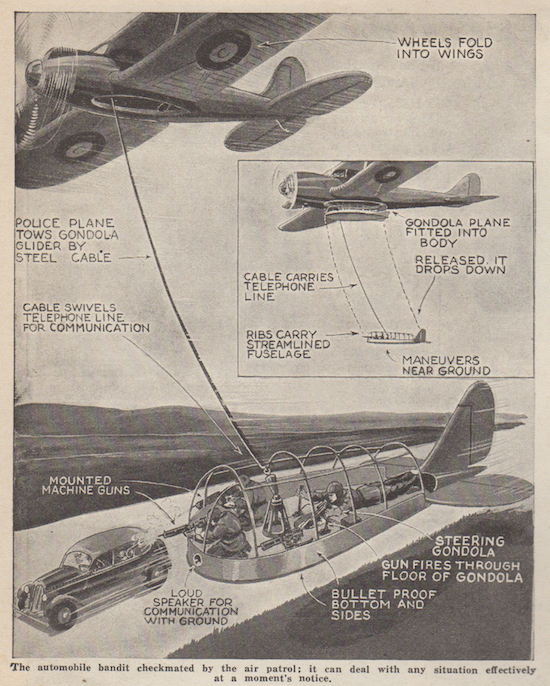
An illustration showing just how Gernsback's air patrol would work
/https://tf-cmsv2-smithsonianmag-media.s3.amazonaws.com/accounts/headshot/matt-novak-240.jpg)