
1970s Children Draw Robot Presidents and Nuclear Apocalypse
Kids predict the darndest things
/https://tf-cmsv2-smithsonianmag-media.s3.amazonaws.com/accounts/headshot/matt-novak-240.jpg)
/https://tf-cmsv2-smithsonianmag-media.s3.amazonaws.com/filer/20120223112055dome-home-1976-470x251.jpg)
American futurism of the 1970s is a fascinating mix of sleek Jetsonian utopianism and dreary mushroom cloud hellscapes. Nowhere is this dichotomy of tomorrowism more evident than in children’s drawings of the future.
I’ve always found that some of the most interesting predictions come from children, who tend to express ideas that reflect both the best and worst of any decade’s futurism. The 1970s was a rather contentious time in the United States. The country saw a tremendous loss of manufacturing jobs and a sharp spike in crime, but the moon landing of 1969 was still fresh in the public’s mind — even if the last person to set foot on the moon was in 1973. Kids were watching re-runs of The Jetsons (which only lasted one season in 1962-63) but the Vietnam War was still being hotly debated until the withdrawal of American forces in 1975. There was little faith in government, with President Nixon’s resignation in 1974, and the state of the environment was of growing concern.
The year 1976 marked America’s Bicentennial. As festivities were planned across the country, it became a time of reflection for rattled Americans who wanted to be hopeful about the future of the country.
The American oil company ARCO (Atlantic Richfield Company) celebrated the Bicentennial in a curious way, by soliciting and publishing the ideas of average Americans about what the United States would look like in the year 2076 — it’s Tricentennial. I found The Tricentennial Report, which was published in 1977, tucked away in the University of Wisconsin-Milwaukee’s library. The book explains in its introduction:
The people had been asked by Atlantic Richfield Company in newspapers, magazines and television advertisements, to discuss their country’s future. Some 60,000 Americans responded and this report is a distillation of their ideas and feelings.
The drawings by children are, of course, a highlight of the book.
The Tricentennial Program received hundreds of letters and drawings from schoolchildren throughout the United States. Here are a few examples, taken mainly from Dr. Harriet Eisenberg’s classes at John F. Kennedy High School in New York.
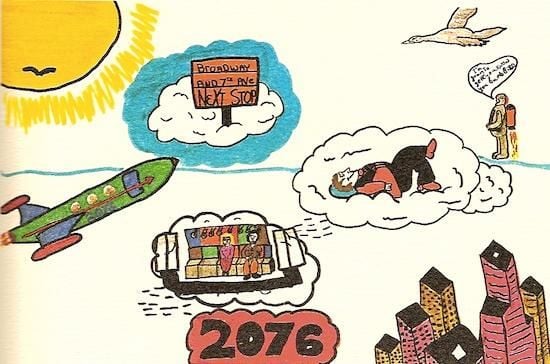
This drawing, by high schooler Eduardo del Villas, features soaring rockets and a jetpack pilot shouting the taunt, “I’m going to get you now you dumb bird!”
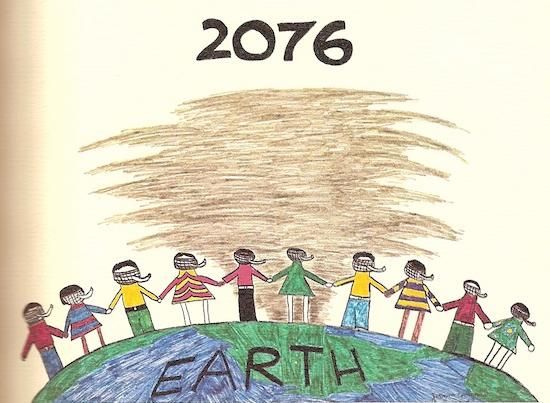
This drawing by Joanne Connaire seems to show children of the world joining hands in 2076, with their faces obscured, quite possibly wearing masks to protect themselves from whatever brown mass (air pollution?) is behind them.
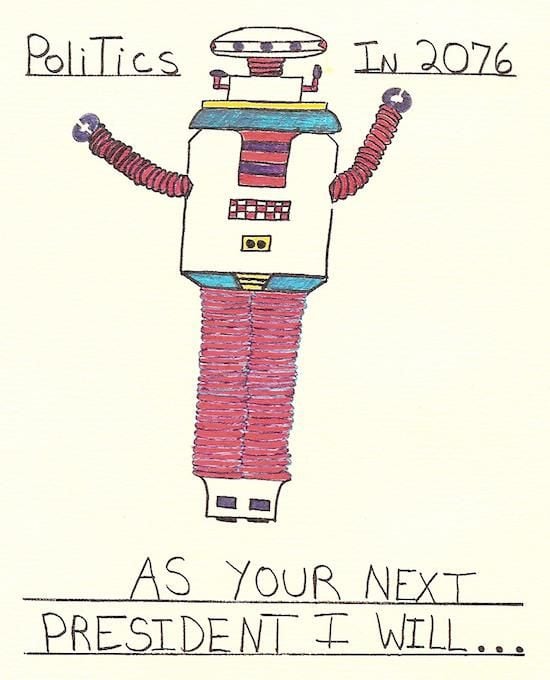
High schooler Robert Berman took a stab at politics in the year 2076, with a robot campaigning to be president of the United States.
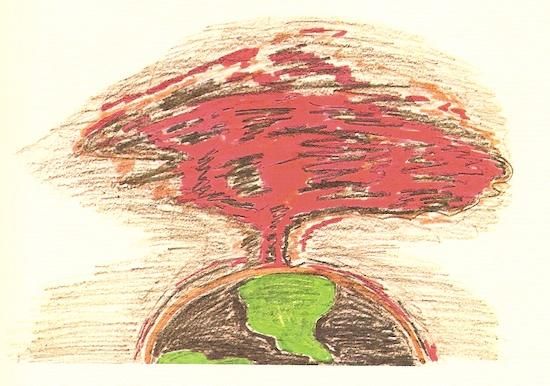
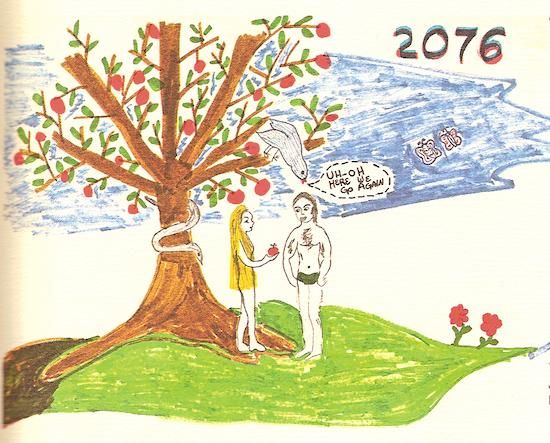
Tina Kambitsis created two drawings: one of the entire world being destroyed in a red mushroom cloud, the other a brand new Garden of Eden in the year 2076, with a bird remarking, “Uh-oh, here we go again.”
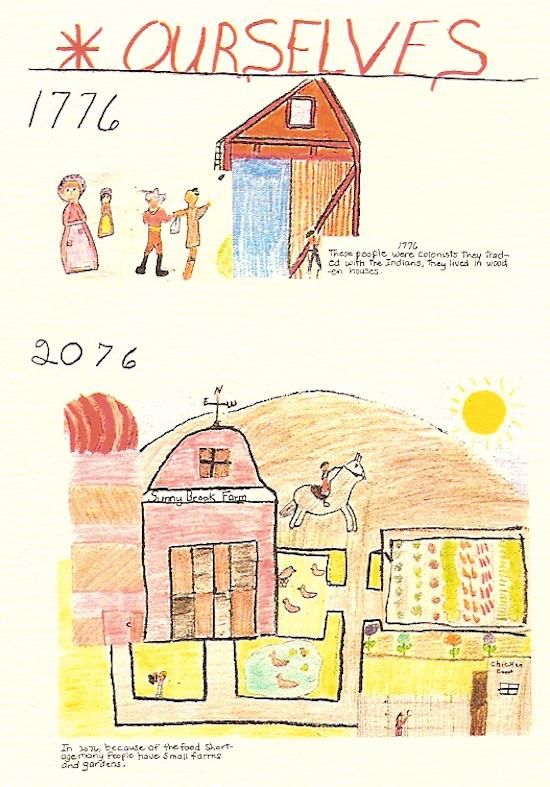
This vision of the far future, drawn by an unnamed fourth grader in Mary Ellen Caesar’s class at Sacred Heart School in Massachusetts, may be the most telling of the illustrations. The child imagines a return to the land in a way that seems to be more harmonious, a romanticization of the people in 1776 who were depicted as trading with the Indians and living a simpler life. The food crisis was on everyone’s mind in the 1970s, so the child imagined that this would encourage people of the future to have their own farms and gardens.
1776 — These people were colonists. They traded with the Indians. They lived in wooden houses.
2076 — In 2076 because of the food shortages many people have small farms and gardens.
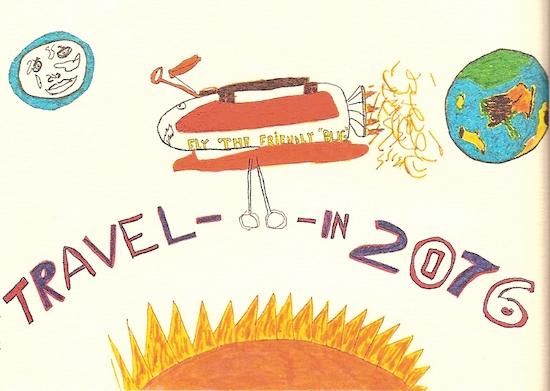
And John F. Kennedy High School student Michael Urena drew what appears to be a commercial spaceliner, called The Friendly Bug, traveling to the moon.
/https://tf-cmsv2-smithsonianmag-media.s3.amazonaws.com/accounts/headshot/matt-novak-240.jpg)