
Hunting Dinosaurs on Venus
Why bother with cloning and time travel, when your dream safari awaits on a nearby planet?
/https://tf-cmsv2-smithsonianmag-media.s3.amazonaws.com/accounts/headshot/matt-novak-240.jpg)
/https://tf-cmsv2-smithsonianmag-media.s3.amazonaws.com/filer/201202010150551950-dinosaur-venus-470x251.jpg)
In 1950, the Hayden Planetarium promoted its new exhibit, “Conquest of Space,” by soliciting letters for the public to reserve a seat on the first trip into space. The letters all make for an entertaining read, but one in particular stuck out for me. A letter from a man named Arthur described how he’d like to travel to Venus to find out for himself if there really are dinosaurs there.
Gentlemen:
I would like to submit my name for an application for a space trip to Venus. I have always been interested in this planet, and would like to find out for myself if there are really dinosaurs living on it. Ancient animals have been a constant source of interest with me, and, providing the theory is correct, I would be thrilled to see a tyranosaurus or a brontosaurus “in the flesh.” Astronomy also holds a place of honor among my pastimes, and the urge to travel beyond the earth has always been in me.
Dinosaurs? On Venus? Where would Arthur get such an idea? There have been a number of science fiction stories set on Venus, but it seems plausible that he got the idea of a dinosaur-filled planet from a futuristic story in the March 1950 issue of Coronet magazine, called “Mr Smith Goes to Venus.”
The story (which strangely doesn’t credit any writer) tells of a family in the year 2500 who take a vacation on the planet Venus. The introduction explains that the harnessing of atomic energy just might hold the key to universal peace and travel to distant planets.
Today, the world stands on the threshold of the Atomic Age. Many people fear that the dazzling new power may bring the most destructive wars in history. In this mid-century year of 1950, weapons are still far in advance of other developments within the infinitely complex world of the atom. However, for the many who believe that atomic power can be the key to man’s most magnificent achievements, this story will have special meaning as a glimpse into the future — a glimpse into an age when the atom may mean universal peace — and a vacation to Venus for the neighbors next door.
What’s interesting to remember is that when this story was published in 1950, commercial airplane travel in the United States was still in its infancy. Most families had never been on a plane, let alone a rocket to Venus.
The story included an illustration of brochures from the future touting “big game hunting” on Venus. A mid-century style raygun is seen pointing down at a triceratops. But dinosaurs weren’t just to be hunted for sport. They would also be found in zoos on Venus:
The Venopolis Zoo was one of the most fabulous attractions of Venus. Deep pits separated visitors from the lumbering dinosaurs and other prehistoric beasts. Still, Mrs. Smith was uncomfortable being so close to the dragonlike creatures, and breathed easily again only when they had moved on to the amazing exhibits of brilliantly plumaged birds, and to the smaller animal enclosures. The children were disappointed that there was no Reptile House, but so far no serpents had been found on Venus.
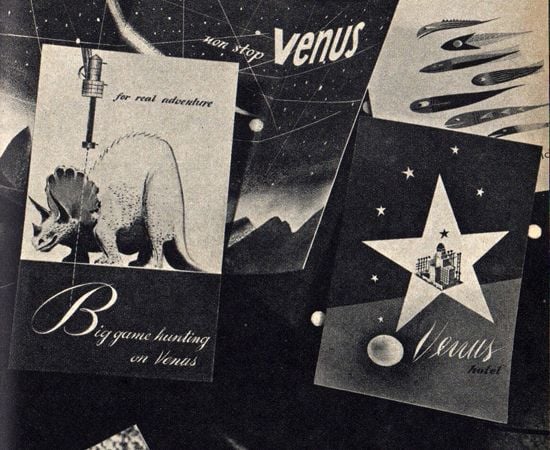
Chesley Bonestell did the illustrations– 25 pages worth — for the story. Bonestell was a prolific artist who is credited with helping fuel American interest in space exploration with his incredibly captivating space art. Perhaps most notably, he did illustrations for Wernher von Braun’s 1950s Collier’s series which laid out the possibilities of spaceflight.
/https://tf-cmsv2-smithsonianmag-media.s3.amazonaws.com/accounts/headshot/matt-novak-240.jpg)