Blogs

  • News
  • |
  • Art
  • |
  • History
  • |
  • Food and Travel
  • |
  • Science
Paleofuture

A history of the future that never was

Past Imperfect

History with all the interesting bits left in


March 9, 2012

Super-Sized Food of the Future

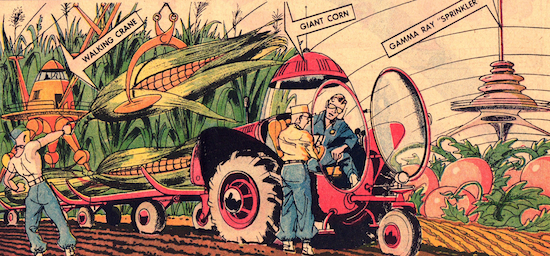
Colossal crops of the future in the Sunday comic "Closer Than We Think" (January 28, 1962)

We often associate food futurism with the concept of meal pills. But another popular prediction from the “freaky science” file of retro-futurism involved gigantic fruits and vegetables. (And not just Great Pumpkins, such as the ones that competitive growers are creating today.)

The December, 1900 issue of Ladies’ Home Journal featured a fascinating article titled “What May Happen in the Next Hundred Years” by John Elfreth Watkins, Jr. in which he predicts that super-sized crops would find their way to American dinner tables in the year 2000.

Strawberries as Large as Apples will be eaten by our great-great-grandchildren for their Christmas dinners a hundred years hence. Raspberries and blackberries will be as large. One will suffice for the fruit course of each person. Strawberries and cranberries will be grown upon tall bushes. Cranberries, gooseberries and currants will be as large as oranges. One cantaloup will supply an entire family. Melons, cherries, grapes, plums, apples, pears, peaches and all berries will be seedless. Figs will be cultivated over the entire United States.

Peas as Large as Beets. Peas and beans will be as larges as beets are today. Sugar cane will produce twice as much sugar as the sugar beet now does. Cane will once more be the chief source of our sugar supply.

Arthur Radebaugh’s Sunday comic strip “Closer Than We Think” predicted gigantic food a few times during its run from 1958 until 1963.

The April 9, 1961 edition of “Closer Than We Think” envisioned a highly automated factory farm of the future and showed a laboratory technician hard at work injecting enormous tomatoes with what we can only guess is a synthetic growth hormone.
Laboratory technician injects tomatoes on the "factory farm" of the future (1961)

The January 28, 1962 edition of Radebaugh’s strip showed off the farm of the future with incredibly large ears of corn being loaded onto the back of a tractor (see image at top of page). I’m not even sure how one would go about eating corn on the cob that appears to be 8 feet long.

COLOSSAL CROPS — In addition to dire threats of destruction, the atomic age has also produced many brighter horizons for mankind’s future. One such happy prospect is the use of radiation to create more uniform and dependable crops that will end famine everywhere in the world.

Gamma ray fields now operating on the east coast point to a day when crops will grow to giant size, vastly enlarging yield per acre. These super-plants will be disease and insect resistant — more tender and tasty — and controllable as to ripening time. Seasonal vegetables like corn will be available fresh nearly everywhere for most of the year instead of only a month or so.

It’s interesting to note that opening line, “In addition to dire threats of destruction,” before the strip explains the wondrous advances in food technology that are in store. Too often we can romanticize past visions of the future, believing that people of a certain era were of one mind. It’s important to remember that even during the Golden Age of American Futurism, there was always the looming threat of nuclear war.


***

Sign up for our free email newsletter and receive the best stories from Smithsonian.com each week.

Posted By: Farms,Food | Link | Comments (5)

5 Comments »

  1. Lucien Alexandre Marion says:

    SCIENCE COULD BE AMAZING…

    If competitive growers can and have developped Great Pumpkins,could that 1900 prediction becomes reality in this 3rd Millennium…It sure would help to feed the planet’s habitants…Remember Jules Verne…some of his fictions became realities…Why not!!! …Science could be amazing…

  2. Frank says:

    Strawberries the size of apples… Well, we’ve got that one – the big ones are as big as some small apples. Unfortunately, with that size came a complete lack of flavor. Only the grapes ended up being seedless.

    And the sugarcane was WAY off – while the corn didn’t get bigger, it certainly changed everything. There’s FAR more HFCS than cane sugar used now.

    Considering how tasteless most of today’s tomatoes are, I can only imagine how bad a tomato engineered to grow that size would be.

  3. smallerdemon says:

    Without stories like this, of course, we wouldn’t have the context for amazing movies like Peter Graves’ THE BEGINNING OF THE END: http://www.imdb.com/title/tt0050177/

    “Reporter, military officer and scientist discover the complete destruction of a small town was caused by giant grasshoppers, accidently enlarged by the scientist’s experimenting with radioactive material at a nearby agricultural research project. ”

    The experiment? Giant tomatoes, of course!

  4. Greg says:

    Popcorn of Military proportions!!

  5. Regarding this article on “Super Sized Food”, it’s really not that far-fetched… There are some articles written in the late 1700s and 1800s that discuss how some growers experimenting with electro-horticulture have been able to grow very large crops (both in size & yield) using electricity.

    It turns out that one of the proposed physiological mechanisms that gets activated in plants when they’re stimulated with electricity is the release or production of hormones like gibberellins which are known as growth enhancers. While some commercial growers artificially apply gibberellic acid to their crops for larger yields, through the use of electricity, larger yields and accelerated growth (and disease resistance/treatments, too) can be realized without any artificial hormones or chemicals, via the application of minute amounts of electricity.

    In my own experiments I’ve seen some of my seedlings experience substantial improvements in growth over my control group, resulting in taller plants, 3-5x leaf area, and significantly deeper green leaves in only 35 days.

    I’ll be brief, but there used to be a rather large movement in Europe and England in the aforementioned time period revolving around the use of electricity in crop acceleration. I suspect that it fell out of popularity because of poor experimental record-keeping, a partial understanding of the factors that affect plant acceleration (and failure), and the coming of the ‘chemical revolution’.

    In my opinion I see the use of electrified agriculture as a harmless way of protecting crops against early frost, helping urban growers get more yield in a limited amount of space, and improving the productivity of the land in general without using expensive chemical fertilizers.

RSS feed for comments on this post. TrackBack URI

Leave a comment

Comments are moderated, and will not appear until Smithsonian.com has approved them. Smithsonian reserves the right not to post any comments that are unlawful, threatening, offensive, defamatory, invasive of a person's privacy, inappropriate, confidential or proprietary, political messages, product endorsements, or other content that might otherwise violate any laws or policies.

Spam protection by WP Captcha-Free

Advertisement


Follow Us

Travel with Smithsonian


Advertisement