Blogs

  • News
  • |
  • Art
  • |
  • History
  • |
  • Food and Travel
  • |
  • Science
Paleofuture

A history of the future that never was

Past Imperfect

History with all the interesting bits left in


May 23, 2012

Mechanical Matchmaking: The Science of Love in the 1920s

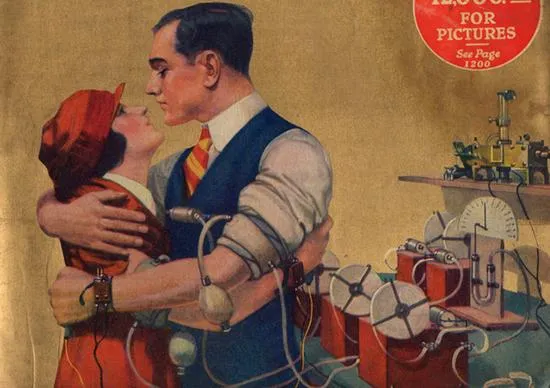
"Scientific Mating" on the cover of the April, 1924 issue of Science and Invention magazine

Online dating sites like eHarmony and OkCupid claim they can find you the perfect romantic match by using algorithms. These kinds of sites have catchy slogans like “date smarter, not harder,” implying that they’ve finally perfected a scientific approach to matchmaking. Just answer a few questions, and their super-secret love science will find the person who is right for you.

While much of the “science” behind online dating sites has been called into question, that doesn’t seem to dissuade us from wanting to make the messy (and often frustrating) world of romantic love into something quantifiable. This idea, of course, is nothing new—and at least one futurist thinker of the early 20th century hoped that new technological developments might one day create the perfect matchmaking device.

The April 1924 issue of Science and Invention magazine ran an article by Hugo Gernsback, the magazine’s publisher, which examined the different “scientific” ways to determine if a marriage will succeed or fail.

How much would the average man or woman give to know beforehand if his or her prospective married life is to be success or failure? At present, marriage is a lottery. It seems impossible to predict beforehand how your prospective mate will turn out in the future. Through certain fundamentals, which can easily be ascertained, one can be reasonably certain as to one’s choice. We take extreme care in breeding horses, dogs and cats, but when we come to ourselves we are extremely careless and do not use our heads nor the means that science puts in our hands for scientific breeding. There are certain basic tests which can be made today and which will give one a reasonable assurance of married happiness.
A woman is made to smell her partner's body odors to see if they're suitable for marriage

In the article Gernsback explains four different tests that can be administered to a couple in order to determine scientifically whether a marriage will work.

1) Physical Attraction Test

According to Gernsback, physical attraction is the single most important element for a successful marriage. He explains that in order to measure the level of a couple’s physical attraction for one another, electrodes must be attached to each person’s wrist so that an “electrical sphygmograph” can record their pulse. Then a chain is wrapped around their chests to measure breathing:

…around the chest of each is a chain which is secured to a piece of spring covered by a rubber hose. One end of the tube thus formed is sealed, the other connects to a manometer and also to a tambour supplied with a stylus. The stylus leaves a record on a moving paper tape showing the rate of respiration.

Essentially, if your pulse rate rises and you breathe more quickly while embracing or kissing your partner, Gernsback contends that this is scientific evidence of physical attraction.

2) Sympathy Test

The sympathy test involves one of the partners watching the other go through something mildly traumatic, like having blood drawn. In the illustration below, the young woman watches her partner and if her muscular contractions and sudden inhalations “due to excitement” are wild enough, then she’s supposed to be sufficiently sympathetic to him as a partner.
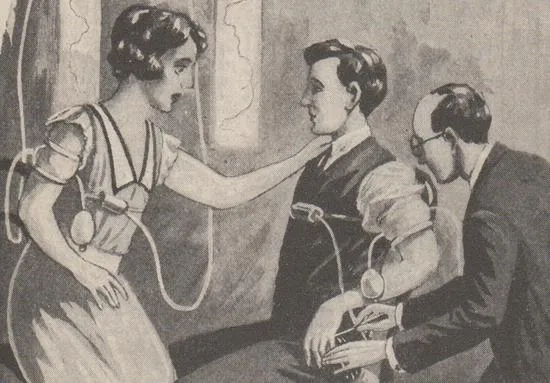
A woman is given a "sympathetic test" to see if her marriage will work

3) Body Odor Test

Interestingly, Gernsback claims that more marriages are probably wrecked by body odors than any other cause. During the body odor test, the couple is made to smell each other (“not a pleasant experience,” Gernsback opines) by one person being placed inside a large capsule with a hose coming out the top. The hose is led to the nose of the other person and if the smells aren’t found too objectionable (again, measured by devices strapped to the chest and wrist) then the romantic pairing is deemed safe.

4) Nervous Disorder Test

According to Gernsback it’s important that at least one partner can be calm under pressure. The nervous disorder test is perhaps the most amusing in that it imagines a man (let’s call him Professor Sixshooter) delivering a surprise gunshot in the air. The “nervous reaction” of both people is recorded on tape and if they both are too startled “marriage should not take place.” I don’t know about you, but I’d be a little uneasy if my partner wasn’t startled at the sound of a gunshot.
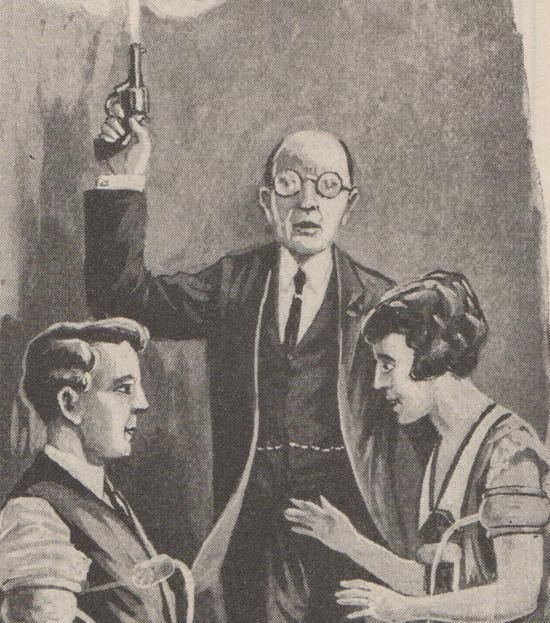
Shooting a revolver in the air to test the "nervous disorders" of two people in love


***

Sign up for our free email newsletter and receive the best stories from Smithsonian.com each week.

12 Comments »

  1. Camilla says:

    Hysterical, esp. the gunshot test!

  2. Kathy says:

    Thanks for the laugh. Gernsback must have been an e-motional moron or…

  3. Bill McCullam says:

    The test of true love in the 1920s was a sniff test. The girl could pick her mate from his odor. The preferred men’s cologne at that was was …..”gasoline”! Yup, if he smelled of gas at the dance it meant he had a car or access to one….love at first sniff.

  4. Lisa says:

    Other than the gunshot test, I can see how the other tests have validity even though they are rudimentary.

  5. liebepur says:

    Pferdezüchter, Dating und Dunstglocken…

    Wir verwenden große Sorgfalt auf die Züchtung von Pferden, Hunden und Katzen, aber wenn es um uns selbst geht, dann werden wir extreme nachlässig und nutzen weder unsren Verstand noch die Möglichkeiten, die die Wissenschaft uns in die Hand gibt, um uns…

  6. merdiss provencher says:

    very good magazine. i subscribe to it myself.

  7. William Ray says:

    I find it amusing how much modern “intelligent” readers enjoy reveling in their superiority over those primitive savages from the previous century. Unless we start acting quite a bit more enlightened, 90 years from now our descendants are going to think we were pretty darned dumb too…

    All of these tests, while rudimentary by today’s standards, actually do get to measuring some meaningful neurophysiological indicators that might be predictive of irrational (“romantic”) attachments.

    Even the gunshot test. Certainly we could probably conceive of more sophisticated tests today, but, the gunshot test would have exposed underlying purely reactive “fight or flight” responses to potential danger or alarm. The difference between a reaction where both members of the couple’s instant, unreasoned response was personal safety, rather than the safety/protection of their potential mate, versus a couple that reacted instantly to protect/comfort the other, before personal concerns, would say something quite informative about the underlying psychology of the relationship.

  8. Scott Amun says:

    I agree with Mr. Ray. Also, smell is not a sense that should be considered unimportant. Why else is the perfume and deodorant business so profitable? I certainly am affected by a woman’s smell, not just her perfume, but her natural body smell. Many people are clearly recognizable by their smell, and this is not even considering those with “BO”. Scents are recognized to affect the mid-brain, and often call up very recondite memories. If they have the power to do this, is it not wise to recognize that a person’s natural smell could have a great deal of influence on whether another will find him/her attractive or repulsive?

  9. molly says:

    This is great. You wouldn’t happen to gave the original article in some format? Or know where i can get it? I would love to use with A Level Language students but I have to use the original text?

    Many thanks – your blog is recommended to many students!

    Molly
    (tday31@gmail.com)

  10. Danna Rickard says:

    On a segment of a medical news show, I think they discussed women on “the Pill” and how it changed their sense of smell. The implication was a little on how it might be best to go off the Pill before you commit to marriage or anything long-term, just to check the chemistry of compatibility. Other medications might affect things also. I didn’t check the Pill study for facts —
    it seemed an important consideration though.

  11. Kathy says:

    I watched a program about sexual attraction on either the science or discovery channel. It explored different ways that scientists are attempting to quantify and/or define how/why people become attracted to one another. One experiment ‘captured’ the individual scent/natural odor of a whole group of men, and then asked women to sniff the samples and pick out the scents that attracted them.
    One interesting fact was that if a women was ovulating she found all the scents to be attractive, and she could not distinguish any differences. I don’t believe that this means she wants to mate with all of them, rather my guess is that she uses other factors when determining with whom she will mate(i.e.potential provider).
    My guess could very well be wrong, but I do believe that there are so many other factors that go into the equation of love that it is very difficult to isolate the variables and predict the end result.

  12. Oh dear.

    I think there’s something Mr Gernsback forgot to test: mutual trust and respect.

    If physical attraction is the most important factor, those are going to be some darn short marriages… :)

RSS feed for comments on this post. TrackBack URI

Leave a comment

Comments are moderated, and will not appear until Smithsonian.com has approved them. Smithsonian reserves the right not to post any comments that are unlawful, threatening, offensive, defamatory, invasive of a person's privacy, inappropriate, confidential or proprietary, political messages, product endorsements, or other content that might otherwise violate any laws or policies.

Spam protection by WP Captcha-Free

Advertisement


Follow Us

Travel with Smithsonian


Advertisement