
Yesterday’s Tomorrows: How a Smithsonian Exhibit I Never Saw Changed My Life
Meet the historians who pioneered scholarship of retro-futurism
/https://tf-cmsv2-smithsonianmag-media.s3.amazonaws.com/accounts/headshot/matt-novak-240.jpg)
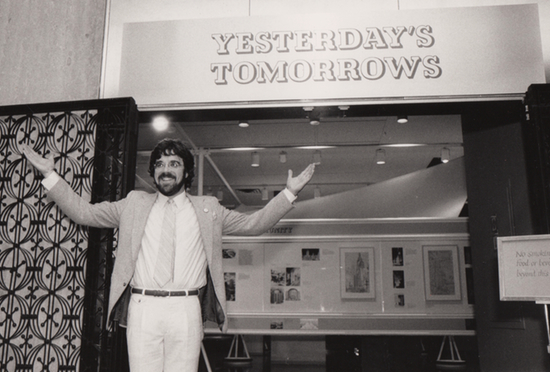
Co-curator Brian Horrigan at the opening of Yesterday’s Tomorrows in 1984
Twenty-eight years ago this month an exhibit called Yesterday’s Tomorrows opened to the public at the National Museum of American History in Washington, D.C. I wasn’t even a year old yet, but this 1984 exhibit would have a profound effect on my life many years later after I discovered the exhibit book by Smithsonian curators Joseph Corn and Brian Horrigan.
Back in 2007, the Paleofuture blog was still just a hobby for me, but once I discovered Yesterday’s Tomorrows I felt a sense of validation that this weird and wonderful topic of retro-futurism was indeed worthy of serious study. Maybe my blog more than an excuse to write about how cool flying cars and jetpacks might be; maybe we could learn something deeper about the American experience from all these hopes, dreams and fears for the future. After all, I may have been a lowly blogger, but here were two brilliant Smithsonian historians who had tackled the subject of historical futures so thoroughly nearly a quarter of a century earlier.
The book that I discovered and would prove so influential to my life is divided into five main chapters. The first chapter looks at the rise of futurism in America and its role in American life at the dawn of the 20th century through books, magazines, advertising and toys. The second chapter is devoted to the community of tomorrow and what future American cities and towns were supposed to look like. The third chapter involves Brian’s specialty and delves into the houses of tomorrow, while chapter four was Joe’s area of expertise: the transportation of the future. The last chapter explores the weapons and warfare of yestertomorrow, highlighting the various ways people imagined humanity (and of course, robots) might fight in the future.
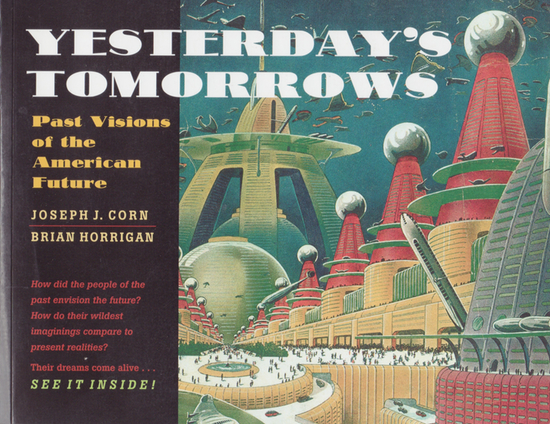
Cover of the book “Yesterday’s Tomorrows” by Joseph Corn and Brian Horrigan
Yesterday’s Tomorrows was undoubtedly the retro-futurism bible and so, back in 2007, I did some quick Googling in an attempt to track down Joe or Brian. I learned that Brian was working at the Minnesota Historical Society. I emailed him in the fall of 2007 and we had lunch at Cossetta’s down the street from the History Center in St. Paul. I had recently moved back to St. Paul after going to school in Milwaukee for a few years. During lunch I learned that not only did Brian live in St. Paul, but that we lived on the same street! Needless to say, Brian and I really hit it off and became fast friends. I have fond memories of sitting out on his porch on Sunday afternoons drinking martinis while we talked about history and politics and futurism.
In 2008, Brian introduced me to the great Joe Corn when he was visiting Minnesota to see some old friends. I immediately liked Joe and was honored to have some time to ask him questions about historical futures and America’s rate of technological progress. I’ll never forget his challenge to me — that I never accept preconceived notions about people and their attitudes toward the future. Generations are made up of people, and though it may be tempting to try to lump those people together to fit our needs, don’t assume you know what an individual was thinking based upon what generation they might belong to.
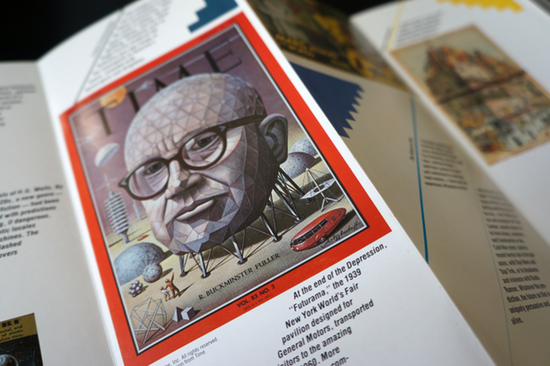
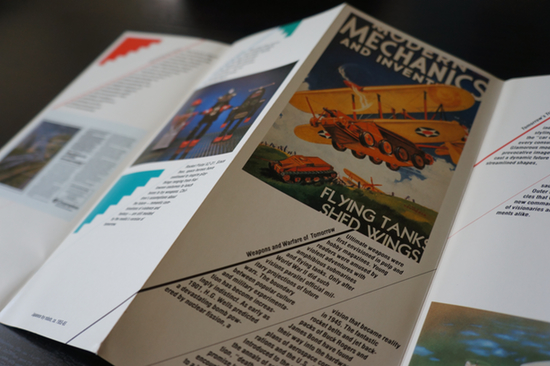
Photo of the the Yesterday’s Tomorrow exhibit pamphlet from 1984
I really wish I had had the opportunity to see Yesterday’s Tomorrows in the flesh, as it were. The exhibit opened on August 9, 1984 and was on display at the National Museum of American History until September 30, when it then went on a tour of the United States. Though I was but a drooling rugrat in 1984, I have some wonderful artifacts from the exhibit that were generously given to me by Brian. One of those artifacts is the pamphlet from the exhibit shown above.
Brian also gave me some newspaper clippings that described the exhibit in great detail. A writer in the August 10, 1984 Washington Post was especially impressed by the 18 minute film at Yesterday’s Tomorrows, which was produced and directed by Karen Loveland and Ann Carroll:
The show ranges from utopian and dystopian views of mankind’s future to children’s playthings. All those toys we wish our parents had kept for us, some people have — and in mint condition. The display covers the play-time continuum in the final frontier: a 1937 Buck Rogers ray gun, a 1952 Space Patrol diplomatic pouch and a 1966 Star Trek phaser.
The highlight of the show is an 18-minute continuously playing movie, tracing science fiction in film clips from the Jules Verne-inspired “Un voyage dans la lune” in 1902 to “Blade Runner,” inspired by Philip K. Dick, in 1982. As the announcer intones, “All of us have wondered what the world would be like 10, or 100 or 1,000 years from today…”
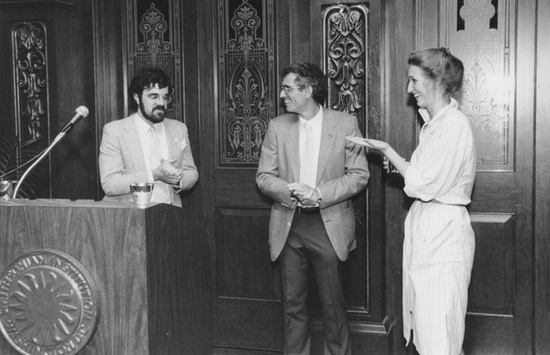
Brian Horrigan (left) and Joseph Corn (middle) and unknown
The exhibit included over 300 models, toys, illustrations, photographs and other artifacts that gave people a glimpse into the future that never was. Brian gave me a handful of photos which show the exhibit as it stood, working jetpack and all.
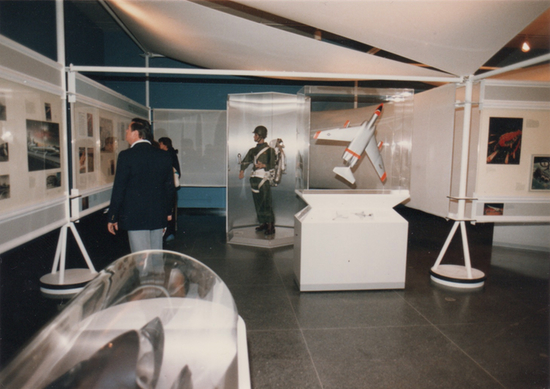
The August 9, 1984 Washington Post declared that the most impressive of the artifacts at Yesterday’s Tomorrows had to be a scale model construction of a Dymaxion House from 1927:
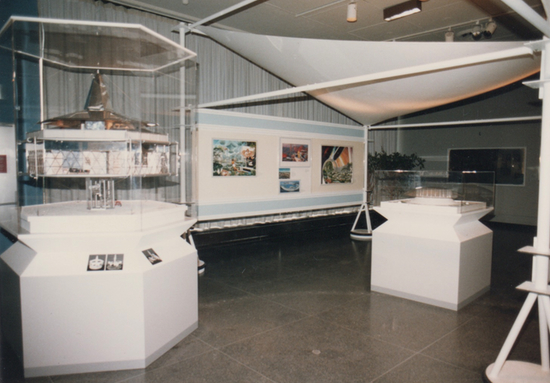
The show’s greatest artifact, hands down, is a model constructed by Jay Johnson from the original plans of Fuller’s wonderful 1927 Dymaxion House. Metal cables from an aluminum mast suspend the glass walls and inflated rubber floor. The living quarters are raised for view and air.
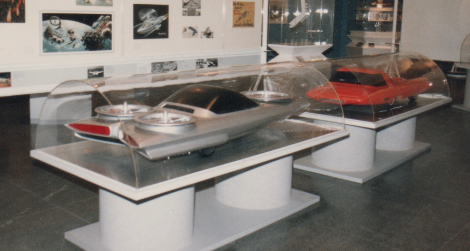
That Dymaxion model is on the left in the picture below.
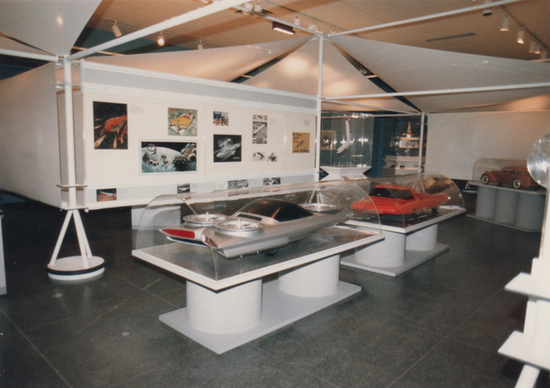
This next picture includes the nuclear powered car of the 1950s and if we look closely we can see some artwork from Wernher von Braun’s Collier’s space series and a 1943 rendering of a helicopter from Alex S. Tremulis in the background.
I’m forever indebted to both Brian and Joe, without whom I very likely wouldn’t have the profession I enjoy today. In 2010, I had the honor of giving a talk hosted by the Minnesota Historical Society with Brian at the Turf Club in St. Paul. Thank you Joe and thank you especially to Brian — your work and guidance have meant the world to me, an accidental historian doing his best to fill the shoes of the two great men who preceded him in this exploration of yesterday’s tomorrows.
Yesterday’s Tomorrows started at the National Museum of American History in Washington, D.C. but went on to many other cities around the U.S. The exhibit was also revived in the early 2000s and went on a limited tour of the U.S. at that time. If you visited the exhibit in the 2000s or in any of these cities from its original tour in 1984-85, I’d love to hear your impressions of the experience in the comments: the Chicago Museum of Science and Industry, the Willamette Science and Technology Center in Eugene Oregon, the California Museum of Science and Industry in Los Angeles, the Oakland Museum in California, the Museum of Science in Boston and the Whitney Museum of American Art in Stamford Connecticut.
/https://tf-cmsv2-smithsonianmag-media.s3.amazonaws.com/accounts/headshot/matt-novak-240.jpg)