Blogs

  • News
  • |
  • Art
  • |
  • History
  • |
  • Food and Travel
  • |
  • Science
Paleofuture

A history of the future that never was

Past Imperfect

History with all the interesting bits left in


September 19, 2012

50 Years of the Jetsons: Why The Show Still Matters

The Jetsons title slate from 1962

It was 50 years ago this coming Sunday that the Jetson family first jetpacked their way into American homes. The show lasted just one season (24 episodes) after its debut on Sunday September 23, 1962, but today “The Jetsons” stands as the single most important piece of 20th century futurism. More episodes were later produced in the mid-1980s, but it’s that 24-episode first season that helped define the future for so many Americans today.

It’s easy for some people to dismiss “The Jetsons” as just a TV show, and a lowly cartoon at that. But this little show—for better and for worse—has had a profound impact on the way that Americans think and talk about the future. And it’s for this reason that, starting this Friday, I’ll begin to explore the world of “The Jetsons” one episode at a time. Each week I’ll look at a new episode from the original 1962-63 series, beginning with the premiere episode, “Rosey the Robot.

Read my recap of Episode 1 here!

Futures Redux

Five decades after its debut, not a day goes by that someone isn’t using “The Jetsons” as a way to talk about the fantastic technological advancements we’re seeing today. Or conversely, evidence of so many futuristic promises that remain unfulfilled. Just look at a handful of news stories from the past few days:

  • In fashion. (“Who better than the Jetsons to be inspired by for an out of space theme?”)
  • Johnny Depp talks about the West Memphis Three emerging from prison after nearly two decades. ( ”By the time you came out, it’s ‘The Jetsons.’ It’s a whole ‘nother world.”)
  • James Cameron talks about the future of interactive movies. (“There might be a certain amount of interactivity, so when you look around, it creates that image wherever you look,” Cameron says. He concedes it is far off: “You’re talking ‘Jetsons’ here.”)
  • The future of cars, as depicted at the Los Angeles Auto Show. (“Considering that 2025 is only 13 years away, you would think that nobody’s going to go ‘Jetsons’ with their presentation, but the LAASDC doesn’t roll like that.”)
  • The sound of kitschy futurism in modern music. (“Silencio allows Sadier’s various musical influences to breathe and linger, without being upstaged by the motorik propulsion, and ‘Jetsons’ kitsch, of the Stereolab formula.”)

Thanks to my Google Alerts for words and phrases like Jetsons, Minority Report, utopia, dystopia, Blade Runner, Star Trek, apocalypse and a host of others, I’ve been monitoring the way that we talk about the future for years. And no point of reference has been more popular and varied as a symbol of tomorrowism than “The Jetsons.”

Golden Age of Futurism

“The Jetsons” was the distillation of every Space Age promise Americans could muster. People point to “The Jetsons” as the golden age of American futurism because (technologically, at least) it had everything our hearts could desire: jetpacks, flying cars, robot maids, moving sidewalks. But the creators of “The Jetsons” weren’t the first to dream up these futuristic inventions. Virtually nothing presented in the show was a new idea in 1962, but what “The Jetsons” did do successfully was condense and package those inventions into entertaining 25-minute blocks for impressionable, media-hungry kids to consume.

And though it was “just a cartoon” with all the sight gags and parody you’d expect, it was based on very real expectations for the future. As author Danny Graydon notes in The Jetsons: The Official Cartoon Guide, the artists drew inspiration from futurist books of the time, including the 1962 book 1975: And the Changes to Come, by Arnold B. Barach (who envisioned such breakthroughs as ultrasonic dishwashers and instant language translators). The designers also drew heavily from the Googie aesthetic of southern California (where the Hanna-Barbera studios were located)—a style that perhaps best represented postwar consumer culture promises of freedom and modernity.

The years leading up to “The Jetsons” premiere in September 1962 were a mix of techo-utopianism and Cold War fears. The launch of Sputnik by the Soviets in 1957 created great anxiety in an American public that already had been whipped up into a frenzy about the Communist threat. In February 1962 John Glenn became the first American to orbit the Earth, but less than a year earlier the Bay of Pigs fiasco raised tensions between the superpowers to a dangerous level. Americans seemed equally optimistic and terrified for the future.

I spoke over the phone with Danny Graydon, the London-based author of the official guide to “The Jetsons.” Graydon explained why he believed the show resonated with so many Americans in 1962: “It coincided with this period of American history when there was a renewed hope — the beginning of the ’60s, sort of pre-Vietnam [protests], when Kennedy was in power. So there was something very attractive about the nuclear family with good honest values thriving well into the future. I think that chimed with the zeitgeist of the American culture of the time.”
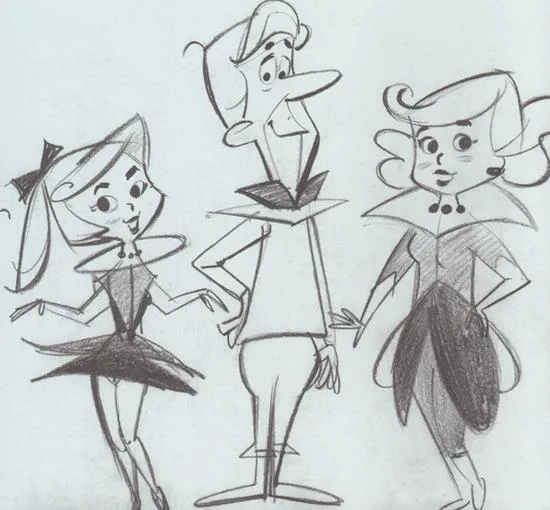
Early character sketch of the Jetson family from the Official Guide to the Jetsons by Danny Graydon

Where’s My Jetpack?

As Graydon points out, “The Jetsons” was a projection of the model American family into the future. The world of ”The Jetsons” showed people with very few concerns about disrupting the status quo politically or socially, but instead showed a technologically advanced culture where the largest concern of the middle class was getting “push-button finger.”

It’s important to remember that today’s political, social and business leaders were pretty much watching ”The Jetsons” on repeat during their most impressionable years. People are often shocked to learn that “The Jetsons” lasted just one season during its original run in 1962-63 and wasn’t revived until 1985. Essentially every kid in America (and many internationally) saw the series on constant repeat during Saturday morning cartoons throughout the 1960s, ’70s and ’80s. Everyone (including my own mom) seems to ask me, “How could it have been around for only 24 episodes? Did I really just watch those same episodes over and over again?” Yes, yes you did.

But it’s just a cartoon, right? So what if today’s political and social elite saw ”The Jetsons” a lot? Thanks in large part to the Jetsons, there’s a sense of betrayal that is pervasive in American culture today about the future that never arrived. We’re all familiar with the rallying cries of the angry retrofuturist: Where’s my jetpack!?! Where’s my flying car!?! Where’s my robot maid?!? “The Jetsons” and everything they represented were seen by so many not as a possible future, but a promise of one.

This nostalgia for the futurism of yesteryear has very real consequences for the way that we talk about ourselves as a nation. So many people today talk about how divided we are as a country and that we no longer dream “like we used to.” But when we look at things like public approval of the Apollo space program in the 1960s, those myths of national unity begin to dissolve. Public approval of funding for the Apollo program peaked at 53 percent (around the first moon landing) but pretty much hovered between 35-45 percent for most of the 1960s. Why is there a misconception today about Americans being more supportive of the space program? Because an enormous generation called Baby Boomers were kids in the 1960s; kids playing astronaut and watching shows like “The Jetsons”; kids who were bombarded with images of a bright, shiny future and for whom the world was much simpler because they saw everything through the eyes of a child.

Why Only One Season?

If ”The Jetsons” is so important and resonated with so many viewers, then why was the show canceled after just one season (though it was revived in the 1980s)? I’ve spoken to a number of different people about this, but I haven’t heard anyone mention what I believe to be the most likely reason that “The Jetsons” wasn’t renewed for a second season: color. Or, more accurately, a lack of color. ”The Jetsons” was produced and broadcast in color, but in 1962 less than 3 percent of American households had a color television set. In fact, it wasn’t until 1972 that 50 percent of American households had a color TV.

The Jetsons’ future is bright; it’s shiny; and it’s in color. But most people watching on Sunday nights obviously didn’t see it like that. The immersive world of “The Jetsons” looks far more flat and unengaging in black and white. And unlike the other network shows it was up against on Sunday nights (which was in most markets “Walt Disney’s Wonderful World of Color” on NBC and “Car 54 Where Are You?” on CBS) “The Jetsons” suffered disproportionately more from being viewed in black and white.

NBC also had an incumbent advantage. If you’d made “Walt Disney’s Wonderful of Color” appointment viewing for the past year (Disney jumped ship from ABC to NBC in 1961 where they not only began broadcasting in color, but added “color”  to the name) it’s unlikely you’d switch your family over to an unknown cartoon entity. “The Jetsons” was the first show ever broadcast in color on ABC, but it was still up to individual affiliates as to whether the show would be broadcast in color. According to the September 23, 1962 New York Times only people with access to ABC’s owned-and-operated stations in New York, Chicago, Detroit, San Francisco and Los Angeles were guaranteed to see the show broadcast in color—provided you owned a color set.

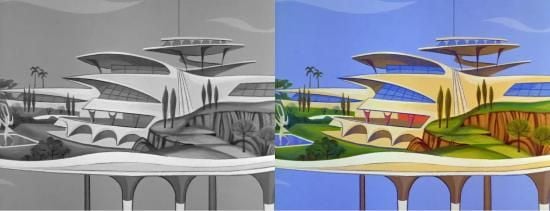
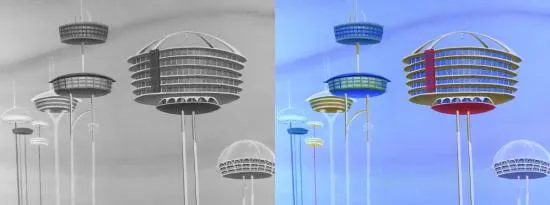
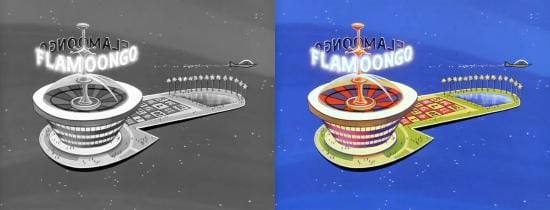
I’ve takens some screenshots from the DVD release of the first season to show just how dramatic a difference color can make with a show like this.
Establishing shot from the Jetsons (“Rosey the Robot” September 23, 1962)

Black and white versus color comparison of the Jetsons (“Las Venus” December 16, 1962)

Screenshots from “Millionaire Astro” originally aired January 6, 1963

There’s also this promo from 1962, which gives us a taste of what “The Jetsons” looked like devoid of color. It’s bizarre for those of us who grew up on “The Jetsons” to see their fantastical world reduced to black and white:

The What-Ifs

There are a lot of “what-ifs” in “The Jetsons” universe that may have had substantial bearing on politicians, policymakers and the average American today. If we accept that media has an influence on the way that we view culture, and our own place in the future—as “The Jetsons” seems to ask us to do—we have to ask ourselves how our expectations might have changed with subtle tweaks to the Jetson story. What if George took a flying bus or monorail instead of a flying car? What if Jane Jetson worked outside of the home? What if the show had a single African-American character? These questions are impossible to answer, of course, but they’re important to recall as we examine this show that so dramatically shaped our understanding of tomorrow.

1985 and Beyond

Obviously the 1985-87 reboot of “The Jetsons” TV show played an important role in carrying the futuristic toon torch, but it’s in many ways an entirely different animal. The animation simply has a different feel and the storylines are arguably weaker, though I certainly remember watching them along with the original reruns when I was a kid in the 1980s. There were also movies produced—1990′s The Jetsons was released theatrically and the made-for-TV movie crossover The Jetsons Meet the Flintstones first aired in 1987. But for our purposes, we’ll just be exploring the first season and its immediate influence during the American Space Age. With talk of a live-action Jetsons movie in the works, it will be interesting to see how a revamped Jetsons might play today.

A few style notes that I’ll get out of the way:

  • I spell Rosey the way it appeared in merchandise of the 1960s. Yes, you’ll sometimes see it spelled “Rosie” in video games and comics of the 1980s, but since our focus is the first season I’m sticking with Rosey.
  • The show never mentions “within world” what year the Jetson family is living, but for our purposes we’ll assume it to be 2062. Press materials and newspapers of 1962 mention this year, even though the characters only ever say “21st century” during the first season of the show.
  • Orbitty is from the 1980s reboot of The Jetsons. Orbitty, a pet alien, is essentially the Jar-Jar Binks of the Jetsons’ world and you probably won’t see me mention him again.

Meet George Jetson

The Jetsons, of course, represents a nostalgia for the future; but perhaps more oddly, it still represents the future to so many people who grew up with it. I’m excited to get started on this project and welcome your comments throughout this process, especially if you have vivid memories of the show from when you were a kid. I know I certainly do — I turned it into my career!


Update: The first paragraph of this post was revised to clarify that more episodes of “The Jetsons” were produced in the 1980s.


***

Sign up for our free email newsletter and receive the best stories from Smithsonian.com each week.

39 Comments »

  1. Amar Mahmood says:

    The Jetsons to me was by far the most favourite animated show ever. I simply loved the show and the crazy contraptions. However I do have some points that I would like to state.
    Though the Jetsons was representing an ideal future, it is still socially of the 1960s (the time it was produced).
    As you’ve pointed out ‘What if George took a flying bus or monorail instead of a flying car? What if Jane Jetson worked outside of the home? What if the show had a single African-American character?’
    During the 1960s interstate highway construction was in full swing and public transportation especially rail transportation began to decline due in part to lack of investment. The 1960s was a time when the women’s movement was beginning to make a return. In 1963 The Feminine Mystique was published by Betty Friedan which documented the desire for women who wanted to have a life that suited their needs. Also in the 1960s the civil rights movement was gaining pace with African Americans such as Martin Luther King and Malcolm X demanding civil rights.
    So I would argue that although The Jetsons were attempting portray a certain vision of the future that vision cannot be divorced from the social and political realities of the 1960s.
    However, it is interesting to note that there were changes in the 1980s and the 1990 Jetsons film. The 1990 Jetsons film was tackling issues such as environemtalism which became a bigger issue in the 1980s and 1990s.
    There has been talk of a live action Jetsons film, though whether or not it will occur is another issue.

  2. Being a huge Jetsons fan, I am really stoked to see this blog series. I’m totally geeking out, here!

  3. Wonderful post: thank you. 2012 is also the 50th anniversary of another vision of the future, Seattle’s “Century 21″ World’s Fair. So it’s the 50th anniversary of the Space Needle — which would have looked quite inconspicuous in “The Jetsons.” Here in Seattle there is a multi-month long celebration, both looking back to the Fair and to “The Next Fifty,” which looks ahead. The celebration includes a nice website, http://thenextfifty.org and the fittingly titled book, “Remembering the Future”…. Good stuff!

  4. I’ll be following along on your reviews of The Jetsons. I have both a fondness for everything 1962 and miss the future that never happened. (Even though I only saw it in black-and-white.)

  5. Chris Nash says:

    Let me preface this with two things, nice project and I’m tangent prone. I’ve absorbed many, many hours of The Jetsons, but something that has long perplexed me about the show and I’m sure others, but yet I haven’t read brought up is the state of Earth itself. I can’t help but think of Fritz Lang’s Metropolis with a deep division of classes. Everything we see is elevated. Maybe the poor, or worse, the poor and other races, are left living on the surface of the Earth or just beneath it in the catacombs of the remaining terra firma because the surface for some reason is too hostile and the ‘upper’ class are completely separated from the lower class and live in the pristine clouds just above whatever is below. Rosey could be a domesticated Saturday morning cartoon (I grew up with the ’80s re-boot) version of The Maschinenmensch. Global warming or just shear pollution could be the true motivation for elevating essentially everything. Much like how people used to just dump their waste in the streets. Maybe when you can’t see the ground, you do pretty much the same, and if people still live down there in the elevated future, so be it.

    The video evidence from this surveillance footage

    http://video.adultswim.com/harvey-birdman-attorney-at-law/do-we-have-to-walk.html

    clearly shows that the Jetsons’ privileged lifestyle has spoiled them. A Mediator, like that of Metropolis, must be found to unite the upper and lower classes. Maybe this project will find that Mediator, in a time-shifting, reality-defying sense.

  6. Ted Hewitt says:

    I remember the World of Tomorrow at 1960s Disneyland. It was a bright, shiny electric future (it was sponsored by Edison after all). I recall the Monsanto ride where we got to shrink down and see the big plastic ball surrounded by swirling lights which they called the nucleus of an atom inside a water molecule. The phone company had camera phones. It was magic, but still imaged a hopeful reality. Now it is more of a Sci Fi homage. The dream is there, but no hope to wake up to. So with the Jetsons.

  7. Noëlle says:

    Chris Nash, it’s an interesting thought, and one that I’ve seen elsewhere (in fact, the general consensus appears to be that the Earth is toxic or otherwise devastated in the Jetsons future).

    Sadly, the show itself demonstrates it to be untrue: we see the surface of the Earth a few times (one memorable gag has birds refusing to fly because the sky got too crowded) and it’s still lush and green; and at least once we see a homeless person, and he’s right up there on the platforms with the rest of the characters. The living conditions seem to simply be a futurist tautology: Humans in The Jetsons live on elevated platforms because that’s where humans in The Jetsons live.

    Matt, great article; I’m looking forward to the rest of the series! Even though I agree that color was probably a large factor in the series’ premature demise, I’m astonished by how well The Jetsons reads in black and white. It’s a testament to the skill of the animators.

  8. Matt says:

    Firstly, The Jetsons is not the most important piece of 20th Century futurism. That would be Star Trek, by a country mile. Think of all the technology and gadgets that have been and still are being inspired by Star Trek. Think of all the scientists and engineers who entered their fields because they watched Star Trek as kids (I am one). The Jetsons doesn’t come close to having had that kind of real world impact or enduring hold on the popular imagination.

    Secondly, what do you mean the future never arrived? We’re living in the future. We do have robots that can automatically clean our houses (roombas). We have giant flat panel televisions that hang from our walls. We all carry incredibly powerful pocket computers (smartphones) that can give us instantaneous access to the sum of human knowledge, and almost any book, photo, film, or piece of music, and which can allow us to communicate with people anywhere in the world at negligible cost. We can easily video chat with people anywhere in the world. Our pocket computers and our cars carry tech that communicates with orbiting satellites to locate us anywhere on the globe and give us directions to anywhere else. If you care to spend the money, you can know the complete sequence of your own genome.

    You are wrong that the future never arrived. We are clearly living in it. We just failed to notice.

  9. Jim Hale says:

    Thanks for this article and I look forwards to the others you are planning. We got The Jetsons in the UK at some point and to me, and to probably many kids of the time, it was hugely influential in forming our view of the future.

    Where’s my flying car???

  10. Daniel Kim says:

    One of the things that strikes me about The Jetsons is a repeated gag about occupational repetitive strain injuries. In the linked episode 1, Jane has a case of ‘push button finger.’ I remember long ago watching an episode where George complains about his fingers being injured from pressing buttons too much at work.

  11. Mike Cane says:

    >>>It’s bizarre for those of us who grew up on “The Jetsons” to see their fantastical world reduced to black and white

    Is that a joke? In 1962, most people would have been watching The Jetsons on a B&W TV. Including me.

    The Beatles appeared on Ed Sullivan in 1964, two years later. All the footage from that is B&W.

  12. Chris Sobieniak says:

    I’m sure he meant that as a joke Mike. The few people with color TV’s might’ve seen that if it wasn’t tuning to NBC’s programming that was taking advantage of color (and RCA sponsorship of programming). It was much easier to produce a cartoon in color than it was for a live-action program at the time as some studios like Hanna-Barbera had the hindsight to produce many of it’s cartoons in color despite debuting in B&&W anyway (since color was down the road and it made sense to do it that way, The Flintstones were also produced in color but aired for the first two or three seasons in B&W). NBC also had “The Bullwinkle Show”, a carry-over from ABC’s Rocky & His Friends which was on the air since ’61 in color yet had previous segments produced in color anyway.

    Arguably I don’t want to rule out color as the victim even though I feel there were plenty of animated shows that showed potential for dual-ability in either format despite perhaps being a little too early to the party (I see that in Bob Clampett’s “Beany & Cecil” cartoons). The Jetsons footnote could’ve ended that way had it not been for Saturday morning and syndication that kept it at least in the public eye for another couple decades prior to Cartoon Network and home video.

  13. Mister X says:

    I agree The Jetson’s shred, but if you’re going to talk Color Cartoon history then look no farther than my boyhood favorite, Colonel Bleep which was the first color cartoon ever made for television originally syndicated in 1957.

    https://en.wikipedia.org/wiki/Colonel_Bleep

  14. Knute Berger says:

    RE: Seattle’s Century 21 Exposition in 1962, as I write in my book, “Space Needle, the Spirit of Seattle,” Jetson’s designer Iwao Takamoto said that the Jetson’s Sky Pads were based on the Space Needle. The Needle was took inspiration from many directions, most directly the Stuttgart Tower, flying saucers (first made famous in a sighting near Mt. Rainier), and Buckminster Fuller’s Dymaxion House. Space Age ideas were everyone, and architects and cartoonists took inspiration from everywhere.

  15. Curt Adams says:

    Matt of comment #8, I understand why you’d think Star Trek is more important, but the author specifically says he has been looking for references to “Star Trek” for some time and the references to “Jetsons” are more common *as a symbol of the future*. As an inspiration to go into engineering or comp sci, I would agree with you that Star Trek is more likely (but I would have said that about symbolism as well prior to the article, so…)

    But thinking about it, I understand why the Jetsons would have better wormed its way into our thinking. The Jetsons is about archetypical 50′s life imagined in the future. Getting up in the morning, going to work, talking to friends – these are things we all must think about *constantly*. Star Trek is about exploring strange new worlds – an exciting topic for fiction, but something nobody does literally today and few do even metaphorically. The Jetsons is about stuff we think about so much we don’t really notice how much we think about it. Via that route, it’s become part of our mental metaphors – without us noticing it.

    (I am one of the many shocked that there was only one season of the Jetsons. I watched it a fair amount as a kid and I can’t believe I didn’t notice there were so few episodes.)

  16. David says:

    The Flintstones, which debuted on ABC in 1960, was produced in color from the very first episode; it was generally broadcast in color by the network’s owned-and-operated stations. The Jetsons was the first show offered in color to the entire ABC network.

  17. Jim Belfiore says:

    A fantastic article, Matt. Looking forward to the rest of the series.

    A theme you touched on which I think would be fascinating to explore as a subtext is the evolution (or devolution) of futurism in later 20th century and early 21st century societies. “The Jetsons” are a milestone that Gen-X’ers and older generations can point to as a point of inspiration. Do such iconic milestones exist today for younger generations, and what to they point to in terms of the future, and futurism?

  18. Pamela says:

    Oh thank you for taking me back in time to such a happy place. I just watched the Jetsons first show ‘Rosey the Robot’ from the 60′s with your link…….LOVED, LOVED, LOVED IT !!! Now, I am going back to watch the Jetsons meet the Flintstones. Great article.

  19. Dan C says:

    It reflected a Utopia that valued the ‘nuclear’ family and naively believed that having material things could ensure family health and happiness.

    Lost in Space was the same way with an added myth that sex was not an issue when young adults (the Major and Judy) lived in close proximity (see Gilligan’s Island).

    Therefore, the early 60s culture is a very interesting and important time in history.

  20. Chris Sobieniak says:

    That’s very true Dan. I often also view those episodes involving George and his “hanging-by-a-thread” job as one of problematic calamities if he wasn’t so careful enough. From the ’62 series, I find the episodes I loved often had George getting in big trouble and losing his job as usual. The show could be seen as a message that even in the future, one can still foul up if he or she wasn’t careful in their daily life.

    At least that’s a better opinion than the usual post-apocalyptic dystopia some have about the show over why we never see the planet’s surface with everyone living up on those towers and other platforms. I’m sure that’s been in our heads too but the show never dwells on it far enough (perhaps overpopulation did it).

  21. Like the Flinstones, the Jetsons projects the postwar world of a very small subset of humanity (middle-class, suburban United States residents in a nuclear family and of mainstream white – and whitebread stock into another era – into the future instead of into the very distant past.

    The Flinstones has a lot of bizarre anachronisms (not the deliberate, cute ones) by having these white people visiting “Eurock” – when of course early humans who had travelled to the Americas were Amerindian, not “European”, in features) not to mention postwar, developed-country capitalist labour relations – of course they weren’t hunter-gatherers, or even early agriculturalists. The Jetsons, projecting the same world into the future, was swiftly made anachronistic not only by some technological advances that went far beyond the script, and others that lagged, but also by the retrograde social relations in terms of progress won by Black people (whether African-Americans or other people of colour) and other non-whitebread “ethnicities” and by women.

    And indeed, the most innnovated technologies in terms of transport involve futuristic trams – alas still more common in Europe and Asia than in North America, though this is bound to change.

    Star Trek was certainly more progressive in terms of the presence of human – and non-human! – beings of a range of races and nationalities (planetalities?) and in terms of women not only working but holding important positions. But it came along a bit later.

  22. Thomas says:

    I can see some of what Matt is saying about Star Trek, and Curt rightly pointed out that the focus of this series was due to popular references not practical impact. I’d also like to point out that while Star Trek inspired some innovations (just as Tom Swift inspired the TASER aka Thomas A Swift Electric Rifle), The Jetsons portrayed everyday life ON EARTH. Futurism can take several paths, including imagining interstellar and or space/time travel, but it quite often embodies a look at the impacts on society and everyday life here on the home planet. We only ever got the most fleeting glimpses of that on Star Trek … and most involving Earth didn’t show up until the movies.

  23. wi-kiry-lan says:

    I am not convinced that black and white imagery was that big of a deal. Surely audiences then didn’t consider it an issue. Science fiction maybe just wasn’t as popular in the era where star trek neeeded to pitched as a wagon train to the stars.

  24. Patrick says:

    VERY well written article — thanks for this brilliant trip down memory lane!

  25. Chuck says:

    Is it just me or is the sketch of “Daughter Judy” X rated?

  26. Chris Cotter says:

    Love the Jetsons!

  27. Bill Wilson says:

    I only saw a glimpse of the Jetson’s while flipping channels. Thought it was stupid compared to real entertainment like the Three Stooges and Tex Avery cartoons.

  28. Gene Corrigan says:

    Jim Belfiore’s Comment nails it in Smithsonian about The Jetsons and futurism. Earlier epocs found a next life to await, with something to look forward to in each sunrise. Generation X and later children who cut their teeth on Tv found a hope in technology, but were taught by other cartoons of the discomforture of unrealized social and world change. Now overtaken by the approaching machine Singularity and uncertain about the end of human control, the boomers and their children find no future to buoy their hopes. Etched into racial consciousness by The Bomb,
    the universal fear of technology has not left room to accept the marvelous discoveries of the evolving universe
    being announced nearly monthly from Webb, Kepler and Hubbell facilities. The ennui afflicting world peoples reflects the lack of the new Freedom From Fear of the Future needed to be added to FDR’s Four Freedoms. Regain hope. Don’t wait for cartoons to inspire it.

  29. Dan C says:

    Right legatta. It reinforced white America’s hope and visions that nothing would ever change because things were as they were supposed to be: a white, capitalist, suburban type culture that produces and is subsequently dependent upon the latest technology.

    Which is why it is still so fascinating and fun to watch and read about.

  30. katherine says:

    One thing I’d love to read about is the origin of hte sound effects. As with Star Trek, there are some sound effects from the Jetsons that still are used today to evoke certain actions or events. The bubbly noise of the space vehicles is of particular interest to me.

    Looking forward to the rest of the series!

  31. George says:

    this is some amazing work.

  32. Duane G says:

    I am excited to read this series. I would have bet good money that the Jetsons was on for two or three years. One year, wow.

    I think you’re making too much of the color vs black and white aspect. In 1963, for most fo us, everything was in B&W, even movies. We didn’t even notice it unless we saw a color set in a store. We mentally added color without thinking as we watched. I recall seeing many advertisments for a mouthwash that wasn’t sold in my area. I never thought much about it, until I finally saw it in a store, and IT WAS THE WRONG COLOR! That is, the color I has assumed, or imagined, for whatever reason was not it’s actual color.

    Another aspect is the Flintstones. That show was a runaway and surprise hit. Imagine adults watching a primetime cartoon show I think just a year earlier (I may be wrong). The Jetsons was put on TV as a “me too” or copycat show to catch that wave, and advertsing $’s! But George wasn’t as interesting as Fred. He was kind of wimpy, there was no male buddy (Barney). Fred Flintstone was so like the live action sitcom characters, you could almost forget he was a cartoon. The stone age world of the Flintstones was exactly like ours, with a comic twist.

    The Jetsons did not resonate the same way, unless you were a sci fi fan, or a future fan. The Jetsons went off, and was revived much like the original Star Trek. The Flintstones took our world and changed it just enough for safe satire. The Jetsons took us to another world, one not everyone could relate to. In 1963, satire beat futurism. The same fate befell Star Trek six years later. In the 1980′s the world caught up with both series.

    Live Long and Prosper George!

    dg

  33. Paul says:

    I loved watching the Jetsons in the 60′s Saturday rerun period. It amazed me to see those color scenes -it never occurred to me until reading this article that the Jetsons was produced in color. I was in the 50% of households without a color tv until early 70s, by which time I’d stopped watching. To me, the Jetsons was fascinating in b/w, no color needed!

    Great article, looking forward to more.

  34. Dennis says:

    Neither kid looks like their parents! Judy might have some resemblance to Jane, but Elroy looks nothing like George. The hair is a different color for each character. Maybe they picked out the frozen embryos at the baby store. The only grandparent figure was building supervisor Henry, though Rosey could be a grandma or aunt.

  35. Maryann says:

    It was a fantastic show…i am sooo proud to be part of that generation. I wish you all would just enjoy the memorabilia and not try to analyze the whats, the whos and the wheres of that show.

  36. Cygnifier says:

    Thanks for the trip back down memory lane! The Jetsons was one of my favorite Saturday morning cartoons. I’ll look forward to your follow-up posts on each episode.

    I agree with others that the case for color as a reason for its short life might make sense if those of us who were watching when it first ran ever got to see anything in color, but the vast majority of us saw tv only in black and white anyway, so it being produced in color would’ve been pretty irrelevant. To be honest, I had no idea until I read this post that it was even in color.

    Perhaps its futuristic bent had more to do with its short life? Its one-year gig was almost repeated by Star Trek (which in the 60s, along with Lost in Space, managed to squeak out 3 years) and was repeated by the only other futuristic cartoon that I recall, Jonny Quest.

    I’d also suggest calling it the “single most important piece of 20th century futurism” might be overstating the case a bit. The Jetsons (or even Star Trek) wouldn’t have existed without Flash Gordon, Buck Rogers, or Forbidden Planet. Definitely the Jetsons have importance, but the “single most important” piece of futurism of the whole 20th century? Maybe just in Saturday morning cartoons, which certainly would be impact enough!

  37. Pam says:

    Geez. “It was a CARTOON” not a history show. No one said it was an ideal future. Can we just leave the politics out of one thing in life. I liked the Jetsons just the way it was. I hope they create it just the way it was. Not everything is about black and white and who has more money than whoever.

  38. VanillaMan says:

    The reason the Jetsons only lasted one season:

    1.) It came years after TV audiences had watched the similar story lines peddled via the Flintstones. The novelty had worn off. Both HB series featured a family, one in the past, and one in the future – a lot of the humor was based on interpretations of how a typical family in the past, or the future, could live like a white nuclear family in the 1960s. After a few years of watching the Flintstones copy the Honeymooners with this kind of added twist on daily life, the Jetsons were too darn similar in HB stylings.

    2.) There was a real future to explore. It is one thing to make fun of a prehistoric past no one has any value on, and another to make fun of our goals towards space exploration, and future society. With real astronauts and rockets, poking fun with cheap-looking animation just wasn’t where a viewer’s imagination lay. The Jetsons cheapened what was believed to be a very real possibility.

    This is why Star Trek worked – it took itself serious. Viewers wanted to believe in what we were doing as noble and exciting, as well as expensive and dangerous. The Jetsons’ milieu was too Fisher Price and Playschool.

    The 1980s fashion stylings were retro 1960s. The Jetsons’ cartoon interpretation on the future fit that the fashion of that age.

    3.) HB was not brilliant. It’s series were silly knock offs of real television show characters. It’s animation was cheap. The success of the Flintstones as a prime time series was not seen before with previous HB television projects, or since. Anything the Jetsons put out in it’s single season was accidental happenstance based on HB tried and true formulas and flat-out copying other shows and movies. Hanna-Barbera is not an orginator of what it lifted from other entertainment genres of the time.

  39. Marc Schneider says:

    I agree with Pam. Not everything is a symbol for something else. I doubt that the people producing The Jetsons had some hidden Marxist meaning in mind. They were making a TV show that they hoped would appeal to viewers. Yes, there were deeper issues going on, but to say, as someone did, that you can’t divorce the Jetsons from those times is simply wrong. Most shows at that time-other than, eg., The Twilight Zone, were escapist entertainment. So was The Jetsons. Expecting The Jetsons to deal with the latent dissastisfication of women at the beginning of the women’s movement strikes me as a bit silly. They wanted to make a show that was fun to watch.

    But if you are going to analyze it, The Jetsons seems to me to reflect the essentially optimistic outlook of the period. Life is good and getting better.

RSS feed for comments on this post. TrackBack URI

Leave a comment

Comments are moderated, and will not appear until Smithsonian.com has approved them. Smithsonian reserves the right not to post any comments that are unlawful, threatening, offensive, defamatory, invasive of a person's privacy, inappropriate, confidential or proprietary, political messages, product endorsements, or other content that might otherwise violate any laws or policies.

Spam protection by WP Captcha-Free

Advertisement


Follow Us

Travel with Smithsonian


Advertisement