
Recapping “The Jetsons”: Episode 02 – A Date With Jet Screamer
The Jetson family’s descent into sex, drugs and rock & roll
/https://tf-cmsv2-smithsonianmag-media.s3.amazonaws.com/accounts/headshot/matt-novak-240.jpg)
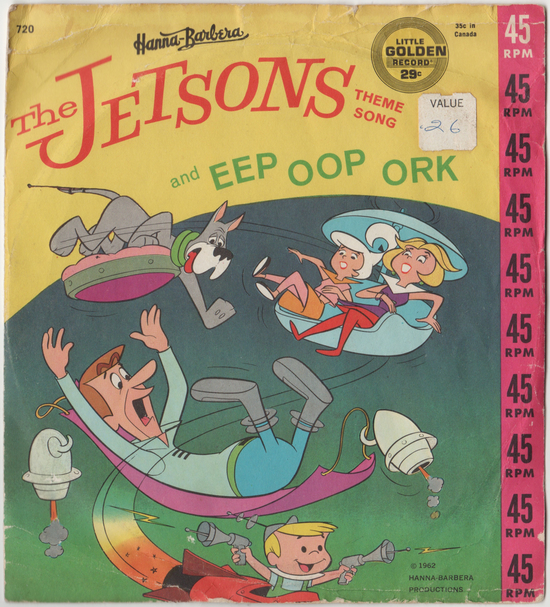
45 RPM record of the Jetsons theme song and “Eep Opp Ork Ah Ah” from 1962 (misspelled “OOP”)
This is the second in a 24-part series looking at every episode of “The Jetsons” TV show from the original 1962-63 season. Read the recap of Episode 1.
The second episode of “The Jetsons” aired September 30, 1962 and was titled “A Date With Jet Screamer.” Arguably the most famous of all the Jetsons episodes, it’s also certainly the most hedonistic; with sex (well, dating), drugs (cigarettes and booze), rock and roll (lotsa rock and roll) and easy living (just lousy with push buttons) dominating the story arc. This postwar version of wholesome hedonism would come to be the aspirational cliche of Americans decades later — work hard, play hard. But in Jetsonian push-button fashion, this episode aspires to drop the “work hard” part.
Fitter, Happier, More Productive
The problem of too much leisure time was something that some people of the 1950s and ’60s were convinced was just over the horizon. Increased efficiency in postwar factories, along with the rising dominance of unions caused many to assume that we’d be working fewer and fewer hours by the 21st century. The continued maturity of the labor movement was seen as a certainty for the latter half of the 20th century and in an article from the Associated Press in 1950, they make some predictions about labor for the next half century:
There is every reason to believe that the steady growth of organized labor in the first half of 1950 will continue along the same trend in the second half of the century.
Labor developed to where it is today from practically nothing at the beginning of the 20th century. It’s still in the process of growth. The various elements and cliques making up the American economy – labor is just one of them – are learning more and more that the national security and well-being requires them to remain strong and work together.
The article also notes that things like the minimum wage, strict child labor laws and unemployment compensation — unheard of at the turn of the 20th century — would progress much in the same trajectory as they had in first half of the 20th century. The AP article predicts that the American worker may even see a 20-hour work week by the year 2000:
It’s a good bet, too, that by the end of the century many government plans now avoided as forms of socialism will be accepted as commonplace. Who in 1900 thought that by mid-century there would be government-regulated pensions and a work week limited to 40 hours? A minimum wage, child labor curbs and unemployment compensation?
So tell your children not to be surprised if the year 2000 finds 35 or even a 20-hour work week fixed by law.
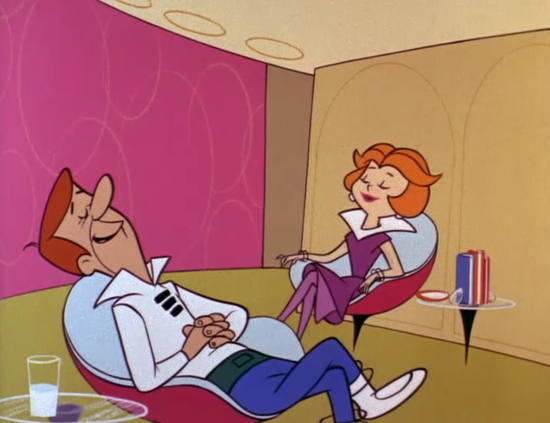
The Jetsons relaxing at home in the year 2062
This thinking carried on into the late 1960s, like in this Associated Press article from November 26, 1967. But the idea of “forced free time” didn’t sit too well with the political scientist they spoke with.
Those who hunger for time off from work may take heart from the forecast of political scientist Sebastian de Grazia that the average work week, by the year 2000, will average 31 hours, and perhaps as few as 21. Twenty years later, on-the-job hours may have dwindled to 26, or even 16.
But what will people do with all that free time? The outlook may not be cheery.
As De Grazia sees it: “There is reason to fear, as some do, that free time, forced free time, will bring on the restless tick of boredom, idleness, immorality, and increased personal violence. If the cause is identified as automation and the preference for higher intelligence, nonautomated jobs may increase, but they will carry the stigma of stupidity. Men will prefer not to work rather than to accept them. Those who do accept will increasingly come to be a politically inferior class.”
One possible solution: a separation of income from work; perhaps a guaranteed annual wage to provide “the wherewithal for a life of leisure for all those who think they have the temperament.”
Future Fix
A scene from “Jet Screamer” that may be slightly jarring to those of us here in the year 2012 is one in which George lights up a cigarette and sips a martini. Today, there are campaigns by youth smoking prevention groups who have lobbied the MPAA in attempts to weigh smoking as a consideration for a movie’s rating (they’d like movies with smoking to get an automatic R). And some media companies have erased smoking completely from old cartoons. But when this episode aired, smoking in the U.S. was at an all-time high.
The adult smoking rate in the U.S. peaked in 1965 at 42.4 percent. Today the adult smoking rate in the U.S. is just 19 percent.
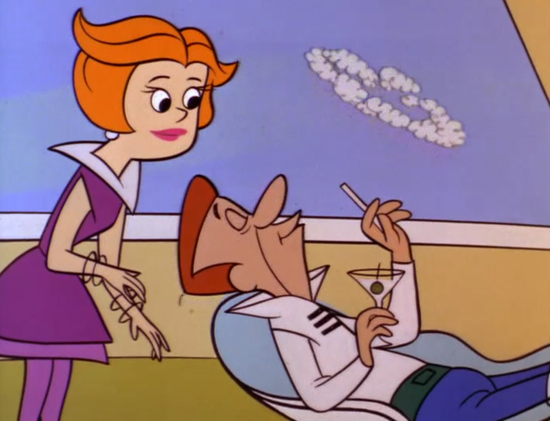
George Jetson enjoys a cigarette and a martini after work (1962)
Postwar Amusements
This episode, even more so than the first, seeks to project the late-1950s/early ’60s vision of the American teenager into the future. Judy’s accidental success in winning a contest (despite her father’s attempts at sabotage) mean that the cool young rock star Jet Screamer takes her for a date in his flying car — to a fly-in burger joint. The burgers, cars and teens image of mid-century suburban living mirror a vision of American adolescence that some were already nostalgic for just a decade later in films like American Graffiti, a film that shows 1973′s nostalgia for 1962.
The 1954 book, 1999: Our Hopeful Future by Victor Cohn projected a similar vision of teenage burger and car culture onto the reading public. But in this case it’s a slightly more unrecognizable burger for Americans in the 1950s:
“Where’s Susan?” said John. “Oh, here she comes.”
“Hi,” said the teen-ager. “Gosh, I’m not very hungry tonight. The gang stopped at Joe’s Fly-in for plankton-burgers.”
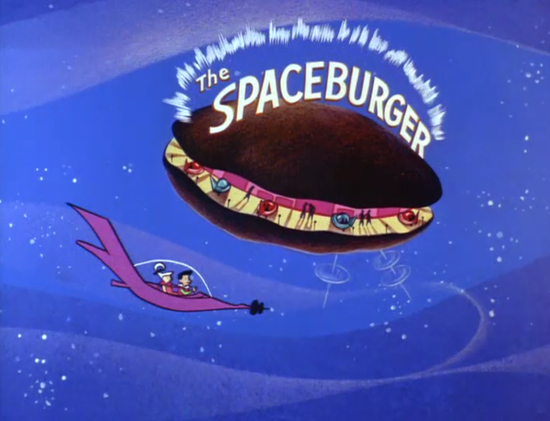
Jet Screamer drives Judy in his flying car to The Spaceburger drive-in (fly-in?) restaurant
In the years leading up to the Jetsons premiere in September 1962, the United States had seen an explosion in investment in the amusement park industry. Disneyland opened in Anaheim in 1955, attracting 3.5 million visitors in its first year. Pacific Ocean Park opened in Venice, CA in 1958 with 1.2 million visitors in its first year. Pleasure Island opened in Massachusetts in 1959 to large crowds. Freedomland U.S.A. opened in the Bronx in 1960 attracting 1.4 million visitors in its first year. Six Flags Over Texas opened in 1961 with 1.2 million visitors in its first year.
Theme parks were of course not new in the mid-20th century, but postwar they flourished becoming ever more sophisticated with their use of electronics and higher standards of cleanliness and safety. Many of these parks served as family destinations for their respective surrounding states, but of course some like Disneyland had a national draw – which also had a national TV show that competed with “The Jetsons”!
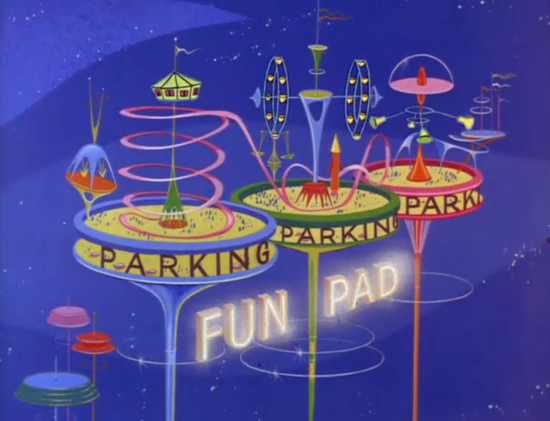
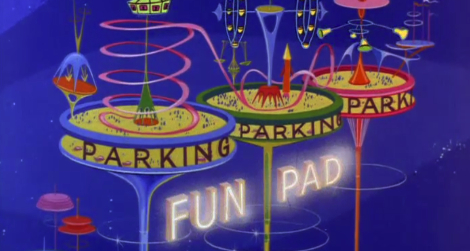
The amusement park “fun pad” of the future from the second episode of The Jetsons
This postwar version of wholesome hedonism was set free in Southern California where high-end amusement parks were sprouting like gangbusters. After the success of Disneyland in 1955, other parks in the Southern California area (where the Hanna-Barbera studios and its employees were located) were built. The photo below is from the Pacific Ocean Park, opened in 1958 by CBS in Venice, California. Like many of the other parks that sprang up mid-century it didn’t have the benefit of national exposure yet worked through high operating costs. Pacific Ocean Park was shuttered after less than a decade in 1967.
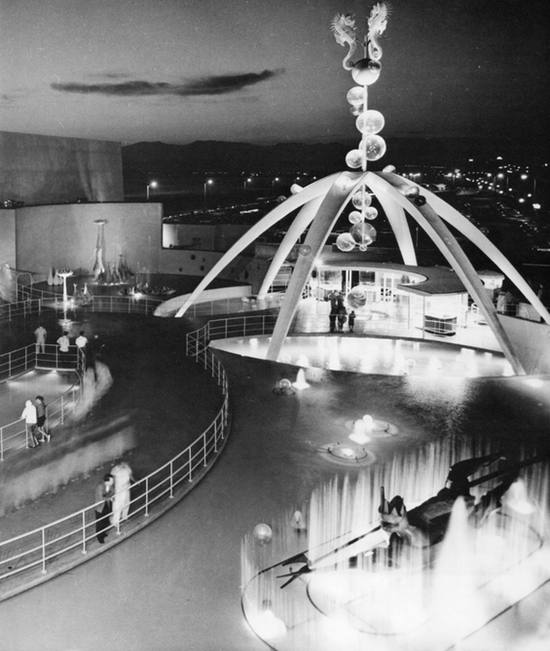
Neptune’s Entrance to Pacific Ocean Park circa 1958 (from the book Venice of America by Jeffrey Stanton)
Eep Opp Ork Ah Ah
The early 1960s Billboard charts were filled with the teenage idols and crooners that clearly inspired the character of Jet Screamer. But Jet Screamer himself became a bit of a hit. The song “Eep Opp Ork Ah Ah” is undeniably catchy and is one of those that rattles around in your brain (whether you want it to or not) for days after you hear it. And because of its association with the Jetson family and all the space age optimism burned into the minds of so many kids, you see the song pop up in a number of unexpected places. If you’ve ever visited the History Center of Minnesota you’ll notice that the song is played in an exhibit about space travel. Many years later the song would be covered by the Violent Femmes on an album of Saturday morning cartoon songs covered by popular bands.
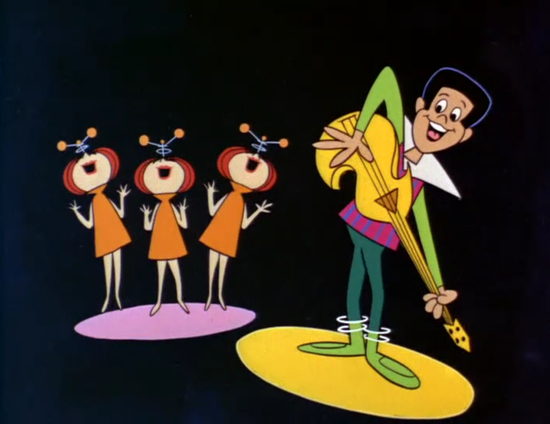
Screenshot from the Jetsons episode “A Date With Jet Screamer” originally aired Sept 30, 1962
The second episode of the show has fewer gadgets than the first, but its promise of easy living and constant entertainment is as emblematic of the Jetsons future as any episode in the series: the world of tomorrow will be much like today, only better.
/https://tf-cmsv2-smithsonianmag-media.s3.amazonaws.com/accounts/headshot/matt-novak-240.jpg)