
Sex and Space Travel: Predictions from the 1950s
The cure for lonely space missions? One astronomer proposed hiring astronaut concubines
/https://tf-cmsv2-smithsonianmag-media.s3.amazonaws.com/accounts/headshot/matt-novak-240.jpg)
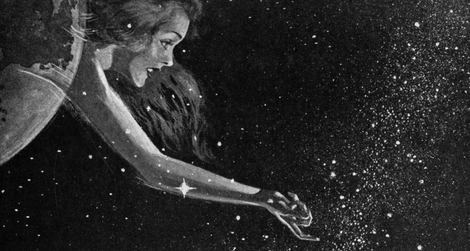
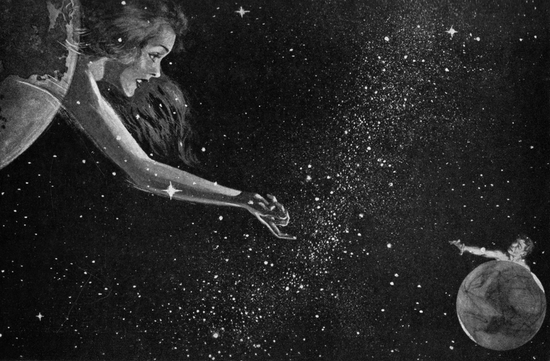
Illustration by L. Sterne Stevens in the March 1956 issue of Sexology magazine (source: Novak Archive)
In September of 1992 astronauts Jan Davis and Mark Lee became the first married couple to leave the planet together. But NASA didn’t originally plan on it happening that way.
NASA had an unwritten rule that married astronauts couldn’t be sent into space together. Davis and Lee had been assigned to the mission in 1989 but were later married in January 1991. After the agency learned of their marriage, NASA took two months to review the situation and believed that both were too important to the mission (the second flight of Space Shuttle Endeavour) for either of them to be removed. The couple had no children and NASA explained that if they had, they most certainly wouldn’t have flown together.
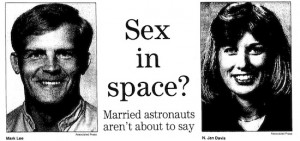
June 26, 1992 Wisconsin State Journal
Their flight was a minor public relations scandal because of an obvious question that reporters of the time were not shy about asking: would they be having sex in space? The answer from the astronauts and NASA was an unequivocal “no”.
Outside of science fiction, the topic of sex in space has received surprisingly scant attention. But it was science fiction that inspired Dr. Robert S. Richardson to write an article in the March 1956 issue of Sexology: The Magazine of Sex Science, wherein he describes his vision of what sexual relations might look like when space travel is a reality. This was a year and a half before the launch of Sputnik, so the Space Age wasn’t even firing on all thrusters yet. But Dr. Richardson opens his article by discussing his frustration with the fact that sex is never addressed in any of the sci-fi shows on TV. Given the reputation of 1950s broadcasting as a sexless environment — where married couples on programs like I Love Lucy had to sleep in separate beds, and wouldn’t even say the word “pregnant” — Richardson’s surprise comes across as a bit disingenuous. Nonetheless, Richardson makes his case for what he believes the future of sex in space might look like.
From the introduction to the 1956 article:
Recent announcements by the United States and Soviet Governments that they are planning space satellites and space rockets have stimulated universal interest in the problems of space travel. Space voyages to Mars will take a long time, and settlements on the distant plants will be lonely. While much has been written about the various scientific aspects of space travel, this is the first article which deals with the important medical problem: How will the natural sexual needs of early space travelers be met so as to provide a modicum of mental health for the space pioneers?
Perhaps unsurprisingly, Dr. Richardson’s views on women in space aren’t the most enlightened. He writes under the assumption that only men will be astronauts and that these men will have certain carnal needs to be met during long missions in space. Many of Richardson’s ideas about space, and especially Mars, clearly come from the Collier’s series of articles on space travel from 1952 to 1954. Interestingly, Richardson becomes fixated on Mars throughout the article, ignoring the moon — a place humans wouldn’t even sink their boots until a full 13 years after his article was published.
Richardson compares the establishment of an inevitable Martian base to the experience of military men in remote regions of the Arctic. But unlike relatively short tours in Greenland of a year or less, he acknowledges that a trip to Mars would be an adventure of three years or more.
But can healthy young men work efficiently and harmoniously for long without women ?
Reactions to this question vary widely. There are some who think it outrageous that sex should enter into the question at all. Just forget about the women. Keep busy and you won’t need to worry.
Others recognize sex as a disturbing factor, but feel it is not too serious. In the old days, sailors made long voyages without women and still managed to perform their duties and bring the ship into port. They admit there was sexual over-indulgence soon after the sailors got on shore, but that was only to be expected. The remark heard most often is that the men turn to homosexualism and auto-eroticism during extended voyages.
None of these answers meets the problem squarely. They either side-step the issue or suggest some degrading compromise solution.
Richardson’s solution to the problem of loneliness for astronaut men sailing towards Mars is rather offensive, proposing that women tag along as sex objects with a mission to serve the crew (and take dictation when necessary).
In our expedition to Mars, let our healthy young males take along some healthy young females to serve as their sexual partners. (Of course it would also help if they could operate a radio transmitter and take dictation.) These women would accompany them quite openly for this purpose. There would be no secrecy about this. There would be nothing dishonorable about their assignment. They would be women of the kind we ordinarily speak of as “nice girls.”
“But then they wouldn’t be nice girls any more!” people will object.
Judged by the arbitrary standards of our present social reference system, they certainly would not. But in our new social reference system they would be nice girls. Or rather, the girls would be the same, but our way of thinking about them would be different.
It is possible that ultimately the most important result of space travel will be not what we discover upon the planets, but rather the changes that our widening outlook will effect upon our way of thinking. Will men and women bold enough to venture into space feel that they are still bound by often artificial and outmoded conventions of behavior prevalent upon a planet fifty million miles behind them ? May not men and women upon another world develop a social reference system — shocking as judged by us on earth today — but entirely “moral” according to extra-terrestrial standards?
This last bit of speculation — of proposing that on other planets people may develop their own set of cultural and moral standards by which to judge sexual activity — would certainly be an interesting discussion to have, if it weren’t predicated on the notion that women would necessarily be secretaries and sex objects acting at the pleasure of the all-male astronaut crew.
As far as we know, no one has yet had sex in space. But when they inevitably do, I suspect neither party will need to supplement their astronautic duties by taking dictation.
/https://tf-cmsv2-smithsonianmag-media.s3.amazonaws.com/accounts/headshot/matt-novak-240.jpg)