November 30, 2012
In the 1920s, Shoppers Got Punk’d By Fake Televisions
![]()

Faked TV demonstration illustrated in the August 1926 issue of Science and Invention
Today advertisers use futuristic tech like jetpacks and robots in their TV ads so that potential consumers think of their brand as forward thinking and innovative. In the 1920s, the cutting edge gadget that advertisers most wanted to associate themselves with was television. But, since the technology was still in its infancy, they faked it.
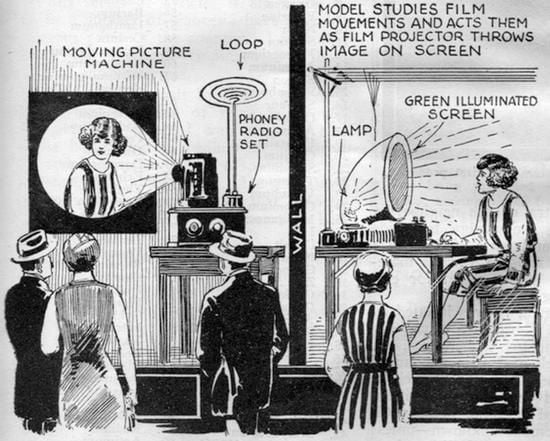
The August 1926 issue of Science and Invention magazine included two illustrations showing ways that businesses could create “fake” television demonstrations to lure customers inside their stores.
The illustration above depicts a bogus TV demo in a store window, divided by a wall. On the left side of the window display, people saw what was meant to look like a TV projector being sent a wireless signal by a woman sitting in the right side of the display. Instead the projection was just a movie made earlier with the same actress, who did her best to mimic the pre-recorded actions.
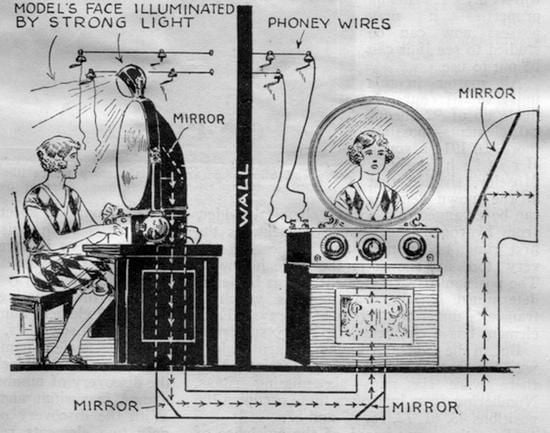
Another method of creating fake TV broadcasts was to use a series of mirrors. In the illustration below, unneeded wires give the impression that the TV signal is being sent between the two rooms. In reality, mirrors have been strategically set up so that the actress’s image appears on the fake TV set in the next room.
Another faked TV image concept using mirrors (1926)
Businesses that couldn’t stage fake TV demonstrations still used television as a theme in their advertisements. The illustration below hung at Martin’s Lunch Room at 15 Wall Street in Norwalk, Connecticut around 1929. The poster’s message was that even though technology is developing at a rapid pace, you can still find great customer service with a human touch at their restaurant.
Cartoon poster which hung outside Martin’s Lunch Room circa 1929 (Source: Yesterday’s Tomorrows)
As we’ve looked at many times before, the idea of TV being a purely broadcast medium (rather than a point-to-point service which today we might call videophone) wasn’t yet a certainty until the late 1940s. In fact, TV had many false starts before it would become a practical reality in American homes after World War II. But fittingly enough, it would be TV itself — along with the dwindling influence of the downtown department store — that would cause advertisers to abandon storefronts, opting instead to promote their wares via commercials. Of course, what was promised in those commercials wasn’t always genuine… but that’s a story for another time.
Sign up for our free email newsletter and receive the best stories from Smithsonian.com each week.
9 Comments »
RSS feed for comments on this post. TrackBack URI


You can’t credit television for the demise of storefront window advertising. It was still going strong decades after television appeared. The demise of downtowns is what the cause was, because it still is strong in towns and cities where Wal-Mart hasn’t killed off downtown shopping. Likewise, look at the giant multi-page illustrated newspaper ads from the 40s into the 80s. They also continued to exist after the growth of TV. TV commercials were not the advertisers’ only option.
The point-to-point vs. broadcast decision for TV was preceded by a similar process for AM radio.
http://earlyradiohistory.us/buildbcb.htm
It was even expected that there would only be the need for 2 broadcast frequencies in an area (1 for crop reports & weather, and the other for news and entertainment)
Two methods are described, but were these methods actually used? If so, do any contemporary descriptions or photographs of such fake TV demonstrations exist?
Wow in the second system they were faking color TV. That was more than a little ahead of its time.
It amazes me that, when radio was still new and movies were still silent, people already had the idea of television in mind. More amazing is that people may have actually fallen for these scams and that a published periodical provided instructions for perpetrating a criminal enterprise – it is a third-millenium idea that widespread and open disclosure of such information began with the internet.
The mirror scam seems like a variation of some of the deceptions perpetrated by psychics/mediums, which date back even farther, I guess that this would have made TV the modern medium (sorry – couldn’t resist the pun).
I would like to see an article on the evolution of the idea and technologies that originally made television a reality, then more on the technological changes over the years that brought us color TV, HDTV, and 3-D TV; as well as the upcoming technologies such as holographic projection devices.
Thanks for the interesting article!
Off-topic, but have you seen Dr Goebbel’s predictions about the year 2000, if Germany should lose the war?
http://www.calvin.edu/academic/cas/gpa/goeb49.htm
In the archives of Popular Science Magazine (where I once worked), there are very scientific articles published in the 1920s about real television. I believe there were genuine television broadcasts to very limited audiences in both New York and London.The war put an end to them.
We have a museum viewed here at http://www.youtube.com/watch?v=ucGQ2uxn-yo where you can see some of our vintage TV sets; my specialty is collecting sets with the fabled Channel 1 on them; quite a unique hobby segment! Philo T. Farnsworth patented a working TV method in 1929 and the Olympics in Berlin 1936 was supposedly the first public appearance of demonstration TV. I didn’t know about these advertising fakir folks; that was a lot of fun reading it! We had several different methods of making TV really work; flying spot scanners, rotating wheels and more. The Cathode Ray Tube (CRT) made it practical for viewing at last. The Antique Wireless Assn has the oldest TV set I am aware of; it is from right at 1929-30 and is quite crude even for those days but impressive to see! Our oldest one is 1939 and the smallest we have are a Philco Safari 2″ set and a 3″ Pilot in the collection. Bob.Burchett@EEonTheWeb.com if you want to know more.
I honestly don’t know which is worse — the public being punk’d by fake TV in the 1920s, or being punk’d by real TV in the 2000s.
“More amazing is that people may have actually fallen for these scams…”
I’m not amazed at all. Gullibility in the general public seems to be the norm, and rising. History is rife with these scams and, along with them, proof positive that overall, the general public have remained absolutely rock stupid.