
Recapping ‘The Jetsons’: Episode 09 – Elroy’s TV Show
Kids of the 1960s were let in on the secret of how television is made.
/https://tf-cmsv2-smithsonianmag-media.s3.amazonaws.com/accounts/headshot/matt-novak-240.jpg)
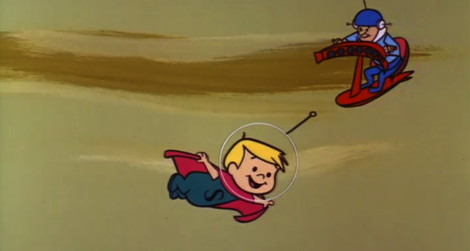
This is the ninth in a 24-part series looking at every episode of “The Jetsons” TV show from the original 1962-63 season.
When I was a kid I didn’t quite understand how TV and movies were made. Around the age of four or five, I had a basic understanding of how live TV was recorded with cameras and beamed to homes all around the country. And I understood that every time I put my Captain EO VHS tape (I think we recorded it off TV, since it was never issued officially) into the VCR, I would get to watch Michael Jackson singing and dancing. But I conflated the two and believed that every time I put in that VHS tape I was somehow telling people in some distant production studio to stage a live performance of Captain EO.
As a kid, there’s something magical about learning how the things you like are made, even if you’re a bit fuzzy on the details. Whether it’s crayons or robots or movies, I and many others have fond memories from childhood where we felt like we were being let in on a wonderful production secret. There’s no story that writers, actors and producers of media like telling more than their own and these self-reflexive tales serve an important guide in our long-term understanding of the media itself. Even if it’s done for laughs, we’re meant to absorb something akin to a mission statement when producers poke at the artifice of their own creations.
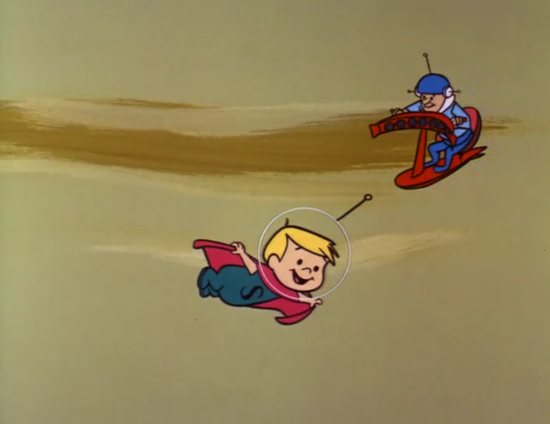
A TV cameraman shoots Elroy as “Space Boy” on Jupiter (1962)
The ninth episode of “The Jetsons” aired on November 18, 1962 and featured pneumatic tubes, flying cars, videophones, and even another look at the ground in 2062! But the most important aspect of this episode, titled “Elroy’s TV Show,” was that it gave kids a peak behind the curtain, letting them in on the secret of how television was made. People who grew up prior to the YouTube generation most often learned about media production from watching the media itself. And “The Jetsons” delivered, poking fun at TV writers as lazy, directors as control freaks and actors (and their overbearing parents, in this case) as impossibly difficult prima donnas. George, Elroy and Astro travel to Jupiter to shoot Elroy’s TV show and kids of the 1960s were let in on the secret of how television is made, albeit in a heightened cartoonish form.
The episode highlights the perennial debate over the role of TV programming in the American home. The latter half of the 20th century saw numerous fights over the regulation of TV programming and the battles were especially vicious when this episode premiered in 1962. The public airwaves were (and still are) regulated by the government and networks were obligated to devote some time each day to educational and public service broadcasting (such as news shows and the like). Of course, many of these FCC regulations are still on the books, but the 1980s declawing of the FCC meant that media deregulation advocates largely won that battle, arguing that TV networks should answer only to the market rather than what regulators deem to be the public interest. In fact, that’s what this episode argues, as Jane Jetson says that she doesn’t watch TV anymore since it’s “over her head.” Instead she wants more “doctor and cowboy shows.” When a TV producer named Mr. Transistor visits Jane to pitch a show based on the adventures of her son Elroy and her dog Astro, she says that she doesn’t want any more education on TV. Mr. Transistor replies, “I don’t blame you.”
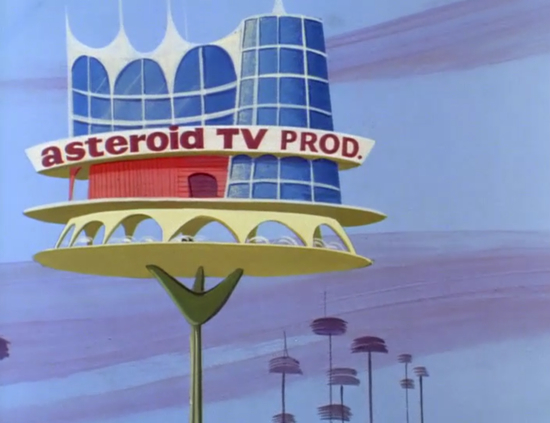
The Asteroid TV production building in the ninth episode of “The Jetsons”
The Jetsons was rather infamously billed by broadcasters in the 1990s as an example of “educational TV” because it taught kids about the future. Which, while that is in some ways true, it’s certainly a stretch. Many early experimenters saw television as a promising tool for educating people — especially in rural farming communities where distance prohibited some from traveling to a major university for their education. But today we take it for granted that television is an entertainment medium first and foremost, often forgetting the many battles of previous decades.
What are we meant to take from this episode? That despite the battles being waged over TV regulations, in the future Americans will get the action-packed (read: low-brow) programming they want. Entertainment finds a way, if you will. And while the episode is obviously not malicious in its intent to call educational programming uncool, such a message rings loudly throughout.
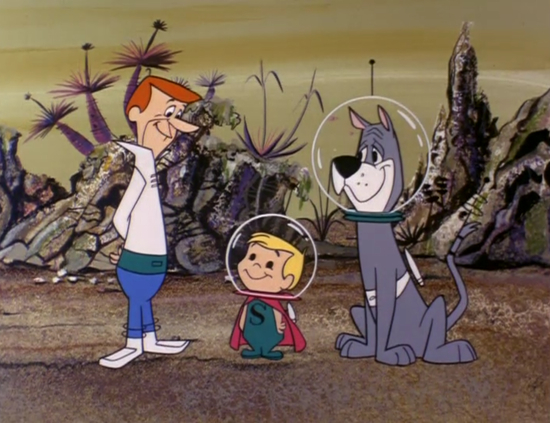
George, Elroy and Astro on Jupiter shooting Elroy’s TV show (1962)
Elroy Jetson was voiced by Daws Butler who also did classic cartoon characters like Yogi Bear, Snagglepuss and Huckleberry Hound. But it was Lucille Bliss who was originally offered the job of Elroy. Bliss was a voice actress best know for her work as Smurfette on the 1980s TV show “The Smurfs,” and she died earlier this month. Bliss is reported to have lost the job of voicing Elroy Jetson in 1962 when she refused to be credited under a pseudonym. Apparently it was somewhat scandalous for an adult woman to be voicing a cartoon boy, though it’s obviously quite common and not at all controversial today.
/https://tf-cmsv2-smithsonianmag-media.s3.amazonaws.com/accounts/headshot/matt-novak-240.jpg)