May 2, 2012
The Biggest Supermoon in Years is Coming Saturday Night
![]()

The supermoon of March 2011, rising behind the Lincoln Memorial In Washington, DC. Photo by NASA/Bill Ingalls
This Saturday evening, take a look at the night sky and you might see something special. The moon will make its largest, most stunning appearance of the year—an event known to scientists as “the perigee-syzygy of the Earth-Moon-Sun system” and to the popular skywatching public simply as the “supermoon.” As one of the most spectacular supermoons in years, the moon will appear 14 percent bigger and 30 percent brighter than when it is on the far side of its orbit.
Why does the moon sometimes appear larger, and sometimes smaller? The answer lies in the fact that its orbit around Earth is elliptical, so its distance from us varies—it ranges from roughly 222,000 to 252,000 miles away each month. On Saturday, the moon will reach what is known as the perigee, coming as close as it ever does to the Earth, just 221,802 miles away. At the same time, it will be a full moon, with the entirety of its Earth-facing surface illuminated by the light of the sun.
This supermoon will appear especially large because the exact moment of perigee will neatly coincide with the appearance of a perfectly full moon. The full moon will occur at 11:34 p.m. EST, and the perigee will occur at 11:35. During last year’s supermoon on March 19, 2011, for comparison, the perigee and full moon were 50 minutes apart.
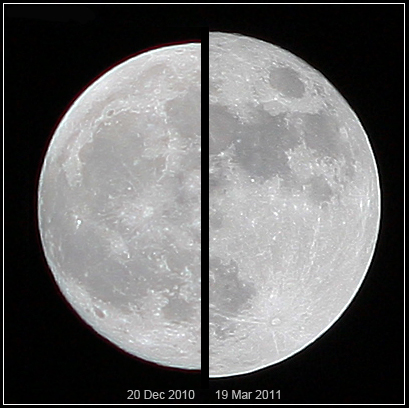
A comparison of last year's March supermoon (right) with an average moon from December 2010. Photo by Wikimedia Commons user Marcoaliaslama
“The timing is almost perfect,” says NASA, according to the Washington Post. AccuWeather’s astronomy blogger Daniel Vogler notes that a look through recent data reveals no more closely-timed (and therefore bigger) supermoons.
Apart from providing a sight to behold in the night sky, the moon’s perigee also has a tangible effect on Earth: It causes higher than normal tides. Because tides are driven by the moon’s gravitational effects, a closer moon means that the oceans will be pulled more than usual towards the satellite. In most places, this will mean a tide that is an inch or so higher than usual, but geographical factors can multiply the effect up to around six inches.
There has long been speculation that the moon’s gravitational effect during its perigee could be the cause of natural disasters, including earthquakes and volcanic activity. In particular, many suggested this link following the earthquake and subsequent tsunami off the coast of Japan in March of 2011. However, the devastating quake occurred over a week before the supermoon, and studies have shown no strong evidence for increased frequency of high-intensity seismic activity during the moon’s perigee.
There are more concrete examples, though, in which supermoons may cause problems. In particular, flooding during storms may be made more severe because of the higher tides. In 1962, the coincidental arrival of a powerful storm with the moon’s perigee inundated the entire Atlantic coast of Cape Cod, causing 40 deaths and $500 million in property damage.
On Saturday, assuming no damaging storms or floods are at your doorstep, just hope for a clear night and take a look outside. The moon will appear larger and brighter than usual all night, but for the most striking views, try to catch it just after it rises above the horizon, when an optical illusion causes it to look larger than it really is, and viewing it through the gases of the earth’s atmosphere can cause the moon to appear yellow, orange or red in color.
Sign up for our free email newsletter and receive the best stories from Smithsonian.com each week.
36 Comments »
RSS feed for comments on this post. TrackBack URI


I’m sending this to everyone I know – supermoons are breathtaking!
If you’re Pagan, or open to it, you might appreciate that this coincides with true Beltane. Beltane is the Spring fertility festival, when traditionally Wiccans, Witches, Druids, and Pagans of all kinds celebrate the season by making love outside under the stars and moon. These days its often celebrated on May 1st but true Beltane is the halfway point between Spring Equinox and Summer Solstice — May 5th. Have fun!!!
No pusieron a q hora se puede ver por ejemplo desde mexico… ojala lo hagan… saludos
Are your quoted times (11:35, 11:35 EST) supposed to be EDT (Eastern Daylight Time)?
What crap. The moon is in a near circular orbit. There is no discernable difference. Its not going to be brighter than usual. Too bad the Smithsonian has fallen for this garbage. how about looking it up in Snopes. OR NASA.
Will this be vivsible from the uk?
its spooky
@Frank Schiffel: Actually, NASA concurs:
http://www.nasa.gov/centers/langley/news/researchernews/supermoon.html
Snopes had no reference to the phenomenon at all.
To distrators, do you even know where he Moon is?
Too bad Frank doesn’t know anything about astronomy or physics.
@Frank Schiffel: “how about looking it up in Snopes. OR NASA.”
See NASA’s own information on the supermoon:
http://www.youtube.com/watch?feature=player_embedded&v=dvHQ1vV21i0
or
http://science.nasa.gov/science-news/science-at-nasa/2012/02may_supermoon/
or
http://www.nasa.gov/topics/moonmars/features/supermoon.html
Snopes has nothing to say on the subject.
THANKS FOR THE ANOUNCEMENT!!!!!!!!!!!!! I’LL CERTAINLY WATCH!!!!!!!!!!!!!
Frank Schiffel
Maybe you should do some research?
science.nasa.gov/science-news/science-at-nasa/2011/16mar_supermoon/
Yea, old but from NASA and explains it
NASA’s take on Supermoons
http://science.nasa.gov/science-news/science-at-nasa/2011/16mar_supermoon/
Here Frank, this might help you out too.
Lunar Perigee and Apogee Calculator
http://fourmilab.ch/earthview/pacalc.html
Frank Schiffel, “near circular” can certainly be an ellipse and the numbers for apogee and perigee appear to be correct. That means that the at apogee the moon is approximately 1/7 the distance further than it is at perigee. Seems to me that could make a significant difference in what you see.
Oh, and by the way, couldn’t find anything on Snopes about the moon’s orbit or “supermoon.”
This is also the precious festival of Wesak, celebrating Buddha Sakyamuni’s Birth, Enlightenment and Nirvana. Feels like a very auspicious time for everyone of every belief system (or no belief system)! Happy Day to All!
Psalm 19:1 The heavens declare the glory of God; and the firmament showeth His handiwork.
#3 – ERic sends greeting in Spanish & is wondering at what time it would be visible in Mexico. ?Los tiempos son los mismos en EEUU y Mexico? ?Depende en que parte de Mexico y la zona del tiempo? Mira al cielo Sabado.
Near circular is elliptical.
Goddard’s Chief Scientist explains:
“‘Supermoon’ is a situation when the moon is slightly closer to Earth in its orbit than on average, and this effect is most noticeable when it occurs at the same time as a full moon. So, the moon may seem bigger although the difference in its distance from Earth is only a few percent at such times.”
@Frank Schiffel the moon’s orbit is elliptical, try looking it up before pretending to be a skeptic. Some of these occurrences are real.
Frank Schiffel is in error. Snopes has nothing about the “super moon” one way OR the other, and NASA has a link with information about it, to wit: http://science.nasa.gov/science-news/science-at-nasa/2012/02may_supermoon/
@Frank – it’s an elliptical orbit, and you will be able to see the difference.
Source (per your recommendation):
http://science.nasa.gov/science-news/science-at-nasa/2012/02may_supermoon/
(sigh)
To Frank Schiffel
http://science.nasa.gov/science-news/science-at-nasa/2012/
I did check NASA and there it was!
By the way, Frank, I happen to work with NASA and NASA verifies this. And since when is the Smithsonian not a worthy source. If you read the article, they do quote NASA.
Hey Frank,
Go home and cry. Some of us love this forecast.
@ Frank Schiffell – Too bad you don’t do your homework. This article says basically the same thing that the article on NASA’s states including the shape of the moons orbit. What makes this particle super moon so spectacular is the timing between the actual full moon and the perigee.
Very very exciting event coming up. Astronomically, astrologically and mythologically, these are events that deserve to be watched and appreciated.
Well Folks I think Franks comments have been nullified. So lets move on and concentrate on the wonderment and awe inspiring benefits of planet earth!!
T Fishman
“Ladies And Gentlemen”
Its Too Late For Poor Fankie Boy….”His Eyes Are Wide Shut.!!
Hes been Brainwashed.by That Book, You Know The One!.
Full of Fairy Stories on Imaginary People,Adam & Eve,etc…
He Sadly Cannot See Clearly Now, What Is Real and Fiction,,,
So-We Should all let him Go To Bed Tonight.no more attention.
Hes Probably still waiting on The Tooth Fairy? Smile….
The photos are deceiving. They just zoomed in on a far away object, making the moon appear bigger. It’s going to look about the same size as the past few months. Sorry to burst your bubble.
i love the night sky. i don’t know why people speak when they should not. i am so looking forward to this event. and thank you for the address to get more info on the night sky (NASA)
Well, Frank thinks the world is flat, too. Doesn’t believe in Columbus, either. He fell off the edge. Probably thinks Van Ellen is a fashion designer of men’s belts, too…
LMAO!
The moon is cool in all of its forms. Here’s a collection of moon photos: http://www.dreamstime.com/moonlight-and-moonlit-rcollection14299-resi239750
I thought it would be important for readers to note that Saturday night marks the end of the holy month of Ramadan for Muslims and also marks the beginning of the Eid Al-Fitr celebration. After roughly 30 days of fasting from sun rise to sun down without food or water Muslims gather and await this beautiful moon and give thanks to god!