
This Insect Uses Its Victims’ Carcasses As Camouflage
Acanthaspis petax, a type of assassin bug, stacks dead ant bodies on its back to confuse predators
/https://tf-cmsv2-smithsonianmag-media.s3.amazonaws.com/accounts/headshot/joseph-stromberg-240.jpg)
/https://tf-cmsv2-smithsonianmag-media.s3.amazonaws.com/filer/20120508123104assassin-bug-small.jpg)
Imagine you’re wandering in the forests near Lake Victoria, in Kenya or Tanzania, when you spot something strange crawling on a leaf. It looks like a dozen or so ants, stuck together in a ball. But look more closely and you’ll see the ants are dead. And there’s a nasty-looking insect underneath, hauling these ants corpses along like a miniature backpack.
This is Acanthaspis petax, a member of the Reduviidae family, which is found in East Africa and Malaysia. Like other assassin bugs, it hunts its prey by piercing it with its proboscis, injecting paralysis-inducing saliva and an enzyme that dissolves tissue, then sucking out the innards. But unlike other bugs, it then fashions empty ant exoskeletons into protective outerwear. The insect can carry as many as 20 dead ants at a time, and binds them together with a sticky excretion into a cluster that may be larger than its own body.
For years, scientists debated why Acanthaspis petax engaged in this unusual behavior. It hunts several different types of prey, but appears to exclusively stack ant bodies on its back. Some suggested that the ant corpses may provide olfactory camouflage when hunting, while others thought the mound of bodies may be used as a visual distraction for larger creatures that are hunting the assassin bug.
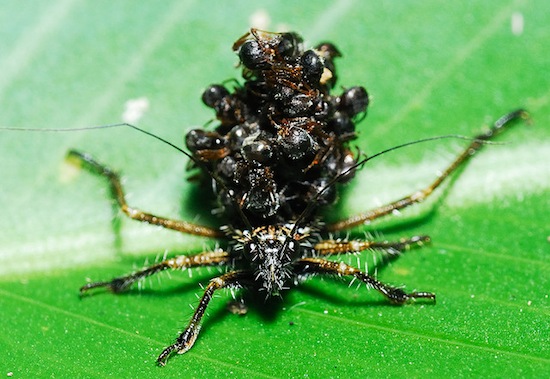
Photo by Mohd Rizal Ismail
In 2007, a team of researchers from New Zealand carried out an experiment to test whether the insect’s corpse-carrying strategy truly helped protect it from predation. In the study, they left assassin bugs alone in glass cages with several species of jumping spiders, which are their natural predators. Some of the insects were carrying balls of ant carcasses on their backs (the researchers called these “masked” bugs) while others were left naked. Since the jumping spiders have excellent vision but a poor sense of smell—they hunt by using their acute sense of sight to make a precisely gauged leap and land on their prey—the experiment would indicate if the ant bodies served as visual camouflage or not.
The result: the spiders attacked the naked bugs roughly ten times more often than the masked ones. The researchers even repeated the experiment with dead, preserved assassin bugs, to control for the effects of movement and behavior, and the results remained the same. Carrying that ball of dead ants, it turns out, is a great strategy for the assassin bug to use in trying to survive for its next meal.
The scientists speculate that the large mound of corpses changes the visual form of the insect to the point where the spiders can’t recognize it as prey.
But why do the assassin bugs refrain from using other insects in the same way? The researchers suggest that Acanthaspis petax may actually be relying on the spiders’ inherent reluctance to attack ants. Because ants have a tendency to swarm and may secrete chemical weapons, the spiders don’t typically hunt them.
Good strategy for Acanthaspis petax. Raw deal for the ants.
/https://tf-cmsv2-smithsonianmag-media.s3.amazonaws.com/accounts/headshot/joseph-stromberg-240.jpg)