
African Grey Parrots Have the Reasoning Skills of 3-Year-Olds
A new experiment showed that the birds are capable of abstract logical reasoning, a trait previously shown only by primates
/https://tf-cmsv2-smithsonianmag-media.s3.amazonaws.com/accounts/headshot/joseph-stromberg-240.jpg)
/https://tf-cmsv2-smithsonianmag-media.s3.amazonaws.com/filer/African-grey-hero-631.jpg)
When we think about the smartest animals, chimpanzees are usually the first to come to mind. Experiments show that they can memorize sequences of numbers, learn the meaning of words and associate particular voices with specific faces. Crucially, previous studies have found that chimps and other apes are the only non-human animals capable of making abstract logical inferences based on cues from their environment.
A new experiment, though, might make us recognize that an entirely different species belongs in this exclusive group: the African grey parrot.
In several previous experiments, researchers claimed they’d revealed the ability of parrots to make inferences based on their skill in completing an extremely simple task. The animals were shown a pair of closed canisters, one with food inside and one empty, and the top of the empty one was briefly opened. Afterward, when they were given the chance to choose one or the other, they reliably selected the one with food. Critics, though, said that this didn’t necessarily demonstrate any sort of inferential reasoning—they could simply be avoiding the empty canister, rather than realizing its emptiness implied there was food in the other.
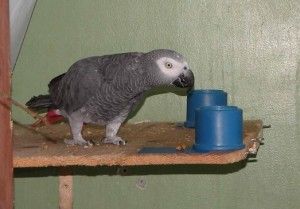
In the new study, however, published yesterday in the Proceedings of the Royal Society B, researchers from the University of Vienna gave six grey parrots a slightly more complex task. Instead of being shown an empty and a full canister, the researchers merely shook one of the containers, so the parrots could hear either the sound of walnuts rattling around inside or silence.
When given the chance to select a canister, the parrots consistently chose the one with the walnuts, whether they had heard the shaking of either container. They were able, therefore, to determine both that a noisy shaking meant “food is inside” and that a noiseless shaking meant “no food is inside, so it must be in the other one.”
To confirm that the parrots were actually making inferences about the location of food, and not merely avoiding a silent box, the researchers introduced one more variation to the task. Instead of using the actual canisters to make the noises, they wore small speakers on their wrists that emitted shaking noises. In some cases, they shook the box in their right hand, but emitted the shaking noises from a speaker on their left wrist; in other cases, they played the sounds from the correct side. The parrots only made the right selection on a consistent basis when the sound lined up with the shaking—so they were making an inference not based on a visual or aural cue alone, but from noting the connection between both.
Although this might not seem that impressive, no other non-primate species has been able to successfully complete this type of task, and humans are not typically able to do this until they reach three years of age. The fact that the parrots were able to make these sorts of judgements based on sounds associated with food—and visuals that would logically produce the sounds—confirms that they are indeed capable of abstract, inferential reasoning. ”It suggests that grey parrots have some understanding of causality and that they can use this to reason about the world,” lead author Christian Schloegl told LiveScience.
Most interesting, from an evolutionary perspective, is the fact that parrots are not close relatives of primates, so their ability to reason presumably evolved separately. ”The most important point is that higher intelligence is nothing that evolved only once,” Schloegl said. “Comparable cognitive skills evolved several times in parallel in only distantly related species such as primates and birds.”
/https://tf-cmsv2-smithsonianmag-media.s3.amazonaws.com/accounts/headshot/joseph-stromberg-240.jpg)