Blogs

  • News
  • |
  • Art
  • |
  • History
  • |
  • Food and Travel
  • |
  • Science
Dinosaur Tracking

Where paleontology meets pop culture

Hominid Hunting

Meet the members of the tangled human family tree

Innovations

How human ingenuity is changing the way we live

Surprising Science

Ideas, news and discoveries from the world of science


August 31, 2012

Is Geoengineering the Answer to Climate Change?

Geoengineering could replicate the cooling effects of a massive volcanic eruption as a tool to reduce climate change. Photo via Wikimedia Commons

Climate change used to be thought of as a long-term worry; now, there’s good reason to believe we’re already encountering its effects. As the problem grows more urgent, some say we ought to take a radical approach: Instead of struggling in vain to limit greenhouse gas emissions, we should try to engineer systemsto directly stop the warming of the planet.

This approach is known as geoengineering, and it might be the most controversial area in climate science.

The term encompasses a wide variety of techniques. One company tried to fertilize the ocean with iron, to encourage the growth of algae to absorb excess carbon dioxide. Other scientists have suggested spraying clouds with seawater to increase their whiteness—and thus reflectivity—reducing warming by bouncing light back out to space. The U.S. government has even considered gigantic, sun-blocking mirrors in outer space as a last-ditch option if climate change hits a tipping point.

The most debated suggestion, though, is inspired by a natural phenomenon: Massive volcanic eruptions can trigger several years of global cooling because they by suspend sulfur aerosols and other particulate matter high enough in the atmosphere where they remain aloft for years, blocking a small fraction of sunlight. This effect could be mimicked using aircraft, artillery or even suspended pipes to send sulfate particles into the atmosphere where they would counteract the effect of rising greenhouse gas concentrations.
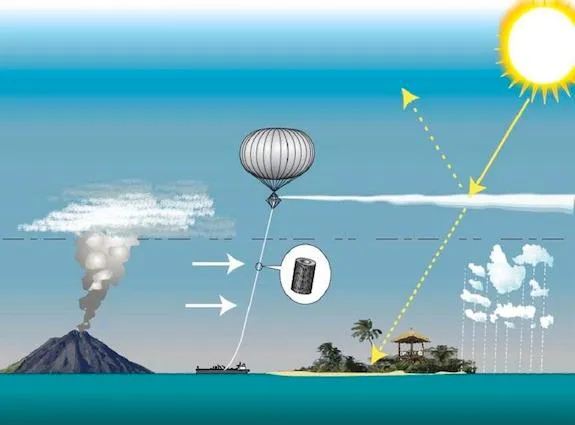
One proposed experiment would have used a balloon-tethered pipe to pump sulfur aerosols into the stratosphere and block a portion of solar radiation from reaching earth. Image via Wikimedia Commons/Hugh Hunt

Now, for the first time, a team of scientists has specifically analyzed the immediate financial costs of employing such a technique. Their results, published yesterday in the journal Environmental Research Letters, might be seen as encouraging by advocates of geoengineering—but depressing for everyone hoping to limit greenhouse gas emissions.

The researchers, from Aurora Flight Sciences, Harvard University and Carnegie Mellon University, found that continuously delivering materials into the stratosphere to deflect sunlight could theoretically be accomplished with current technologies and could cost as little as $5 billion per year worldwide. Although this might sound like a large sum, reducing emissions enough to prevent carbon dioxide levels from surpassing 450 ppm—a figure often cited as a stabilization target to prevent significant warming—would cost anywhere from $200 to $2,000 billion, making geoengineering seem like a relative bargain.

The detailed cost analysis evaluated systems that could deliver 1 million tonnes of sulfates annually to altitudes greater than 11 miles, well into the stratosphere, between 30°N and 30°S for the entire planet. In comparing six different techniques—the use of existing aircraft, a new aircraft designed to perform at high altitudes, a new hybrid airship, rockets, guns and suspended pipes—the authors found that using existing or newly designed aircraft would be the most cost-effective options.

Designing aircraft specifically for performance at high altitude, they found, would likely be less expensive than modifying current aircraft for the task, although both options would be possible given current technology. Using guns and rockets or suspended pipes would be more costly, largely because they wouldn’t be reusable, whereas devoted aircraft could deliver the particles to the stratosphere time and time again. The most fanciful option—a large gas pipe that would rise miles into the sky, perhaps supported by helium-filled platforms—could be the most expensive, due to the cost of developing such an unprecedented system and the overall uncertainty involved.

The authors note, though, that the unknowns and potential risks of this type of geoengineering could outweigh the reduced pricetag. For one, it treats a symptom of climate change (a warmer atmosphere) rather than the cause (greenhouse gas concentrations), so it does nothing to address other related problems, such as ocean acidification. There’s also the fact that once such measures induce dependence: If we started them on a global scale, we’d have to continue indefinitely, or risk an accelerated return of the climate to where it would have been without any action.

Most alarmingly, intentionally pumping millions of tons of aerosols into the atmosphere is an experiment for which we have no precedent. Our understanding of the climate is still incomplete, so embarking on an intentional plan to re-engineer it (after already doing so quite unintentionally) could lead to unexpected consequences. Other researchers have noted that deploying sulfates into the stratosphere could cause ozone depletion, trigger drought, alter cloud formation and might even counterintuitively cause more warming.

This is one area of science where some say that merely performing research can irresponsibly alter the actual outcome of events. Once concrete information about geoengineering techniques is out there, it could sap public support for emissions reductions and provide a politically handy “backup plan” for policymakers. Additionally, it raises the frightening idea of unilateral deployment: With the world’s nations seemingly incapable of a binding agreement to reduce emissions, an island nation facing sea level rise could simply start re-engineering the atmosphere for its own survival.

This study helps us better understand the visible expenses of geoengineering as a solution for climate change. It’s long-term costs, though, are still up in the air.


***

Sign up for our free email newsletter and receive the best stories from Smithsonian.com each week.

11 Comments »

  1. Nenad says:

    Geo-engineering is not the answer. It is very naive, with possible consequences uncontrollable “solution”. The only solution which will in the same time solve global economic problem is momentary and massive economy switch from fossil to generally hydrogen based economy.
    How? Send me an question and I will sent you an answer. Solutions does exist.

  2. Dan Pangburn says:

    Ice can melt because the surrounding water is warmer than it was when the water froze. The planet has warmed a lot since the last glaciation and has been warming more or less regularly since the depths of the LIA until about 2001. The observation that arctic ice is melting is evidence that warmer water got to the arctic ocean but does not necessarily mean that the planet is still warming.

    Paraphrasing Richard Feynman: Regardless of how many experts believe it or how many organizations concur, if it doesn’t agree with observation, it’s wrong.

    The IPCC and many others perceive that increased atmospheric carbon dioxide was the primary cause of global warming. Measurements demonstrate that they are wrong.

    The average global temperature trend has been flat since 2001. No amount of spin can rationalize that the temperature increase to 2001 was caused by CO2 increase but that 25.2% additional CO2 increase had no effect on average global temperature after 2001.

    Without human caused global warming there can be no human caused climate change.

    Average GLOBAL temperature anomalies are reported on the web by NOAA, GISS, Hadley, RSS and UAH. The first three all draw from the same data base of surface measurement data. The last two draw from the data base of satellite measurements. Each agency processes the data slightly differently from the others. Each believes that their way is most accurate. To avoid bias, I average all five. The averages are listed here.

    2001 0.3473
    2002 0.4278
    2003 0.4245
    2004 0.3641
    2005 0.4663
    2006 0.3930
    2007 0.4030
    2008 0.2598
    2009 0.4022
    2010 0.5298
    2011 0.3317

    A straight line (trend line) fit to this data has no slope. That means that, for over a decade, average global temperature has not changed. If the average so far in 2012 is included, the slope is down.

  3. blindboy says:

    Hmmm Dan,
    So NASA cannot even interpret its own data and all those professonal climatologists are wrong. What’s your job? The immediate suspicion when spurious material of this ilk appears on a science site is that the poster is some sort of stooge for the fossil fuel industry. So Dan, what do you do? Are you being paid? Why should we believe a rough analysis with 11 data points against the mass of data in the computer climate models? Because (a) you are very clever (b) climate scientists are very stupid (c) there’s a global conspiracy involving tens of thousands of scientists (d) none of the above. Voting below please.

  4. person says:

    A little concerning that Aurora Flight Sciences builds aircraft (obvious from a glance at their website) and that their research with two eminent universities favors a new-aircraft solution.

  5. Larry says:

    Right on Dan. Great overview of the “truth!” NASA needs to churn out the reports to sustain their grants. There is no alarm. The politicians have hijacked the science and in return reward the scientists who put the word “climate” in the title of their grant. Nuff said.

  6. Dan Pangburn says:

    Blind,

    Dr. Hansen is a devout Warmer who appears to be blind to anything that disagrees with his perception. He is in charge of what NASA says about weather and climate. All reports from NASA must be viewed in that light. Their temperature data, however, appear to be consistent with the other reporting agencies.

    The measurements demonstrate that those Climate Scientists who believe that Global Warming was caused primarily by the increase in atmospheric carbon dioxide are wrong.

    I am unfunded.

    You appear to have missed the point. CO2 up over 25% with no noticeable influence on the temperature trend.

    Anyone who actually understands the type of program that is used in the computer climate models is aware that they are actually weather models and their predicting ability fades to worthless computational noise in only a few days. It is woefully naïve to believe that all that is needed to turn a global weather model into a global climate model is to run it longer.

    I developed an equation using the first law of thermodynamics (as a Mechanical Engineer I know how to do that) that calculates average global temperatures, for all of the years since accurate measurements world wide have been made (about 1895), with an accuracy of 88%. This includes and thus corroborates the flat trend since 2001. The equation does this using only one readily available, naturally occurring set of measurements, the sunspot numbers, as a proxy for energy retained by the planet. Including the influence of CO2 only increased the accuracy by 0.5%. The equation along with some of the rest of my stuff is made public at the ClimateResearch website.

  7. jc says:

    The fastest mitigation to climate change is to severely reduce consumption of animal foods. About 1/2 of human induced warming is attributable to animal agriculture. Methane is 24 times more potent than CO2 and takes only 7 years to cycle out of the atmosphere. CO2 takes around 100 years to come out. Human pursuit of animal protein is the leading cause of methane release and a primary cause of CO2 concentrating in the atmosphere. Check the facts and act!

    “As environmental science has advanced, it has become apparent that the human appetite for animal flesh is a driving force behind virtually every major category of environmental damage now threatening the human future: deforestation, erosion, fresh water scarcity, air and water pollution, climate change, biodiversity loss, social injustice, the destabilization of communities, and the spread of disease.” Worldwatch Institute, “Is Meat Sustainable?”

    “The livestock sector emerges as one of the top contributors to the most serious environmental problems, at every scale from local to global. The findings of this report suggest that it should be a major policy focus when dealing with problems of land degradation, climate change and air pollution, water shortage and water pollution, and loss of biodiversity. Livestock’s contribution to environmental problems is on a massive scale and its potential contribution to their solution is equally large. The impact is so significant that it needs to be addressed with urgency.” UN Food and Agricultural Organization’s report “Livestock’s Long Shadow”

    “If every American skipped one meal of chicken per week and substituted vegetables and grains… the carbon dioxide savings would be the same as taking more than half a million cars off of U.S. roads.” Environmental Defense Fund

    Why would someone choose to be vegan? To slow global warming for one! Here are two uplifting videos to help everyone understand why so many people are making this life affirming choice: http://www.youtube.com/watch?v=fKr4HZ7ukSE and http://www.veganvideo.org

    “Nothing will benefit human health and increase the chances for survival of life on earth as much as the evolution to a vegetarian diet.” ~ Albert Einstein

  8. Aryeh Frankfurter says:

    Dan, You are a mechanical engineer so that makes you a qualified expert in the field of climatology? I am wondering if you might also feel qualified to perform open heart surgery as well?

  9. Aryeh Frankfurter says:

    Dan, your “equations” have never been peer reviewed by a relevant scientific community of climatologists. They have been merely “published” for public consumption on your website Others who are about as qualified as you are have taken the time to show that your equations are deeply flawed:

    (e.g.) http://greenfyre.wordpress.com/2011/11/08/dan-pangburn/

    I can appreciate a well informed, erudite views and opinions shared on these comment pages, but to have the pretense to be qualified in an area where you have no experise and make the claims you do is rather absurd and I might say reckless.

    When you get your degree in climatology, or have your equations and papers published in a peer reviewed journal, I’ll pay attention to what you have to say.

  10. Dan Pangburn says:

    There is only one equation. There is only one independent variable, the sunspot number (two if atmospheric CO2 is included). As used in the time-integral of sunspot numbers, appropriately reduced by the energy being radiated from the planet, it works as a proxy for energy retained by the planet.

    This equation calculates temperatures since they have been accurately measured world wide (about 1895) with an accuracy of over 88%. Including the influence of atmospheric CO2 increases the accuracy another 0.5%. The resulting calculated temperature trajectory includes the flat temperature trend since 2001 that has confounded many Climate Scientists.

    You can learn more from my papers at the Climate Realists web site.

  11. Dan Pangburn says:

    Paraphrasing Richard Feynman: Regardless of how many experts believe it or how many organizations concur, if it doesn’t agree with observation, it’s wrong.

    The Intergovernmental Panel on Climate Change (IPCC), some politicians and many others stubbornly continue to proclaim that increased atmospheric carbon dioxide was the primary cause of global warming.

    Measurements demonstrate that they are wrong.

    The atmospheric carbon dioxide level has now increased since 2001 by 23.2 ppmv (an amount equal to 25.9% of the increase that took place from 1800 to 2001) (1800, 281.6 ppmv; 2001, 371.13 ppmv; October, 2012, 394.32 ppmv).

    The average global temperature trend since 2001 is flat.

    That is the observation. No amount of spin can rationalize that the temperature increase to 2001 was caused by a CO2 increase of 89.5 ppmv but that 23.2 ppmv additional CO2 increase had no effect on the average global temperature trend after 2001.

    Without human caused global warming there can be no human caused climate change.

    Analyses that can be reached at the link (highlighted in red) given at http://www.switched.com/profile/2996642/ include an equation based on rational physics that, without considering any influence from CO2 whatsoever and using only one independent variable, has calculated average global temperatures since they have been accurately measured world wide (about 1895) with an accuracy of 88% (R2 = 0.88, correlation coefficient = 0.938). Including the influence of CO2 (a second independent variable) increased the accuracy to 88.5%.

RSS feed for comments on this post. TrackBack URI

Leave a comment

Comments are moderated, and will not appear until Smithsonian.com has approved them. Smithsonian reserves the right not to post any comments that are unlawful, threatening, offensive, defamatory, invasive of a person's privacy, inappropriate, confidential or proprietary, political messages, product endorsements, or other content that might otherwise violate any laws or policies.

Spam protection by WP Captcha-Free

Advertisement


Follow Us

Travel with Smithsonian


Advertisement