Blogs

  • News
  • |
  • Art
  • |
  • History
  • |
  • Food and Travel
  • |
  • Science
Dinosaur Tracking

Where paleontology meets pop culture

Hominid Hunting

Meet the members of the tangled human family tree

Innovations

How human ingenuity is changing the way we live

Surprising Science

Ideas, news and discoveries from the world of science


September 10, 2012

This African Fruit Produces the World’s Most Intense Natural Color

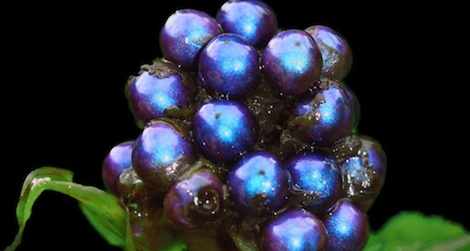
Pollia condensata, native to Africa, uses nanoscale-sized structures to produce the most intense color ever studied in biological tissue. Image via PNAS

The tiny, rock-hard fruits of Pollia condensata, a wild plant that grows in the forests of Ethiopia, Mozambique, Tanzania and other African countries, can’t be eaten raw, cooked or turned into a beverage. In Western Uganda and elsewhere, though, the plant’s small metallic fruits have long been used for decorative purposes because of an unusual property: They stay a vibrant blue color for years or even decades after they’ve been picked. A specimen at the Kew Botanical Gardens in London that was gathered in Ghana in 1974 still retains its iridescent hue.

Intrigued, a team of researchers from Kew, the University of Cambridge and the Smithsonian Natural History Museum decided to look into how this plant produces such a dazzling and persistent color. When they attempted to extract a pigment to study, though, they were surprised to discover the fruit had none.

When they examined P. condensata on a cellular level, they realized that the fruit produces its characteristic color through structural coloration, a radically different phenomenon that is well-documented in the animal kingdom but virtually unknown in plants. They determined that the fruit’s tissue is more intensely colored than any previously studied biological tissue—reflecting 30 percent of light, as compared to a silver mirror, making it more intense than even the renowned color of a Morpho butterfly’s wings. Their findings were revealed in a new study published today in the Proceedings of the National Academy of Sciences.

The vast majority of colors in the biological world are produced by pigments—compounds produced by a living organism that selectively absorb certain wavelengths of light, so that they appear to be the color of whichever wavelengths they reflect. For example, most plants are green because of the pigment chlorophyll, used in photosynthesis, which absorbs most wavelengths of visible light except green, reflecting that color into our eyes. As a consequence, plant colors created by pigmentation appear to be the exact same hue no matter which angle we view them from, and the color degrades when the plant dies.

P. condensata, however, produces its vibrant blue via tiny, nanoscale-size cellulose strands that are stacked inside its skin. These strands are arranged in layers of twisting, arced helix shapes, which interact with each other to scatter light and produce the fruit’s deep blue coloration. Here’s a view of the fruit through an electron microscope, revealing the presence of the color on a cellular level:
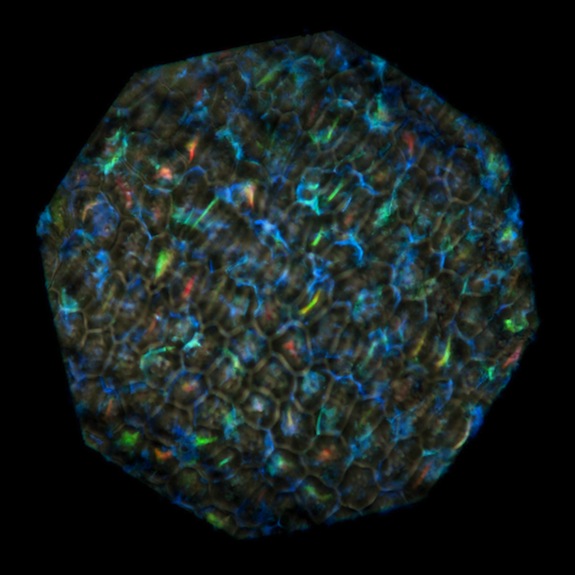
The plant’s deep blue hue is produced on a cellular level. Image via PNAS

These strands also give the plant an even more fascinating quality, something that can (unfortunately) only be appreciated in person: Depending on how you hold the fruit and from what angle you view it, each of its skin cells actually appears to change color. This is because the distance between the stacked nanoscale fibers varies from cell to cell, so each cell produces a slightly different hue, reflecting light either to the left or right, depending on your vantage point. This accounts for its striking, pixellated appearance:

Each skin cell produces a slightly different color, leading to the fruit’s pixellated effect. Image via PNAS

The reason the fruit’s color lasts so remarkably long, it turns out, is because its color is built into its structure, rather than relying on pigments that can degrade over time. Researchers have reported seeing vibrant blue fruits hanging on dried-up, dead P. condensata stems in the field.

The research team also took a stab at explaining why the plant would go to such trouble to evolve a striking color—deception. By imitating the appearance of a juicy, nutritious plant, the color can trick birds and animals into eating the fruit, thereby widely dispersing the seeds inside when they defecate.

Although using animals for dispersal is a strategy common to many plants, most are forced to devote precious calories to produce a sweet, fleshy pulp. P. condensata, however, is able to spread its seeds simply by showing its true colors.


***

Sign up for our free email newsletter and receive the best stories from Smithsonian.com each week.

25 Comments »

  1. Carl Craver says:

    Man, this is some cool stuff. Great work Joey.

  2. That is so amazing..Its the most beautiful color. Its hard to believe it grows like that. Beautiful!

  3. Phil Esteen says:

    There are obvious applications of this ‘structural coloration’ in the electronic components and clothing industry.

    Of course, a pair of such ‘brilliant blue’ jeans that don’t fade with washing might prove unappealing.

  4. Earl Handy says:

    I have seen something simular in a marine life structure. In Kaneohe Bay on Oahu Hawaii I have found a grape size irridecent pearl-blue color. I am not sure if it is of animal or plant origin. They seem to be gas filled but don’t float. They are eye catching. Anyone know what these could be?

  5. Jenny says:

    This is a really amazing fruit, but I don’t buy the research team’s “stab at explaining why the plant would go to such trouble to evolve a striking color—deception.” I mean couldn’t it have just been a juicy, nutritious plant? What’s the compelling reason for why it had to have this molecular structure? Surely, it must have taken some energy/calories for the plant to create these berries.

  6. Diane Heckel says:

    Now that you have teased us, is there any way to get seeds/plants to grow in the USA?

  7. jinay says:

    It was amazing

  8. jinay says:

    How it is done

  9. jinay says:

    It seems to very good

  10. Al says:

    Reflected, or refracted?
    Microscopic structures, placed in close proximity of uniform distance could refract light on certain frequencies, eliminating the need to use pigment as the coloring principle.

  11. Boom says:

    why cant it be eaten?

  12. BILL says:

    What color!!!!! Just amazing how powerful God is to create the world and everything in it! I just wan’t to eat it so bad!!!!! :/ too bad u can’t, then it shouldn’t be called a “fruit” xD

  13. Dr. F says:

    Thank you for this interesting piece of information. I had known of the phenomenon of structural coloration in insects and in minerals such as labradorite and peristerite, but had never observed this in any plant species. This gives it a bit more universality.

  14. Nancy says:

    @Bill

    that “color” wasn’t just created or appeared out of nowhere… it took a long time to evolve into such perceived appearance… be more curious of our natural world… instead of stop short of thinking and attributing everything to “God”

  15. Ayom says:

    Fascinating and beautiful. Do you know whether ‘other African countries’ includes South Sudan? We’re just next door to Uganda here, and I’d love to try growing some…

  16. Gerald Flaherty says:

    I would like to acquire some of this fruit or some of these seeds please tell me if you can how or where to do that.

    Thank You

    Gerald Floaherty

  17. James says:

    Hey, don’t you think the seeds look a little bit like the ones from the Dionaea muscipula (aka Venus Flytrap) ? similar “pixely” structure.. What do you think?

  18. william c wesley says:

    I doubt whether there is much fruit present, its probably all color layer and the rest is seed. Human salesmen do the same thing, a functional model car is gradual degraded in functional value in favor or flashy colors and reflective curves which sell even better than a good engine.
    Most likely it started as a conventional fruit but then “discovered” it could entice more animals with less calories by beefing up color, this could easily evolve, nature is full of rip off schemes just like civilization…which is also natural.

  19. william c wesley says:

    Another possibility is these are attractive to some kind of male Bowery Birds who would line their Bower with them since blue is their favorite color, giving an ideal clearing for the seeds to germinate in

    Still another possibility is these serve as temporary gizzard stones of superior quality, when the outer layer wears off the remaining seed might be excreted in a distant local. A better gizzard stone might be of more benefit to the bird than a few extra calories and easier for the plant to provide than calories would be.

  20. TareX says:

    Would have been nice if the article included a line about how it tastes… I expect some irony.

  21. tom says:

    @ Nancy: Trolled.

  22. Angela says:

    This is fascinating because I just started a book called “The Interesting Narrative of the Life of Olaudah Equiano,” published in 1789 by a slave from Africa, and he writes of a form of dress they wore in his native country of Benin dyed blue, “…which is our favorite color. It is extracted from a berry, and is brighter and richer than any I have seen in Europe.” It’s so strange that I just read this yesterday and then read this article today!

  23. Non-relevant says:

    So I have been ignored by all when trying to find out how to acquire this plant or seeds for this plant. Its driving me nuts.

  24. Janet Mcdonald says:

    @ Non-relevant: Go to Google. Type in Pollia condensata. Select “Pollia condensata sseds for sale.”

  25. Mariana says:

    I remember seeing it in Brazil
    I was amazed every time I looked at that fruit, I squeezed it it had a strong aroma and I stained..
    Just too beautiful!

RSS feed for comments on this post. TrackBack URI

Leave a comment

Comments are moderated, and will not appear until Smithsonian.com has approved them. Smithsonian reserves the right not to post any comments that are unlawful, threatening, offensive, defamatory, invasive of a person's privacy, inappropriate, confidential or proprietary, political messages, product endorsements, or other content that might otherwise violate any laws or policies.

Spam protection by WP Captcha-Free

Advertisement


Follow Us

Travel with Smithsonian


Advertisement