
What Makes Chocolate So Irresistible? A New Study Hints at an Answer
Scientists reveal that surges of a chemical in an unexpected area of the brain might make us crave sweets
/https://tf-cmsv2-smithsonianmag-media.s3.amazonaws.com/accounts/headshot/joseph-stromberg-240.jpg)

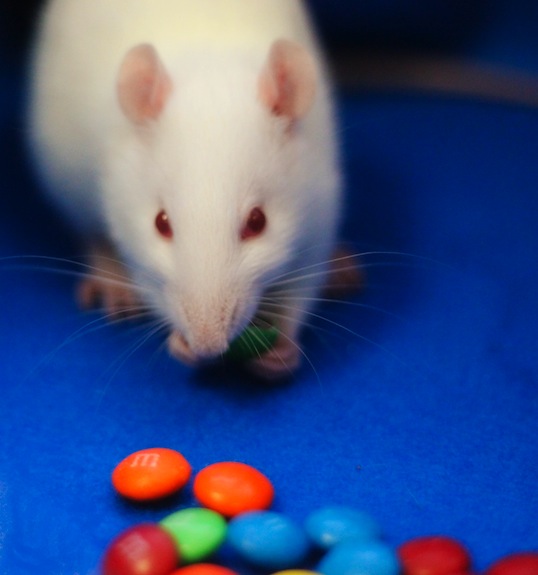
To examine why we overindulge in sweets, a research team gave rats M&M’s and stimulated an area of their brains they suspected was involved. Image via Current Biology, DiFeliceantonio et al.
We’ve all had that moment. You’ve eaten your fill of M&M’s, you know you shouldn’t eat any more and you’re not even hungry—but if a big bowl of them is sitting in front of you, it’s nearly impossible to resist reaching in. What is it about our mental makeup that drives so many of us to indulge in sweets, fatty foods and even drugs and alcohol to excess?
A group of scientists from the University of Michigan wondered about this question, so they decided to try out a similar scenario on lab rats. When they offered them unlimited amounts of M&M’s—and at the same time stimulated an area of the rats’ brains that they suspected was related to craving, the neostriatum—the rats ate more than twice as many candies as they would have otherwise. Their findings, published today in the journal Current Biology, indicate that the urge to overeat is closely related to this part of the brain—as well as levels of the naturally occurring, drug-like chemical they used to stimulate it, enkephalin.
“This means that the brain has more extensive systems to make individuals want to over-consume rewards than previously thought,” said the study’s lead author, Alexandra DiFeliceantonio of the University of Michigan. “It may be one reason why over-consumption is a problem today.”
The researchers looked at the neostriatum—a part of the brain traditionally thought of a center of movement coordination—because of recent studies that implicated it might also be involved in providing the “reward” signal that we receive when engaging in pleasurable tasks. In the first phase of the experiment, the team simply monitored the neostriatum while offering the rats M&M’s, tracking levels of the chemical enkephalin in this part of the rats’ brains via implanted probes. (A relative of the more well-known endorphin, enkaphalin is a natural opioid, a drug-like chemical that is produced in the brain and binds to the same receptors as many anesthetic or psychoactive drugs.)
When the researchers set the M&M’s down and let the rats have at them, they unsurprisingly observed “avid consumption,” with the average rat eating 10 candies in 20 minutes—quite a feat, given their small body size. More interestingly, levels of enkaphalin in the targeted area of their brains spiked, and the rats that ate the most M&M’s the quickest had the highest peak levels of the chemical:

After eating M&M’s, enkephalin levels in the rats’ neostriatums spiked. Image via Current Biology, DiFeliceantonio et al.
To figure out whether this drug-like chemical was the result or the cause of the binge eating, though, the researchers had to go one step further. They injected a synthetic analogue of enkephalin (called DAMGO) into this same region of the brain and then let the rats eat as many M&M’s as they wanted.
The results were startling: Most rats ate more than twice as much candy as before, more than 17 grams—roughly 5 percent of their body weight. For a 150-pound human, this is equivalent to eating roughly 7.5 pounds of M&M’s in one sitting. The rats also ate faster than they had before, indicating that enkephalin signals the brain to “eat faster” as well as “eat more.”
Finally, the research team attempted to determine whether the injection of DAMGO actually made the M&M’s subjectively taste better, or whether it simply made the rats want more of the same thing. To do so, they looked at the facial reactions of the rats as they ate. Although it might sound absurd, it’s been previously established that, for rats, sweeter foods trigger more frequent expression of certain behaviors (tongue protrusion and lip licking).
When they compared the expressions of the artificially-enhanced rats (injected with the enkephalin-analogue) with the control rats, though, each group gorging on candy looked essentially the same. In other words, the drug-like chemical didn’t make M&M’s any more pleasurable for the rats, it only made them want to eat more of them, more quickly.
If this sounds like a familiar situation to you, you’re not alone: The researchers think their findings about this neural pathway could be relevant to a number of analogous situations in humans. ”The same brain area we tested here is active when obese people see foods and when drug addicts see drug scenes,” DiFeliceantonio said. “It seems likely that our enkephalin findings in rats mean that this neurotransmitter may drive some forms of over-consumption and addiction in people.”
/https://tf-cmsv2-smithsonianmag-media.s3.amazonaws.com/accounts/headshot/joseph-stromberg-240.jpg)