
Can We Link Hurricane Sandy to Climate Change?
Models indicate that climate change will cause more frequent and intense hurricanes, but the overall trend can’t be linked with any particular storm
/https://tf-cmsv2-smithsonianmag-media.s3.amazonaws.com/accounts/headshot/joseph-stromberg-240.jpg)
/https://tf-cmsv2-smithsonianmag-media.s3.amazonaws.com/filer/SurprisingScience-Hurrican-Sandy-hero-631.jpg)
Hurricane Sandy has collided with a cold front to form a “Frankenstorm,” bringing extreme weather to the East Coast. Experts predict that the storm will cause billions of dollars in damages and could cause as many as 10 million people to lose power. This historically unprecedented weather event brings to mind a troubling question: Is the storm a natural occurrence or a consequence of human-driven climate change?
The answer—as often happens in science—is more complicated than a simple yes or no. For starters, there’s the distinction between weather and climate. As my colleague Sarah Zielinski wrote here in 2009, “Weather is a data point. Climate is a collection of data.” Science tells us that increasing concentrations of greenhouse gases will doubtlessly change the climate, but linking that overall shift to any one weather event is far less certain.
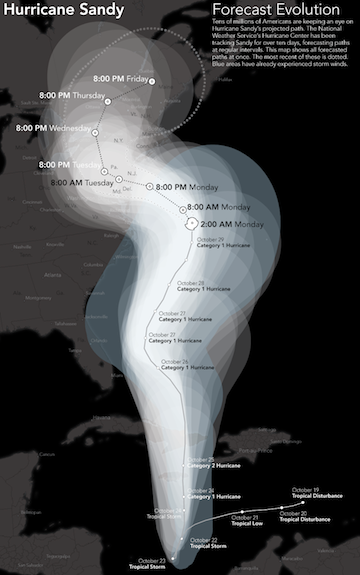
Nevertheless, climate models do predict that on the whole, cyclones (a category that includes hurricanes, typhoons and other extreme storms, named depending on their location) will become more frequent and intense as the climate changes. The reason is that, as noted in a 2010 Nature Geoscience study, warmer oceans cause more evaporation and precipitation, theoretically leading to more frequent powerful storms like Sandy.
As Bill McKibben writes at The Daily Beast, “when that ocean is hot—and at the moment sea surface temperatures off the Northeast are five degrees higher than normal—a storm like Sandy can lurch north longer and stronger, drawing huge quantities of moisture into its clouds, and then dumping them ashore.” A study published earlier this month in Proceedings of the National Academy of Sciences found a strong positive association between warmer years and storm activity in the 20th century, while the Nature Geoscience study noted that the latest models indicate that by 2100, tropical cyclones (including hurricanes) will occur 6 to 34 percent more frequently.
However, it’s important to note that these predictions are made with less confidence than many others dealing with the climate’s future. As Adam Frank writes at NPR, these types of long-term climate forecasts are arranged in a confidence hierarchy. Climate models allow us to be most certain, for example, that global average temperatures will increase and extreme heat events will become more frequent.
The amount of confidence that can be assigned to the prediction of increased cyclones and hurricanes over time is lower. As an IPCC special report on extreme weather events notes, “There is low confidence in any observed long-term (i.e., 40 years or more) increases in tropical cyclone activity (i.e., intensity, frequency, duration), after accounting for past changes in observing capabilities.”
The reason for this reduced amount of confidence is partly the fact that storm formation is far more complicated than the simpler physics of greenhouse gases trapping radiation and causing overall warming. Additionally, since cyclones occur irregularly—and there is limited historical data on their frequency and magnitude prior to the satellite era—the degree to which their formation can be linked to climate change is restricted.
As Andrew Revkin points out at the New York Times’ Dot Earth blog, the overall scientific picture is simply more complex than advocates for action on climate change might prefer. He cites a 2002 Nature study that notes:
Climate models suggest that human activities, specifically the emission of atmospheric greenhouse gases, may lead to increases in the frequency of severe storms in certain regions of the Northern Hemisphere. However, the existence of natural variability in storminess confounds reliable detection of anthropogenic effects.
Put most bluntly, this storm will bring terrible consequences to millions of East Coast residents, and we have many compelling reasons to limit anthropogenic climate change to whatever degree possible before it’s too late. But it’s scientifically disingenuous—even for those of us who are most desperate to convince others of the seriousness of the threat—to explicitly link this one weather event to the overall experiment we’re conducting on the planet’s atmosphere.
/https://tf-cmsv2-smithsonianmag-media.s3.amazonaws.com/accounts/headshot/joseph-stromberg-240.jpg)