Blogs

  • News
  • |
  • Art
  • |
  • History
  • |
  • Food and Travel
  • |
  • Science
Dinosaur Tracking

Where paleontology meets pop culture

Hominid Hunting

Meet the members of the tangled human family tree

Innovations

How human ingenuity is changing the way we live

Surprising Science

Ideas, news and discoveries from the world of science


December 5, 2012

Cavemen Were Much Better At Illustrating Animals Than Artists Today

Prehistoric humans correctly depicted the gait of four-legged animals, such as this bull in the famous cave paintings of Lascaux, France, more frequently than modern artists. Image via Horvath et. al., PLOS ONE

The iconic caveman in popular culture is Fred Flintstone: slow-witted and unskilled. In general, we think of the cave art produced by prehistoric people as crude and imprecise too—a mere glimmer of the artistic mastery that would blossom millenia later, during the Renaissance and beyond.

If this is your impression of prehistoric humans, a new study published today in PLOS ONE by researchers from Eotvos University in Budapest, Hungary, might surprise you. In analyzing dozens of examples of cave art from places such as Lascaux, the group, led by Gabor Horvath, determined that prehistoric artists were actually better at accurately depicting the way four-legged animals walk than artists from the 19th and 20th centuries.

The researchers evaluated the prehistoric artists on the basis of the landmark 1880s finding by British photographer Eadweard Muybridge that horses (and, it was later discovered, most four-legged animals) move their legs in a particular sequence as they walk. The “foot-fall formula,” as it’s called, goes LH-LF-RH-RF, where H means ‘hind,’ F means ‘fore,’ and L and R mean ‘left’ and ‘right,’ respectively. At the time of Muybridge, this was thought to be an entirely novel discovery.

Except, as it turns out, prehistoric people apparently knew it too—and got it right in their drawings the majority of the time. Of the 39 ancient cave paintings depicting the motion of four-legged animals that were considered in the study, 21 nailed the sequence correctly, a success rate of 53.8%. Due to the number of combinations of how a four-legged animal’s gait can be depicted, the researchers state that mere chance would lead to a 26.7% rate of getting it right. Cavemen artists knew what they were doing.
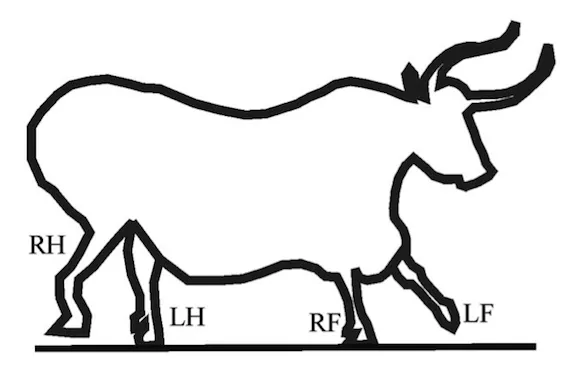
This labelled contour drawing of the Lascaux painting shows that the hoofs are placed on the ground in a realistic manner according to the foot-fall formula. Image via Horvath et. al., PLOS ONE

When the researchers looked at 272 paintings and statues of four-legged animals made during modern times but before Muybridge’s findings in the 1880s, such as a famous horse sketch by Leonardo da Vinci, it turned out that these more recent artists were much worse: They only got the sequence right 16.5% of the time. Remarkably, even the 686 paintings and statues studied that were made more recently than 1887, after scientists knew for sure how four-legged animals walked, still got it right just 42.1% of the time.
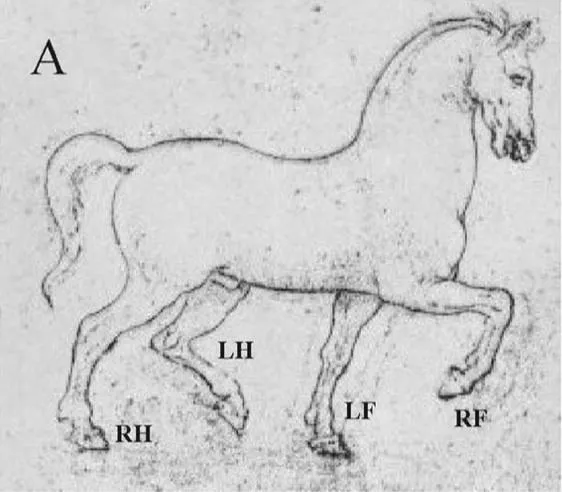
In this drawing, even Leonardo da Vinci draws the sequence of a horse’s gait in an unrealistic manner. Image via Horvath et. al., PLOS ONE

Even apart from artists, a sizable number of depictions of four-legged animals made during the 20th century specifically for the sake of accuracy got the sequence wrong too, according to references used in the study. Out of 307 renditions analyzed, just 58.9% of depictions in natural history museums were correct, along with 56.9% of those in taxidermy catalogues, 50% of animal toy models and 36.4% of illustrations in animal anatomy textbooks.

Although the amount of art studied in each group varies greatly, the accuracy rate for animal depictions in prehistoric times is noteworthy. How could prehistoric humans possibly be this skilled at depicting animals such as bulls, antelopes and wild horses? For a potential answer, consider the way these ancient artists probably thought about the animals: as prey.

For prehistoric humans, “the observation of animals was not merely a pastime, but a matter of survival,” the study’s authors write. “Compared to artists of latter eras, when people were not as directly connected to nature, the creators of such cave paintings and carvings observed their subjects better and thus they depicted the walk of the animals in a more life-like manner.”


***

Sign up for our free email newsletter and receive the best stories from Smithsonian.com each week.

20 Comments »

  1. Riven Homewood says:

    DaVinci’s horse is trotting, not walking. Horses have 3 basic gaits, and the legs move differently in each. DaVinci is accurately depicting a trot or perhaps a piaffe.

  2. Joseph Stromberg says:

    That’s a fair point. In the study, the authors consider it and conclude that the horse is meant to be depicted as walking: “On the basis of the leg attitudes Fig. 4A could, in principle, depict a trotting horse. However, because the fore legs of trotting horses are never lifted so high, and the angle between the femur and tarsus cannot be nearly 90°, this should be a walking horse.”

  3. Jennifer Ferrini says:

    That horse is trotting. Walking horses don’t bring their legs to ninety degrees, trotting horses do. the authors are scrambling now to cover what is obviously a mistake. Furthormore, a walking horse would never be going with an elevated head and the kind of natural collection in that drawing. Please go look at some real horses before making such a erroneous statement.

  4. alanborky says:

    Joseph based on the extremely pained looking grimace on Leonardo’s horse’s jaw I’d suggest it’d been trained in an extremely cruel fashion to walk in such an unnatural and stylised manner an early form of what’s known as Spanish Walking.

  5. Riven Homewood says:

    I just ran a Google Image search for “piaffe horse” and got several modern photos that could have served as models for DaVinci. Try it yourself.

    A piaffe is a highly collected trot that is done in place. It’s a traditional dressage movement, and was probably common in DaVinci’s time.

  6. Halley says:

    If anyone is curious, here is photo of a trotting horse that is in the same position as da Vinci’s drawing: http://upload.wikimedia.org/wikipedia/commons/2/20/WC07b.JPG

  7. Jennifer Ferrini says:

    Here is a nice video of a horse at liberty doing first the Piaffe and then the spanish walk atliberty with no cruel training methods http://www.youtube.com/watch?v=ht2T7x5AXIE

  8. I have to agree with the comments about the trotting of horses,etc. I’ve studied the animal gates for some time now, 20 plus years, (i’m an wildlife artist, when not at the museum 2 days per week). Of all of the animals, especially horses, have some of the most varied gates due to various training over the centuries. Now some of this does look kind of cruel/odd at times when compared to the ungulates(deer) family,etc., it is what it is. Also, of all of the artists I’ve studied, Da Vinci would be one of the last of the artists I would tangle with, his research for virtually everything he did was exhaustive, hence why we continually are amazed 500 plus years later. I hope I’m not being rude here, just trying to stress a point. By the same token, I am also amazed at the cave paintings of Lascaux, Altamira, etc, but for different reasons, ie: gesture, general proportions, especially when we consider the crude tools they had at their disposal, although stick charcoal isn’t a bad one , just no gum erasers, different weights of paper,easels,etc. It sounds to me that some researcher has bungled it again, at least when it comes to the Da Vinci, example.

  9. Stick To What You Know says:

    The author needs to a do a little more research on a topic, specifically horses and movement, before he publishes his article. There are many more styles of movement and training techniques other than your general “walk, trot, canter”. For instance, a gaited horse is going to move much differently than your typical draft horse. Leonardo was probably not drawing and studying a wild mustang but perhaps a mounted, trained equine companion. Maybe do a little more homework, or perhaps do a little “Googling”.

  10. Bob Bubbles says:

    I visit this smithsonianmag.com for a relief from the sites that constitute the vast majority of the Internet. Imagine my delight at finding an article where the comments are not only, it appears to me, accurate and constructive, but also referenced! Though there is some unnecessary hostility directed at the authors, the tone is refreshingly civilized.

    If “gait” had just been spelled correctly more often I would have been even more impressed, but that’s a cheap price to pay for some civility.

    Thanks, horse-gait community!

  11. Elle says:

    The Leonardo drawing is a correct sketch of a horse trotting. It is not walking. The statement that, “On the basis of the leg attitudes Fig. 4A could, in principle, depict a trotting horse. However, because the fore legs of trotting horses are never lifted so high, and the angle between the femur and tarsus cannot be nearly 90°, this should be a walking horse.” is entirely incorrect.

    Horses, depending on their conformation, or skeletal structure, can and do move in this elevated manner. Here are a couple of photo references:

    http://fairytalefriesian.com/images/friesian_kwintus.jpg

    http://horsephotos.ca/photocart/index.php?do=photocart&viewGallery=2424#image=152387

    Note, both sample photos are of horses being led, not under the influence of a rider. As for the action of draft horses, the second sample shows even the very big horses can indeed move with elevated action.

    Since the researchers came to the wrong conclusion about the very basics of the gaits, then applied that to their assessments, I think the entire article is compromised.

  12. The answer is simple – the da Vinci horse is trotting. Doesn’t detract from the cave men that they were not any better than more modern artists – still amazing that they got it correct without the aid of stop motion photography (Muybridge).

    dml

  13. Denver Johnson says:

    I think you should take “artistic license” into consideration when you are viewing any artistic work. For instance, Picasso excelled in placing human facial features in unexpected places, making a human face look more like a flounder-fish. Maybe the cave-artists also made some of their drawings for beauty, or simply the pleasure of making them.

  14. John says:

    Da Vinci was concerned with the placement of the legs in this drawing since he clearly made alterations to three of them. I’m speculating here, since this drawing is isolated and out of context to other drawings (if any) of this particular horse on the page this was taken from, but the drawing could be a study for the horse part of a statue with a rider. In such cases it’s not unusual for the artist to take a little “artistic license” with the subject matter.

    Particularly if the rider were an important person, since the placement of the number of legs touching the ground is an indicator of how the rider died. If I recall correctly, three legs means the rider was wounded in battle and two legs means the rider died.

  15. Lou Gagnon says:

    The da Vinci drawing referenced is a weak example (especially as a pivot point for the article) that may fit the “illustration” premise but ignores “artistic” license. The drawing looks like a design document for the monumental bronze Gran Cavallo. It is clear that the legs are positioned to balance the weight of the piece from side to side and front to back. Is it possible that the “reality” da Vinci was after was the heroic power, grace and movement of a sculpture realized through the static limits of clay, metal and gravity?

    There is no question that science informs art. The reciprocal is often tenuous at best because, as Picasso said:

    “We all know that Art is not truth. Art is a lie that makes us realize truth at least the truth that is given us to understand. The artist must know the manner whereby to convince others of the truthfulness of his lies.”

  16. Spenser says:

    I’m disappointed by the assumptions of the Da Vinci drawing, which calls the whole paper into question. The order of the gait depends entirely on the way in which you view the image, and they appear to be assuming LH is on its way down and RF has just be raised. Da vinci’s horse could easily be interpretted as accurate: LH was just lifted and on its way up and RF at it’s apex and on it’s way down, next LF will be lifted and so on, with the cycle exactly correct. The main issue is that drawings are… drawings… so trying to judge the sequence of a single frame is a contradiction in terms.

  17. Derek Bair says:

    Leonardo definitely knew the accurate way to portray a horse moving in many different ways. He even studied the proportions of their limbs and has 3d sliced sections of them. You’ll notice the slightly faded legs accompanying the more obvious ones in the sketch – he devised a way to show movement within a single image much like an animation with both horses and the flight of birds. A precursor to the first films taken of a horse running. This is also possibly a preparatory sketch for a bronze horse monument he was working on instead of an accurate sketch – although judging by the previous comments it is correct! cool!

  18. Cherie says:

    Interestingly, the mural depicting animals in motion at the Burpee Natural History Museum (IL) annoyed me greatly by showing ungulates – such as the giraffe – running like horses.
    As an artist specializing in animal painting, I know they don’t.
    Am particularly annoyed that the California artist made a mint off the the painting while at the same time getting it wrong.
    And yeah, folks, Da Vinci’s horse is NOT walking.

  19. annamaria says:

    It is obvious that Da Vinci’s horse is TROTTING. The legs are correct for how a horse trots.

    It is also doing a collected, high-stepping gait that was probably accurate for trained horses at the time. Da Vinci probably put a lot of thought into capturing this movement intentionally.

    I was really interested in the article but amazed at that glaring mistake, and it makes me wonder, did the researchers make this mistake as well and assume every depiction of a trot was just an incorrectly drawn walk?

  20. mark says:

    whenever evaluations are done, the difficulty of categorizing all possible outcomes into manageable groups becomes apparent. like a flying bumble bee, the throwing motion of a potential quarterback, or a lake placid gold medal for the us hockey team there are always exceptions to the rule. we should applaud the researcher(s) for presenting such an interesting perspective. as knowledgeable as many of the comments are regarding the numerous movements of all horses under all circumstances, we should always consider the limitation could be in the scope of subgroups rather than in the researcher’s googling skills.

RSS feed for comments on this post. TrackBack URI

Leave a comment

Comments are moderated, and will not appear until Smithsonian.com has approved them. Smithsonian reserves the right not to post any comments that are unlawful, threatening, offensive, defamatory, invasive of a person's privacy, inappropriate, confidential or proprietary, political messages, product endorsements, or other content that might otherwise violate any laws or policies.

Spam protection by WP Captcha-Free

Advertisement


Follow Us


Travel with Smithsonian


Advertisement